
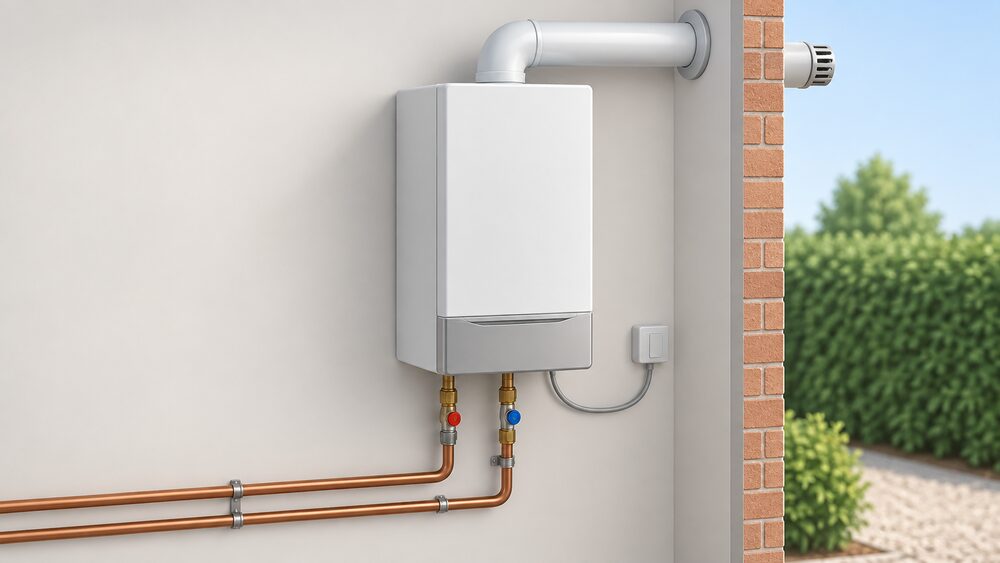
In this comparison
A fuel cell and a micro-CHP unit are both gas appliances that make heat and electricity at the same time, and both are treated as microgeneration rather than as a replacement for a boiler. The practical difference is the way the electricity is made: a fuel cell converts gas electrochemically, while a Stirling engine or small gas engine drives a generator mechanically. Official guidance describes micro-CHP as gas-fired and notes that it generates about 1kW of electricity while it is running1.
The capacity ceiling matters more than the label. Feed-in Tariff guidance set fossil fuel-derived Combined Heat and Power at up to 2kW, described as microCHP, and a later decision on replacement equipment kept micro-CHP at 2kW combined total installed capacity2. Scheme statistics use a looser figure of no more than 50kW total installed capacity for micro-CHP installations, so the term is used at two different scales in official documents4.
Neither technology is common. Micro-CHP is left out of Feed-in Tariff capacity totals because it makes up less than 0.001% of total installed capacity in one quarterly report, less than 0.002% in another, and less than 0.01% of total installed capacity over the scheme lifetime5. That is the honest starting point for anyone comparing them: both are niche, and the fuel cell version is the more specialised of the two.
Fuel cell or micro-CHP: what the difference actually is
The two names describe different parts of the same idea. Micro-CHP is the category: a unit that produces heat and electricity from a single fuel input, sized for a single dwelling. A fuel cell is one way of building the prime mover inside that unit. Official guidance on replacement generating equipment lists the prime mover as "either gas engine, small gas turbine, or fuel cell", which places the fuel cell inside the micro-CHP family rather than beside it3.
That distinction matters when reading scheme rules, because the rules are written around capacity and fuel, not around the internal technology. Feed-in Tariff guidance defines fossil fuel-derived Combined Heat and Power as up to 2kW, or microCHP, without separating fuel cells from engines2. The Smart Export Guarantee licensee guidance lists micro-CHP, solar PV and wind together at 50kW or below as certified technology types, again without distinguishing the prime mover10.
So a household comparing "fuel cell vs micro-CHP" is really comparing a fuel cell micro-CHP unit against a Stirling engine or internal combustion micro-CHP unit. Both sit under the same accreditation route, both are gas-fired, and both are capped at the same small electrical output. The differences that matter in practice are the electrical efficiency, the moving parts, the servicing regime and the price, and the published figures on those points are thinner than the marketing material suggests.
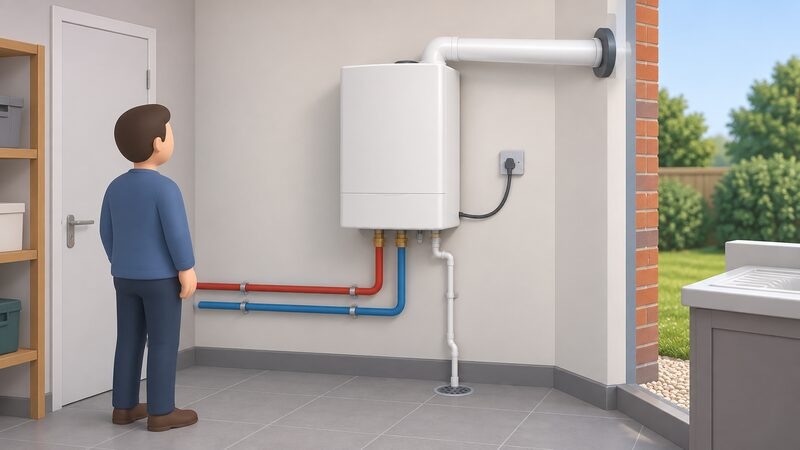
How each technology produces heat and power
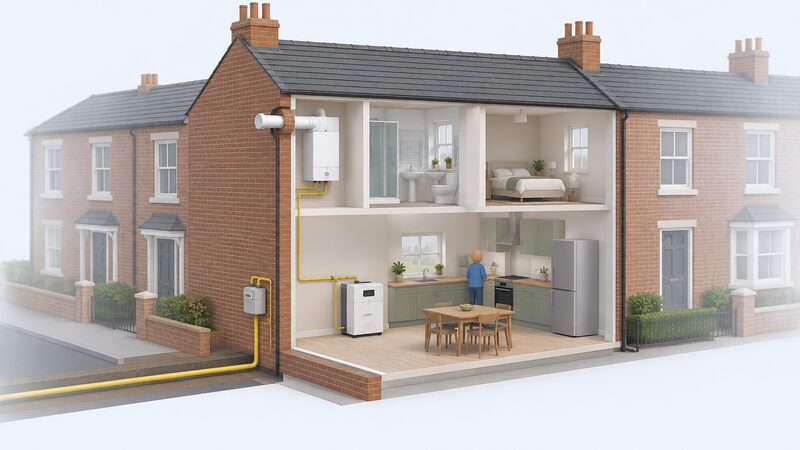
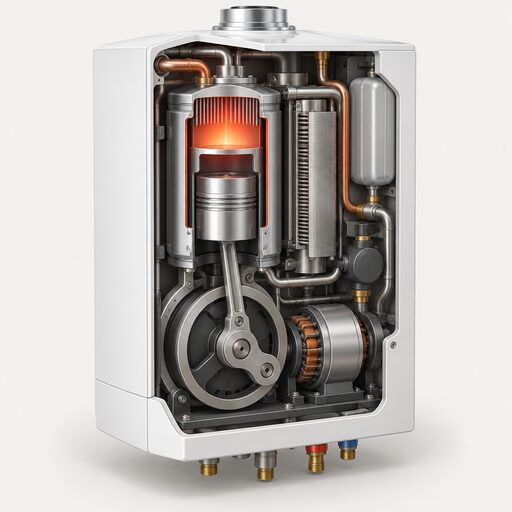
A micro-CHP unit recovers heat from a prime mover and uses the same run to turn a generator. The generating equipment is defined in official guidance as the prime mover, generator, heat recovery equipment and associated pipework, valves and controls within the unit3. In a Stirling engine unit, an external burner heats a sealed gas circuit and the engine drives a linear alternator. In an internal combustion unit, a small engine turns a generator directly. Both produce heat as the primary output and electricity as a by-product.
A fuel cell unit works differently. Gas is reformed into hydrogen-rich gas, and the cell converts it electrochemically to produce electricity and heat, with no combustion in the cell itself. The ECO4 innovation measure list describes one such product as "a domestic sized micro Combined Heat and Power (mCHP) unit that contains a low temperature fuel cell"11. That is the clearest official description of the fuel cell variant in the figures here.
The output figures are modest in both cases. Northern Ireland's guidance states that a CHP unit is gas-fired and generates about 1kW of electricity while it is running, alongside heat and hot water1. That 1kW is a background load, not a whole-house supply. For comparison, the Feed-in Tariff annual report for scheme year 2011 to 2012 recorded micro-CHP generating 241.9 MWh and exporting 114.5 MWh across the accredited fleet, which shows how small the installed base was even at the scheme's peak12.
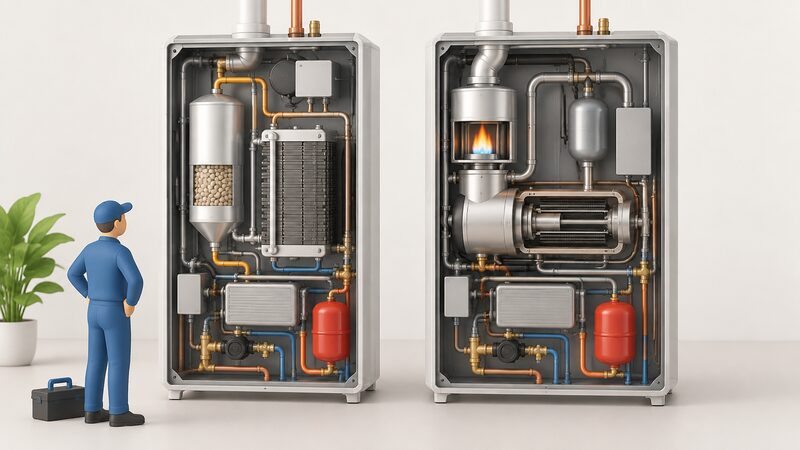
Efficiency compared: electricity and heat output
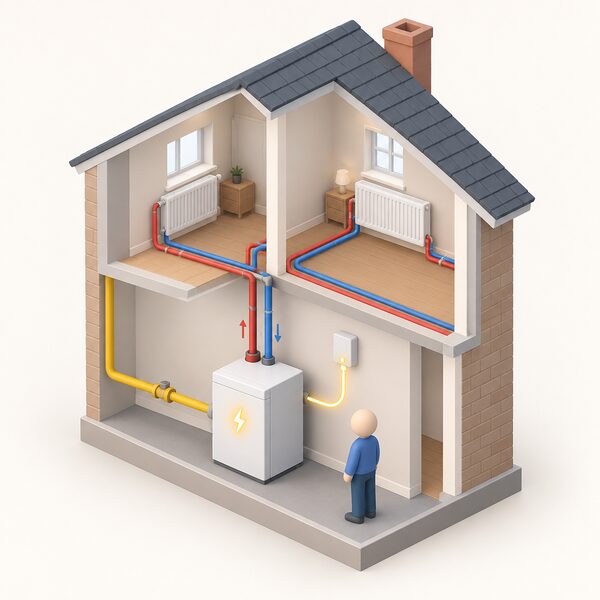
The published efficiency figures for these units are about electrical output and emissions rather than a single headline percentage. Approved Document L sets a limit for micro-CHP: the maximum heating plant emission rate must be no greater than the emission rate of a regular boiler using the same fuel13. That is a performance floor, not an efficiency claim, and it means a micro-CHP unit has to match a regular boiler on emissions at the plant level.
The electrical side is where the two technologies diverge in principle. A fuel cell converts gas electrochemically and is generally described as having a higher electrical efficiency than a combustion-based prime mover, which is why the fuel cell variant exists at all. The figures here do not include a side-by-side electrical efficiency percentage for the two types, so any specific comparison would be unsupported. What is supported is the output: about 1kW of electricity while running, in the Northern Ireland guidance1.
The heat output is the larger share in both cases, because the unit is sized to meet a home's heating and hot water demand and the electricity is a by-product. That is why the capacity ceiling is set at 2kW of electrical output rather than 2kW of heat: the scheme rules are concerned with how much electricity the unit can push onto the network, not how much heat it delivers to the radiators2.
| Measure | Figure | Source |
|---|---|---|
| Electrical output while running | about 1kW | 1 |
| Capacity ceiling for fossil fuel-derived CHP | 2kW | 2 |
| Micro-CHP capacity ceiling in scheme statistics | 50kW total installed capacity | 4 |
| Heating plant emission rate | no greater than a regular boiler on the same fuel | 13 |
| Micro-CHP share of FIT capacity | less than 0.001% of total installed capacity | 5 |
Running costs and fuel supply in the UK
Both technologies run on mains gas. Northern Ireland's guidance states plainly that a CHP unit is gas-fired, and the fuel cell units described in the innovation measures run on natural gas1. That single fact settles the fuel question and rules out the technology for any home without a gas connection. Off-gas homes are outside this comparison entirely.
Running cost depends on the gas price, the unit's electrical output and how much of that electricity is used in the home rather than exported. The figures here do not include a running cost comparison between a fuel cell unit and a micro-CHP unit, and no published unit price is given for either. Prices for both are installer-quoted, and any figure quoted will reflect the property, the flue route and the electrical work rather than the appliance alone.
The wider cost context is that gas heating carries a fuel poverty gap. Official statistics for England give a £230 fuel poverty gap for households with gas central heating, and a separate figure of £700 appears in the same year's statistics; the two figures are reported here as they stand14. That gap is a measure of the shortfall between a household's income and its required energy costs, and it is the backdrop against which any gas-fired generating appliance has to be judged.
Which homes each option suits
Neither unit suits a home that needs a straightforward boiler replacement. The capacity ceiling of 2kW of electrical output means the unit is sized for a dwelling with a steady baseload of electricity use during the hours the heating runs, so that the generated power is consumed on site rather than exported at a lower value. A home that is empty during the day, or one with a very low electricity baseload, gets less benefit from the same unit.
The fuel cell variant is the more specialised of the two. Scotland's microgeneration strategy described micro CHP as being in a pre-commercial state, with 15,000 fuel cells under test in Japan, which is a statement about the maturity of the technology rather than its suitability for a particular house16. The same document records that Berwickshire Housing Association installed Europe's first natural gas fuel cell CHP into a domestic property in Eyemouth in 2005, which shows how long the technology has been demonstrated in the UK without becoming a mass-market product16.
For homes in fuel poverty, the policy direction is energy efficiency first. Scotland's Heat in Buildings Strategy sets targets of EPC C by 2030 and EPC B by 2040 for homes with households in fuel poverty17. A gas-fired generating appliance does not address the fabric of the building, and the Warm Homes: Social Housing Fund caps the proportion of homes at or above EPC band C that can receive low carbon heating measures at 10% of homes in an application18.
Installation, servicing and maintenance compared
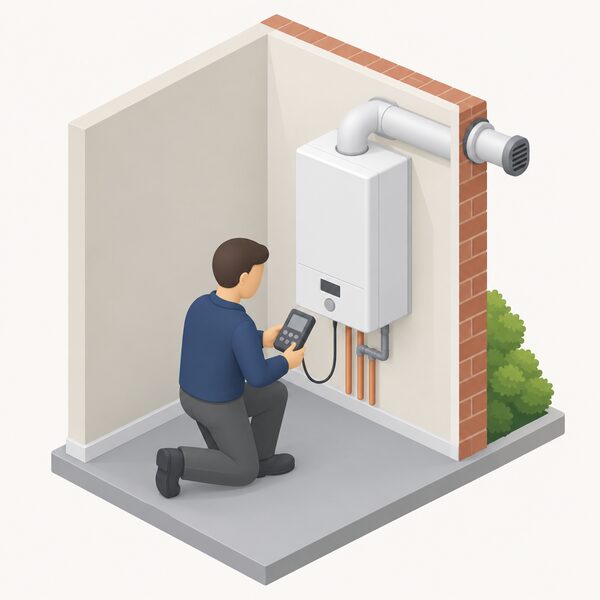
Installation follows the boiler pattern with an electrical connection added. Micro-CHP, solar PV and wind installations at 50kW or below must be commissioned by a Microgeneration Certification Scheme-certified installer using an MCS-certified product, under the Feed-in Tariff rules19. The same requirement appears in the Warm Homes: Social Housing Fund guidance, which states that low carbon heating or solar panels must be installed using an MCS approved product, by an MCS certified installer, to the relevant MCS installation standard18.
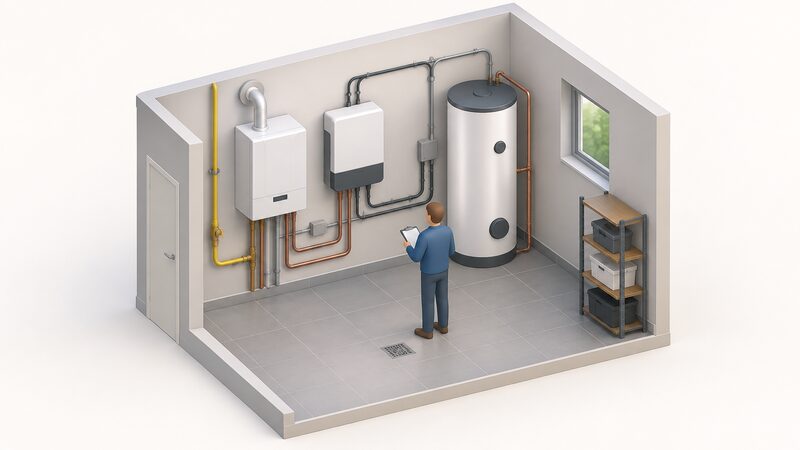
Servicing differs between the two types in principle. A Stirling or internal combustion unit has moving parts and a burner, so it carries the servicing needs of a boiler plus the mechanical side. A fuel cell unit has no combustion in the cell but has a reformer and control electronics, and the published figures here do not set out a servicing schedule for either. What is published is the support period: micro-CHP installations were eligible to receive support for ten years, and a number of installations reached the end of that ten-year eligibility period8.
The tariff period for micro-CHP under the Feed-in Tariff was six months, rather than the annual period used for other technologies, which reflects the way the scheme treated these units20. That is a scheme mechanic rather than a maintenance interval, but it is the only period figure attached to the technology in the official guidance.
How they fit with heat pumps, solar and the grid
Micro-CHP and fuel cells sit alongside solar and heat pumps rather than replacing them. The Smart Export Guarantee licensee guidance lists micro-CHP, solar PV and wind together as certified technology types at 50kW or below, so a micro-CHP unit can be accredited for export payments on the same scheme as a solar array10. The Feed-in Tariff application route treated PV or wind with a declared net capacity up to 50kW, or micro CHP up to 2kW, as applications to a FIT licensee19.
The comparison with solar is instructive on scale. The Feed-in Tariff annual report notes that, apart from micro-CHP, solar PV installations are on average smaller than installations of other technology types, which places micro-CHP at the small end of the range8. A solar array and a micro-CHP unit both generate electricity at a scale suited to on-site use, but the solar array has no fuel supply and the micro-CHP unit has no output when the heating is off.
Heat pumps are a different proposition again. Air source heat pumps are not subject to prior notification or approval but must comply with MCS Planning Standards or equivalent standards, and the heat pump must comply with those standards for permitted development23. A heat pump replaces the gas supply with electricity; a micro-CHP unit keeps the gas supply and adds a small electrical output. The two approaches pull in opposite directions on fuel, which is why they are usually presented as alternatives rather than as a combined system.
Where each technology stands today in the UK market
The market position is best read from the scheme statistics. Micro-CHP is excluded from Feed-in Tariff capacity totals because it makes up less than 0.001% of total installed capacity in the June 2026 quarterly report, less than 0.002% in the March 2026 report, and less than 0.002% of total installed capacity over the scheme lifetime to 31 March 20255. A later quarterly report puts it at less than 0.01% of total installed capacity as at 31 December 20247. The figures cover different periods and different bases, and the precise share is not settled.
The fuel cell variant is the smaller part of that already small figure. Scotland's microgeneration strategy described micro CHP as pre-commercial, with 15,000 fuel cells under test in Japan, and that assessment dates from 201216. The ECO4 innovation measures list includes a domestic fuel cell micro-CHP product, which shows the technology is recognised in current energy efficiency policy even though it is not widely deployed11.
For context on how slowly domestic low carbon technology spreads, an Ofgem consumer survey found that 25% of GB energy consumers have an electric vehicle, solar PV, smart appliances or heating controls, or a heat pump26. Micro-CHP and fuel cells are a much smaller slice than that. Northern Ireland's guidance states that domestic sized models are now available, which is the most positive official statement on availability in the figures here1.
Sources26 cited
- Micro-combined heat and power, nidirect, 2026
- Feed-in Tariffs: Guidance for renewable installations, Ofgem, 2021
- Feed-in Tariffs: Consultation on the treatment of replacement generating equipment, Decision, Ofgem, 2021
- SEG 2022-23 Annual Report, Ofgem, 2023
- Feed-in Tariffs Quarterly Report Issue 64, Ofgem, 2026
- Feed-in Tariffs Quarterly Report Issue 63, Ofgem, 2026
- Feed-in Tariffs Quarterly Report Issue 59, Ofgem, 2025
- Feed-in Tariffs Annual Report Scheme Year 13, Ofgem, 2023
- Micro-combined heat and power: planning permission, Planning Portal, 2026
- Guidance for SEG Licensees, Ofgem, 2019
- ECO4 Innovation Approved Innovation Measures, Ofgem, 2023
- FITs Annual Report 2011-2012, Ofgem, 2012
- Approved Document L, Volume 1: Dwellings, HM Government, 2026
- Fuel poverty statistics, House of Commons Library, 2025
- Smart Export Guarantee: generators, Ofgem, 2026
- Microgeneration Strategy Scotland, Scottish Government, 2012
- Heat in Buildings Strategy, Scottish Government, 2021
- Warm Homes: Social Housing Fund Wave 3 scheme guidance addendum, HM Government, 2026
- FIT FAQ, Ofgem, 2016
- Feed-in Tariffs Guidance for Licensed Electricity Suppliers, Ofgem, 2021
- Planning permission: micro-combined heat and power, Welsh Government, 2026
- Householder permitted development rights guidance, Scottish Government, 2021
- Biomass fuelled appliances: planning permission, Planning Portal, 2026
- Air source heat pumps fact sheet, Pendle Borough Council, 2021
- Feed-in Tariffs Quarterly Report Issue 60, Ofgem, 2025
- Consumer Survey 2021: Decarbonisation and home energy use, Ofgem, 2021
 Micro-CHP TypesWhich type of micro-CHP actually gets fitted in UK homes, and how much electricity does one make while it heats your house?
 Micro-CHP for HomesA micro-CHP boiler makes electricity while it heats your home, but only when the heating is on.
 Micro-CHP Cost and OutputDomestic micro-CHP costs more than a conventional boiler and produces roughly 1kW of electricity alongside its heat.
 Domestic Fuel CellsA fuel cell boiler makes electricity and heat at the same time, usually from mains gas.
 Micro-CHP Performance TestingHow well a micro-CHP boiler performs in your home decides what you get paid and what you save.
 The Full Wind, Hydro and Micro-CHP GuideCould a small wind turbine or water wheel work at your home, and what about boilers that make their own electricity?