
In this guide
A domestic fuel cell is a box the size and shape of a boiler that makes heat and electricity at the same time from a single fuel, usually mains gas. It is the most efficient form of micro combined heat and power (micro CHP) available for a house, and it is the only one that converts fuel to electricity without a flame. A typical domestic system generates up to 1kW of electricity once warmed up1.
The technology is not new in principle. Combined heat and power has been used in Northern Ireland for some time in large scale installations such as hospitals and leisure centres, and the domestic version shrinks the same idea to a unit that resembles a gas-fired boiler2. What has held it back is not the engineering but the economics and the fuel: a fuel cell for a home runs on gas, and its electricity output is tied to how much heat the house needs.
This page explains what a domestic fuel cell or micro CHP unit is, how much electricity it produces, what fuels it can use, what it costs relative to a boiler, the planning and flue rules, and what it means for a household's energy independence. It also states plainly where the technology falls short, because the limitations are structural rather than fixable by buying a bigger model.
What a domestic fuel cell or micro CHP unit actually is
A micro CHP unit is a single appliance that produces heat and electricity together. The official definition in the Feed-in Tariff rules describes the generating equipment as the prime mover, generator, heat recovery equipment and associated pipework, valves and controls within the unit, and names the prime mover as either a gas engine, a small gas turbine, or a fuel cell8. The fuel cell version is the one this page is about: it produces electricity electrochemically rather than by burning fuel to drive a moving part.
The wider concept is defined in legislation as the simultaneous conversion of primary fuels into mechanical or electrical and thermal energy, meeting certain quality criteria of energy efficiency9. That definition matters because it sets out what distinguishes CHP from a boiler: a boiler throws away the heat that a power station would discard, while a CHP unit captures both outputs from the same fuel.
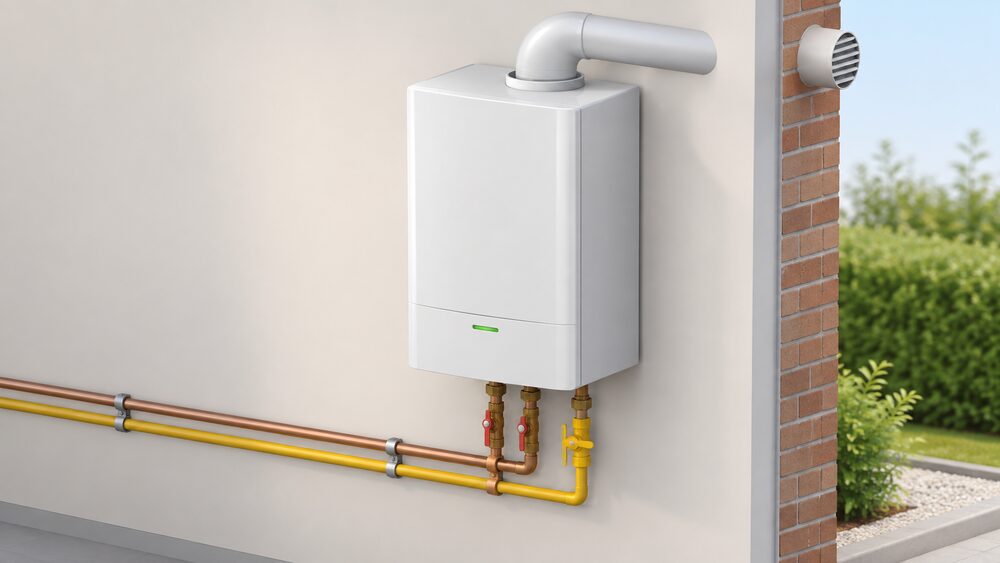
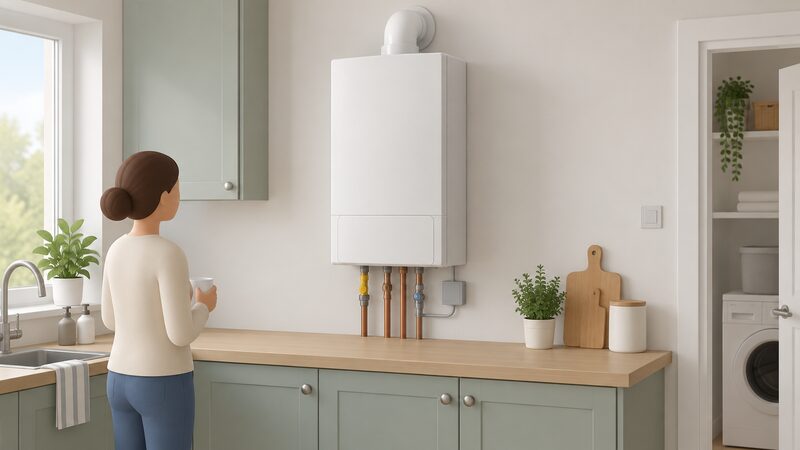
In practice, a domestic unit looks like a boiler. Micro CHP units are compact and come in similar sizes and styles to standard boilers, with options for wall-mounted or floor-standing installation5. A micro-CHP unit resembles a gas-fired boiler and produces electricity from mains gas or LPG10. That resemblance is deliberate: the unit is designed to slot into the space and the plumbing that a conventional boiler occupies, which is why the question of replacing an existing boiler comes up so often.
The technology has a longer track record than its current market presence suggests. Berwickshire Housing Association installed Europe's first natural gas fuel cell CHP into a domestic property in Eyemouth in 200511. By 2012 the Scottish Government described micro CHP as being in a pre-commercial state, with 15,000 fuel cells under test in Japan11. That description of a pre-commercial state is a useful corrective to any assumption that the domestic fuel cell is a mature, widely stocked product in the UK.
Heat first, electricity second: the 6:1 output ratio
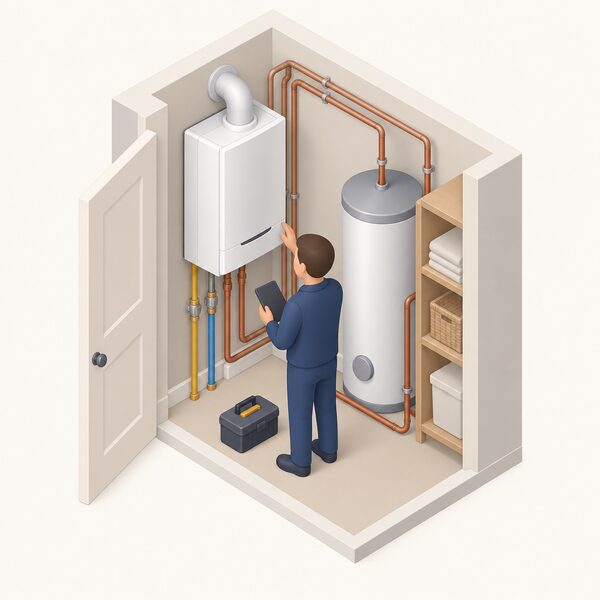
The defining characteristic of a fuel cell for a home is that it is a heating appliance that happens to generate electricity, not a generator that happens to produce heat. The heat output is several times the electrical output, and the unit only generates electricity when there is a demand for heat. This is why the technology is described as heat-led.
The consequence is straightforward. In winter, when the heating runs for hours at a time, a micro CHP unit generates electricity for hours at a time. In summer, when the only demand is hot water, it generates for short bursts. A household that wants electricity in July is not served by a heat-led appliance, however efficient it is.
Fuel cells are more efficient than Stirling engines, the other common micro CHP technology, and internal combustion engines are generally not suitable for use in a home5. That efficiency advantage is the reason fuel cells are the more capable branch of micro CHP, but it does not change the heat-led nature of the appliance.
Micro CHP is still considered a low-carbon option because it uses fuel more efficiently than separate heating and grid electricity, even though it uses fossil fuels5. That is the honest framing: the carbon benefit comes from displacing the losses of centralised generation and the boiler, not from the fuel being renewable.
"While it uses fossil fuels, micro CHP is still considered a low-carbon option because it uses fuel more efficiently than separate heating and grid electricity."
How much electricity a home unit produces: up to 1 kW once warmed up
A typical domestic system will generate up to 1kW of electricity once warmed up1. That figure is the ceiling for a domestic unit, and it is reached only when the unit is running and warm. It is not a continuous rating that can be drawn on at will.
To put that in context, previous price cap figures are based on 12,000 kWh of gas and 2,900 kWh of electricity for a typical dual fuel household12. A unit running at full electrical output for a substantial number of hours could cover a meaningful share of that 2,900 kWh, but the share depends entirely on how many hours the house calls for heat. A well-insulated home with a short heating season will run the unit less, and generate less, than a draughty one.
The maximum size of a micro CHP system is set by scheme rules rather than by physics. For the Feed-in Tariff, the maximum capacity was 5 megawatts, or 2 kilowatts for micro-CHP3. For the Smart Export Guarantee, an eligible installation must have a total installed capacity of no more than 5MW, or no more than 50kW for micro-CHP4. MCS accreditation covers micro CHP with an electrical capacity of 2kW or less7. The 2kW figure recurs because it is the boundary of the domestic category.
| Measure | Figure | Source |
|---|---|---|
| Electrical output, typical domestic unit | up to 1kW once warmed up | 1 |
| Feed-in Tariff maximum, micro-CHP | 2 kilowatts | 3 |
| Smart Export Guarantee maximum, micro-CHP | 50kW | 4 |
| MCS accreditation limit | 2kW or less electrical capacity | 7 |
| Typical household electricity use | 2,900 kWh annually | 12 |
Fuels: mains gas, LPG, oil and bio-liquids
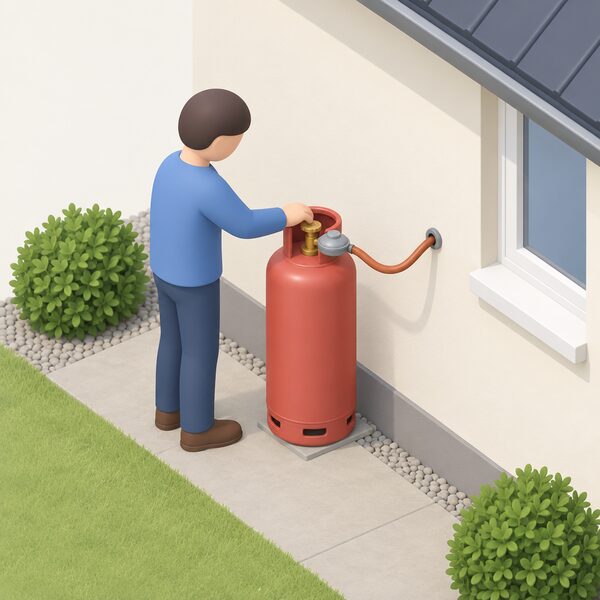
Domestic micro-CHP systems are usually powered by mains gas or liquefied petroleum gas (LPG), however some models are now available that run on oil or bio-liquids, including biodiesel1. That is the full fuel picture: gas and LPG for the mainstream units, oil and bio-liquids for a minority of models aimed at off-gas-grid homes.
The off-gas-grid market is real and sizeable. Households without a gas connection use a range of other fuels to heat their homes including heating oil, liquefied petroleum gas (LPG), solid fuels, mains electricity, and microgeneration13. In Scotland, 6% of households (142,000) use oil as their primary heating fuel, and in rural locations oil accounts for 28% and electricity 22% of primary heating fuel, compared with urban locations where electricity is used in 8% and oil in 1% of dwellings14. A fuel cell that runs on oil or bio-liquid is therefore aimed at a genuine rural market, not a niche within a niche.
For the gas units, the fuel is the same natural gas that a boiler uses. The notional dwelling used in building regulations modelling has mains gas as its main heating fuel for both space and water15. The Domestic RHI metering guidance sets out the calorific values used for fuel measurement, selected from published calorific values for propane and butane for LPG, burning oil for oil, and natural gas consumed for natural gas16. Those are the fuels the technology is measured against.
The VAT position is favourable. The reduced rate for fuel and power covers a wide range of fuels used within homes17. That applies to the fuel the unit consumes, not to the appliance itself.
What it costs to buy, install and service compared with a boiler
Published UK prices for domestic fuel cell units are not available in the sources behind this page, so any figure quoted here would be invented. Prices for the unit and its installation are installer-quoted, and a household should expect to obtain a quotation for its own property rather than work from a list price.
What can be stated is the cost of the alternative. A gas boiler has been costed at £980 in total, comprising £200 in upfront costs, £80 in maintenance costs and £700 in running costs18. That is the baseline a fuel cell unit has to beat or justify, and it is a low baseline: the running cost of a gas boiler is dominated by the fuel, not the appliance.
The comparison is not like for like, because a micro CHP unit produces electricity as well as heat. The value of that electricity depends on what it displaces, which depends on the household's tariff and consumption. A unit that generates when the house needs heat may generate at times when the household would otherwise be importing electricity at the retail rate, which is the most valuable time to generate.
Servicing is a separate consideration. It is advisable to contact an installer who can provide the necessary advice, preferably one who belongs to the relevant Competent Person Scheme19. For heat pumps, the equivalent guidance is to use an installer who belongs to either the Microgeneration Certification Scheme or the relevant Competent Person Scheme20. The pattern is consistent across technologies: the installer's competence matters more than the appliance's specification.
Savings and selling surplus electricity back to the grid
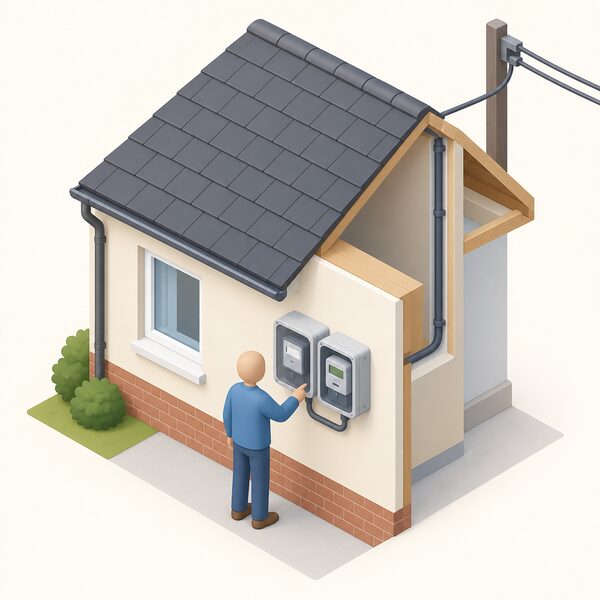
Micro combined heat and power is an eligible technology type for the Smart Export Guarantee4. That is the route by which a household can be paid for electricity it exports, and it is open to new installations that meet the scheme's capacity rules.
The Feed-in Tariff, which is closed to new applicants, also covered micro-CHP. Under that scheme, an MCS-FIT installation was a solar PV or wind installation with a declared net capacity at or below 50kW, or a micro CHP installation with a capacity up to the 2kW scheme maximum3. The Feed-in Tariff scheme's maximum capacity was 5 megawatts, or 2 kilowatts for micro-CHP3. Feed-in Tariff licensees were responsible for managing the MCS application process for solar PV and wind (DNC 50kW or less) and micro-CHP installations21.
The principle behind export payments is the same as for other microgeneration: sell any surplus energy you don't use back to the grid13. For a heat-led appliance, surplus is likely to be modest, because the unit generates when the house is drawing heat and therefore, in winter, when the house is also drawing electricity. The export opportunity is greatest in the shoulder months, when heating demand and household electricity demand do not coincide.
Statistics on the number of solar photovoltaic, wind and micro combined heat and power installations registered on the Microgeneration Certification Scheme database are published by the Department for Energy Security and Net Zero18. Those figures are the best available measure of how many micro CHP installations exist in the UK, and they are worth checking before assuming the technology is widespread.
Planning permission and flue rules for micro CHP
Planning permission is not normally needed when installing a micro-combined heat and power system in a house if the work is all internal6. That is the default position in England, and the same wording applies in Wales22. For most installations, which replace a boiler in the same location, no planning application is required.
If the installation requires a flue outside, it will normally be permitted development if the conditions are met22. Flues on the rear or side elevation of the building are allowed to a maximum of one metre above the highest part of the roof6. In a conservation area or in a World Heritage site the flue should not be fitted on the principal or side elevation if it would be visible from a highway6.
Scotland has its own rules. A planning permission is needed for flues for dwellinghouses or flats within an Air Quality Management Area, and planning permission is required if the flue is to be attached to the principal elevation of a dwellinghouse or flat within a conservation area or World Heritage Site23. Those rules are stated for biomass heating systems and for combined heat and power systems alike23.
Listed buildings need care. If the building is listed or in a designated area, even if permitted development rights apply, it is advisable to check with the local planning authority before a flue is fitted, and consent is likely to be needed for internal alterations6. The same advice appears in the Welsh guidance22.
Building regulations apply regardless of planning. A micro CHP installation must adhere to the building regulations set out in Approved Document L: Volume 1 (Section 6, Page 45)19. For permitted development on air source heat pumps, compliance with the Microgeneration Certification Scheme or equivalent is required24, and the same principle of using certified installers runs through the microgeneration rules.
Choosing an MCS-approved installer
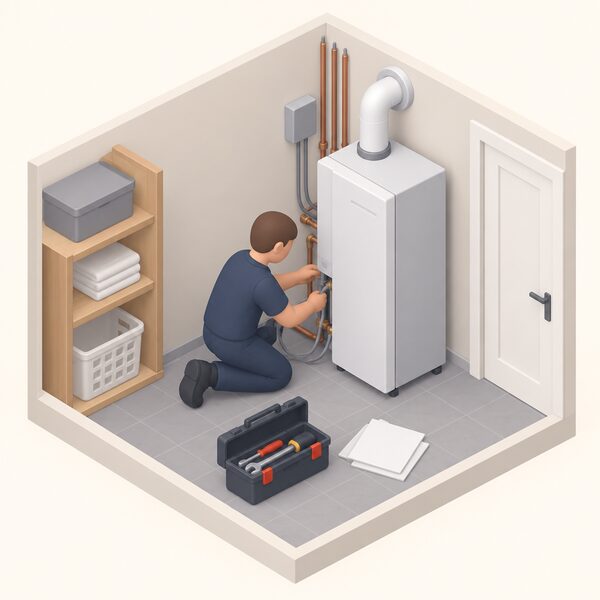
The Microgeneration Certification Scheme is a certification scheme for microgeneration installation companies and products, defining and maintaining consistent standards21. It is the quality assurance organisation for microgeneration technologies of 50kW or smaller25. For a domestic fuel cell, MCS certification is the recognised route to demonstrating that the product and the installation meet a defined standard.
A new system will be designed and installed in accordance with MCS Standards5. That is the assurance a household is buying when it chooses an MCS certified installer: not a guarantee of performance, but a defined process and a defined standard.
The installer guidance is consistent across technologies. For micro combined heat and power installations, it is advisable to contact an installer who can provide the necessary advice, preferably one who belongs to the relevant Competent Person Scheme19. For heat pumps, the advice is to use an installer who belongs to either the Microgeneration Certification Scheme or the relevant Competent Person Scheme20. For solar photovoltaics, the best way to avoid problems with building regulations is to use an MCS certified installer26. For energy storage or battery systems up to 50kW, an MCS installer is recommended, with the system installed in line with the MCS Battery Standard7.
The practical implication is that a household should look for an installer with experience of fuel cell or micro CHP units specifically, not simply a gas-safe boiler engineer. The technology has different components and different servicing requirements from a condensing boiler, and the certification framework exists to distinguish installers who have been assessed against it.
Where micro CHP fits: homes and small offices it suits
Micro CHP suits buildings with a long, steady heat demand. A house that runs its heating for many hours a day, every day through the winter, gives the unit the running hours it needs to generate a useful amount of electricity. A house that heats in short bursts gives it very few.
The technology is not limited to houses. Combined heat and power has been used in Northern Ireland in large scale installations such as hospitals and leisure centres2, and the domestic version is the small end of that same principle. Small offices and other buildings with all-day occupancy and a steady heat load are a natural fit for the same reason.
The housing stock matters. In Scotland, flats have higher levels of electricity (14%) as the main heating fuel than all three house types, and private rented dwellings are more likely to use electricity as their primary fuel type at 21% compared with 8% of owner-occupied dwellings14. A flat with electric heating has no gas supply to a boiler flue, which makes a gas-fired fuel cell a difficult proposition regardless of its merits.
The environmental performance of the housing stock also varies by fuel. The mean Environmental Impact Rating by primary heating fuel is 67.4 for gas, 46.6 for oil, 53.4 for electric and 66.9 for other fuel types27. A fuel cell running on gas starts from the best-performing fuel category in that table, which is part of why the technology is presented as a low-carbon option despite using fossil fuel.
For a household weighing the options, the relevant comparisons are set out elsewhere on this site: fuel cell heating versus micro-CHP, micro-CHP versus a condensing gas boiler, and micro-CHP versus an air source heat pump. The wider context of small-scale generation is covered in microgeneration beyond solar.
What micro CHP means for household energy independence
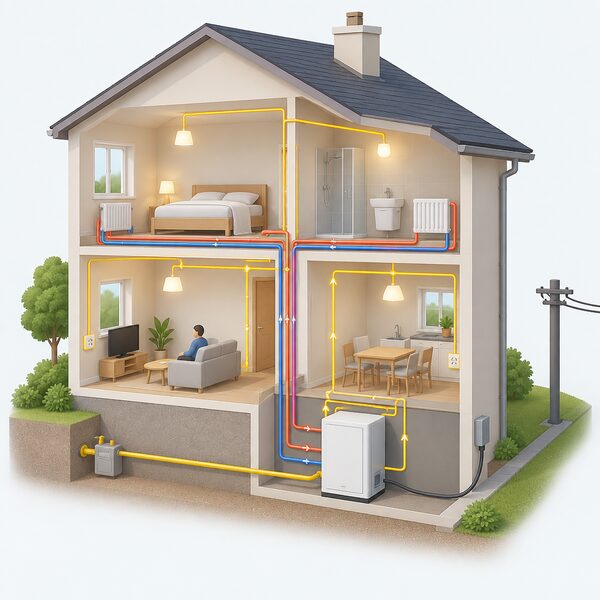
A domestic fuel cell changes the relationship between a household and its energy supply in one specific way: it generates electricity on site, from the same fuel that heats the house, without relying on the grid for that electricity. For the hours it runs, the household is producing rather than importing.
That independence is partial and conditional. The unit runs on mains gas or LPG5, so the household remains dependent on a fuel supply and a supplier. It generates only when there is a demand for heat, so it cannot be called on to produce electricity at will. And it is a manufactured appliance with a manufacturer behind it, which means the household's independence is bounded by that company's continued existence and its willingness to honour a warranty.
The carbon case rests on efficiency rather than fuel. Micro CHP is considered a low-carbon option because it uses fuel more efficiently than separate heating and grid electricity5. That is a real benefit, but it is a benefit measured against the alternative of a boiler plus grid power, not against a renewable generator.
The technology's deployment status is the honest caveat. Micro CHP was described by the Scottish Government as being in a pre-commercial state, with 15,000 fuel cells under test in Japan11. That assessment dates from 2012, and the market has not since become a mass-market one in the UK. A household considering a fuel cell for a home is an early adopter of a technology that has been demonstrated, certified and supported by scheme rules, but not widely deployed.
For households whose priority is independence from the gas grid entirely, the alternatives are different technologies with different constraints. Micro wind, micro hydro and solar PV generate without a fuel supply, and the site requirements for each are set out in the linked pages. The energy independence page sets out how the different microgeneration technologies compare on that measure.
Sources27 cited
- Micro combined heat and power, Energy Saving Trust, 2022-08-05
- Micro combined heat and power, nidirect, 2026-09-17
- Feed-in Tariffs: information for generators, Ofgem, 2026-09-17
- Smart Export Guarantee: information for generators, Ofgem, 2026-09-17
- Micro CHP, MCS Certified, 2026-08-17
- Micro combined heat and power: planning permission, Planning Portal, 2026
- Guidance for FIT generators V18, Ofgem, 2024-09-06
- Feed-in Tariffs consultation on replacement generating equipment, Ofgem, 2021-12-13
- Directive 2002/91/EC, legislation.gov.uk, 2002-12-16
- Microgeneration planning advice, Scottish Government, 2013-03-04
- Microgeneration strategy for Scotland, Scottish Government, 2012-06-22
- Fuel poverty scenario modelling based on Ofgem energy price caps, Scottish Government, 2026-09-02
- Seven reasons we still need heat pump subsidies, Nesta, 2025-11-20
- Scottish House Condition Survey 2024: key findings, Scottish Government, 2024
- Approved Document L: conservation of fuel and power, Volume 1, HM Government, 2026-09-17
- Domestic RHI guide to metering, Ofgem, 2022-03
- VAT fuel and power manual, HM Revenue and Customs, 2026-09-17
- Feed-in Tariffs quarterly statistics, Ofgem, 2026-09-17
- Micro combined heat and power: building regulations, Planning Portal, 2026
- Warm Homes: Social Housing Fund wave 3 scheme guidance addendum, HM Government, 2026-06
- Feed-in Tariffs annual report, scheme year 13, Ofgem, 2023-12
- Planning permission: micro combined heat and power, Welsh Government, 2026-09-17
- Circular 1/2024: householder permitted development rights, Scottish Government, 2024-05-28
- Air source heat pumps: planning advice and guidance, Cornwall Council, 2026-09-17
- Building regulations and renewables guidance, Bedford Borough Council, 2026-09-17
- Solar panels: how do I retrofit my home, Oxfordshire County Council, 2026-09-17
- Scottish House Condition Survey 2024: complete report, Scottish Government, 2024
 Fuel Cell Cars as Home PowerCan you really run your home from a hydrogen car?
 Heat Batteries and Zero EmissionA heat battery stores cheap overnight electricity as heat, then releases it to warm your home or your hot water.
 Energy IndependenceA heat pump runs your heating on electricity instead of gas or oil, so how much does that really cut what you pay and how exposed you are when fuel prices jump?
 Heating and Energy IndependenceCan you heat your home without relying on gas or oil, and what would that take?
 Whole-Home Energy DesignHeating and hot water use more energy than anything else at home, so that choice shapes everything.
 Living Off the Gas GridNo mains gas at your home?