

In this answer
Short answer
A home battery can run a heat pump and it can put energy into an electric car, but it does neither in the way a boiler or a petrol pump does. A heat pump uses electricity to move warmth from outside your home to inside your home, and a battery can supply that electricity1. A car needs far more energy in one go than a domestic battery holds, so the battery supplements a grid charge rather than replacing it.
The scale matters. One benchmark household running a heat pump for all its heating and hot water used 5.66 MWh of electricity in a year and no gas2. An electric car with a 50kWh battery capacity costs approximately £17 to charge fully at home3. A domestic battery measured in single-figure kWh is therefore a buffer and a tariff tool, not a fuel tank.
What the battery buys a household is timing: it stores free, renewable electricity to power your heat pump, making you less reliant on grid electricity4. What it does not buy is independence from the grid, from a supplier, or from the gas that still sets the price of electricity. This page sets out what each load actually draws, how to size for it, and where a battery alone falls short.
What a heat pump actually draws from a battery
A heat pump is not a resistive heater. It is usually powered by electricity, but the amount of heat energy delivered is several times more than the electrical energy it consumes7. That ratio is why a battery sized for lighting and a fridge will not stretch to whole-home heating, and why the electrical draw is smaller than the heat output but still the largest load in most electrified homes.
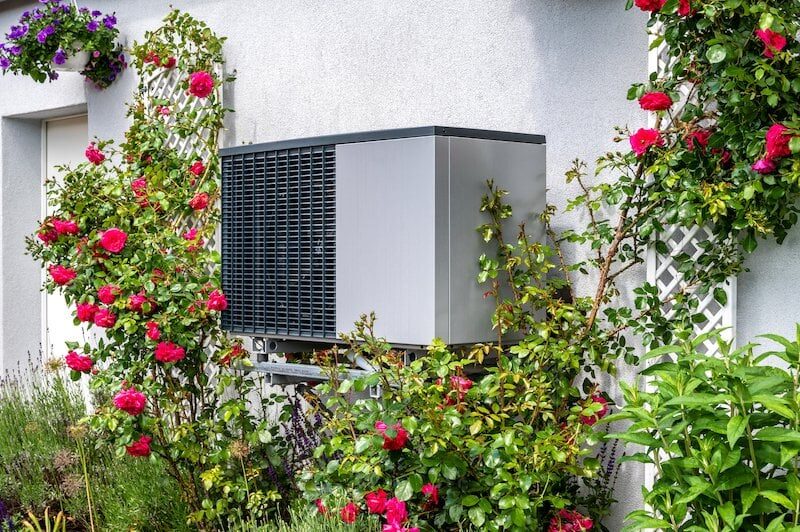
The draw varies with the source and the season. Heat pumps extract heat from the outside air or ground, which can then be used to heat radiators, underfloor heating systems and hot water8. Air source units absorb heat from the outside air to heat your home and provide hot water9. Water source units transfer energy from natural heat stored in a body of water to heat the home and domestic hot water10. In every case the compressor runs on electricity, and in cold weather it runs harder and longer.
Consumption figures are best read as annual benchmarks rather than daily rules. The 5.66 MWh figure for a benchmark heat pump household covers a full year of space heating and hot water with no gas2. Monitored homes in summer, when demand is mostly hot water, indicated approximately 75 litres of hot water usage per household per day, assuming 45°C water temperature and a coefficient of performance of 2.811. Winter daily draw is several times the summer figure, which is the number that decides battery size.
For a household, the independence question is straightforward. A battery charged from solar or a cheap overnight window can cover a large part of the heat pump's running hours without importing at peak rates. It cannot cover a cold snap indefinitely, and it cannot run the heat pump at all if the battery is empty and the grid is down.
What charging an EV demands from a household battery

An electric car is the largest single load a home can take on, and it is the one a battery is least able to cover alone. Home charging accounts for 85% of charging needs on average for battery electric vehicle drivers with a charge device at home5. That share is met at home, but mostly from the grid, not from a battery.
The arithmetic is blunt. A full charge at home for an electric car with a 50kWh battery capacity costs approximately £173. A domestic battery holding single-figure kWh covers a fraction of that, so a single battery cycle moves the car a short distance rather than filling it. Charging from your own electricity is significantly cheaper than using grid power and far cheaper than petrol or diesel over the same distance12, which is the case for solar and battery-assisted charging, but the volume still has to come from somewhere.
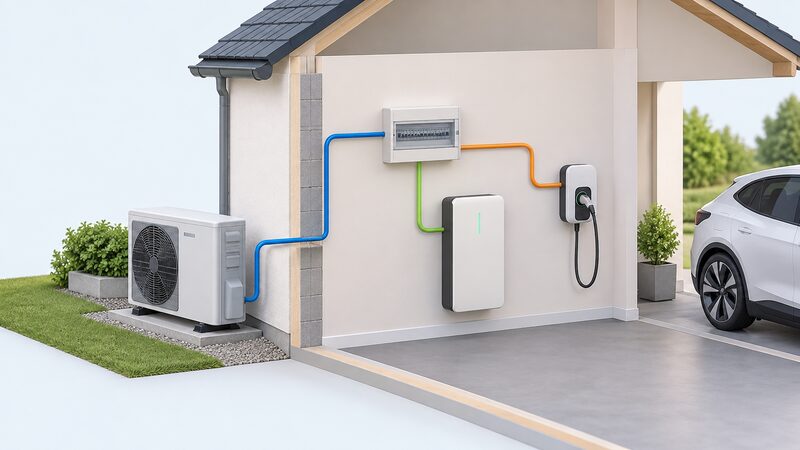
The connection side is where batteries and chargers interact most. To achieve faster charging speeds, a dedicated EV charge point over a standard household socket (13A) is recommended13. Most local authorities specify that households install a dedicated EV charger, with protective earth neutral fault protection14. New-build homes are required to have EV charge points installed15.
In Northern Ireland the process runs through the network operator. Homeowners or property owners must choose the equipment and nominate an EV charge point or heat pump installer, who carries out checks and submits the application on their behalf16. Homes sharing a looped electricity cable with a neighbour need their own dedicated cable installed before the charger can go ahead16, and installing a home EV charger typically requires a fuse upgrade to 80 to 100 amps, which often cannot be done on a looped supply without overloading the shared cable17.
Sizing the battery: capacity, power rating and throughput
Sizing has three separate dimensions, and households usually consider only the first. Capacity is how much energy the battery holds. Power rating is how fast it can deliver that energy. Throughput is how much energy it can pass through over its life before the warranty terms bite.
Capacity first. A battery used with a heat pump is the reference case. A battery used instead with regular electric heating would need to be three times as big and three times as expensive4. That comparison is the clearest published guide to how much a heat pump load dominates a household's storage requirement.
Power rating second. A heat pump over 12kW typically requires 18 amps from a dedicated electrical supply6. A battery that can hold enough kWh but cannot discharge at the rate the heat pump's compressor and backup heater demand will either trip or fall back to grid import. Correctly sized heat pumps, based on peak heat demand in watts, keep that peak lower18.
Throughput third. Energy throughput limits can affect a home battery warranty before the advertised term ends19. A battery cycled hard every day for heating and car charging will reach its throughput cap sooner than one used for evening lighting, so the warranty term in years is not the whole story.
| Sizing dimension | What it governs | Reference figure |
|---|---|---|
| Capacity (kWh) | How long the battery can run the load | Electric heating instead of a heat pump needs three times the capacity4 |
| Power rating (kW, amps) | Whether the load can start and run | Heat pumps over 12kW typically need 18 amps from a dedicated supply6 |
| Throughput (MWh over life) | How long the warranty lasts in practice | Throughput limits can end a warranty before the advertised term19 |
Product ranges sold in the UK span a wide capacity band. The LG THERMA V R290 Monobloc is offered with a capacity range of four sizes from 9 to 16 kW for renovation and large new-build properties20. That is a heat pump output range, not a battery figure, and it illustrates why the electrical supply and the battery's discharge rating have to be matched to the unit chosen rather than to the house's floor area.
How tariffs and solar change the running costs
Tariff choice is the decisive variable. On standard electricity tariffs, where electricity is nearly four times more expensive than gas, heat pumps can cost slightly more to run than new gas or oil boilers21. A battery changes that position only if it is charged when electricity is cheap.
The published guidance is specific. Look for a good SEG tariff for your exported electricity and then either a dynamic tariff or a heat pump tariff for your import, from the same company22. Where that combination is not available, consider a solar panel and battery tariff, which could be especially useful if your solar panel system is bigger than average or your heat pump smaller than average22. Other tariffs are available for heat pumps and electric vehicles23.
Solar and battery together do more than shift cost. You can use solar panels to power a heat pump, which can lower both your electricity and heating bills24. Combining solar panels with a home battery lets you store free, renewable electricity to power your heat pump, making you less reliant on grid electricity4. Home energy management systems can also integrate EV chargers, heat pumps and PV diverters, so the battery, the car and the heating can be sequenced rather than competing19.
Advice services exist for the control side. Smart Energy Action Plans help households understand how to use their heat pump controls, shift their electricity usage to use as much of their solar generation as possible, sign up to export tariffs, and identify which heat pump or time-of-use tariffs might be suitable25.
Where a battery alone falls short, and what fills the gap
A battery is a store, not a generator, and it cannot cover every load in every condition. The limits are worth stating plainly.
Heat pumps will not work without power, in the same way as gas boilers, hobs, internet and phones26. A battery with a backup supply can keep selected circuits live, but a battery without one, or one wired only to lighting and sockets, will not run the heating during an outage. This is the single most important limit for a household thinking about winter resilience.
Some systems need a secondary heat source by design. Backup energy is required when the energy provided by the heat pump is insufficient to meet the total demand for all the required services27. Air-to-air heat pumps do not produce hot water, so a separate hot water heat pump cylinder, heat battery, an electric immersion heater or a point-of-use water heater would be needed for that28. Solar assisted heat pumps do not produce enough heat to cover both the hot water and the heating needs of most homes29.
Grant rules show how the sizing question is treated officially. Under the Warm Homes: Local Grant, for retrofit and packaged hybrids the heat pump is sized to provide a minimum of 55% of the calculated heat load30. Under the Boiler Upgrade Scheme, the heat pump or biomass boiler must provide both space and hot water heating and be capable of meeting the full space heating and hot water heating demands of the property31. Those two positions differ on how much of the load a heat pump must carry on its own.
What fills the gap is a combination: a correctly sized heat pump, a battery sized to the overnight load rather than to the annual total, a tariff that makes the charging window cheap, and a grid connection that remains the ultimate backup. A battery improves a household's position on cost and on self-consumption. It does not remove dependence on the grid, on a supplier, or on the gas price that still sets the marginal cost of electricity.
Sources31 cited
- Deciding if a heat pump is right for you, Citizens Advice, 2025
- How to pay for energy, Cadent, 2026
- Electric vehicles: debunking myths, Energy Saving Trust, 2025
- Battery storage advice, Energy Saving Trust, 2026
- EV charging VAT, Zapmap, 2026
- Heat pump installation guidance, HHIC, 2026
- Making the most of your solar PV panels, Centre for Sustainable Energy, 2026
- Off-gas grid heating options, OFTEC, 2026
- Renewable energy, Consumer Council for Northern Ireland, 2026
- Eligible heating systems, Ofgem, 2026
- Grid impacts of heat pumps, EVs and solar revealed, Energy Systems Catapult, 2025
- Can solar panels charge electric cars?, CPA, 2026
- Connecting to the networks: LCT strategy, Energy Networks Association, 2026
- Cross-pavement charging solutions, Energy Saving Trust, 2025
- Electric vehicle charging building regulations, Planning Portal, 2026
- EVs and heat pumps, NIE Networks, 2026
- Looped services, NIE Networks, 2026
- Measuring the invisible: HTC and the future of retrofit, Stroma, 2026
- How to ensure a heat pump runs efficiently, Energy Saving Trust, 2026
- LG THERMA V R290 Monobloc 14kW, Quiet Mark, 2026
- Air source heat pumps, Energy Saving Trust, 2026
- Tariffs for renewable technology, Energy Saving Trust, 2026
- EDF Energy, Energy Helpline, 2026
- Solar photovoltaic, MCS Certified, 2026
- Smart Energy Action Plans, Centre for Sustainable Energy, 2026
- Power cut 105, Energy Networks Association, 2026
- Heat pump methodology, Department for Energy Security and Net Zero, 2026
- Air-to-air heat pumps, Nesta, 2026
- Solar assisted heat pumps, Energy Saving Trust, 2025
- Warm Homes: Local Grant policy guidance, Department for Energy Security and Net Zero, 2026
- Boiler Upgrade Scheme guidance, Ofgem, 2023
 Energy IndependenceA heat pump runs your heating on electricity instead of gas or oil, so how much does that really cut what you pay and how exposed you are when fuel prices jump?
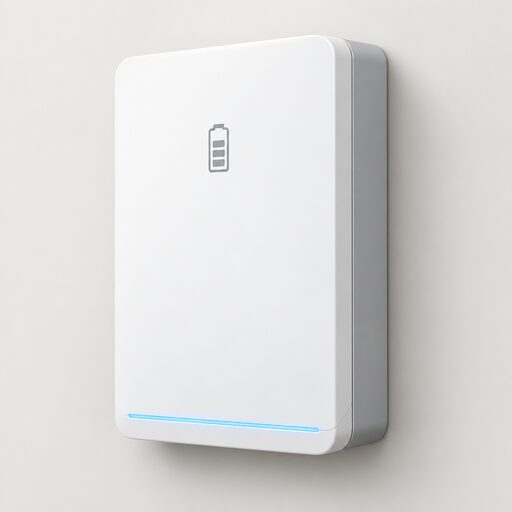 Charging With a Home BatteryHow a home battery and an EV charger share one supply, whether a battery can usefully charge a car, and how combined systems are controlled so the battery is not discharged into the vehicle at a loss.
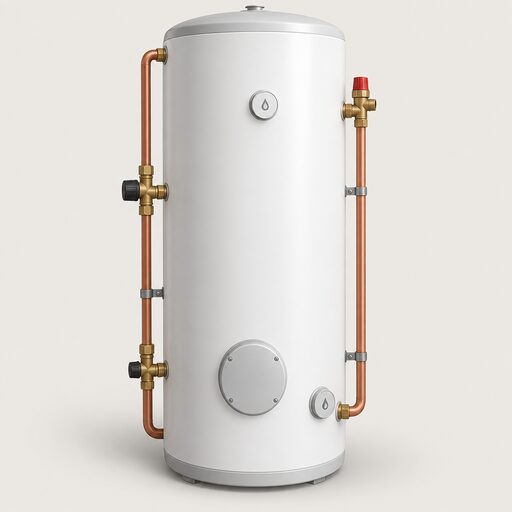 Whole-Home Energy DesignHeating and hot water use more energy than anything else at home, so that choice shapes everything.
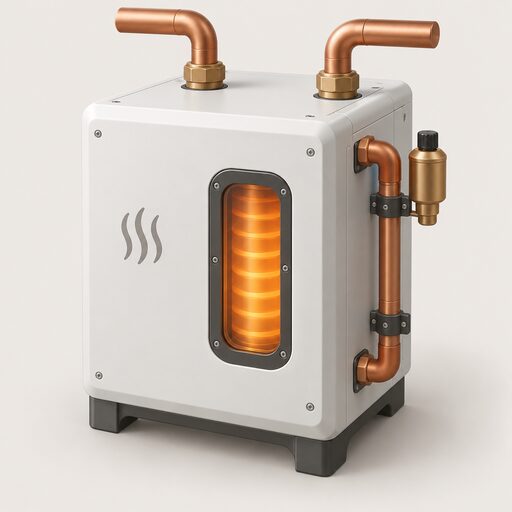 Heat Batteries and Zero EmissionA heat battery stores cheap overnight electricity as heat, then releases it to warm your home or your hot water.
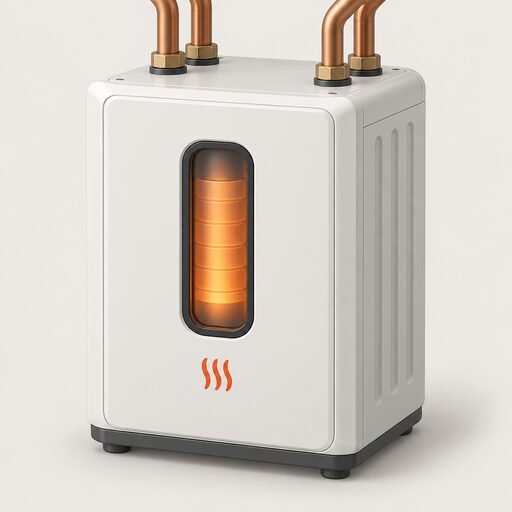 Heat Batteries with Heat PumpsCan a heat battery replace a hot water cylinder if you have no space for one?
 Fuel Cell Cars as Home PowerCan you really run your home from a hydrogen car?