
In this answer
Short answer
Yes. A Sunamp thermal battery charges from an air-source or ground-source heat pump, from solar PV, from a boiler, or from grid electricity. The maker lists the charging sources as air-source heat pumps, ground-source heat pumps, photovoltaics and electricity from the grid, and describes the wider family as working with heat pumps, wind and solar, grid and microgrid electricity, waste heat, combined heat and power (CHP) and boilers1. The Thermino range is listed as chargeable by air-source heat pumps, ground-source heat pumps, grid electricity and boilers, and as future-proofed for solar PV3.
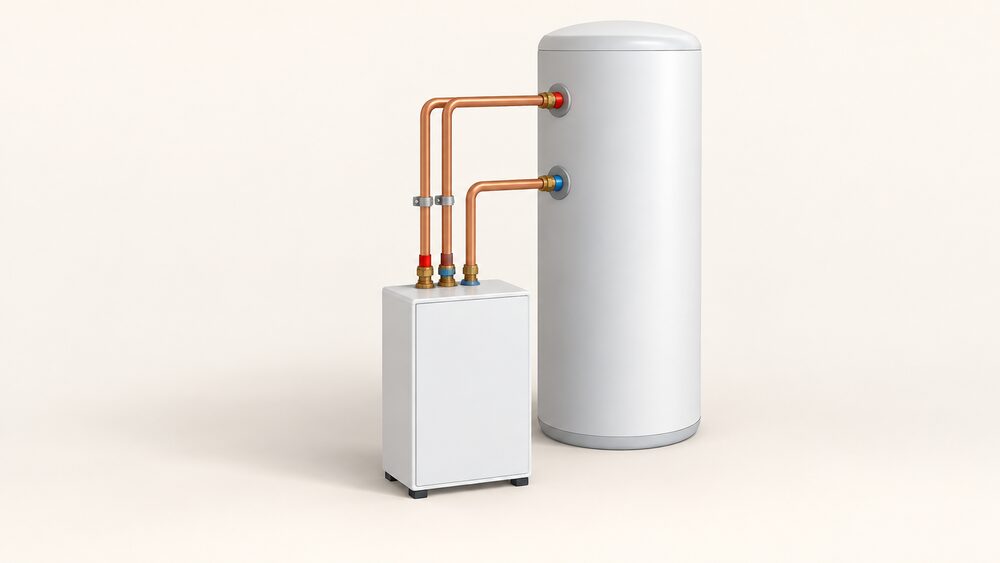
What makes this different from a hot water cylinder is what is being stored. A Sunamp unit stores heat, not electricity, in a phase change material the maker calls Plentigrade, and releases it when and where it is needed2. That is why the charging question is about heat sources as much as about electricity: a heat pump, a boiler or an immersion element can all put energy into the same store.
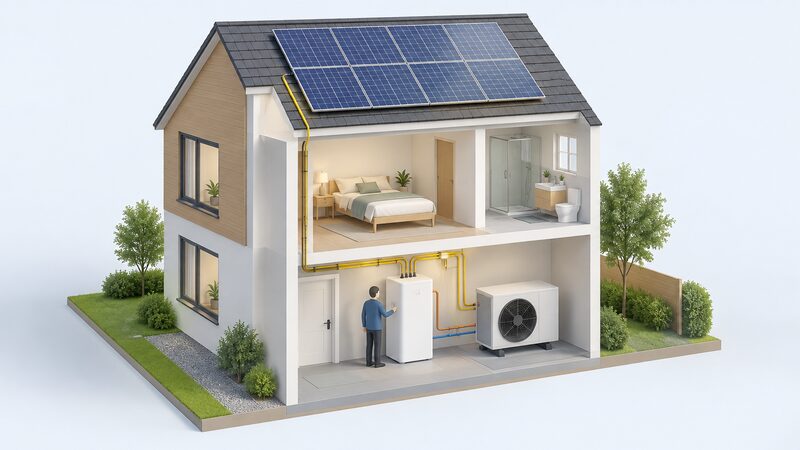
The practical consequence for a household is that the battery decouples when energy is bought or captured from when hot water is drawn. A Sunamp heat battery stores thermal energy at times when renewable generation is plentiful and cheap, to be used for heating later on demand5. The dependence that remains is on whatever charges it: a heat pump still needs electricity, a solar array still needs daylight, and a grid-charged unit still needs a supplier.
Charging sources: heat pumps, solar PV, grid and more
The list of things that can charge a Sunamp battery is longer than most householders expect. Sunamp states that its thermal batteries charge from renewable energy sources such as air-source heat pumps, ground-source heat pumps and photovoltaics, and separately that they work with heat pumps, wind and solar, grid and microgrid electricity, waste heat, combined heat and power (CHP) and boilers1. The Thermino product pages repeat the core set: air-source heat pumps, ground-source heat pumps, grid electricity and boilers, with solar PV described as future-proofed3.
Plentigrade, the phase change material inside, is listed with its own charge sources: heat pumps, boilers, resistive elements and solar11. That is the widest statement of compatibility in the material, and it explains the design logic. Because the store holds heat rather than electricity, almost any device that can deliver heat into a fluid or an element can charge it.
There are firm exclusions. Sunamp states that Thermino batteries do not connect to solar thermal units, pellet, oil or wood burning stoves, swimming pools or hot tubs10. A household with a solar thermal panel, an oil boiler or a wood stove therefore cannot use those as the charging source, even though a gas or heat pump circuit can be used.
For a household's energy independence, the breadth of charging sources is the point. A unit that can take heat from a heat pump, an immersion element on a cheap overnight tariff, a solar diverter or a back boiler gives the household more than one route to hot water. It does not remove dependence on the grid or on a fuel supply, but it means no single one of them is the only way to get a shower.
How heat pump charging performs: 230 to 250% efficiency at 70 degree flow temperatures
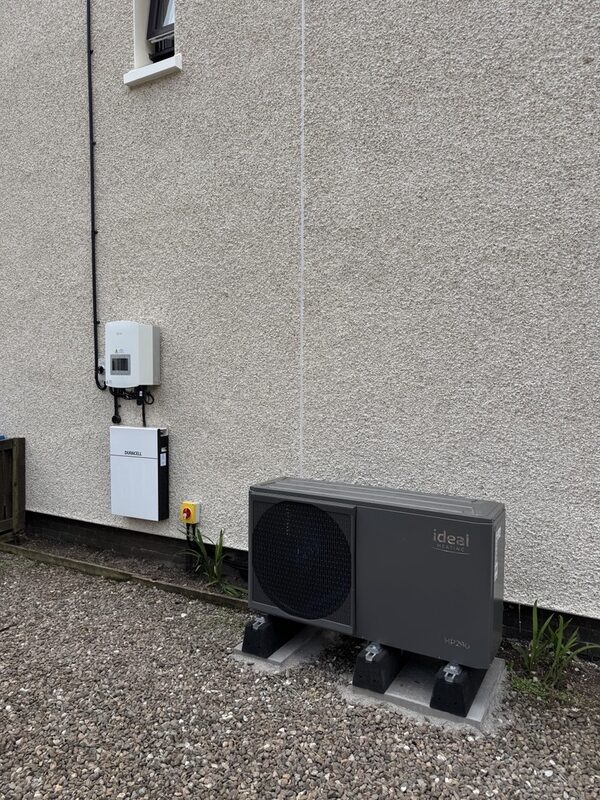
The efficiency of a heat-pump-charged Sunamp is the efficiency of the heat pump feeding it, not a property of the battery. Independent and official sources put heat pump performance at around 300%: Croydon Council guidance states that heat pumps typically achieve an efficiency rating of 300%, meaning that for every unit of electricity they consume they produce around three units of heat12. Energy Saving Trust figures reported by Uswitch give the same figure, describing heat pumps as generally producing around three times more energy than they take in, 300% efficient13. Which? puts heat pumps at 300% efficient or more, creating three times as much heat as the energy they use14.
The maker's own comparison page puts a heat pump water heater at around 300 to 400% efficiency (COP 3 to 4)8. Ideal Heating notes that a water-source heat pump can reach up to 600% efficiency because of how readily heat transfers in water15. Those higher figures apply to specific heat pump types and conditions, not to a typical UK air-source installation.
The efficiency a household actually sees depends on the flow temperature the heat pump runs at and the temperature of the source. A heat pump delivering hotter water works harder and returns a lower figure; a well-insulated home with larger radiators or underfloor heating can run cooler and return more. The battery itself does not change that relationship, but it does allow the heat pump to run at a time of day when electricity is cheaper or when the solar array is generating, which is where the running cost benefit sits rather than in the efficiency number.
"Heat pumps typically achieve an efficiency rating of 300%, this means for every unit of electricity they consume, they produce around three units of heat."
What solar PV charging means in practice
Solar PV, defined in Northern Ireland legislation as solar photovoltaics, is the second charging route a household is likely to consider16. East Hertfordshire Council guidance describes solar panels being used to charge up an on-site battery storage system17, and Energy Saving Trust notes that a solar battery can increase savings further by storing the sun's energy to power a heat pump later in the day18. Solar Energy UK describes solar PV as an obvious choice to provide the low carbon and cost-effective electricity needed to drive heat pumps19.
For a Sunamp unit, the mechanism is direct. A high-powered heat exchanger or heating element immersed in the patented phase change material rapidly charges the thermal battery20. That means surplus solar generation can be diverted into the store as heat rather than exported, and drawn off later as hot water.
The limit is the season. Solar generation in the UK peaks in summer, when space heating demand is lowest, and falls away in winter, when hot water demand continues. A Sunamp battery charged from PV therefore reduces grid draw in the sunnier months and does less in the darker ones. The Energy Saving Trust's point about a solar battery applies equally here: storage shifts the benefit later in the day, not later in the year.
A maker press release reports that pairing a Sunamp Thermino heat battery with 2.5kW of solar PV preheating for a gas combi boiler delivered yearly cost savings of around £9121. That figure is specific to that configuration and that study, and it is a maker's reported result rather than an independently verified one.
Running costs: about £300 a year, and how they compare with a cylinder
Heat pumps cost around £800 to £1,050 a year to run, which makes them one of the cheapest electric heating options21. A worked ground source example at COP 4.0 puts the annual cost of electricity for heating and hot water at £587.82, rounded to £58822. An air source installation modelled with subsidy comes to an annualised total of £960, made up of £300 upfront, £80 maintenance and £580 running costs23. For contrast, panel heaters in a flat run at around £1,080 a year21. A heat pump tumble dryer adds around £54 a year, based on three full loads a week on cotton and cupboard dry settings at the July energy price cap of 26.11p/kWh24.
Running cost is where the charging source matters most, and the figures in circulation are for heat pumps generally rather than for a Sunamp unit specifically. The Centre for Sustainable Energy puts heat pumps at around £800 to £1,050 a year to run, describing them as one of the cheapest electric heating options22. For comparison, the same source puts panel heaters at around £1,080 a year for a flat22. Which? gives an annual electricity cost for heating and hot water of £587.82, rounded to £588, for a ground source heat pump example at COP 4.0, from April 202623. Nesta's annualised figure for an air source heat pump with subsidy is £960, made up of £300 upfront, £80 maintenance and £580 running costs24.
Those numbers vary because they assume different heat pumps, tariffs, house sizes and levels of insulation. A Sunamp battery does not have a running cost of its own in the way a boiler does: it has the cost of whatever charges it. A unit charged from a heat pump inherits the heat pump's running cost; a unit charged from an immersion element on a cheap overnight tariff inherits the electricity price at that time.
The comparison a householder usually wants is against a hot water cylinder. No direct figure for that difference is published. What is recorded is the maker's reported £91 annual saving from solar PV preheating paired with a gas combi boiler20, alongside the general heat pump running costs above. Any comparison depends on the heat source, the tariff and how much hot water the household uses, so it is an installation-specific calculation rather than a product specification.
Space and sizing: up to four times smaller than a cylinder, and expandable
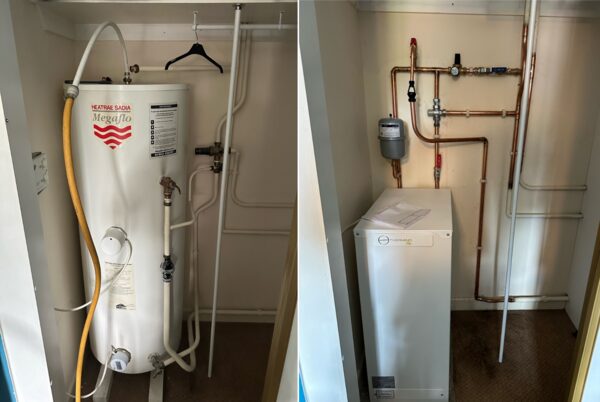
The size claim is consistent across Sunamp's own material. The maker states that its thermal batteries are up to four times smaller than the equivalent hot water cylinder, and repeats the figure in specifier guidance, housing development pages and social housing material6. The Thermino product page puts it as up to four times smaller than the equivalent hot water tank3.
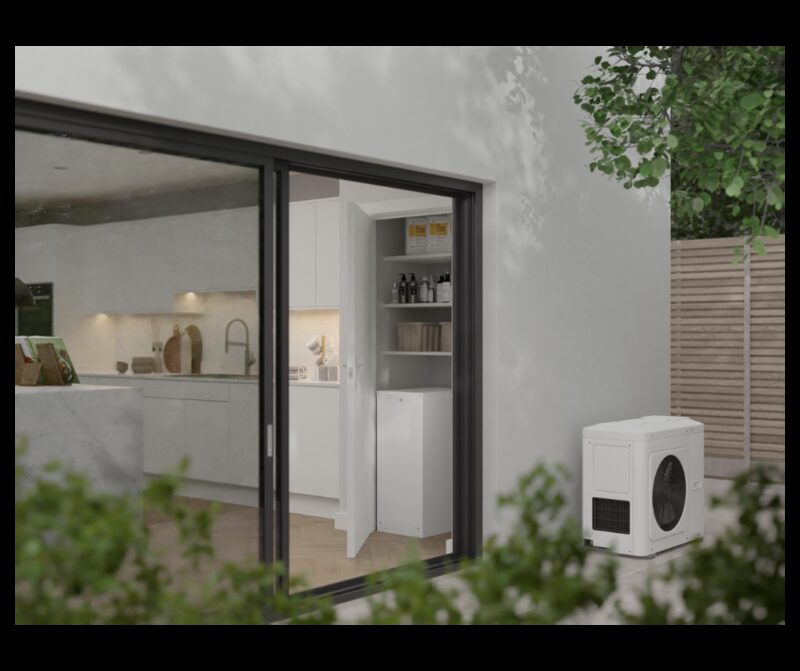
That matters because it changes what is possible in a home that has no cylinder cupboard. Sunamp states that the Thermino hp thermal battery allows heat pumps to be installed for homes with no space for an indirect hot water cylinder, and that this means heat pumps can be installed where they do not normally fit since hot water cylinders are not required7. For a flat, a terraced house with a converted loft or a home where the airing cupboard has been absorbed into a bathroom, that is the difference between a heat pump being feasible and not.
On expansion, the material documents retrofit and new build applications rather than a modular add-on path. Sunamp thermal batteries are described as combining with renewables to deliver instant hot water in housing developments, and as suitable for retrofitting existing hot water systems26. The Whetstone development's Green Apartments are cited as using Sunamp heat batteries to harness solar PV for reliable hot water26. Sizing is settled at specification stage with the stockist or installer.
The independence point here is spatial rather than financial. A smaller store frees the cupboard, and a store that does not need to be a cylinder opens up heat pump installation in homes that would otherwise be ruled out. The dependence that remains is on the heat source and on the electricity or gas feeding it.
The company behind the battery: Sunamp, East Lothian, and RAL-certified PCM
Sunamp is an East Lothian based manufacturer of heat batteries, according to Scottish Government guidance29, and the company describes itself as headquartered in the United Kingdom30. East Lothian places the business in south-east Scotland. For a UK household, that means the manufacturer, its engineering and its support sit in the UK rather than overseas, which bears on spare parts, technical support and the practicalities of a warranty claim.
The technology claim the maker makes most strongly is about certification. Sunamp states that it is the only thermal battery manufacturer in the world to have been awarded RAL certification for phase change material10. RAL is a German quality mark for products and services; the claim is the maker's own and is not corroborated by an independent source in the material.
The material itself is Plentigrade, described as patented, storing energy in high-performance phase change materials20. The Thermino stores heat, not electricity, unlike a lithium-ion battery, and the phase change material absorbs and releases thermal energy during a melting and freezing cycle9. Sunamp heat batteries are described as energy-saving thermal stores containing Plentigrade2.
The distinction between a heat battery and an electrical battery is worth stating plainly, because the two are often confused. A Sunamp Thermino heat battery is not designed for whole-home electrical use9. It does not power lights, appliances or a heat pump's compressor. It stores heat for hot water and, in some configurations, space heating. A household wanting electrical backup needs a separate electrical battery, and the two serve different purposes.

Buying one: Sunamp does not sell directly to homeowners
Sunamp states plainly that it does not sell directly to homeowners, and that its hot water products are available through approved stockists10. Direct enquiries are forwarded to the installer and distributor network10. A householder therefore buys through a stockist or an installer, and the commercial relationship, the price and the installation date sit with that third party.
That has consequences for anyone comparing options. There is no manufacturer direct price list for a householder to work from, and prices are installer-quoted. The one published figure in the material is the maker's own: a Thermino heat battery offering 12 kWh of thermal storage capacity for around £3,400 (MRRP), which the maker puts at approximately £390 per kWh9. That is a recommended retail figure, not a quoted installed price, and it excludes installation.
The route to a technical answer runs through the same channel. Sunamp publishes a Thermino FAQ and a general FAQ on its UK site, which is where product and technical questions are directed31. Questions that concern a specific installation are handled by the stockist, installer or distributor.
For a household's independence, the sales model is a dependence worth naming. The household depends on a third party for specification, price and installation, and on the manufacturer for the product and its support. The battery reduces dependence on a single energy source for hot water; it does not reduce dependence on the supply chain that puts it on the wall.
Sources32 cited
- Sunamp for social housing, Sunamp, 2026-03-24
- How thermal batteries work, Sunamp, 2026-09-17
- Thermino hot water overview, Sunamp, 2026-03-17
- How heat batteries work, Sunamp, 2024-07-28
- Sunamp heat batteries case study, Energy Systems Catapult, 2021-09-24
- Sunamp for specifiers, Sunamp, 2026-09-17
- Sunamp hot water product range, Sunamp, 2026-09-17
- Heat pump water heater vs Sunamp Thermino heat battery, Sunamp, 2026-09-10
- Comparing home battery storage: electric batteries vs heat battery, Sunamp, 2025-11-13
- Sunamp frequently asked questions, Sunamp, 2026-08-17
- Plentigrade applications: hot water and heating, Sunamp, 2026-03-31
- Air and ground source heat pumps, Croydon Council, 2026-09-17
- Heating fuel guide, Uswitch, 2026-01-27
- Hydrogen boilers: what you need to know, Which?, 2026-09-17
- Heat pumps: different types, Ideal Heating, 2026-09-17
- Solar thermal and PV definitions, Northern Ireland, legislation.gov.uk, 2015
- Solar panels planning guidance, East Hertfordshire Council, 2026-09-17
- Is now a good time to get a heat pump?, Energy Saving Trust, 2025-12-12
- Solar heat: the future of residential heat decarbonisation, Solar Energy UK, 2021-03-15
- How thermal batteries work (Canada), Sunamp, 2026-03-23
- New research on PCM heat batteries for domestic hot water, Sunamp, 2025-11-17
- Electric heating advice, Centre for Sustainable Energy, 2026-06
- Ground source heat pump costs and savings, Which?, 2026
- Seven reasons we still need heat pump subsidies, Nesta, 2025-11-20
- Decarbonising social housing through funding, regulations and technology, Sunamp, 2024-08-06
- Sunamp for housing developments, Sunamp, 2026-03-20
- Sunamp for public housing, Sunamp, 2026-03-24
- Sunamp for housing development, Sunamp, 2026-03-24
- Heat Pump Sector Deal Expert Advisory Group, Scottish Government, 2021-12-02
- Sunamp, Sunamp, 2026-05-21
- Thermino frequently asked questions, Sunamp, 2026-08-17
- Decarbonising the built environment in new buildings, Sunamp, 2024-08-06
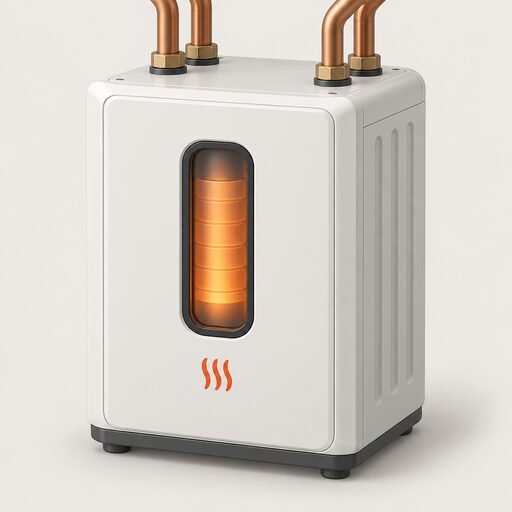 Heat Batteries with Heat PumpsCan a heat battery replace a hot water cylinder if you have no space for one?
 Energy IndependenceA heat pump runs your heating on electricity instead of gas or oil, so how much does that really cut what you pay and how exposed you are when fuel prices jump?
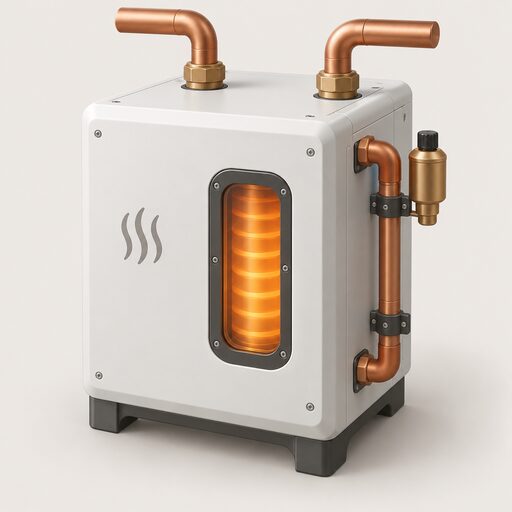 Heat Batteries and Zero EmissionA heat battery stores cheap overnight electricity as heat, then releases it to warm your home or your hot water.
 Financing an InstallationPaying monthly for a boiler, solar panels, battery or heat pump sounds simple, but who actually lends you the money and what happens if the work goes wrong?
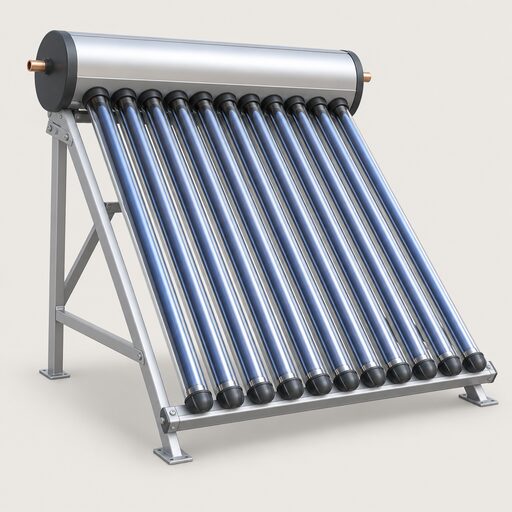 Solar Thermal Water HeatingSolar thermal panels heat your water using the sun, working alongside your boiler rather than replacing it.
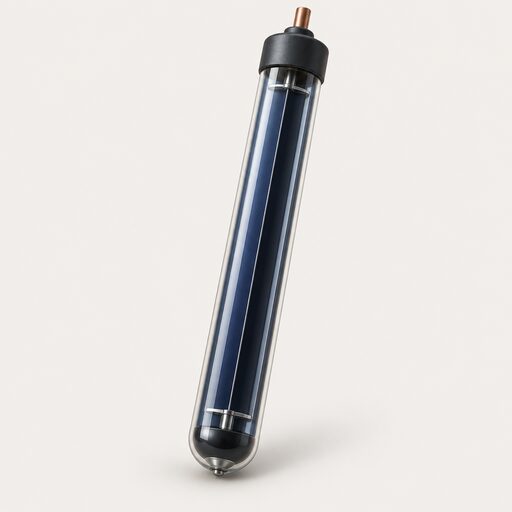 Solar Water Heating CollectorsSolar water heating uses panels on your roof to warm the water in your cylinder, working alongside your boiler rather than replacing it.