
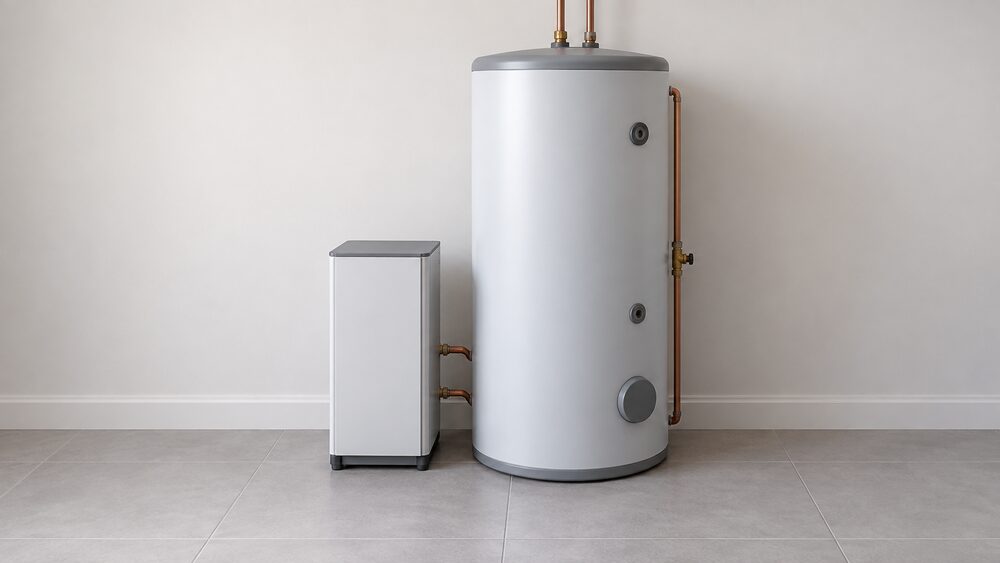
In this comparison
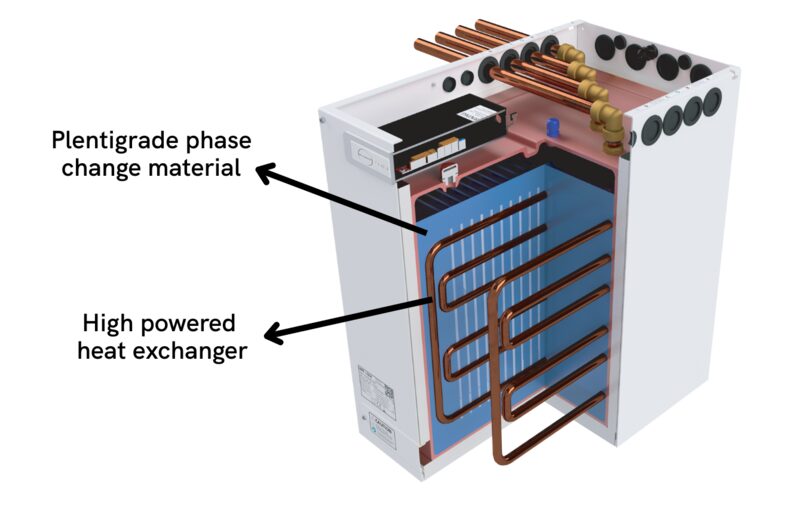
A heat battery stores heat in a material rather than in a tank of water. One type uses a phase change material (PCM) that shifts from solid to liquid as it absorbs heat and back to solid as it releases it; the other stores heat in a material such as ceramic where no phase change occurs1. A hot water cylinder does the opposite job in the simplest possible way: it holds water that has been heated during the day and supplies it later2.
The practical differences are space, standing loss, cost and grant eligibility. Heat batteries can be up to four times smaller than equivalent hot water cylinders3. They run at 55 to 60°C on an existing wet central heating system, need no outdoor unit, and can often work with existing radiators and pipework4. They are not yet eligible for the Boiler Upgrade Scheme, though a £2,500 grant is set to become available once legislation and product standards are in place5.
For a household weighing the two, the choice turns on what the heat is for. A cylinder stores hot water for taps, showers and baths, and it is the component most heat pumps require to run efficiently6. A heat battery stores heat for either taps or radiators, and it can take that heat from electricity or from surplus heat produced by a boiler or heat pump1.
What a heat battery is and how it stores heat
A heat battery stores energy as heat rather than as electricity. The input can be electricity from the grid or from a home renewable source, or surplus heat from a boiler, a heat pump or another heating system1. That flexibility is the point of the technology: it decouples the moment heat is produced from the moment it is used.
There are two families. The first stores heat in a phase change material, a substance that changes from solid to liquid as it absorbs heat and back to solid as it releases it1. The second stores heat in a material such as ceramic, where no phase change takes place1. Independent guidance describes the phase change route in the same terms: spare heat or electricity is stored as heat by a material that changes from a solid to a liquid when it is absorbed, then back to a solid to release the heat9.
A hot water cylinder works on a different principle. It stores the water that is heated up during the day and supplies it for use later2. On a heat pump system, the installer will usually fit a cylinder to store water heated by the pump ready for when it is needed10. An air source heat pump heats water stored in a cylinder for hot taps, showers and baths11, and a solar assisted heat pump stores its output in a cylinder ready for use12.
The distinction matters for independence. A cylinder ties a household to a tank of water and the pipework around it. A heat battery ties the household to a store of heat that can be topped up from more than one source, which is why some units can also act as a thermal store within a central heating system, typically alongside a heat pump1.
Heat battery vs hot water cylinder: the head-to-head
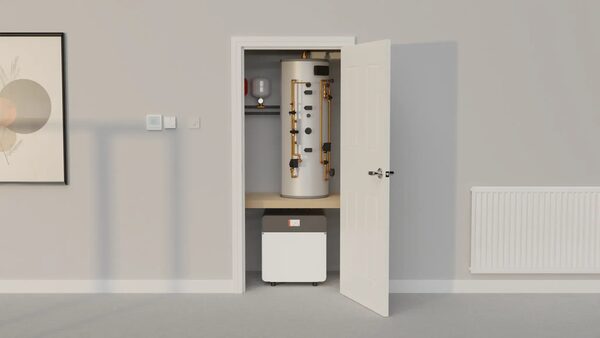
The two devices are not direct substitutes in every home, and the differences show up in four places: what they store, how they connect, how much room they take and how much heat they lose while idle.
| Heat battery | Hot water cylinder | |
|---|---|---|
| What is stored | Heat in a phase change or ceramic material1 | Water heated during the day for later use2 |
| Inputs | Electricity, or surplus heat from a boiler, heat pump or other system1 | Output of a heat pump, boiler or solar thermal system10 |
| Output | Hot water for central heating or taps1 | Hot water for taps, showers and baths11 |
| Flow temperature | 55 to 60°C via a heat exchanger4 | Set by the heat source; many heat pumps reach over 60°C6 |
| Outdoor unit | None needed4 | None needed, but the heat source may need one6 |
| Space | Up to four times smaller than an equivalent cylinder3 | Requires dedicated indoor space6 |
| Grant support | £2,500 planned, not yet open5 | Covered indirectly where the heat pump is eligible9 |
The cylinder's advantage is that it is the configuration most heat pump manufacturers require, because heating water over a longer period lets the pump run more efficiently6. Low-temperature, low-carbon solutions such as heat pumps generally require a hot water cylinder, while many homes with gas combination boilers do not6. A combi boiler uses no cylinder at all: all the heat and hot water comes directly from the boiler itself14.
That is the gap a heat battery fills. Where a household has no cylinder and no space for one, independent guidance lists a heat battery alongside a hybrid heat pump and an instantaneous water heater as the options15. Air-to-air heat pumps, which provide no hot water themselves, can be paired with a separate hot water heat pump cylinder, a heat battery, an electric immersion heater or a point-of-use water heater16.
Space: up to four times smaller than the equivalent cylinder
Floor area is often the deciding factor in a UK replacement. Heat batteries can be up to four times smaller than equivalent hot water cylinders3. For a household converting a cupboard, an airing cupboard or a utility corner, that difference is the whole argument.
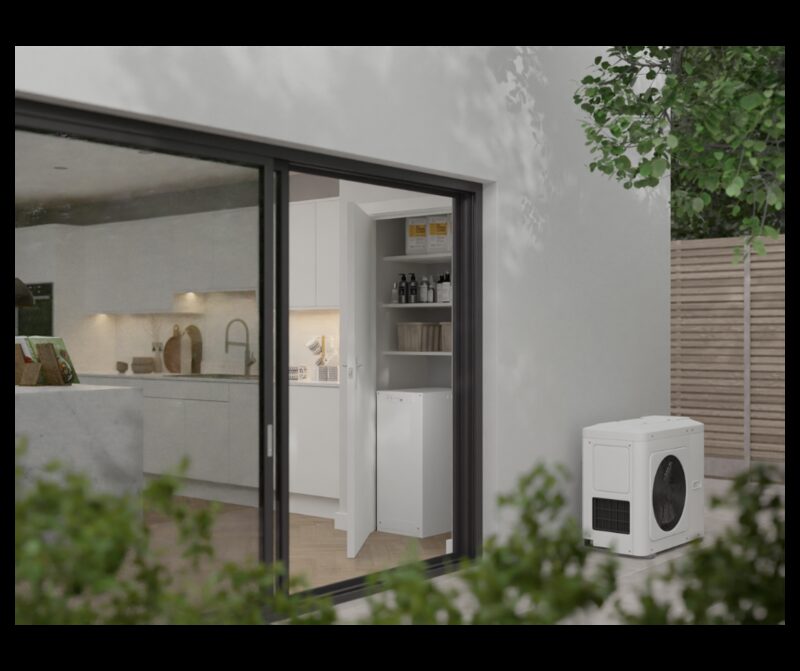
A heat pump installation, by contrast, will require space for a hot water cylinder indoors if the home does not already have one6. That requirement sits alongside the outdoor unit, which needs its own siting. Heat batteries are described as most suitable for smaller homes that do not have space for an outdoor heat pump unit4, and they need no outdoor unit at all4.
The space question also runs the other way. A cylinder is not only a store; it is a buffer that lets a heat pump run in long, efficient cycles6. Removing it to save room can mean the heat source has to work differently. Where a cylinder is built into the case of the heat pump as a fully integrated system, the space is already accounted for; in other models the cylinder is separate17.
Standing losses: about a quarter of a cylinder's heat losses
A cylinder loses heat continuously, whether or not anyone draws hot water. Approved Document L sets maximum daily heat loss figures by nominal volume: a 200 litre cylinder may lose up to 2.06 kWh in a day, and a 1,000 litre cylinder up to 3.57 kWh in a day7. Welsh building guidance gives 1.03 kWh in a day for a 50 litre nominal volume18.
Those losses can be reduced. Insulating a hot water cylinder with a jacket can cut heat loss by up to 75%, and a jacket costs about £3019. That is the cheapest intervention on either side of this comparison, and it changes the arithmetic for anyone keeping a cylinder.
A heat battery stores heat in a material rather than a standing body of water, so it does not carry the same continuous loss from a tank surface. The comparison is not exact, because a heat battery's standing loss depends on its insulation and its state of charge, and no equivalent regulated figure is published for heat batteries in the material available. What can be said is that the cylinder's loss is a known, regulated quantity that a household can measure and reduce, while the heat battery's is not yet subject to the same published table.
For independence, this is a running cost rather than a security question. A cylinder that loses 2.06 kWh in a day is losing heat the household paid for, and the fix is insulation rather than a new device.
Cost: £1,000 to £4,000 plus installation, and the VAT position
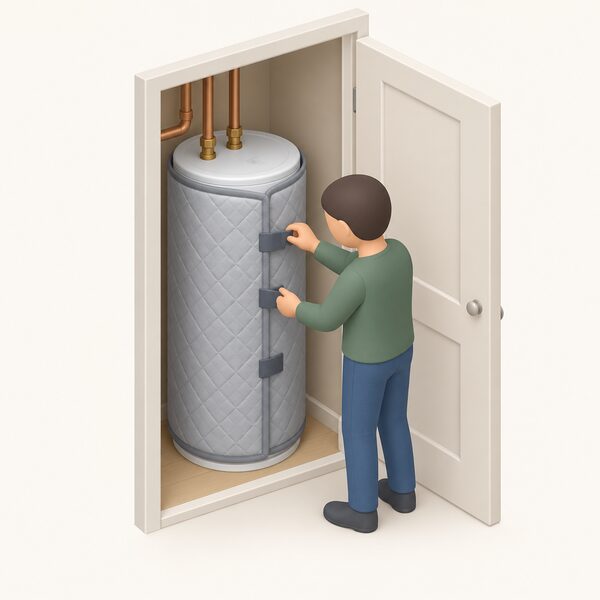
Installing a hot water solution is likely to cost between £1,000 and £4,000, depending on whether a basic immersion heater or heat battery, a smart hot water cylinder or a hot water heat pump cylinder is chosen8. That range covers both sides of this comparison and reflects how much the specification varies.
Cylinder prices are published separately. Swapping a combi for a boiler with a hot water tank means paying £350 to £750 for a vented cylinder, or £900 to £1,400 for an unvented cylinder, depending on the size of the cylinder21. A cylinder jacket adds about £3020.
The VAT position is where heat batteries stand apart. Heat batteries are currently the only major heating technology that does not qualify for VAT relief4. Energy-saving materials normally attract a reduced rate, and the treatment depends on the proportion of materials to labour in the installation: where materials are more than 60% of the total cost, standard rate VAT applies to the materials and 5% to the labour22. In the worked example given, an installer charging £5,385 excluding VAT, made up of £3,500 materials and £1,885 labour, has materials at 65% of the total, so standard 20% VAT applies to the materials and 5% to the labour22.
Running costs are a separate matter. A typical cost for a heat battery is around £1,770 a year for an average home on Economy 7 or an off-peak tariff, and the units have a maximum output of around 12,000 kWh a year, similar to the average UK home's heating demand4. For comparison, an air source heat pump installation is around £6,500 to £11,500 including VAT, labour costs and the Boiler Upgrade Scheme grant23, and heat pumps cost about £10,500 to buy and install with a range from £8,000 to £15,00024.
Grants: not yet eligible for the Boiler Upgrade Scheme
The Boiler Upgrade Scheme currently supports air-to-water heat pumps9. A £2,500 grant for heat batteries will also be available once the legislation and appropriate product standards are in place5, and the same £2,500 value appears in the government's consultation on scheme and certification requirements, to be provided once appropriate product, design and installation standards have been implemented25.
The condition is certification. Heat batteries will not be eligible for the Warm Homes: Local Grant until they can be MCS certified, and once certified, SAP-eligible heat batteries will be eligible26. The same rule applies to the Warm Homes: Social Housing Fund: heat batteries will not be eligible until they can be MCS certified, and once MCS certified, SAP-eligible units will be eligible27. MCS consulted on a Thermal Energy Storage System Standard in March 2025 and announced a pilot in September 202527.
Phase change material heat batteries face a further hurdle. They cannot currently be installed through the scheme until there is a formally approved convention or they are a formally recognised technology category in SAP26.
Other scheme conditions apply to any household considering a grant-funded installation. The installation cannot be funded by more than one source of public funds, and an applicant cannot have already received government funding or support for a heat pump or biomass boiler28. A property is not eligible if a previous Boiler Upgrade Scheme grant has already been received for installing a heat pump or biomass boiler at the same address29. Grants for air-to-air heat pumps are not available yet but will be in the future30.
Where each fits: smaller homes, heat pumps and existing pipework
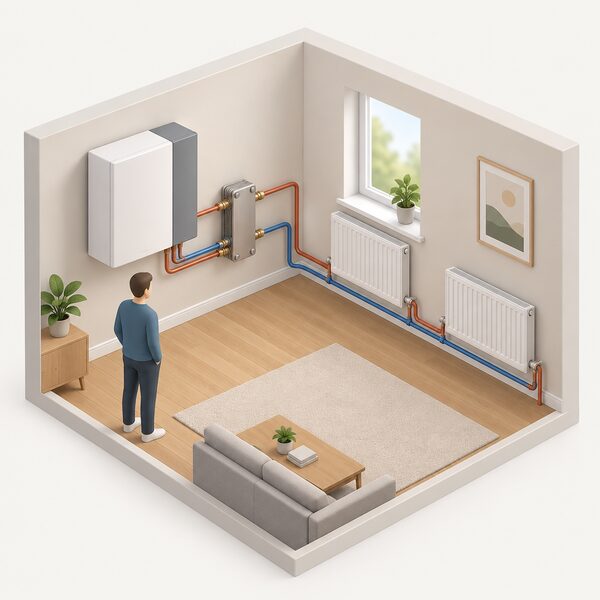
Heat batteries are most suitable for smaller homes that do not have space for an outdoor heat pump unit4. They connect to an existing wet central heating system through a heat exchanger and run at 55 to 60°C, which means they can often work with existing radiators and pipework4. That combination, no outdoor unit and no cylinder, is what makes them a candidate for flats, terraces and conversions where a heat pump would be difficult to site.
Cylinders fit where a heat pump is going in. Most heat pump manufacturers require the use of a cylinder, because it lets the pump run more efficiently by heating the water over a longer period6. Many heat pumps can provide hot water over 60°C consistently, the minimum temperature the cylinder needs for sterilisation, while heating hot water to 50 to 55°C very efficiently before the sterilisation cycle raises the temperature6.
Existing pipework matters on both sides. A conventional boiler with a hot water cylinder is often compatible with solar water heating, though the existing cylinder would need replacing with one designed for solar water or a dedicated solar water cylinder13. Having a hot water cylinder also lets a household store energy from solar panels14. A solar assisted heat pump cannot provide hot water on demand like a combi boiler, so a way to store hot water is needed12.
For a household with a combi and no cylinder, the choice is between adding storage or adding a heat battery. For a household with a cylinder already in place, the cylinder is doing a job that a heat battery would have to replicate, and the pipework is already there.
Heat battery or home battery: which stores what
These are different products with confusingly similar names. A home battery stores electricity; a heat battery stores heat. Official guidance on energy storage lists the forms storage can take: the heat stored in the fabric of the building, hot water storage, electric battery storage and heat batteries using phase change materials31.
That list is useful because it separates the two questions a household usually has. If the aim is to keep electricity generated during the day for use in the evening, the device is an electric battery. If the aim is to keep heat produced cheaply for use when it is needed, the device is a hot water cylinder or a heat battery.
Heat batteries may have a longer lifespan than electrical batteries1. No service life in years is published for heat batteries in the material available, so a specific figure quoted by a seller should be treated as a maker's claim. Heat batteries can also help balance the electricity grid4, which is the same argument made for electric storage: they can absorb power when it is plentiful and release it as heat when demand peaks.
For independence, the distinction is about what the household controls. An electric battery reduces reliance on the grid at the moment of use. A heat battery reduces reliance on the grid at the moment of heating, and it can take surplus heat from a boiler or heat pump that would otherwise be wasted1. Neither removes the connection to a supplier, and a heat battery still needs electricity or another heat source to charge.
Sources31 cited
- Storing energy, Energy Saving Trust, 2026-07-15
- Generating your own energy: solar water, Welsh Government, 2018-09
- The suitability of clean heating options for challenging dwelling types, ClimateXChange, 2024-09-20
- Electric heating, Centre for Sustainable Energy, 2026-06
- Carbon Budget and Growth Delivery Plan: heat and buildings factsheet, GOV.UK, 2026-06-23
- Heating and heat pump factsheets, CIBSE, 2026-09-17
- Approved Document L, Conservation of fuel and power, Volume 1: Dwellings, GOV.UK, 2026-09-17
- Air-to-air heat pumps: common questions, Nesta, 2026-06-24
- Boiler Upgrade Scheme: installers, Ofgem, 2026-09-17
- Heat pump installation: a step by step guide, Energy Saving Trust, 2026-07-15
- Air source heat pumps, Energy Saving Trust, 2026-07-16
- Solar assisted heat pumps, Energy Saving Trust, 2025-06-13
- Could solar water heating work for you, Energy Saving Trust, 2026-05-20
- Boilers, Energy Saving Trust, 2026-05-20
- Is now a good time to get a heat pump, Energy Saving Trust, 2025-12-12
- Air-to-air heat pumps, Nesta, 2026-09-17
- Exhaust air heat pumps, Energy Saving Trust, 2025-06-05
- Building Regulations Part L and F review, stage 2a, Approved Document L, Welsh Government, 2020-11
- Energy savings tips, British Gas Energy Trust, 2026-02-27
- Tips to improve the EPC rating of your home, Energy Saving Trust, 2026-08-03
- Boiler prices: how much does a new boiler cost, Which?, 2025-09-17
- VAT on energy saving materials, HM Revenue and Customs, 2026-09-20
- Heat pumps explained: experts answer your questions, GOV.UK, 2024-03-28
- Heat pumps as an employee benefit, Nesta, 2026-09-17
- Boiler Upgrade Scheme and certification requirements for clean heat schemes, GOV.UK, 2025-04-30
- Warm Homes: Local Grant policy guidance, GOV.UK, 2026-07
- Warm Homes: Social Housing Fund wave 3 scheme guidance addendum, GOV.UK, 2026-06
- Boiler Upgrade Scheme, GOV.UK, 2026-09-18
- Boiler Upgrade Scheme guidance for installers, Ofgem, 2026-04-28
- Air-to-air heat pumps, Energy Saving Trust, 2026-09-11
- Energy Company Obligation ECO guidance 2022 to 2026, GOV.UK, 2022-07
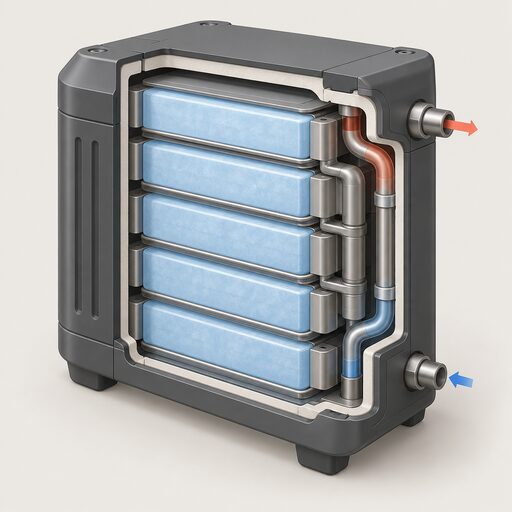 Heat Battery Trials and ResultsDo heat batteries actually work in real UK homes, and what did the trials find?
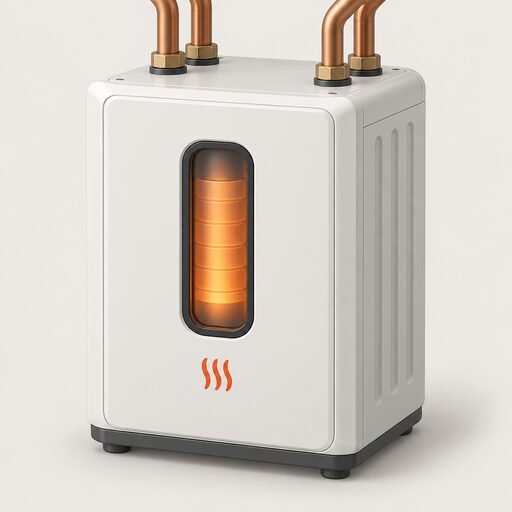 Heat Batteries with Heat PumpsCan a heat battery replace a hot water cylinder if you have no space for one?
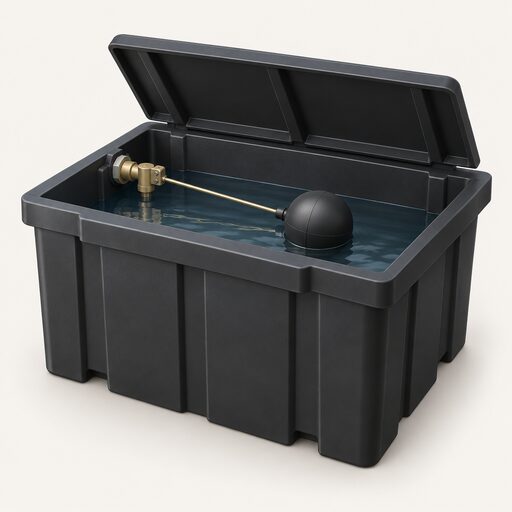 Hot Water CylindersWhich hot water cylinder suits your home, and what is the real difference between a vented one, an unvented one and a thermal store?
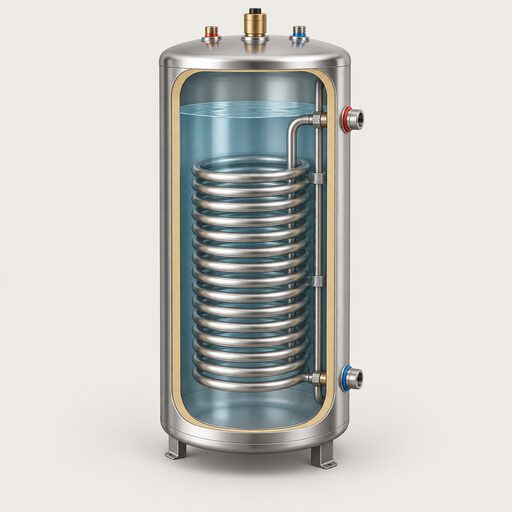 Hot Water Cylinder ManufacturersWhich hot water cylinder brands are actually made in the UK, and which are imported?
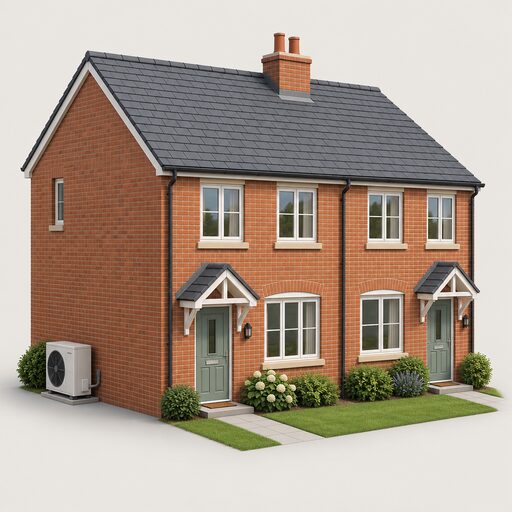 Which Homes Suit a Heat PumpMost UK homes can have a heat pump fitted, so the real question is whether yours makes it easy or expensive.
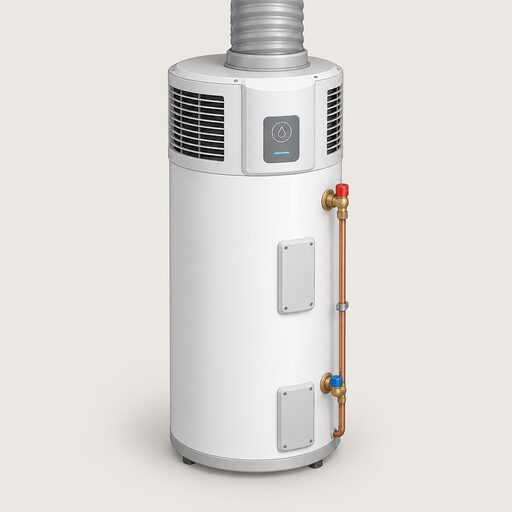 Hot Water Heat PumpsA hot water heat pump heats only the water in your cylinder, using air instead of a boiler flame.