
In this comparison
A heat battery stores energy as heat rather than as electricity, and releases it when hot water or heating is needed. The two names most often put side by side in the UK are Sunamp, which builds its batteries around a patented phase change material called Plentigrade, and Caldera, which builds ceramic heat storage boilers. The storage medium is the real difference between them: one melts and re-solidifies a material to absorb and release heat, the other holds heat in a solid ceramic mass with no change of state1.
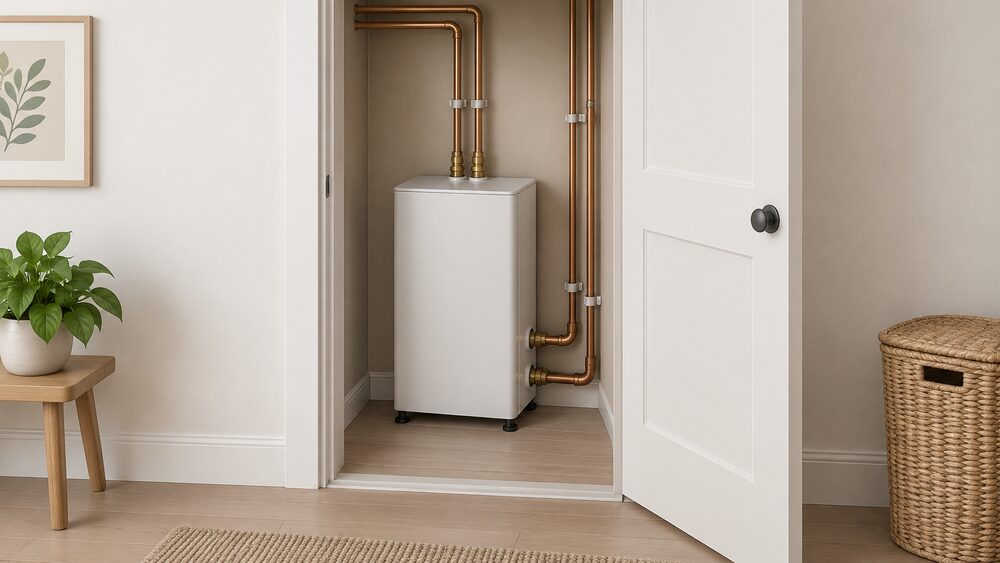
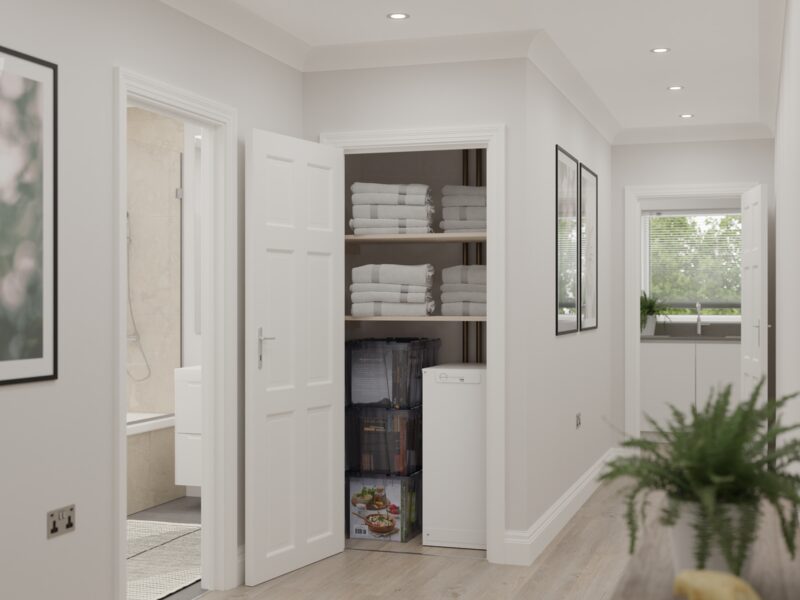
For a household, the appeal is space and timing. Sunamp states that its thermal batteries are up to four times smaller than the hot water cylinders they replace, and that each battery holds less than five litres of water, so there is no large cylinder of hot water standing in a cupboard losing heat3. Independent guidance describes heat batteries as modern energy stores that release heat slowly into the home and are charged up when electricity is cheap5. That combination, small footprint plus off-peak charging, is what makes them interesting to homes that cannot fit a cylinder or an outdoor heat pump unit.
The limits are as firm as the benefits. Heat batteries are not yet eligible for the government's main heat grants, because they cannot be MCS certified under the current standards, and they are currently the only major heating technology that does not qualify for VAT relief6. Costs are quoted by installers rather than published as a single national figure, and the figures that do exist come from the maker and from industry bodies rather than from a scheme.
What a heat battery is and how it stores heat
A heat battery is a thermal store: it takes electricity or surplus heat, converts or moves it into a storage material, and gives it back later as hot water or space heating. Sunamp describes the principle as storing energy as heat and releasing it when and where it is needed, and its Thermino range stores heat rather than electricity, unlike a lithium-ion battery1. Independent guidance from the Energy Saving Trust sets out the same idea in two parts: heat batteries store energy as heat provided by electricity, from the grid or a household's own renewable source, and by surplus heat from a boiler, heat pump or another heating system2.
The charging logic is what makes the technology useful to a household. Sunamp states that its thermal batteries store heat generated when electricity is cheaper and release it when it is needed, which is the same time-shifting behaviour a household gets from a smart tariff, but applied to hot water rather than to a household circuit3. Energy UK describes heat batteries as modern energy stores that release heat slowly into the home and which are charged up when electricity is cheap5.
What the battery does not do is generate heat. It is a store, and it depends on something else to fill it: a heat pump, an immersion element on an off-peak tariff, a solar array, or waste heat from an existing system. That dependence is the first thing to understand about household energy independence with this technology. A heat battery shifts when a home buys its energy, and can absorb self-generated heat that would otherwise be exported or wasted, but it does not remove the need for a heat source or, in most installations, a grid connection.
Two storage types: phase change material or ceramic
The Energy Saving Trust divides heat batteries into two families. One stores heat in a material that changes from a solid to a liquid and back, called phase change materials, or PCM. The other stores heat in a material such as a ceramic where there is no phase change2. Which type a household ends up with is usually decided by which product the installer fits, not by a preference expressed at the quotation stage, but the distinction explains most of the differences in size, weight and behaviour between brands.
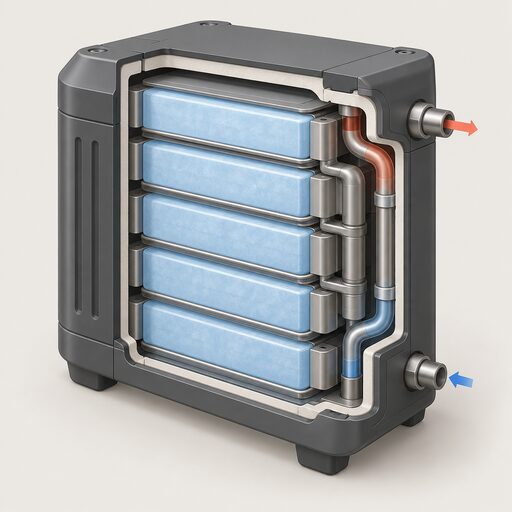
Sunamp's material is branded Plentigrade, described by the maker as patented technology that stores energy in high-performance phase change materials8. The company states that its heat batteries store 4 to 10 times more energy than conventional materials, which is the claim behind the small physical size of a PCM unit10. A ceramic store works differently: it holds heat in the mass of the material and releases it by passing air or water over it, with no melting point to design around.
The practical consequences run in both directions. A PCM battery packs more storage into less space, which matters in a flat or a small house. A ceramic store avoids the engineering questions that come with a material that changes state, and its output is governed by how the stored heat is moved into the water or air circuit. Both types are charged by the same kinds of source, and both are described by independent guidance as able to heat hot water for central heating or taps, with some units usable as a thermal store within a central heating system, typically alongside a heat pump2.
Sunamp vs Caldera: how the two approaches differ
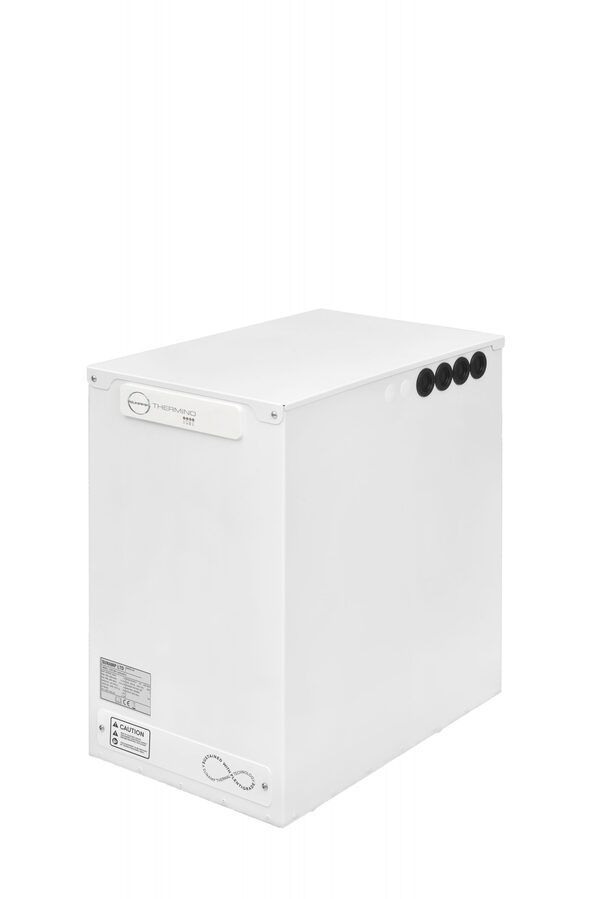
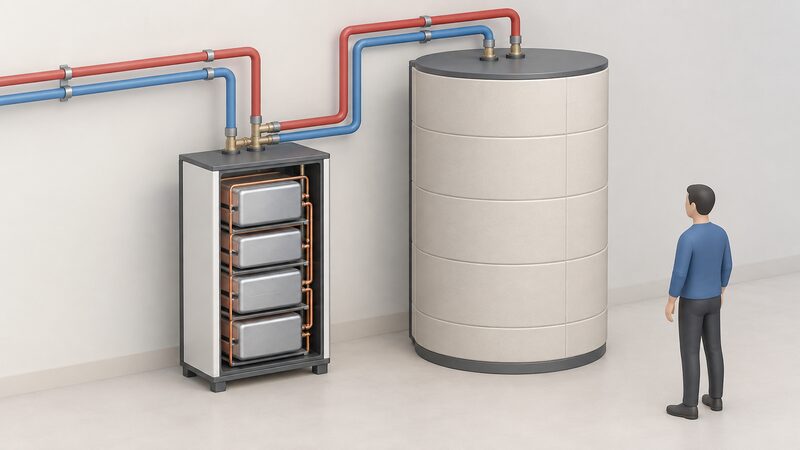
Sunamp builds thermal batteries that store heat for hot water, and positions them as a low carbon, reliable, space-saving alternative to traditional hot water cylinders4. The company's range is modular and scalable, with batteries that can be connected in parallel to increase heat storage capacity, and it is aimed at both retrofit of existing hot water systems and new-build specification4. Sunamp states that its batteries are up to four times smaller than equivalent hot water cylinders, and that the compact size releases storage space in each home, which helps meet mandatory space standards in new developments4.
Caldera's approach is a heat storage boiler built around ceramic storage. The two products therefore sit in slightly different places in a home. A Sunamp battery is most often a direct replacement for the cylinder, serving hot water and, in some configurations, acting as a thermal store for heating. A ceramic heat storage boiler is designed to take on the heating load as well, charging on cheap electricity and releasing heat to the property's emitters.
The comparison a household actually faces is less about the storage material than about what the rest of the system looks like. Where a cylinder is being replaced and the heating is already served by a heat pump or a boiler, a PCM battery slots into the existing arrangement. Where the intention is to move space heating off gas as well, a storage boiler that can carry the heating load is the closer fit. Both approaches share the same constraint: the battery is only as low carbon as the electricity or heat that charges it.
| Sunamp thermal battery | Caldera heat storage boiler | |
|---|---|---|
| Storage medium | Patented phase change material (Plentigrade)8 | Ceramic, no phase change2 |
| Typical role | Hot water, replacing the cylinder4 | Hot water and space heating |
| Size claim | Up to 4 times smaller than the equivalent cylinder4 | Not stated in the same terms |
| Water content | Less than 5 litres per battery3 | Not stated in the same terms |
| Scalability | Modular, can be connected in parallel4 | Not stated in the same terms |
| Stated lifespan | 50+ years for Thermino9 | Not stated in the same terms |
Size and space: up to four times smaller than a cylinder
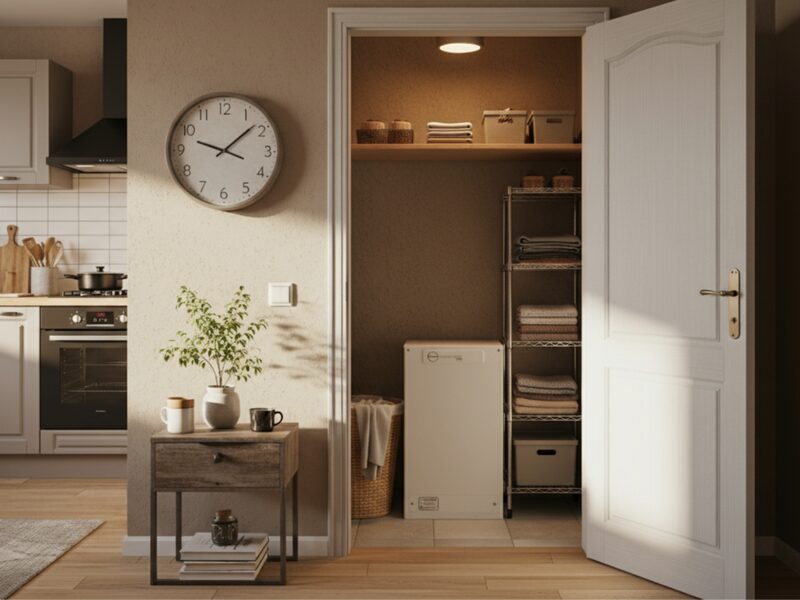
Space is the argument that sells heat batteries, and it is the one with the clearest figures behind it. Sunamp states that its thermal batteries are up to four times smaller than equivalent hot water cylinders, and repeats the claim across its housing pages4. The company also states that each battery holds less than five litres of water, against the 100 to 250 litres a typical domestic cylinder holds, which is why the unit can be fitted neatly in a cupboard3.
Independent sources support the direction of the claim without repeating the multiple. The Energy Saving Trust's case study material quotes a householder describing a heat battery as smaller than a hot water tank, and the Catapult energy systems project on Sunamp notes that the company's range of four battery sizes can be combined to match a property's exact heating requirement13. That modularity matters in small homes: capacity can be added in units rather than by finding floor area for a larger single vessel.
The space saving has a second effect that is easy to miss. Sunamp states that the compact size releases storage space in each home, which helps meet mandatory space standards in new-build developments11. In a flat or a terraced house where the airing cupboard is the only storage in the property, removing the cylinder returns usable space to the household. Independent guidance notes that heat batteries are most suitable for smaller homes that do not have space for an outdoor heat pump unit, which is the same constraint seen from the other side5.
Cost: £1,200 to £3,000 plus installation, and no VAT relief yet
Published prices for heat batteries are thin, and the figures that exist come from different places. Sunamp states that its Thermino heat battery offers a 12 kWh thermal storage capacity for around £3,400 manufacturer's recommended price, that the cost per kWh is approximately £390, and that the installed price can go up to about £4,7009. Industry guidance quoted by the Association for Decentralised Energy puts the market range at £1,200 to £3,000 plus installation, and notes a £2,500 grant figure in the same discussion7. The two sets of numbers are not directly comparable: one is a maker's price for a specific capacity, the other a market range across products and sizes.
The VAT position is the sharper issue. The Association for Decentralised Energy states that heat batteries are currently the only major heating technology that does not qualify for VAT relief7. Official guidance confirms that heating equipment not funded through an energy efficiency grant attracts VAT at 20 per cent15. Where a grant does fund the work, the treatment changes: official guidance on energy-saving products sets out how VAT applies to installations funded through an energy efficiency scheme, including the split between materials and labour15.
For a household, that means the installed cost of a heat battery carries a tax treatment that a heat pump or a solar installation does not. Prices are installer-quoted, and the figures above should be read as the maker's own published numbers and an industry range rather than as a national price. Any quotation should set out the VAT treatment explicitly, because the difference between standard-rated and reduced-rated work on a several-thousand-pound installation is material.
Grants: why heat batteries are not yet eligible for the WH:SHF

Heat batteries are excluded from the government's main domestic heat schemes, and the reason is technical rather than political. Official scheme rules state that heat batteries will not be eligible for the Warm Homes: Social Housing Fund until they can be MCS certified, and that once MCS certified, SAP-eligible heat batteries will be eligible6. The Warm Homes: Local Grant guidance uses the same wording: heat batteries will not be eligible for the WH:LG until they can be MCS certified16.
The certification route is in progress but incomplete. Official scheme rules record that MCS consulted on a Thermal Energy Storage System Standard in March 2025 and announced a pilot in September 20256. No date for a live standard is given in the scheme guidance. For comparison, heat pumps are certified under MCS 007, which is the kind of product standard a heat battery would need an equivalent of before a scheme can recognise it17.
The same guidance explains why phase change material batteries in particular are held back. It states that they cannot currently be installed through the scheme until there is a formally approved convention or they are a formally recognised technology category in SAP16. SAP is the calculation method behind energy performance certificates, so a technology that has no agreed way of being modelled cannot be counted towards a home's assessed performance, and a grant scheme that pays for measured improvement cannot pay for it.
Two related exclusions sit alongside this. Hybrid heat pumps are not eligible for funding under the Home Energy Scotland scheme, and low-carbon communal heating and district heat networks are not currently eligible measures under the Warm Homes: Local Grant because they are not covered by the required quality standards18. A household considering a heat battery should treat grant eligibility as a live question rather than a settled one, and check the position at the point of quotation.
Where a heat battery fits: smaller homes without space for an outdoor unit
The clearest statement of fit comes from independent guidance: heat batteries are most suitable for smaller homes that do not have space for an outdoor heat pump unit5. That is a narrower case than the marketing around the technology sometimes suggests, and it is worth taking literally. A flat, a mid-terrace house with no garden, or a property where the only external wall is a shared or protected elevation may have no practical location for an air source unit.
In those homes, a heat battery changes what is possible. Sunamp states that its thermal batteries enable heat pumps to be installed where they would not normally fit, since hot water cylinders are not required11. The battery takes over the hot water role that a cylinder would have played, and the heat pump, if one is fitted, can be smaller or sited differently. Independent guidance adds that a heat battery needs no outdoor unit and can often work with existing radiators and pipework, which reduces the disruption of a switch away from a cylinder7.
The technology also has a role in new-build and social housing, where space standards and hot water demand are both fixed by regulation. Sunamp's housing pages describe thermal batteries combining with renewables to deliver instant hot water, and the AECB's new-build certification material records a Sunamp thermal battery used for hot water in a certified project4. The Catapult project on Sunamp notes that the range of four battery sizes can be combined to match a property's heating requirement, which is how a developer would size the store to the dwelling rather than to a standard cylinder14.

Running a heat battery with tariffs, heat pumps and the grid
A heat battery's running cost depends almost entirely on when it is charged and what charges it. Independent guidance gives a typical cost of around £1,770 a year for an average home on Economy 7 or an off-peak tariff, and states that heat batteries have a maximum output of around 12,000 kWh a year, similar to the average UK home's heating demand5. The same guidance notes that no reliable data is available on annual savings from heat batteries, which is a caution against treating any savings figure as established20.
Where a heat battery is paired with a heat pump and a smart tariff, the results reported in trials are stronger. Energy Saving Trust research found that in some cases energy bills were reduced by more than 80 per cent compared with a gas-heated home on a standard tariff, when the system was operated on an appropriate tariff21. The same body's work on technology combinations found that batteries are better paired with heat pumps than with solar panels when the aim is savings on an appropriate tariff22. That finding is about electrical batteries, but the logic applies to thermal storage too: the value comes from shifting load into cheap hours, and a heat pump provides a large, flexible load to shift.
Sunamp lists heat pumps, wind and solar, grid and microgrid electricity, waste heat, combined heat and power and boilers among the sources that can charge its thermal batteries1. The Catapult trial describes a system in which a heat pump charges renewable heat into large capacity time-shifting thermal storage, delivering space heating and hot water on demand23. Independent guidance also notes that heat batteries can help balance the electricity grid, which is the system-level version of the same behaviour7.
The dependence that remains is worth stating plainly. A heat battery does not generate energy, does not remove a home's need for a heat source, and in most installations does not remove the grid connection. What it does is decouple the moment a household buys or collects heat from the moment it uses it, which is the part of energy independence a storage device can actually deliver.
Sources23 cited
- How thermal batteries work, Sunamp, 2026
- Storing energy, Energy Saving Trust, 2026
- Thermal batteries for social housing, Sunamp, 2026
- Thermal batteries for housing development, Sunamp, 2026
- Electric heating, Centre for Sustainable Energy, 2026
- Warm Homes: Social Housing Fund wave 3 scheme guidance addendum, Department for Energy Security and Net Zero, 2026
- No home left behind: how to support lower income homes in the heat transition, Association for Decentralised Energy, 2026
- How thermal batteries work, Sunamp, 2026
- Comparing home battery storage: electric batteries vs heat battery, Sunamp, 2025
- How heat batteries work, Sunamp, 2024
- Thermal batteries for public housing, Sunamp, 2026
- Thermal batteries for housing development, Sunamp, 2024
- Michael and Joan's air source heat pump, Energy Saving Trust, 2022
- Our homes net zero toolkit, Energy Systems Catapult, 2025
- Tax on shopping: energy-saving products, HM Revenue and Customs, 2026
- Warm Homes: Local Grant policy guidance, Department for Energy Security and Net Zero, 2026
- MCS microgeneration certification, BSI, 2026
- Funding: grants and loans, Home Energy Scotland, 2026
- New build house certification, AECB, 2025
- Clean heat: supporting low income households, Energy UK, 2026
- Supporting households with low carbon technology combinations, Energy Saving Trust, 2026
- Renewable technologies: what really cuts energy bills, Energy Saving Trust, 2026
- Sunamp heat batteries, Energy Systems Catapult, 2025
 Heat Batteries with Heat PumpsCan a heat battery replace a hot water cylinder if you have no space for one?
 Heat Battery Trials and ResultsDo heat batteries actually work in real UK homes, and what did the trials find?
 Heat Batteries and Zero EmissionA heat battery stores cheap overnight electricity as heat, then releases it to warm your home or your hot water.
 Hot Water CylindersWhich hot water cylinder suits your home, and what is the real difference between a vented one, an unvented one and a thermal store?
 Hot Water Heat PumpsA hot water heat pump heats only the water in your cylinder, using air instead of a boiler flame.
 Which Homes Suit a Heat PumpMost UK homes can have a heat pump fitted, so the real question is whether yours makes it easy or expensive.