
In this guide
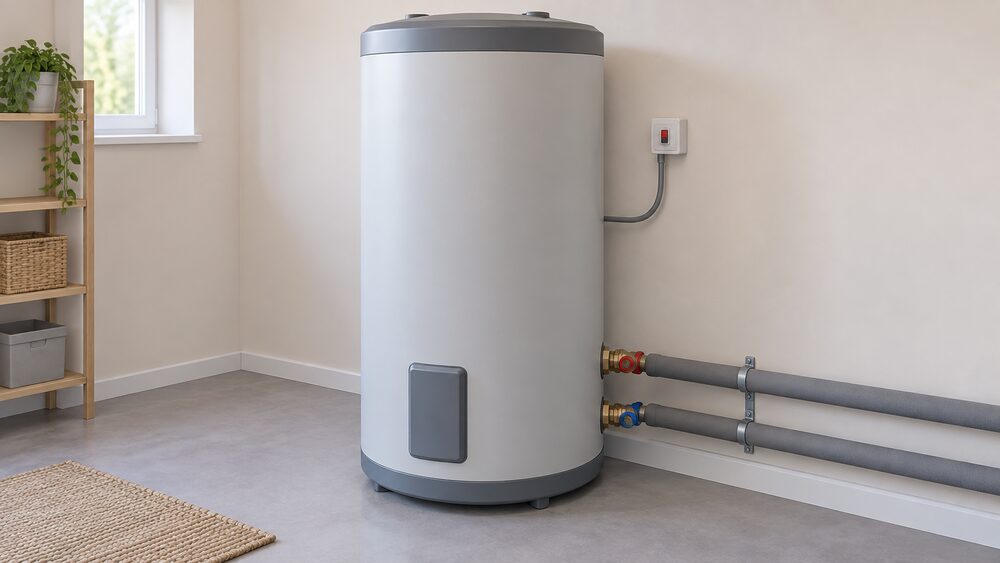
Caldera is a British start-up, based in Hampshire, that makes a heat storage boiler rather than a gas boiler. Its store is a solid material made from volcanic rock and recycled aluminium, heated with electricity and drawn down later as heat for space heating and hot water. The unit the company has tested most widely is a 100 kWh thermal store, first built as a prototype in 2019 and fitted in homes from 20201.
The development path runs from a single prototype to commercial scale. Caldera was founded in 2017 by James Macnaghten and Guy Winstanley, created its heat storage material in 2018, and combined vacuum insulation with heat extraction systems in the 100 kWh prototype in 20191. It has since won £0.8m and then £4.3m in UK government funding, taken £10m in Series A investment from GEA Group in 2025, and received a first order for a 10 MWh Storage Boiler from an NHS hospital1.
For a household, the appeal is a boiler that stores heat rather than burning gas on demand, which shifts the fuel from the gas grid to electricity and makes the timing of that electricity a choice rather than a consequence. The dependence that remains is on the electricity grid, on a supplier, and on a young company whose domestic product is not yet a mass-market appliance.
What Caldera makes: a heat storage boiler, not a gas boiler
The distinction matters because the word boiler carries a set of expectations that do not apply here. A combi boiler produces hot water on demand and uses no cylinder at all: all the heat and hot water comes directly from the boiler itself3. A system boiler does the central heating but heats a quantity of water held in a storage cylinder until it is required4. A heat-only boiler adds two header tanks to store cold water, usually in the loft3. Caldera's product belongs to a different family again: it stores heat in a solid material and releases it later, with no combustion and no flue.
That places it closer to a thermal store than to a gas appliance. Thermal stores are usually large, well-insulated cylinders, often called buffer or accumulator tanks, and they typically serve two or more functions: providing hot water, storing heat from a solar thermal system or biomass boiler, acting as a buffer for heat pumps, storing heat from multiple sources, and heating water through an immersion heater fed by a diverter5. They have proved to work particularly well with wood-fuelled biomass boilers, heat pumps, wind energy and solar water heating systems, and can also be used with a conventional boiler or immersion heater5.
Caldera's version replaces the water with a solid store. The practical consequences are the ones a household would notice: no gas connection, no flue, no annual gas safety check, and a heat store that can be charged when electricity is cheap or plentiful. The trade is that the store has to be sized to the home's daily heat demand, and the heat has to be extracted at a usable temperature. More on how these stores compare with cylinders is at heat battery vs hot water cylinder, and the wider category is covered under phase-change materials for heat storage.
How the storage works: volcanic rock and recycled aluminium
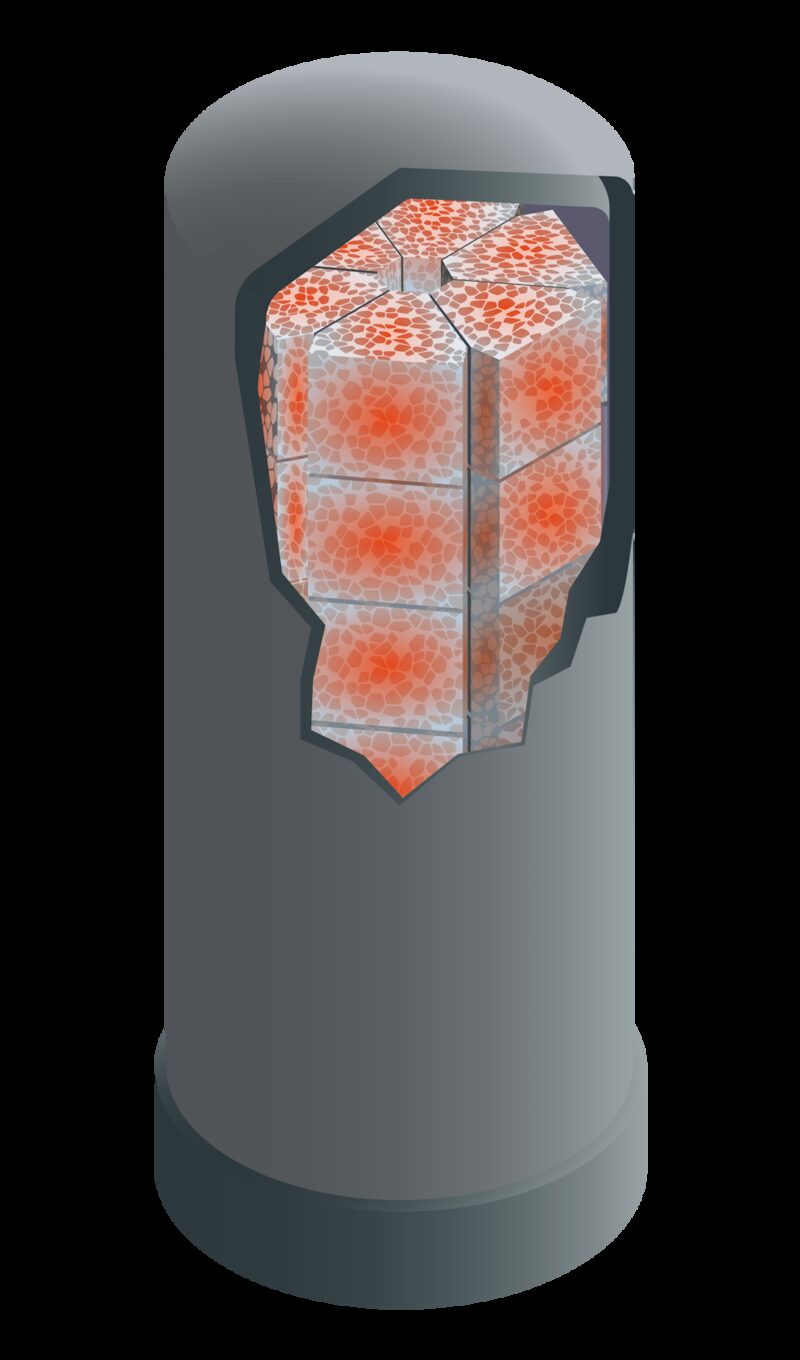
Caldera states it was the first in the world to create a heat storage material using volcanic rocks and recycled aluminium, in 20181. That is the company's own claim about its own material, and it is the only description of the store's composition available. What can be said with more confidence is how the approach differs from the storage technologies already in UK homes.
Electric storage heaters store heat inside their core, which is often made from heavy clay blocks, and high heat retention models are well insulated and have automated controls6. Night storage heaters use electricity to heat ceramic or clay bricks overnight, then release the heat the following day7. The principle is the same in each case: heat a dense material when electricity is available, insulate it well, and draw the heat out later. Caldera's material is denser and its insulation is a vacuum rather than a conventional jacket, which is what allows a smaller unit to hold more heat.
The comparison with water is the useful one for a householder. A 300 litre thermal storage unit usually comes with an energy storage capacity of approximately 22.5 kWhth9. Wood-fuelled thermal stores typically hold between 500 and 5,000 litres of water and can store hot water for days if properly insulated5. Caldera's 100 kWh unit therefore sits in a different bracket from a domestic hot water cylinder, holding several times the heat of a 300 litre store in a footprint the company has been able to install in ordinary homes1.
Capacity and insulation: the 100 kWh unit and how heat is extracted
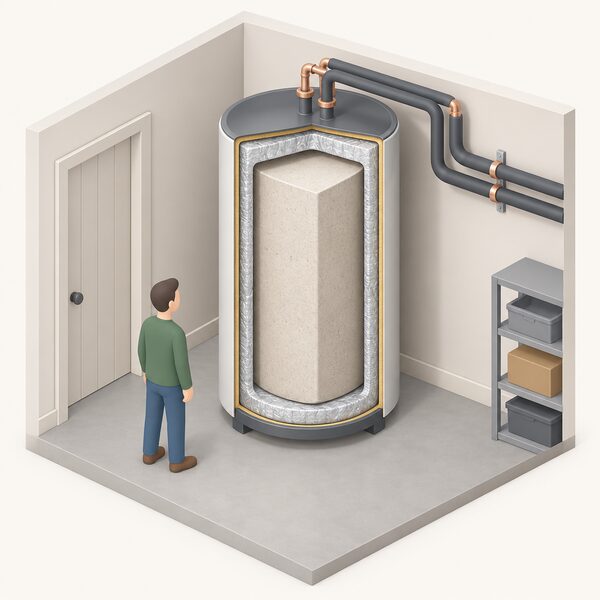
The 100 kWh figure is the one to hold on to, because it is the unit Caldera built, tested and installed in homes. It was combined in 2019 when the company invented its vacuum insulation and heat extraction systems, and the first unit went into the chief executive's home in 20201. Ten more followed on long-term test in homes and a church from 20221.
For scale, a domestic gas boiler's size is its heat output, measured in kilowatts10. A 100 kWh store is a capacity, not an output: it describes how much heat can be held, not how fast it can be delivered. The extraction system is what determines the latter, and Caldera's approach is to draw heat out of the solid core rather than circulate water through a tank.
Insulation is the other half of the design. High heat retention storage heaters are described as well insulated precisely because standing losses decide whether overnight charging pays off6. Vacuum insulation is the mechanism Caldera uses to keep those losses down in a smaller unit, and it is the part of the design the company identifies as its own invention1.
The capacity ladder now runs from that domestic unit upward. Caldera demonstrated a 4 MWh industrial storage boiler under its 2023 funding, and took a first order for a 10 MWh Storage Boiler from an NHS hospital in 20251. The domestic product is the small end of a range that scales by adding storage volume rather than by changing the principle.
Development path: from prototype to first installation
The timeline is unusually well documented for a young hardware company, and it reads as a sequence of funded steps rather than a single launch.
- 2017: Caldera is founded by James Macnaghten and Guy Winstanley to pave the way for sustainable and affordable energy storage1.
- 2018: the first heat storage material, using volcanic rocks and recycled aluminium, is created1.
- 2019: vacuum insulation and heat extraction systems are invented and combined in a 100 kWh prototype1.
- 2020: the first 100 kWh unit is fitted in the chief executive's home1.
- 2022: £0.8m in UK government funding is awarded, and ten 100 kWh units go on long-term test in homes and a church1.
- 2023: £4.3m in UK government funding is won for a follow-on project, developing a full-scale test facility and demonstrating a 4 MWh industrial storage boiler1.
- 2025: £10m Series A investment from GEA Group is secured, and the first order for a 10 MWh Storage Boiler arrives from an NHS hospital1.
The pattern is common to early-stage energy hardware: grant-funded prototypes, then a small fleet in real homes, then a larger demonstration, then a first commercial customer. What it does not yet show is a domestic product in volume production with a published price, a warranty term or an installer network. A householder specifying one today is buying into a development programme rather than a catalogue item, and the questions worth asking are covered under buying pre-production and crowdfunded energy products and cost of early adopter energy technology.
Funding and backing: UK government grants and the GEA investment
Caldera's public funding is separate from the domestic grant schemes a householder might recognise. The Boiler Upgrade Scheme provides upfront capital grants to support the installation of heat pumps and biomass boilers in homes and non-domestic buildings, with grants of £5,000 and up to £7,500 under a £2.7bn investment in grants11. It operates in England and Wales, and the government confirmed funding for further years up to 2029/30 through the Warm Homes Plan in January 202613. None of that money goes to a storage boiler: the scheme is for heat pumps and biomass boilers, with £5,000 for biomass boilers in limited circumstances15.
The £0.8m and £4.3m Caldera received are innovation awards for developing the technology, not installation grants for householders1. That distinction is worth holding on to, because a company with government development funding is not the same as a product eligible for a government installation grant. Whether heat batteries could ever join the Boiler Upgrade Scheme is a separate question, examined at heat batteries and the Boiler Upgrade Scheme.
The commercial backing is GEA Group, which invested in Caldera in March 2025, bringing together GEA's process and heating expertise with Caldera's electric Storage Boilers2. The £10m Series A is the largest single investment disclosed1. GEA is an established process engineering business rather than a domestic heating brand, which suggests the industrial end of the range, the 4 MWh and 10 MWh units, is where the near-term commercial case sits. For a householder, that matters: the domestic product is the one furthest from volume production, and the funding is weighted toward larger installations.
Where it is being used: the NHS hospital order and early deployments
The first order for a 10 MWh Storage Boiler came from an NHS hospital in 20251. That is the largest deployment disclosed and the first commercial-scale one. Before it, the fleet was small and domestic: one unit in the chief executive's home from 2020, then ten 100 kWh units on long-term test in homes and a church from 20221.
Hospitals are a natural early site for a heat store. They have large, steady heat demand, plant rooms with space for a storage vessel, and electricity loads that can be shifted. The same logic applies to other large buildings, and it is the reason the industrial units have moved first. A domestic installation has to fit a house, meet a household's hot water pattern, and be serviced by someone the householder can call.
The hybrid model is the closest familiar arrangement. In a hybrid heating system, a gas boiler supports during colder weather or when extra heat or hot water is needed, with the heat pump doing the work whenever possible16. A storage boiler in a home would sit in a similar relationship to an existing system during any transition, though Caldera's product is designed to replace the heat source rather than supplement it. The evidence base for heat batteries in UK homes more generally is set out at heat battery trials and field results.
What a British start-up in Hampshire means for UK energy independence
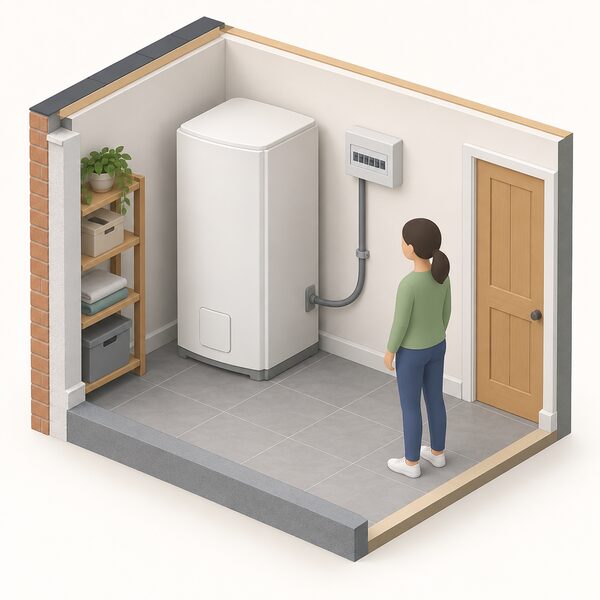
A domestic heat store made in Britain changes where a household's heating dependence sits. A gas boiler ties a home to the gas grid, to a gas supplier and to imported gas. A storage boiler ties it to the electricity grid and to an electricity supplier, but it also lets the household choose when to draw that electricity, which is the part a gas boiler cannot do at all.
The manufacturing base is part of the argument. Caldera is a British start-up based in Hampshire, and its development work, government funding and first commercial order are all UK-based1. That keeps the engineering, the intellectual property and the supply chain closer to the homes using the product than an imported appliance would. It does not make the household independent of the grid: the store is charged from mains electricity, and a power cut leaves it with whatever heat it already holds and no way to recharge.
The honest position is that a storage boiler shifts dependence rather than removing it. It removes the gas connection and the flue, and with them the exposure to gas prices and to the standing charge that comes with a gas meter. It adds a dependence on electricity prices, on the tariff the household is on, and on a young company's ability to support the product over its life. The wider picture of what emerging technology can and cannot do for a household's independence is at emerging technology and household energy independence, and the risks specific to young manufacturers are at energy technology company failures.
What owning a storage boiler means for a household
The practical case rests on three things: what the unit costs, how it is installed, and what happens when it goes wrong. On cost, there is no published price for a Caldera domestic unit, and prices for this class of product are quoted per installation rather than listed. Storage combi boilers are typically cheaper and less expensive to install than a system or heat-only boiler, because everything is built in18. That is a general comparison, not a Caldera figure, and it points the right way: a unit with no flue and no gas connection has less installation work around it than a gas boiler swap.
Installation practice for heat stores is not yet standardised in the way gas boiler work is. Gas boiler commissioning is expected to follow the manufacturer's instructions and BS 7593: 2019 for boiler or hot water storage system commissioning19. A solid-store appliance would need its own commissioning and servicing regime, and no such regime is published for Caldera's domestic unit.
The dependence that remains is worth stating plainly. The store runs on electricity from the grid, so the household still needs a supplier and a connection. It needs the manufacturer to remain solvent and to keep supporting the product, which is a real risk for a company at this stage. And it needs someone qualified to install and maintain it, which in the absence of a certification scheme means relying on the maker. What it does not need is a gas connection, a flue, or an annual gas safety check. For a household weighing independence, that is a genuine change in the fuel and in the timing, and not a severing of the link to the network.
Sources19 cited
- About Caldera, Caldera, 2026
- Caldera, Caldera, 2025
- Boilers, Energy Saving Trust, 2026
- Upgrading and replacing your boiler, Centre for Sustainable Energy, 2026
- Thermal energy stores, Energy Saving Trust, 2025
- Electric storage heaters, Energy Saving Trust, 2026
- Night storage heaters, Centre for Sustainable Energy, 2025
- Electric heaters vs storage heaters, Energy Helpline, 2026
- Thermal energy storage, Solar Heat Europe, 2025
- Boiler energy efficiency, Which?, 2025
- Notice of approved grant categories and values for the Boiler Upgrade Scheme, GOV.UK, 2026
- Reforming consumer protection for home upgrade schemes, GOV.UK, 2026
- £5 million to help Welsh households invest in greener homes, Welsh Government, 2026
- Boiler Upgrade Scheme statistics, July 2026, DESNZ, 2026
- Boiler Upgrade Scheme leaflet, GOV.UK, 2022
- Hybrid boilers, HIES, 2022
- Hybrid heating, Cadent Gas, 2026
- What are the different types of boiler, Which?, 2025
- Domestic Building Services Compliance Guide, Scottish Government, 2021