In this guide
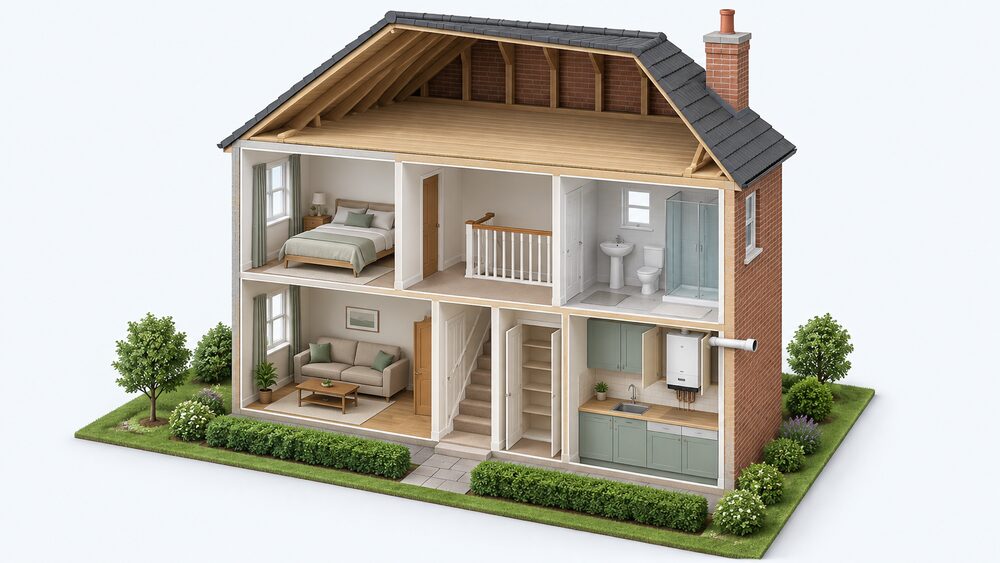
A combi, or combination, boiler is a single domestic appliance that produces both central heating and hot water1. It combines a high efficiency water heater and a central heating boiler in one compact unit, and because it heats water on demand straight from the cold mains it needs no hot water cylinder and no cold water storage tank in the loft2. That one design decision explains almost everything else about a combi: its small footprint, its lower installation cost, its dependence on the incoming mains, and the point at which it runs out of capacity.
Combis are the most common boiler type in UK homes and the default in new build. The trade off is capacity. Hot water is limited by what the boiler can heat as it passes through, so a combi comfortably serves one shower at a time and is generally unsuited to homes with several bathrooms in simultaneous use or with weak mains pressure3. Where those conditions apply, a system boiler or a regular boiler with stored hot water is the usual answer.
On cost and efficiency, a typical installed price of £2,400 to £3,200 has been quoted for a combi in 20264, and turning the heating flow temperature down to 60C or below has been reported to save an average of £112 a year on a combi5. Expect a service life of roughly 10 to 15 years6.
What a combi boiler is: heating and hot water from one unit
A combi produces all of a home's heat and hot water from within one appliance, without storing water in a cylinder or tank1. It is a wall hung unit, and on gas it is the only type of condensing boiler that delivers both central heating and instant hot water in one package. Hot water is not stored and reheated; it is made at the moment a tap or shower is opened.
That has a practical consequence for controls. A combi does not need a hot water timer, because water is heated on demand, though the central heating side remains programmable in the normal way. Because water is made on demand, the boiler will fire whenever hot water is drawn, including outside the programmed heating schedule, and some models keep a small reservoir of preheated water and may fire briefly through the day to maintain it10.
Combis are described by makers as stand alone units suited to small and medium sized homes11, and by the Energy Saving Trust as a more efficient choice for smaller households, since heat and hot water come directly from the boiler with no cylinder to keep warm3. For a household thinking about energy independence, the important point is what a combi does not give you: there is no store of hot water. When the gas supply, the electricity supply or the boiler itself stops, hot water stops within seconds, where a cylinder would have held a tankful.
How a combi works: water heated on demand from the mains
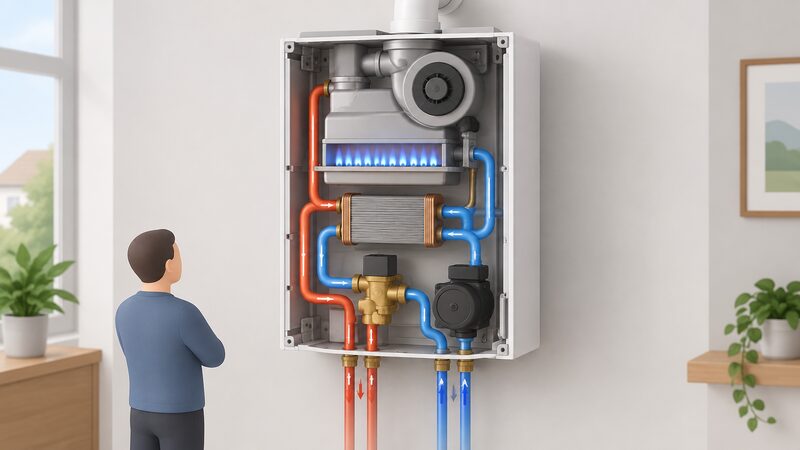
When a hot tap is opened or the room thermostat calls for heat, the boiler detects the demand and starts heating water directly from the mains12. On the hot water side, incoming mains water is passed over a heat exchanger containing freshly heated water circulating the other way, so the cold mains supply is raised to temperature as it flows through and goes straight to the tap or shower13. Priority is given to hot water: while a tap is running, the radiator circuit pauses.
Because the water comes from the mains and is delivered at mains pressure, a combi can give a strong shower without a separate pump2. The flip side is that flow rate at the tap is set by the incoming mains, not by the boiler. Two things therefore limit performance: how much water the mains will deliver, and how much heat the boiler can add to it per minute. Open a second outlet and the boiler splits the available flow between them, which slows both14.
Most modern combis are condensing appliances, recovering heat from flue gases that would otherwise be lost, and they are designed to use less energy through the heating cycle. More detail on that mechanism sits on the condensing boilers page. Safety controls are built in: a combi should shut down automatically if it detects a drop in mains pressure or if system temperature rises too far.
No cylinder, no loft tank: what a combi frees up
Because there is no need for a tank in the loft or a hot water storage cylinder, a combi needs less pipework, which saves time and money at installation13. The space effect is the one householders notice: an airing cupboard released, and a loft with no water tanks in it, which makes conversion easier2. Makers describe combis as ideal where there is little or no loft space2.
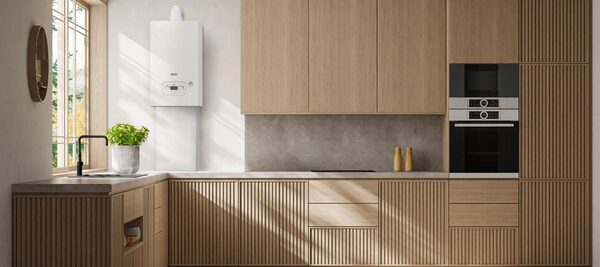
The unit itself is compact enough that combis often fit inside a standard kitchen cupboard, which gives them the most siting flexibility of the three boiler types16. Against this, everything is concentrated in one appliance: there are more moving parts than in a heat only boiler17, and a single failure takes out both heating and hot water at once. Losing the cylinder also closes off options, which matters for anyone planning ahead. Solar thermal and most heat pumps need somewhere to put the heat they make, and that somewhere is a hot water cylinder.
Combi, system or regular: which fits which home
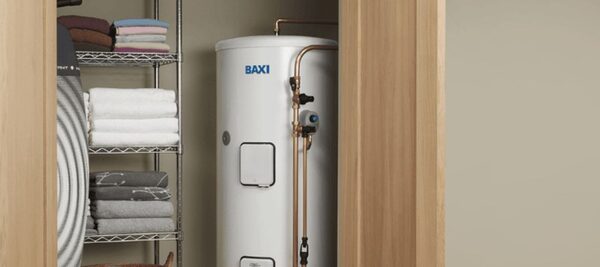
The three types differ chiefly in where hot water lives.
| Type | Hot water | Storage needed | Typically suited to |
|---|---|---|---|
| Combi | Heated on demand from the mains12 | None2 | Small to medium homes, one bathroom11 |
| System | Stored in a cylinder | Hot water cylinder | Larger homes, higher simultaneous demand16 |
| Regular (heat only) | Stored in a cylinder, fed from a tank | Cylinder plus cold water tank in the loft11 | Older systems and larger homes needing more hot water11 |
Regular boilers come with a cold water tank and a hot water cylinder, so they take up more space, work well with older heating systems and suit larger homes needing more hot water11. System boilers and heat only boilers need more room and more pipework than a combi16. Larger households with multiple bathrooms and occupants are, as a general rule given by makers, better served by a system or heat only boiler.
Direction of travel matters on cost. Moving from a conventional system towards a system or combi boiler usually allows most of the existing hardware to be reused, giving a lower cost replacement18. Going the other way, reinstating tanks and a cylinder, is the expensive move. Combis are generally cheaper to run than comparable regular or system boilers, because they only heat what is needed19, and they are often the least expensive kind of boiler to buy3. Regular boilers do not cope well with high demand from multiple taps or showers when converted to combi operation, which is the reason the choice is driven by bathrooms rather than by preference20.
Sizing the output: 24 to 27kW, 28 to 34kW or higher
Combi output is sized on hot water demand as much as on heat loss, because the boiler must raise mains water to temperature as it flows. Published maker guidance clusters as follows.
| Home | Radiators | Bathrooms | Suggested output |
|---|---|---|---|
| 1 to 2 bedrooms | 0 to 10 | 1 | 24 to 27kW7 |
| Flat or 2 to 3 bedrooms | up to 10 | 1 | 24 to 30kW21 |
| Typical 3 bedrooms | up to 12 | 1 | 28 to 32kW21 |
| 3 to 4 bedrooms | 10 or more | 2 to 3 | 28 to 34kW7 |
A 3 bedroom property with one bathroom is often specified at 28 to 34kW16. Another maker guide frames it by radiator count: up to 10 radiators, 24 to 27kW, noting that a 12kW boiler will run only around 10 radiators while a 30kW boiler will heat up to 15 or more22. The ranges differ because each maker weights radiator count, bathroom count and hot water flow differently; they overlap enough that a single bathroom home with ten radiators lands in the mid to high twenties in kW on every version.
Products are sold in steps rather than continuously. The Ideal Vogue MAX Combi is offered in 26kW, 32kW and 40kW outputs23, and the Ideal Logic+ Combi as 24kW, 30kW and 35kW models24. Larger 30kW or 32kW combis are described as working best in homes with high hot water demand9. Oversizing is not free: a boiler far above the heat loss of the house will cycle on and off in mild weather. The boiler sizing page sets out how a proper heat loss calculation is done.
Where a combi falls short: multiple bathrooms and weak mains pressure
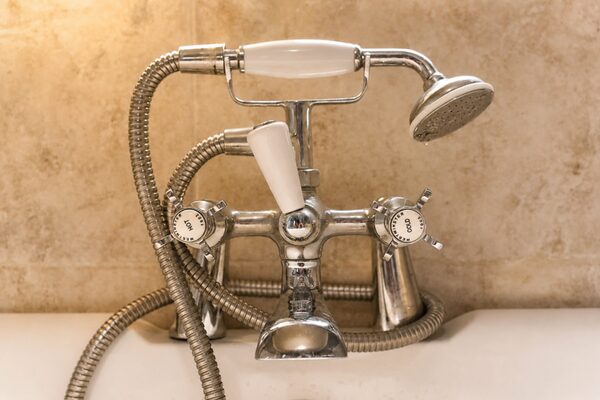
Two conditions rule a combi out, and both are about water rather than heat.
- More than one bathroom in simultaneous use. A combi comfortably powers one shower at a time25, and standard combis cannot supply hot water to several showers at once26. Makers do not recommend running two, because it weakens pressure and can contribute to breakdown25. With several outlets open the boiler splits the flow rate between them and everything slows14. Running a bath and a shower together produces a noticeable drop.
- Low incoming mains pressure. A combi uses the mains pressure it is given19. Where mains pressure is low, or there is more than one bathroom, makers point towards a system boiler instead13. Combis are reported as less effective in larger homes and in areas with lower water pressure, and the Energy Saving Trust lists houses with multiple bathrooms, higher hot water demand or low water pressure as less suitable3.
Because pressure falls as more outlets are used at once, good mains pressure is a precondition, and where it is poor a mains booster or accumulator may be needed26. A shower pump is not an option: it cannot be fitted to a combi, because the boiler must take water directly from the mains27. Power showers, which use an in-built pump connected to a cylinder, are incompatible for the same reason25. Combis do suit mains pressure balanced or thermostatically controlled showers, and thermostatic mixer, digital and electric showers25.
Efficiency: the flow temperature setting does most of the work
A combi is most efficient when the central heating flow temperature is around 55 to 60C, because that is what puts it into condensing mode29. Condensing combis are commonly supplied set well above that point, so the setting found on an existing boiler is often higher than it needs to be. Turning the flow temperature down is the single change with the best evidence behind it.
The reported saving varies from source to source. SGN states that turning a combi's flow temperature to 60C or below could save an average of £112 a year5. Separate analysis puts the figure at £65 a year for the average household8. Boiler statistics published in January 2024 model the change as saving 10.1 TWh a year across the UK, worth £1bn a year, and cutting the average household bill by 8 per cent30. The figures differ because they assume different house types, fuel prices and baseline settings; the direction of the effect is consistent across all of them.
Hot water is a separate control from the heating flow. Reducing the hot water temperature on combis is modelled as saving 4.1 TWh a year nationally, £0.4bn, and 2.1 per cent off the average bill30. Baxi's own instruction for a condensing combi is to turn the dial down so the display reads 55 degrees, at which the boiler is at its most efficient31. Set hot water too low and it may simply not feel hot at the tap. A fuller treatment sits on the boiler flow temperature page.
"Combi boilers run most efficiently with a flow temperature of 60°C or below"
Cost: typically £2,400 to £3,200 installed
A 2026 figure for a combi puts the typical installed cost at £2,400 to £3,2004. Wider ranges are published because the same job varies enormously with pipework, flue position, and whether a cylinder and tanks are being stripped out. One independent guide gives £1,650 to £6,000 for a gas combi, and the same range for a gas combi storage boiler aimed at larger properties that lack space for separate storage32. Boiler statistics from January 2024 give an average gas combi cost of £2,400 excluding VAT30. A national installer quoted prices starting from £2,474 for an all in one combi installation33.
| Source and date | Figure | Basis |
|---|---|---|
| Distributor, June 2026 | £2,400 to £3,200 | Typical installed cost4 |
| Independent, 2026 | £1,650 to £6,000 | Gas combi installed range32 |
| Independent statistics, January 2024 | £2,400 | Average gas combi, excluding VAT30 |
| Installer, 2026 | from £2,474 | All in one combi installation33 |
An oil combi is separately costed at £2,025 to £2,825 for the appliance, with an average total of £3,67530. Where a price is not published, it is installer quoted and will depend on survey. Figures should be checked for VAT position before comparison, and a conversion from a cylinder based system to a combi carries extra work. The new boiler cost page carries the wider picture, and grant support differs across England, Scotland, Wales and Northern Ireland.
Lifespan and servicing: 10 to 15 years, up to 20 with care
A combi should last around 10 to 15 years, the same range as system and regular boilers6. Maker guidance is consistent: modern combis, well maintained, have a similar lifespan to other types at around 10 to 15 years, and many state up to 15 years depending on model and use. Intergas puts a well maintained, annually serviced combi at 15 to 20 years, and says some reach 20 years, though it makes that conditional9:
"In some cases, combi boilers can last up to 20 years, but this depends on installation quality, annual servicing and system water quality"
Those three conditions are the whole of the difference between the lower and upper figures. Installation quality and system water quality are set once; annual servicing is the recurring part. Dirty system water damages the plate heat exchanger that a combi relies on for instantaneous hot water, which is why water treatment matters more on a combi than on a boiler that only serves radiators. See boiler servicing and maintenance and boiler lifespan for the detail, and boiler warranties for the registration conditions that most guarantees attach.
Pressure, leaks and what goes wrong
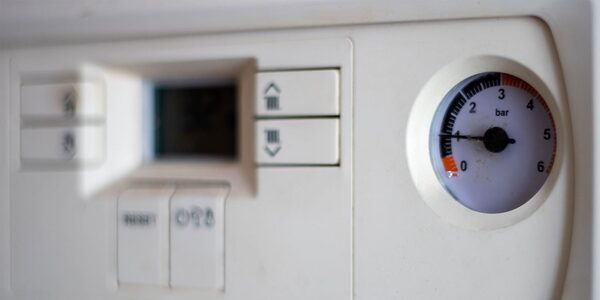
A combi operates on a sealed, pressurised system. Maker guidance places normal pressure between 1 and 1.5 bar with the central heating off, with the specific model's manual as the authority34. Below 1 bar may indicate a leak or a fault, and the system may need re-pressurising, usually by opening a filling valve.
The common causes of pressure loss are water escaping through small leaks in pipes, radiators or valves, and air or water released when bleeding a radiator34. A faulty expansion vessel or pressure relief valve can also be responsible, as can adding too much water through the filling loop during a top up, which raises pressure and can cause a leak in turn. A boiler that needs topping up repeatedly has a fault rather than a habit. The boiler pressure page covers the normal range and topping up, and common boiler faults covers the codes.
Combi boilers and the future: heat pumps, solar thermal and phase out
Combi boilers are still available for sale and there is no current date for a ban in the UK, so they remain available for the foreseeable future37. Gas boilers are not being banned outright: they are being very gradually phased out, starting with new properties37. The gas boiler ban and Future Homes Standard pages set out what is actually proposed.
The practical question for a household is what choosing a combi now forecloses. Few combi models work with solar thermal, because they are not designed to heat water in a cylinder; adding solar water heating is likely to mean installing a solar cylinder and replacing the combi with a conventional boiler or a heat pump38. The Energy Saving Trust makes the same point about heat pumps: switching to a combi now may mean putting a cylinder back in later if a heat pump is wanted, though it notes combis can be adapted for solar water heating3.
Intermediate routes exist. Hybrid systems combine a heat pump and a gas boiler in a single heating system39, with the boiler covering remaining demand. Heat batteries and zero emission boilers are presented as a replacement for a gas combi in a suitable home. Newer combis are being built with larger stainless steel heat exchangers, pre-heat capability and in some cases built-in thermal stores28.
On independence, a mains gas combi leaves a household dependent on three things at once: the gas network, an electricity supply for the controls, and a supplier for both. It removes no dependency except loft space. What it does offer is efficiency on the fuel it burns, and the flow temperature setting is the lever a household actually controls. See home heating and energy independence and the wider guide at /boilers-heating/.
Sources39 cited
- What does a pressure relief valve do, Vaillant, 2026
- Boilers explained, Worcester Bosch, 2026-09-17
- Boilers advice, Energy Saving Trust, 2026-05-20
- Best combi boilers, iHeat, 2026-06-30
- Reducing your energy usage, SGN, 2026
- How long does a boiler last, Uswitch, 2024-11-13
- What size boiler do I need, Vaillant, 2026
- Energy saving statistics, Uswitch, 2025-07-16
- How long do combi boilers last, Intergas Heating, 2026-04-23
- Setting a boiler timer, E.ON Next, 2026-09-17
- How to choose a boiler, E.ON Next, 2026-09-17
- What is a combi boiler, Ideal Heating, 2026-09-17
- How does a combi boiler work, Baxi, 2026-09-17
- Understanding how a combi boiler works, Baxi, 2026-08-05
- Combi boilers, Baxi, 2026-09-17
- Choosing a new boiler, Ideal Heating, 2026-09-17
- Types of boiler systems, Intergas Heating, 2025-12-18
- Back boiler replacement guide, Ideal Heating, 2026-09-17
- Combi boilers, E.ON Next, 2026-09-17
- Regular boilers, E.ON Next, 2026-09-17
- What size combi boiler do I need, Intergas Heating, 2026-01-22
- Guide on what size boiler do I need, E.ON Next, 2026-09-17
- Vogue MAX Combi, Ideal Heating, 2026-09-17
- Logic+ Combi, Ideal Heating, 2026-09-17
- Are combi boilers best for showers, Ideal Heating, 2026
- What is a combi boiler, Navien, 2023-10-16
- How to increase water pressure in a shower with a combi boiler, Vaillant, 2026
- Maximising hot water, Navien, 2025-09-26
- Boiler flow temperature, Smart Energy GB, 2026-04-22
- Boiler statistics, Uswitch, 2024-01-04
- How to turn down the flow temperature of your boiler, Baxi, 2026-09-17
- Different boiler types, Uswitch, 2026-09
- Boiler cost, E.ON Next, 2026-09-17
- Boiler pressure: everything you need to know, EDF, 2026-09-17
- Why is my boiler losing pressure, Vaillant, 2026
- Power cuts, SGN, 2026
- Are combi boilers being phased out, Intergas Heating, 2026-02-18
- Solar water heating, Energy Saving Trust, 2026-05-20
- Hybrid heat pumps, SGN, 2026
 System Boilers ExplainedA system boiler heats your radiators and stores hot water in a separate cylinder, so several taps and showers can run at once.
 Hybrid Heat PumpsHow hybrid systems pair a heat pump with a gas, oil or LPG boiler, what decides which appliance runs, what they cost, how much gas they displace, and why the Boiler Upgrade Scheme will not fund them.
 Electric BoilersHow electric flow boilers heat a conventional wet system, what they cost to buy and run, where they suit UK homes, and why point-of-use efficiency near 99% does not translate into cheap heating at the meter.
 Air-to-Water Wet SystemsAir-to-water heat pumps feed radiators, underfloor heating and a hot water cylinder, and are the most common domestic heat pump in the UK.
 The Full Boilers and Heating GuideWhich boiler suits your home, and when is it worth swapping the old one?
 Which Homes Suit a Heat PumpMost UK homes can have a heat pump fitted, so the real question is whether yours makes it easy or expensive.