
In this guide
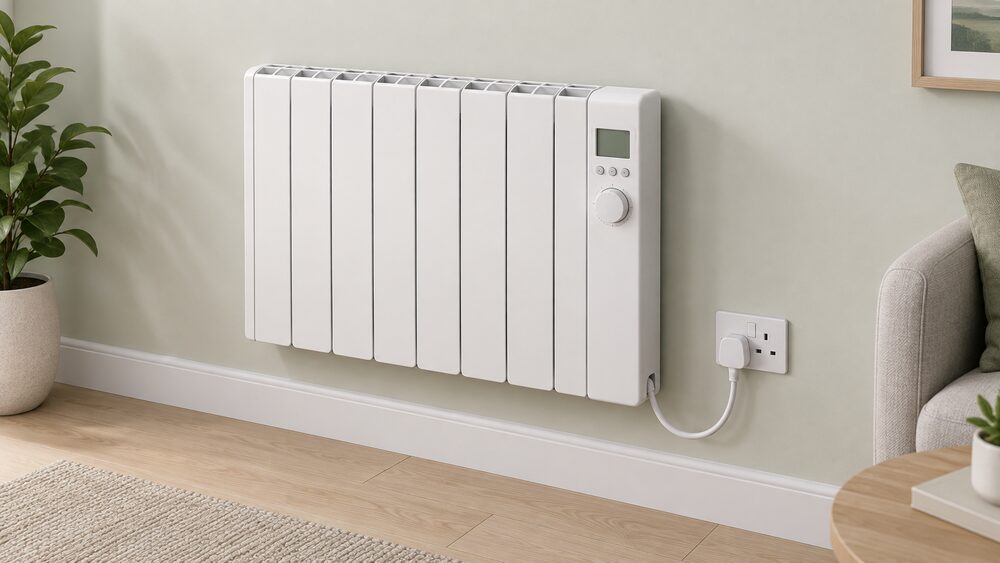
An electric radiator is a self-contained heater that converts electricity directly into heat in the room it stands in. There is no boiler, no flue, no pipework and no hot water circuit: electric heating is any system that uses electricity as the main energy source to heat the home, and the direct-acting form of it covers panel heaters, wall-mounted electric radiators, fan heaters and electric underfloor heating1. Each unit works on its own, so a room can be heated independently of the rest of the house3.
The headline efficiency figure is real but easily misread. All electric resistance heating products are 100% efficient at point-of-use: every unit of electricity drawn from the meter becomes heat in the room2. That is not the same as being cheap. Electricity costs around four times as much as gas per kWh, and the price ratio is the single fact that governs whether direct electric heating is affordable in a given home1. An electric heater run flat out costs in the region of 64p to 65p per hour at recent prices4.
Direct electric heating therefore does two things well and one thing badly. It is cheap to install, needs almost no maintenance, and gives room-by-room control. It is expensive to run in a poorly insulated home that needs heat for long hours. Where it sits in a household's energy independence is covered in full below, alongside storage heaters and electric boilers, the other two ways of heating a home with electricity alone.
What an electric radiator is and how it heats a room
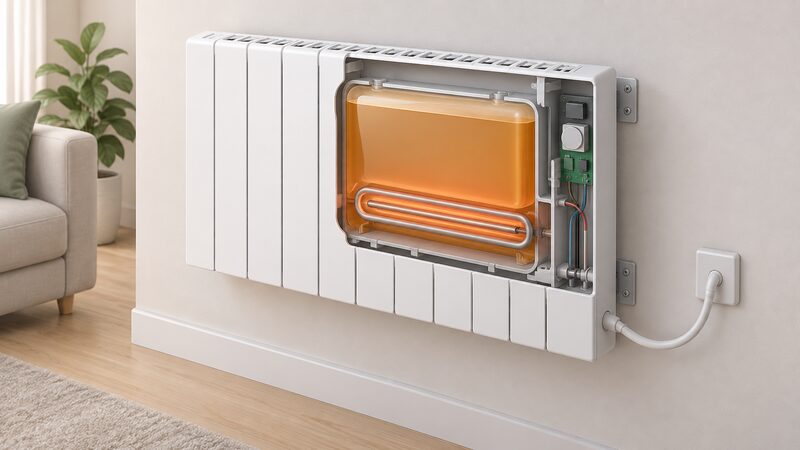
A conventional radiator is a hydronic heat emitter: warm water flows through the body and heat passes to the room. An electric radiator removes the water circuit entirely. A resistive element inside the casing converts electricity into heat, and that heat leaves the appliance as a mixture of radiant output from the front surface and convection as air moves across and through the body6.
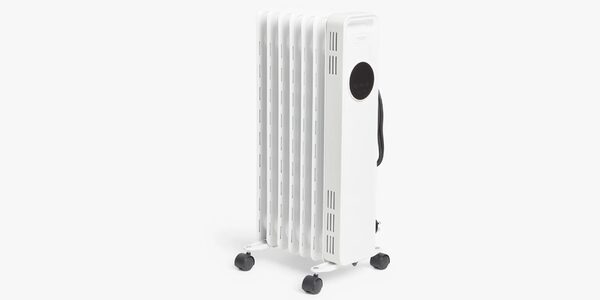
The internal design is what distinguishes the main types. A dry radiator heats a solid element or block directly, with no fluid inside. An oil-filled or thermal-fluid radiator heats a sealed fluid charge that then warms the casing, which gives a slower response and continued output after the appliance switches off. Panel heaters and convectors are lighter, with less mass, and warm the air passing through them rather than the fabric of the room; they reach temperature quickly and cool quickly9.
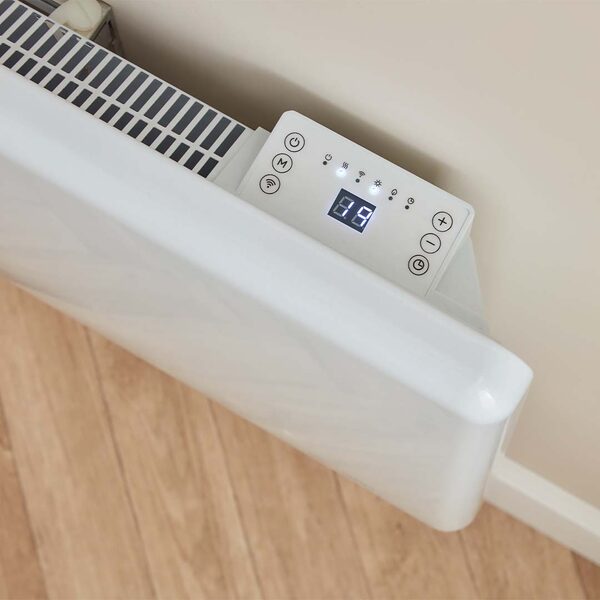
Control is built into the appliance rather than bolted on. A fixed electric radiator carries its own thermostat and, in most current products, a time programmer, so it begins heating automatically when the room dips below the target temperature and stops when it is reached11. That gives complete temperature control room by room and avoids heating unused spaces, but it also means the household is managing a set of separate appliances rather than one system, unless they are linked by an app or a central controller.
Panel heaters, convectors and radiators: which suits which room
The terms overlap in retail use, and the practical differences are about thermal mass, response speed and where the heat ends up.
| Type | How it behaves | Typical reported running cost |
|---|---|---|
| Fan heater | Fast, air-driven output, no retained heat | 60p per hour on average12 |
| Convector heater | Warms air passing through, quick response | 48p per hour on average12 |
| Oil-filled radiator | Slower to warm, keeps giving out heat after switch-off | 33p per hour on average12 |
Those figures come from testing across products, not from a single model, and they reflect how hard each type works to hold a room rather than a difference in conversion efficiency: all of them turn electricity into heat at 100%2. An oil-filled unit appears cheapest per hour largely because its stored heat lets the element cycle off for longer periods13.
Room by room, light fast-response heaters suit spaces used in short bursts. Electric heaters work best in smaller rooms such as bathrooms and garages, where a quick, intense burst of heat is wanted and the room is not held warm all day8. Heavier radiators with more mass suit living rooms and bedrooms occupied for hours, where a steady, even temperature matters more than speed. Direct-acting heating also covers electric underfloor heating and, in a different form, infrared panels, which warm surfaces rather than air2.
Where a wet system already exists, the choice widens. Larger panel radiators with a big surface area perform well at the lower flow temperatures used by heat pumps, which is a reason not to strip out a wet circuit purely to fit electric units9.
Efficiency: 100% at the point of use, four times the price of gas
Every credible source agrees on the conversion figure. Electric radiators are effectively 100% efficient at point of use, and all electric resistance heating products share that rating, whether they are dry, oil-filled, ceramic or panel type2. One manufacturer states 99.9% rather than 100%; the difference is immaterial and the independent figure is the one to work from.
The cost question is separate and decisive. The retail price of electricity per kWh is approximately four times that of gas, a ratio stated by the Energy Saving Trust, by Which? and in Scottish Government consultation material1. Because a gas boiler is not 100% efficient and an electric radiator is, the gap in delivered heat cost is a little smaller than four to one, but it remains large. Nesta's assessment of domestic heating options is blunt that panel heaters, storage heaters and electric boilers are much less efficient as a system, can carry very high running costs and impose extra stress on the grid, because they draw a unit of electricity for every unit of heat rather than moving heat as a heat pump does15.
On carbon, the picture has shifted with the grid. BEAMA states that electric heating, at both off-peak and standard rates, is now less carbon intensive than fossil-fuel heating alternatives2. Other guidance still puts the carbon footprint of direct electric heating at around three times that of gas and twice that of oil-fired central heating per unit of heat delivered16. Those two statements rest on different grid intensity assumptions and different dates, and they are not reconciled here. The direction of travel is that grid decarbonisation improves the electric case year by year without changing the price ratio.
Running costs: around 64p per hour for a typical heater
An electric heater costs about 65p for an hour of use, or 11p per 10 minutes, on the Centre for Sustainable Energy's July 2026 figures, and Smart Energy GB gives 64p per hour for an electric heater5. Those are full-output figures. A thermostatically controlled radiator holding an already warm room draws far less, because the element cycles.
Annual costs depend almost entirely on the building. EDF gives modelled annual figures for electric radiator heating of £1,399 for a two-bedroom 1960s house built to the regulations of its time, and £849 for a two-bedroom 1990s home18. A separate Energy Saving Trust illustration puts direct electric heating for space heating alone in a typical three-bedroom semi-detached house at £2,700 a year, at March 2026 prices19. The spread between those numbers is not disagreement about the technology: it is the difference between a small, later-built dwelling and a larger, older one.
| Comparison | Reported cost |
|---|---|
| Electric heater, one hour | 65p17 |
| Electric heater, per 10 minutes | 11p17 |
| Electric radiators, 2-bed 1990s house, per year | £84918 |
| Electric radiators, 2-bed 1960s house, per year | £1,39918 |
| Direct electric, 3-bed semi, space heating only, per year | £2,700 (March 2026)19 |
| Heat pump, per year | £800 to £1,050 (June 2026)20 |
Purchase cost runs the other way. Basic electric heaters cost upwards of £150 and more advanced models around £500, against £3,000 to £6,000 to install an electric boiler and £900 to £1,400 per room for electric storage heaters7. For fixed radiator installations, prices are installer-quoted and no published range is given here.
Anything that reduces demand cuts the bill directly, since there is no efficiency margin to recover: insulation, draught-proofing and correct thermostat settings all show up pound for pound. Fuller comparisons sit on electric heating running costs and heating running costs by fuel.
Installation: a 13 amp supply, no pipework, no flue
The installation case is the strongest practical argument for direct electric heating. No pipework is needed, only a 13 amp electric supply to each radiator6. Most electric heating products need nothing more than a connection to the electric circuit, and electric space heating does not normally require a flue or pipework at all2. There is no chimney, no fuel storage tank and no extensive pipe run to accommodate21.
That has three consequences a household will notice:
- Disruption is limited to electrical work. Units are wall-mounted and either plugged in or fed from a fused spur, with no lifting of floors for pipe runs.
- The system can be built up in stages. Heaters operate as stand-alone units, so they can be added at any point as budgets allow2.
- In new build, the heater goes in at second fix wiring stage, rather than needing a first-fix pipe layout2.
The limit is the consumer unit and the circuits behind the sockets. Several radiators on the same circuit represent a substantial simultaneous load, and whether the existing supply and protective devices can carry the whole installation is a question for a qualified electrician; this page gives no electrical advice. The related considerations are set out under electrical safety and supply for electric heating and building regulations for heating.
Sizing: watts per square metre, and where the radiator goes
Sizing starts from the room's heat requirement, not from the size of the wall. The BTU or watt requirement of the room is worked out first, and radiators are then selected against their individual ratings11. Guidance for panel-type electric heating suggests an older or draughtier space with solid walls or single glazing can need closer to 100W per m², with better-insulated rooms needing less22. The variables that move the number are the insulation of the house, ceiling height and the presence of draughts23.
Manufacturer output data gives a sense of the scale involved. One electric dry radiator is rated to heat rooms of up to 17 square metres from a single unit24. One aluminium electric radiator range is offered in five sizes with thermal powers from 600 W to 1800 W25. A room that needs more than the largest single unit can supply is either a candidate for two radiators or a sign that the fabric needs attention first.
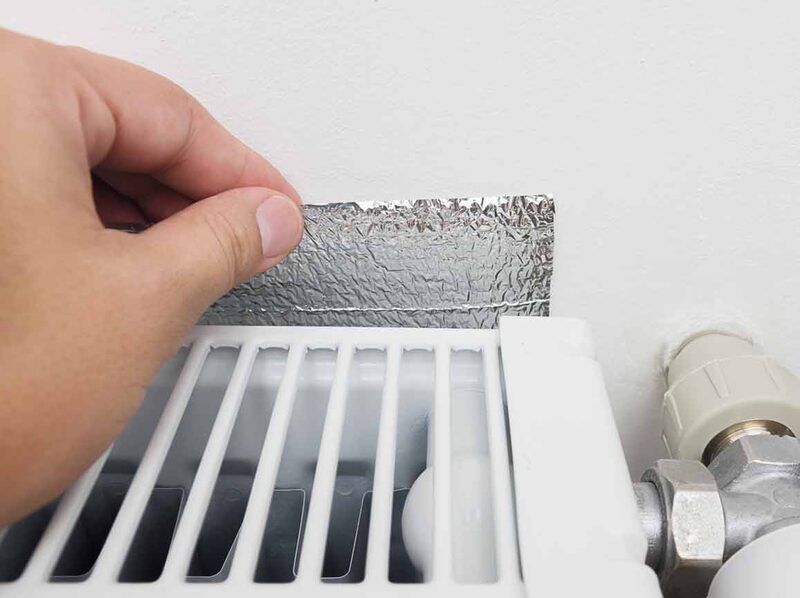
Placement matters more with direct electric heating than with a whole-house wet system, because each unit is trying to hold one room on its own. The recommended position is on the exterior wall or near the window, to offset the heat loss where it occurs and distribute warmth evenly through the room23. Radiator reflector panels behind units fixed to external walls are a standard measure for reducing loss through the wall behind26.
Controls, zoning and smart features
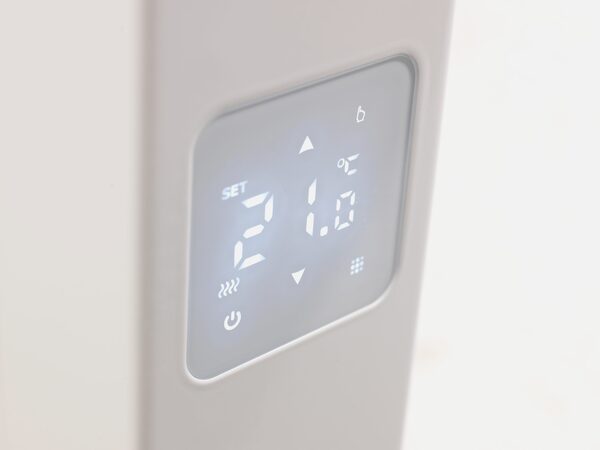
Room-by-room control is intrinsic to the format. Each radiator carries its own thermostat and, in most current ranges, a programmable timer, so heating schedules differ from room to room without any central wiring27. That is effectively zoning built into the appliance, where a wet system needs thermostatic radiator valves or motorised zone valves to achieve the same thing26.
The feature set found across current products includes:
- Digital thermostat, to set an exact temperature and avoid consumption peaks23
- Time programmer, with separate comfort and economy temperatures23
- Open window detection, which senses a sudden temperature drop and stops the element rather than heating the outdoors30
- Adaptive start, bringing the room to temperature by the programmed time rather than from it11
- App and voice control, where the range integrates with smart home systems10
- Low surface temperature and child-safe settings on some slimline models11
Smart control on a wet system is a separate purchase: smart radiator valves use sensors to monitor room temperature and adjust output, usually connecting over home wi-fi to a central system, and typically cost between £35 and £80 each31. On an electric radiator the equivalent intelligence is normally built into the unit, which removes that cost but ties the household to the manufacturer's app and cloud service for remote features. Local thermostat control continues to work if the app or the internet connection does not. See heating controls, thermostats and TRVs for the wider picture.
On settings, the Energy Saving Trust generally recommends maintaining around 18 to 21°C in the home29.
Maintenance and safety: little upkeep, checks every five years
Maintenance is minimal by design. There is no combustion, no water circuit and no annual service requirement of the kind a gas or oil boiler carries: the Energy Saving Trust says very little maintenance is needed and that safety checks should only be required every five years1. BEAMA states that electric space heaters need no regular maintenance and can last an average of 50% longer than a conventional fossil-fuel heat source2. One manufacturer recommends having the interior of electric radiators checked every five years by a professional, which aligns with the independent interval32.
Nor is there any bleeding to do. Bleeding releases trapped air so hot water can circulate and heat a radiator evenly; electric radiators do not circulate hot water and do not trap air, so they never need it33. Sealed oil-filled and thermal-fluid units are charged at the factory and are not topped up.
Warranty terms vary by component rather than by product. One manufacturer's terms for non-portable electric radiators give five years on the aluminium body against corrosion, on the paint finish and on thermal fluid leakage, and two years on electronics, the control panel, heating elements and plastic closures, with extensions available on registration34. Terms differ between makers, and the boiler warranties page explains how registration conditions generally work.
Safety practice for electric heaters is well established and is not negotiable:
"Make sure your heater is at least a metre away from combustible materials, such as paper, furniture or curtains. Never use it to dry your clothes!"
The same guidance is to place a heater on a level surface well away from anything that could knock it over, and never to leave it unattended while in use or asleep; for portable plug-in heaters specifically, overnight use is not recommended35. Where a product has been subject to a recall, Electrical Safety First advises stopping use until it has been checked by the manufacturer36. Painting an electric radiator is advised against, because the added layer can affect heat release and may damage the surface or safety features; on a wet radiator, standard emulsion is best avoided to prevent cracking and discolouration11.
One point often missed: turning a radiator off permanently in an unused room can lead to damp and mould, and the usual advice is to leave it on low and keep the door closed38.
Where electric radiators fit: no gas, flats and part-time rooms
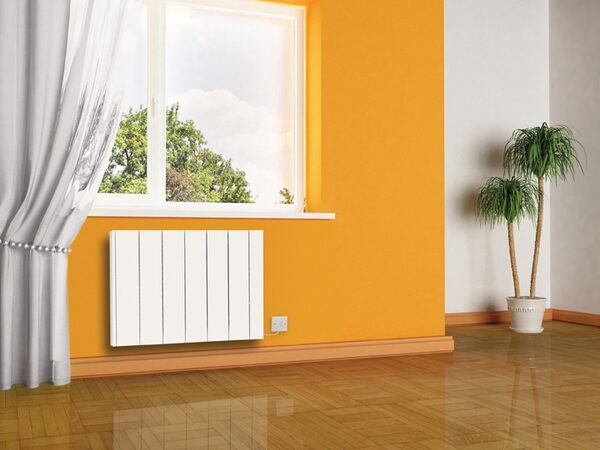
Direct electric heating is described as suited to homes without gas, flats, upgrades from storage heaters, well-insulated homes and properties in part-time occupancy39. The common thread is either the absence of a gas connection or a heat demand too small, too intermittent or too awkwardly located to justify a wet system.
Typical cases include:
- Off gas grid properties, where the alternatives are oil, LPG, biomass or a heat pump, all of which involve either a fuel store or a substantial installation. See heating a home off the gas grid.
- Flats and small dwellings, where there may be nowhere to site a flue or a cylinder.
- Replacing storage heaters, where the household wants heat on demand rather than heat released from a charge made hours earlier11.
- Rooms used occasionally: guest rooms, hobby rooms, attics and extensions, where heat is needed temporarily and selectively and a connection to the central heating pipework may be missing40. Vertical and horizontal formats, and portable options for second homes, exist for exactly this23.
- Conservatories and outbuildings, which are often outside the scope of the main heating system.
Where a wet system is being retained, an electric radiator can be added to a single room without touching it, since it needs no additional plumbing and no alteration to the existing heating21. The comparison against charge-and-release heating is set out on direct acting electric heating vs storage heaters.
What owning electric radiators means for energy independence
Direct electric heating removes several dependencies at once. It ends any reliance on gas, on an oil or LPG delivery, on a flue and on a combustion appliance and its annual service. Electric heating burns nothing indoors, which is why it eliminates the need for carbon monoxide detectors, flues or chimneys for the heating itself, though a detector remains necessary for any other fuel-burning appliance left in the property21. Related points are covered under carbon monoxide and home heating safety.
What replaces those dependencies is a single one: the electricity supply, at its full retail unit rate. There is no thermal store and no buffer in a direct-acting system, so a power cut leaves the house with no heat at all, and every kilowatt-hour of heat is bought at around four times the gas rate1. That is the trade a household makes.
There are two routes to loosening it. The first is time-of-use pricing: electric radiators are compatible with time-of-use tariffs, allowing heat to be taken when electricity is cheaper, though a direct-acting unit with little thermal mass can only shift a small part of its demand compared with a storage heater. Economy 7 and time-of-use tariffs covers how those rates work. The second is self-generation: where electric radiators are powered with self-generated electricity, they can provide heat at close to no marginal cost, though solar output in a UK winter rarely coincides with peak heating demand, and it is the maker of that claim who frames it as "almost free of charge"40.
The dependencies that remain, then, are the grid and a supplier, the manufacturer of each unit for warranty and spares, and, where smart features are used, that manufacturer's app and cloud service. What is gained is a system with almost nothing to fail, no fuel to store, no service contract to hold and a room-by-room control granularity that a single-zone wet system cannot match. Whether that is a good bargain depends less on the radiators than on the fabric of the building around them: in a well-insulated, part-time or small dwelling the running cost is manageable, and in a large, leaky, continuously occupied one it is not. The wider framing is on home heating and energy independence and the full range of options on the main heating guide.
Sources40 cited
- Electric heating advice, Energy Saving Trust, 2026-07-01
- Benefits of electric space and water heating, BEAMA, 2026-09-17
- Renewable heat: what's right for your home, Energy Saving Trust, 2026-05-19
- Which appliances use more electricity, Smart Energy GB, 2026-03-16
- Electric central heating, Which?, 2025-09-22
- Why choose an electric heating system, Electrorad, 2026-09-20
- Electric heaters vs storage heaters, Energy Helpline, 2026-09-20
- Electric radiator comfort guide, Netatmo, 2026-09-20
- The move to electric heating to reduce emissions, Electrorad, 2026-09-20
- Decoding heating jargon, Electrorad, 2026-09-20
- Electric radiators, EDF, 2026
- Best oil-filled radiators, Which?, 2026-06-29
- Portable heaters safety advice, Electrical Safety First, 2026-09-17
- Heat in Buildings Bill consultation analysis, Scottish Government, 2026-01-29
- Domestic heating technology options, Nesta, 2025-02-03
- Heating fuel guide, Uswitch, 2026-01-27
- How much electricity am I using?, Centre for Sustainable Energy, 2026-07
- Storage heaters explained, EDF, 2026-09-17
- Electric wallpaper explained, Energy Saving Trust, 2026-03-26
- Electric heating advice, Centre for Sustainable Energy, 2026-06
- What are the benefits of electric heating, Electrorad, 2026-09-20
- KORE P Series infrared panel, KIASA, 2026-09-20
- How to choose an electric radiator, Rointe, 2025-03-18
- Napoli electric dry radiator, Ferroli, 2026-09-17
- RCES electric radiator, Haverland, 2025-01-13
- Maintaining the ideal home temperature, Smart Energy GB, 2026-08-17
- Thermostats and heating controls, Energy Saving Trust, 2026-02-10
- Create a greener home, Electrorad, 2026-09-20
- Summer energy saving tips for electric radiators, Electrorad, 2026-09-20
- Radiator valves, Smart Energy GB, 2026-04-22
- Best smart radiator valves, Which?, 2026-09
- How to turn the heating back on, Netatmo, 2026-09-20
- How to bleed a radiator, Smart Energy GB, 2026-08-17
- Warranty terms and conditions, Rointe, 2026-08-03
- History of electrical heating and heater safety, Electrical Safety First, 2026-09-19
- Electric radiator product recall, Electrical Safety First, 2026-09-17
- Can you paint radiators?, Vaillant, 2026
- Energy saving myths, Centre for Sustainable Energy, 2026-07
- Complete guide to electric heating in the UK, Fischer Future Heat, 2026-03-19
- Electric heating greener than most people think, Myson, 2024-07-28
 Electric Heating CostsHow to work out what electric radiators, panel heaters, infrared and storage heaters cost to run per hour and per season.
 Electric Radiator ControlsElectric heaters cost far more to run than gas, so the controls really matter.
 Infrared Heating and PanelsDo infrared heating panels cost less to run than normal electric heaters, and how much do they add to a bill?
 Underfloor Heating SystemsWhich rooms suit electric underfloor heating and which need a wet system?
 Heat Pumps vs BoilersWill a heat pump actually cost less to run than my boiler, and does it heat the house as well?
 Heating Films and WallpaperCan electric wallpaper really heat a whole room, and what does it cost to run compared with a gas boiler or heat pump?