In this guide
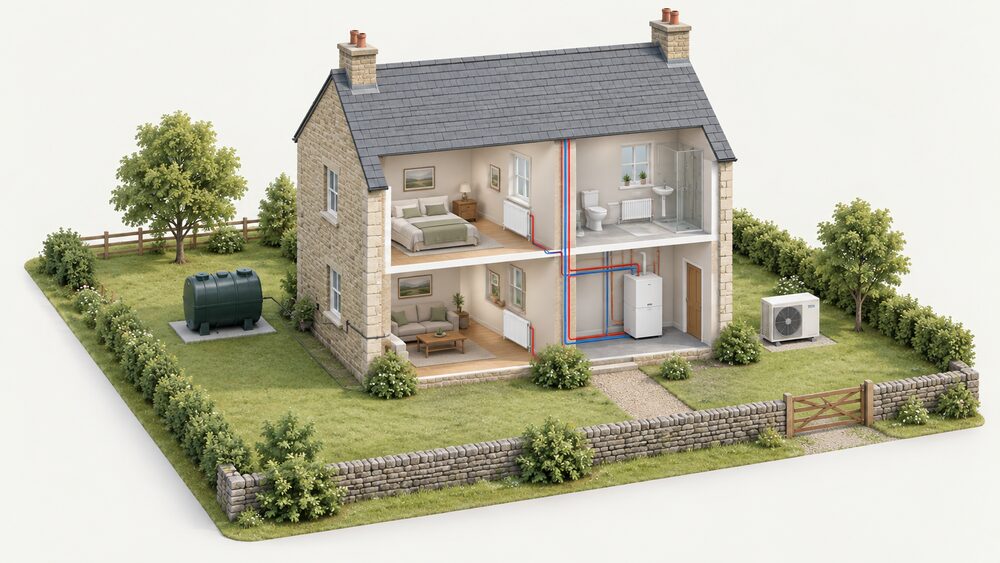
Four million UK households, about 15 per cent of the total, have no mains gas connection1. They heat with heating oil, liquefied petroleum gas (LPG), solid fuels, mains electricity and microgeneration, and the choice between those fuels decides both the running cost and how much of the household's heating depends on somebody else1.
The short answer is that off gas grid heating is a choice between a fuel you store and a fuel you buy as it arrives. Oil and LPG need a tank, a delivery and a boiler. Electricity needs no tank and no delivery, but it comes through the grid from a supplier. A heat pump or a biomass boiler changes the fuel again, and each option carries a different kind of dependence: on a tanker, on a supplier, on a manufacturer, or on the weather.
What off gas grid heating actually means
Most heating in the UK is supplied by gas, and the homes outside that system are a minority with a different set of problems6. The fuels available are heating oil, LPG, solid fuels, mains electricity and microgeneration, and each one has its own supply chain, storage requirement and regulatory position1.
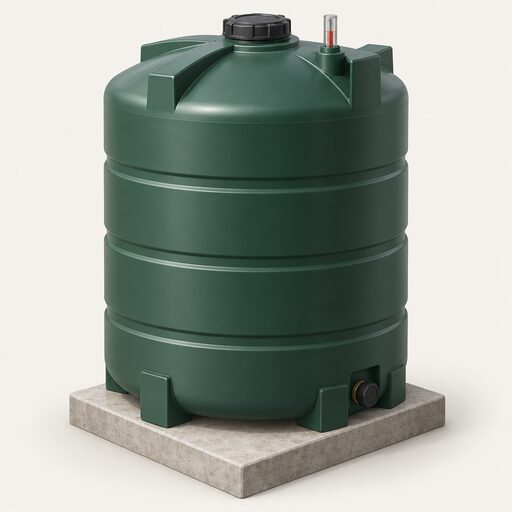
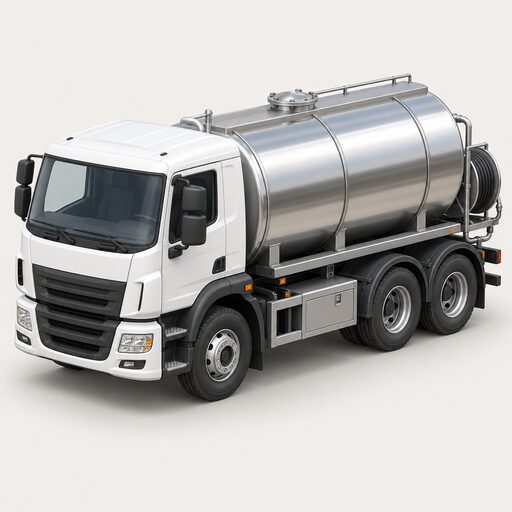
Heating oil is the classic rural fuel: an alternative fuel used to heat homes and buildings that are not connected to the gas grid7. It arrives by tanker, sits in a tank on the property, and feeds a boiler. LPG works the same way with a different fuel and a different storage vessel. Solid fuel is bought by the bag or the tonne and burned in a stove or boiler. Electricity is already connected to almost every home, so an electric boiler, storage heaters, panel heaters or a heat pump need no new fuel supply at all.
The shape of the housing stock explains why oil dominates where it does. Detached homes and bungalows account for 60 per cent of all homes with oil heating in England, 52 per cent in Wales and 71 per cent in Scotland, compared with 31 per cent of all homes in Britain7. Off gas grid homes are disproportionately large, detached and rural, which is exactly the profile that makes a tank and a delivery viable.
The figures that decide the choice
The headline numbers are the count of homes, the support available, and the dates that govern what can be installed. Four million UK households, 15 per cent, are off the mains gas grid1. In Scotland, over 450,000 homes do not use gas as their primary heating fuel2. Around 9 per cent of Scottish dwellings that are on the gas grid use an alternative fuel, such as electricity, as their main heating fuel, which shows that a gas connection does not guarantee gas heating8.
Support has come in two forms with two different figures. The Domestic Alternative Fuel Payment was legislated in October 2022 as a one-off £100 support payment for UK households using alternative fuels for heating10. The Alternative Fuel Payment delivered from February 2023 was a one-off £200 credit on energy bills per household using alternatives to mains gas for heating, such as heating oil, LPG or coal3. The two documents give different amounts, and the £200 figure is the one attached to the payment actually made from February 2023.
| Item | Figure | Source |
|---|---|---|
| UK households off the mains gas grid | Four million (15%) | 1 |
| Scottish homes not using gas as primary heating fuel | Over 450,000 | 2 |
| Scottish dwellings on the gas grid using an alternative main fuel | Around 9% | 8 |
| Alternative Fuel Payment, from February 2023 | One-off £200 credit | 3 |
| Domestic Alternative Fuel Payment, legislated October 2022 | One-off £100 | 10 |
| Proposed off gas grid fossil fuel phase out | 2035 | 4 |
What drives the cost and the choice
Three things drive the decision: what fuel can physically reach the property, what the fuel costs to buy and store, and what the building loses through its fabric. The first is a matter of geography and access. The second is a matter of market prices and delivery arrangements. The third is the one the household controls.
The fabric point is the one official guidance keeps returning to. The Home Upgrade Grant Phase 2 funds local authorities to improve the energy performance and heating systems of off gas grid homes in England, which is a recognition that the cheapest unit of heat is the one the building does not lose11. The same logic sits behind the Scottish proposal that all buildings should be energy efficient by 2035 and that homes should meet a minimum standard broadly equivalent to EPC C where technically feasible and cost effective12.
For heat pumps specifically, the official modelling is favourable on running demand. The air source heat pump consistently resulted in the lowest delivered energy demand across the archetypes modelled, and had the lowest capital cost for the houses, though that relationship was not observed for the block of flats, where the air source heat pump was the highest for the business as usual specification13. That is a modelled result, not a promise about any individual home.
Oil, LPG and solid fuel: stored fuels
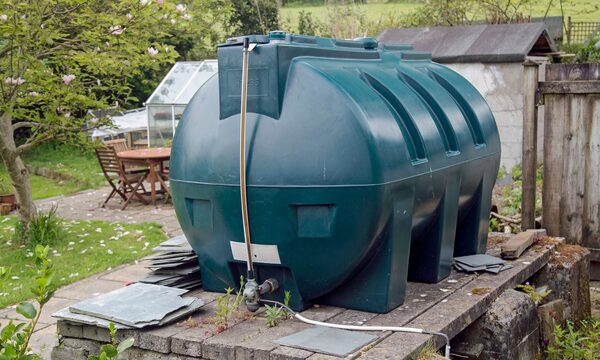
Stored fuels give a household a buffer. A full tank is heat that does not depend on the grid, the weather or a supplier's dispatch system that day. That is the independence argument for oil and LPG, and it is real. It is also bounded, because the tank has to be filled by somebody, and the boiler that burns the fuel has to be serviced and eventually replaced.
The housing profile behind oil heating is distinctive. Detached homes and bungalows account for 60 per cent of all homes with oil heating in England, 52 per cent in Wales and 71 per cent in Scotland, compared with 31 per cent of all homes in Britain7. Those are homes with space for a tank and, usually, no realistic prospect of a mains gas connection being laid to them.
The regulatory direction of travel is against new fossil fuel installations in this group. The UK Government consulted on ending the installation of high-carbon fossil fuels to heat homes that are not connected to the gas grid in England from 2026, and non-domestic buildings not connected to the gas grid from 202414. That date was then delayed. The phase out date for installing new oil and LPG boilers and new coal heating for off grid homes was put back to 20354. The delay was set out as a delay from 2026 to 2035 for England15.
Electric heating and heat pumps
Electric heating needs no tank, no delivery and no flue. That is its independence advantage: the fuel arrives through a connection almost every home already has. Its disadvantage is that the household is buying from a supplier through the grid, so the dependence moves rather than disappears.
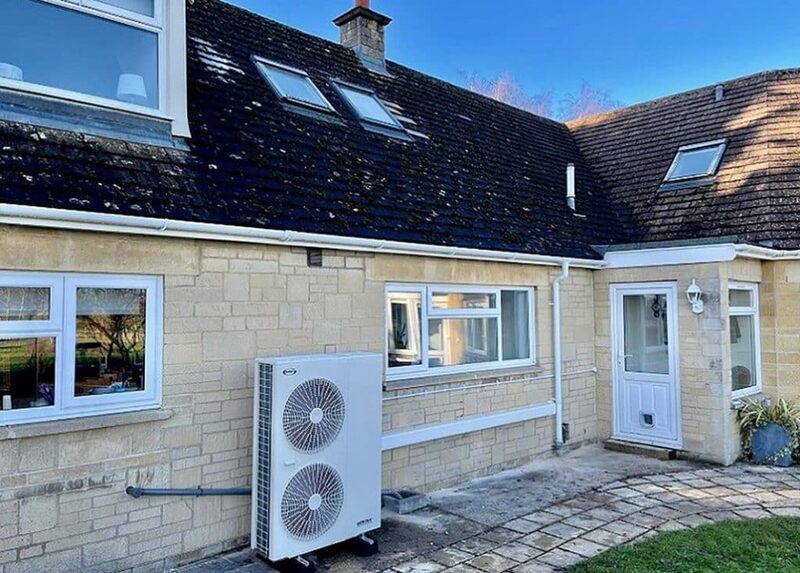
An air-to-water heat pump transfers heat drawn from surrounding air to water in a wet central heating system, which means it can use the radiators and pipework an oil or LPG boiler already feeds16. That matters for off gas grid homes, because it means the distribution system does not have to be replaced, only the heat source.
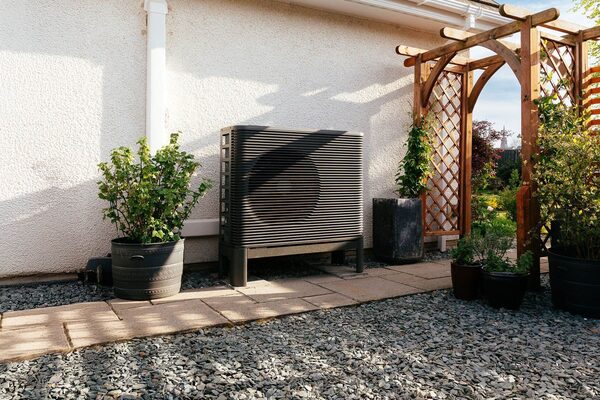
The planning position is permissive in most cases. Air source heat pumps fall under permitted development rights, provided the installation complies with the Microgeneration Certification Scheme Planning Standards (MCS 020a)5. The volume of the outdoor compressor unit, including housing, must not exceed 1.5 cubic metres on a house or 0.6 cubic metres on a block of flats5. All parts must be at least one metre from the property boundary17. Only the first installation is permitted development on a house which is not detached or a block of flats, while for detached houses the first two air source heat pumps are considered permitted development5. Installations on pitched roofs are not permitted development, and on a flat roof all parts must be at least one metre from the external edge of that roof5.
There are exclusions. Permitted development rights do not apply for installations within the curtilage of a Listed Building or within a site designated as a Scheduled Monument5. On land within a Conservation Area or World Heritage Site the heat pump must not be installed on a wall or roof which fronts a highway, or be nearer to any highway which bounds the property than any part of the building5. Noise is a condition: levels for an air source heat pump on its own must stay at or below 42 decibels from a metre away from any habitable room, and if that is exceeded planning permission approval is needed17. Where permission is required, noise must not exceed 37 dB LAeq at any time, measured on the boundary of the site with any neighbouring residential property18.
"Development is permitted only if the air source heat pump installation complies with the Microgeneration Certification Scheme Planning Standards (MCS 020a)"
How the rules differ across the UK nations
The four nations have diverged, and the differences matter for what can be installed and when.
In England, the Future Homes Standard direction is that new UK homes will be built without fossil fuel heating from 202519. For existing off gas grid homes, the proposed phase out of new oil and LPG boilers and new coal heating sits at 20354. Building control has some flexibility: a building control body might declare it is reasonable to install a higher carbon heating system, but the building must still meet the CO2, primary energy and fabric energy efficiency requirements20.
In Scotland, the New Build Heat Standard applies to new buildings applying for a building warrant in Scotland which are not served by a heat network, and they must meet their space and water heating demand from a zero emissions source21. From 2023, only renewable and low or zero emissions heat networks will be consented22. From early 2024, the legislative framework requires that new heat networks, and extensions of existing networks, are powered using low and zero emissions heat sources21. Heat networks must also have a scheme in place to transfer operational rights to a third party to ensure sustained supply22. The proposed backstop date for low or zero emissions heating in existing buildings is 204512.
In Northern Ireland, the Building Regulations Phase 3 proposals set out options. Under Option 1, heat pumps or alternative solutions, potentially biofuel, would be required in areas without access to mains gas, and a significant increase in the uptake of heat pumps is likely under both Options 1 and 2 in new homes off the gas grid if oil heating is no longer viable23.
| Nation | Key off gas grid position | Source |
|---|---|---|
| England | Proposed 2035 phase out for new oil and LPG boilers and new coal heating; new homes without fossil fuel heating from 2025 | 4 |
| Scotland | New Build Heat Standard for buildings not on a heat network; 2045 backstop for existing buildings | 21 |
| Northern Ireland | Phase 3 options would require heat pumps or alternatives in areas without mains gas | 23 |
| Great Britain | Heat network back billing limited to 12 months | 24 |
What the rules require of installations
Beyond the phase out dates, three sets of rules bear on an off gas grid heating installation: planning, building regulations and, for heat networks, consumer protection.
Planning is the most visible. The permitted development conditions for air source heat pumps are set out above, and they apply to the installation, alteration or replacement of an air source heat pump on a house or block of flats, or within the curtilage, including on a building within that curtilage5. Development is permitted only if there is no existing wind turbine on a building or within the curtilage of that property, and additional wind turbines or air source heat pumps at the same property require an application for planning permission5. The unit must not be used solely for cooling purposes, must be sited so far as is practicable to minimise its effect on the external appearance of the building and its effect on the amenity of the area, and must be removed as soon as reasonably practicable when it is no longer needed for microgeneration5.
Building regulations apply in parallel. Building Regulations parts A to T apply to an air source heat pump, plus Regulation 717. For new developments without access to the national grid, Regulation 26 gives building control some room to accept a higher carbon heating system, provided the CO2, primary energy and fabric energy efficiency requirements are still met20.
Heat networks, which serve some off gas grid blocks, now have their own regime. As of January 2026, a new heat network regulatory regime has been introduced, including designating Ofgem as the sector regulator10. The authorisation condition on back billing applies across Great Britain, limiting back billing to 12 months across all heat networks unless there are conflicts with existing housing legislation24. Approximately 14,000 blocks of flats in the UK were served by communal heating as of 20236.
What it means for a household's energy independence
Off gas grid heating is a study in partial independence. A stored fuel gives a household a physical reserve and a choice of supplier, but it depends on a delivery chain, a tank and an appliance with a proposed end date. Electricity gives a household a fuel that arrives without a delivery, but the dependence moves to the grid and to a supplier. A heat pump reduces the amount of delivered energy the home needs, which is the closest thing to independence the evidence supports, but it still runs on electricity and still needs a manufacturer's parts and, often, an app or a controller.
The advice landscape reflects this. The NI Energy Advice service funds independent advice on solar panels, heat pumps and other energy efficiency measures, and directs homeowners to seek that advice from organisations that are not selling the equipment25. That is the structural point: in a market where the household is choosing between fuels with different supply chains, independent advice is the mechanism that keeps the choice informed.
Microgeneration changes the picture at the margin. A micro hydro plant can supply space and water heating when available power exceeds demand, which is a genuine form of self-supply where the resource exists26. Hybrid heat pumps offer a middle path: there were three packaged solutions but a large number of add-on hybrid heat pumps on the market as of 201627. The Climate Change Committee has called for secure UK Government funding for low carbon sources of heating beyond 2021, which is a recognition that the transition depends on policy as much as on equipment28.
The honest summary is that no off gas grid option delivers full independence. Oil and LPG store energy but depend on delivery. Electricity depends on the grid and a supplier. Heat pumps reduce demand but depend on electricity, a manufacturer and often a connected controller. What a household can control is the fabric of the building, which reduces the size of every one of those dependencies at once.
Sources28 cited
- Off gas grid households, House of Commons Library, 2026
- Scotland's off gas homes, Scottish Government, 2021
- Alternative Fuel Payment, UK Parliament, 2023
- Off grid boiler phase out, House of Commons Library, 2023
- Planning permission for air source heat pumps, Planning Portal, 2026
- Domestic heating fuel dependency, House of Commons Library, 2022
- Oil heating and housing type, UK Parliament, 2011
- Scottish House Condition Survey 2024, Scottish Government, 2024
- Scottish House Condition Survey 2023, Scottish Government, 2023
- Heat networks consumer protection guidance, Ofgem, 2026
- Home Upgrade Grant Phase 2, UK Government, 2022
- Heat in Buildings Strategy, Scottish Government, 2021
- Energy standard for new domestic buildings, Scottish Government, 2026
- Heat and Buildings Strategy, UK Government, 2021
- Delivering net zero for Scotland's buildings, Scottish Government, 2023
- ECO4 new measures and products guidance, Ofgem, 2026
- Renewables guidance, Bedford Borough Council, 2026
- Air source heat pump planning advice, Central Bedfordshire Council, 2026
- New low carbon homes commitment, Climate Change Committee, 2019
- Future Homes and Buildings Standards consultation response, UK Government, 2026
- New Build Heat Standard consultation, Scottish Government, 2022
- Heat networks in Scotland, City of Edinburgh Council, 2023
- Northern Ireland Building Regulations Phase 3, Northern Ireland Government, 2023
- Permitted development rights for air source heat pumps, Scottish Government, 2015
- Support to generate your own electricity, nidirect, 2025
- Hydro electricity, Planning Portal, 2026
- Domestic hybrid heat pumps, UK Government, 2016
- UK homes unfit for climate change, Climate Change Committee, 2019
 Living Off the Gas GridNo mains gas at your home?
 Heating Oil and LPG SupplyHow heating oil and bulk LPG reach off-grid homes, who owns the tank, what the fuels cost, why neither is covered by the price cap, and what supply risk looks like in winter.
 Heating and Energy IndependenceCan you heat your home without relying on gas or oil, and what would that take?
 Gas Boilers GuideMains gas boilers heat around 23 million UK homes.
 Gas Absorption Heat PumpsGas absorption heat pumps run on gas rather than electricity, so do they cut your bills and can they work in a normal UK home?
 The Full Statistics GuideHow many homes in the UK have solar panels, heat pumps or batteries?