

In this comparison
For most homes off the gas grid, the choice comes down to two liquid fuels: heating oil and liquefied petroleum gas (LPG). Heating oil is used to heat homes and buildings that are not connected to the gas grid, and around 1.6 million homes across the UK use it1. LPG is the fuel of choice for 193,000 homes, and some two million properties in the UK are off-grid and therefore depend on alternative fuel sources for heating and cooking2.
On running cost, the two are not close. Official statistics give LPG (bulk propane) an annual heating cost of £1,800 to £2,200 for a three-bedroom semi-detached house4. Ofgem guidance states that heating a typical three-bedroom house costs 100% more with LPG than with mains gas, while Oftec describes heating oil as having comparable annual running costs to mains gas5. That gap, with LPG at double the mains gas figure and oil at parity with it, is the single most important fact in the comparison.
The trade-off runs the other way on appliances and on how the fuel behaves in the home. LPG fuels all familiar domestic gas appliances, including central heating boilers, gas fires, gas ranges, AGAs and cookers, and Liquid Gas UK states that the cost of LPG installation, compared with electric, oil and air source heat pumps, is significantly cheaper2. Oil needs its own tank, its own delivery arrangements and its own burner.
Oil and LPG: the two fuels that heat most off-gas-grid homes
Off-gas-grid households use a range of other fuels to heat their homes, including heating oil, liquefied petroleum gas (LPG), solid fuels, mains electricity and microgeneration9. Within that mix, the liquid fuels dominate. Ofgem's archetype work found that of households using "other" main heating fuels, 22% use bulk LPG, 15% use solid fuel and 9% use renewables10.
The scale of the oil market is the reason it sets the terms of the comparison. Around one million homes in Great Britain use liquid fuel heating, with a similar number in Ireland, and the same figure appears in Oftec's separate guidance6. Parliamentary research puts UK heating oil use at around 1.6 million homes, and a 2026 Commons debate referred to 1.5 million UK households that use heating oil to heat their homes1. The two figures are close but not identical, and the difference reflects different collection dates and definitions rather than a disagreement about the trend.
LPG's smaller footprint shapes what it is good for. It reaches properties where an oil tank is impractical, where storage space is tight, or where the household wants gas-style cooking and fires as well as central heating. Liquid Gas UK states that some two million properties are off-grid and therefore depend on alternative fuel sources for heating and cooking2. LPG's share of that is a fraction of oil's, but it is concentrated in homes that have few other options.
For a household's energy independence, both fuels share the same structural feature: the home stores its own fuel, so a delivery failure or a cold snap does not immediately cut the heat, but the household is dependent on a distributor, a tanker route and a price it does not set. Neither fuel connects the home to the gas grid, and neither is a route to generating its own energy. That distinguishes both from a heat pump paired with solar, which is the only option in this comparison that reduces reliance on a delivered fuel at all.
Where off-gas-grid households are: Cornwall to Lincolnshire, and half in urban areas
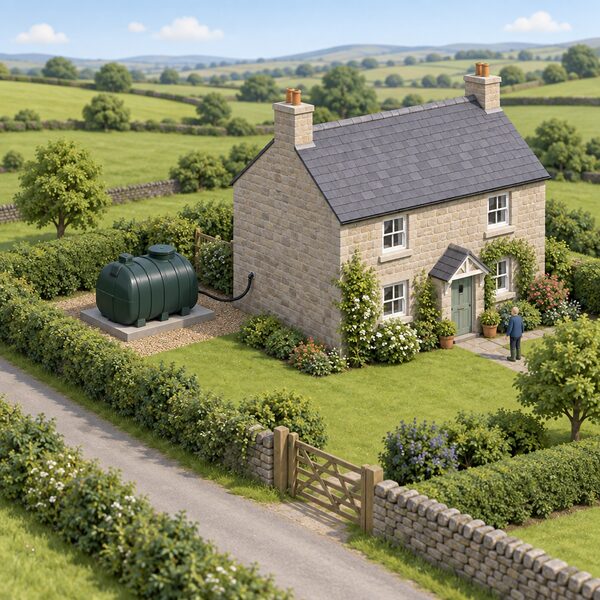
The off-gas-grid map is not simply a rural one. The proportion of households off the gas grid in 2024 was highest in inner London at 26.6%, ahead of the South West at 24.0% and the North West at 10.4%12. That inner London figure surprises most people who assume the off-grid population is entirely rural, and it matters because the support schemes and the practical options differ sharply between a Cornish cottage and a London flat.
In Scotland the split is starker. The Scottish House Condition Survey reports that in urban locations electricity is used in 8% and oil in 1% of dwellings13. Oil is therefore overwhelmingly a rural and remote-rural fuel north of the border, which is why Scottish support for oil-heated households has concentrated on rural areas and on emergency payments when refill costs spike.
The Welsh picture is shaped by new build as much as existing stock. Welsh Government impact assessment guidance states that it is likely that most new homes off the gas grid will be built using low carbon heating, with industry indicating heat pumps rather than LPG or oil are already being used14. That means the off-gas-grid population in Wales is being added to on a different basis from the older stock, and the liquid fuel share should decline over time even without a ban.
Northern Ireland has its own arrangements throughout. The Department for the Economy consulted on support for low carbon heating in residential buildings and found support for widening eligibility to a range of low carbon technologies15. Building regulations discussion documents in Northern Ireland have also examined the delivered energy consequences of replacing an oil-fired boiler with an LPG boiler, using a worked example where an LPG boiler gives 1.075 kWh/kWh heat output and is judged acceptable16.
For a household, the practical consequence of location is access. Rural households are more likely to have space for a tank and to be served by a competitive oil delivery market. Urban off-grid households, particularly flats, are more likely to be on electricity or to have no realistic tank option at all. The off-gas-grid homes page covers the fuel choices in more detail, and rural homes energy covers the rural-specific support.
Running costs: LPG at double mains gas, oil at parity with it
The cost comparison rests on two official figures. LPG (bulk propane) costs £1,800 to £2,200 a year to heat a three-bedroom semi-detached house4. Heating a typical three-bedroom house costs 100% more with LPG than with mains gas, and Oftec states that longer-term comparisons show heating oil has comparable annual running costs to mains gas5. Taken together, those figures put LPG at twice the mains gas cost for the same house and oil at the same annual running cost as mains gas, and that is the comparison a household should carry into any decision.
Oftec is blunt about why. The biggest disadvantage of LPG is that it is one of the most expensive heating fuels, and homeowners are usually tied into long contracts6. That contract point is separate from the unit price and often more consequential: an oil household can switch supplier on every delivery, while an LPG household on a bulk contract typically cannot.
| Fuel | Annual heating cost, three-bed semi | Basis |
|---|---|---|
| LPG (bulk propane) | £1,800 to £2,200 | Official statistics, March 20264 |
| Heating oil | Comparable annual running costs to mains gas | Oftec guidance6 |
| LPG versus mains gas | 100% higher | Ofgem guidance5 |
The environmental comparison is narrower than the cost comparison. LPG emits 35% less CO2 than coal and 12% less than oil3. That is a real advantage over oil on emissions, but it does not change LPG's position as one of the most expensive heating fuels, and it does not make either fuel low carbon.
What a household should expect in practice is that the oil advantage holds over a year but not over every month. Heating oil costs can be affected by sudden price fluctuations, but longer-term comparisons show it has comparable annual running costs to mains gas6. The volatility is in the timing of purchases, not in the underlying annual position. For energy independence, the oil household has more control: it can choose when to buy, from whom, and how much to hold. The LPG household has less, because the contract and the tank usually belong to the supplier.
Appliance costs and flame control: where LPG has the edge
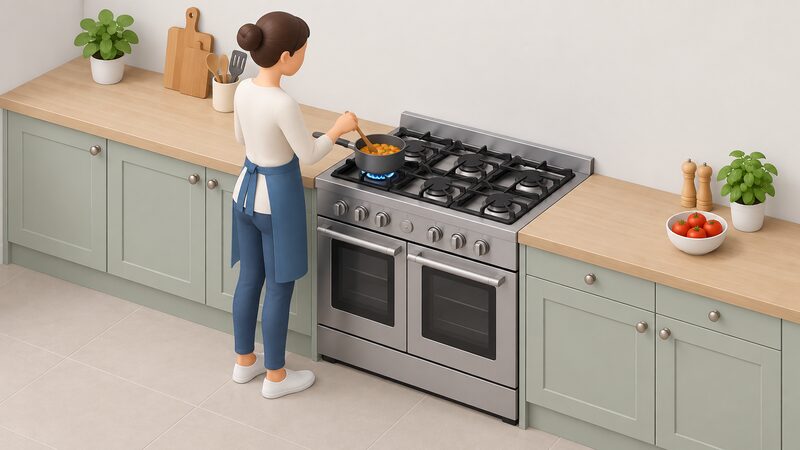
LPG's advantage is at the appliance, not at the meter. The cost of LPG installation, compared with electric, oil and air source heat pumps, is significantly cheaper3. LPG also fuels all familiar domestic gas appliances, including central heating boilers, gas fires, gas ranges, AGAs and cookers2. An oil-fired home typically has a boiler and a tank and little else; an LPG home can run a full gas-style kitchen and living room.
That difference in behaviour is what people mean by flame control. LPG arrives at the burner as a gas and modulates like mains gas, so hobs, fires and range cookers respond in the way most households already understand. Oil arrives as a liquid and is atomised at the burner, which is why oil appliances are a narrower family and why oil is less suited to point-of-use cooking and decorative fires.
The controls themselves are not a differentiator. The Energy Saving Trust's heating controls guide covers heating controls for gas, oil and liquid petroleum gas (LPG) boilers together, so thermostats, programmers and zoning are available across both fuels17. A household choosing between oil and LPG should not expect the control options to decide it.
"LPG fuels all familiar domestic household gas appliances, such as Central heating boilers, Gas Fires, Gas Ranges, AGAs and cookers"
The installation cost advantage is real but should be weighed against the running cost gap. A cheaper installation recovered over a decade of higher fuel bills is not a saving, and the £1,800 to £2,200 annual LPG figure is the number that compounds4. Where LPG wins is in homes that cannot site a tank, that want gas cooking, or that value a single contract over managing deliveries. Where oil wins is on the annual bill, on supplier choice and on the ability to buy ahead of price rises.
Price volatility and winter fuel supply: keeping a sufficient stock and joining an oil club
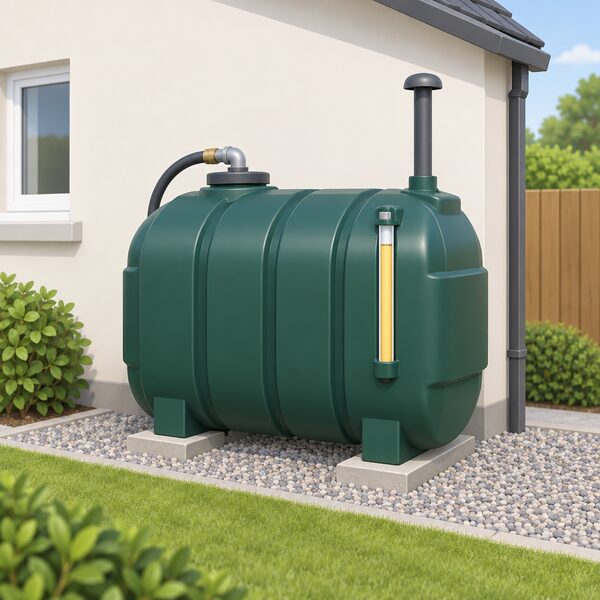
Heating oil costs can be affected by sudden price fluctuations, but longer-term comparisons show it has comparable annual running costs to mains gas6. The volatility is the reason stock management matters more for oil than for any other domestic fuel. A household that buys in summer and holds a full tank through winter is insulated from the winter spike; one that orders when the tank runs low is exposed to it.
The market structure supports that approach. Heating oil, by contrast, is supplied through a highly competitive market, unlike the loyalty penalty that led to the gas and electricity price cap11. Competition between distributors is what makes shopping around and buying ahead worthwhile, and it is the mechanism behind oil clubs.
Fuel clubs are oil syndicates where the community purchase their oil together in order to save as much money as they can18. Carmarthenshire Council guidance states that members can save as much as 8p per litre18. In Northern Ireland, the Housing Executive's Oil Savings Network reports an average saving for members of between £10 and £30 on 200 litres of oil19. The two figures describe different things, a per-litre discount and a per-order saving, and both are worth knowing.
On how much to hold, no official figure sets a stock level. What the evidence shows is the consequence of running short. In Scotland, 28% of fuel poor households report that heating keeps them warm in winter only sometimes or never, compared with 23% of non-fuel poor households20. A household that cannot afford a summer fill is the household most exposed to a winter price rise, which is why the support schemes below matter as much as the fuel choice.
The phase-out consultation: what it means for oil, coal and LPG heating
The ban on installing oil and LPG boilers, and new coal heating, for off-gas-grid homes was delayed from 2026 to 20357. The delay was set out in UK Government consultation documents published in November 2023, and the Climate Change Committee's assessment of recent net zero announcements recorded the delayed phase-out date for oil and LPG boilers as moving from 2026 to 20357.
Two things about that timetable are commonly misunderstood. First, it applies to new installations, not to the continued use of boilers already in place. A household with a working oil boiler is not required to remove it in 2035 on the basis of these documents. Second, the documents published so far cover England, and the devolved administrations have their own consultation processes, including the Scottish proposals in the Heat in Buildings Bill consultation22.
The direction of travel is nonetheless clear. Welsh Government guidance states that it is likely that most new homes off the gas grid will be built using low carbon heating, with industry indicating heat pumps rather than LPG or oil are already being used14. Northern Ireland's consultation on support for low carbon heating found support for widening eligibility to a range of low carbon technologies15. Scotland's Heat in Buildings consultation set out proposals for the buildings bill that would govern the transition there22.
For a household, the practical reading is that an oil or LPG boiler installed now has a working life that extends past the 2035 date for new installations, and that the replacement decision, when it comes, will be a heat pump decision in most cases. The phase-out is a constraint on what can be installed new, not a deadline for ripping out what works. The off-gas-grid homes page sets out the fuel-by-fuel position, and warm homes plan covers the wider policy framework.
Support for the 1.5 million off-gas-grid households needing to upgrade

Support for oil and LPG households runs on two tracks: help with the cost of fuel now, and grant funding for replacing the heating system.
On fuel costs, the UK Government committed over £50 million to help low-income families who use heating oil, and confirmed that heating oil and LPG are in scope, with guidance to local authorities to make that clear11. The Welsh Government's Heating Oil and LPG Scheme provides a one-off £200 payment to low income households who heat their homes using heating oil or liquid petroleum gas24. In Northern Ireland, the £100 digital pre-paid card scheme supports around 340,000 households who use oil as their main source of heating19. Applications require people to confirm their heating fuel type and provide bank details26.
On replacement, the Boiler Upgrade Scheme offers £9,000 towards an air-to-water or ground source heat pump for eligible off-grid properties heated by LPG or oil27. The heating system being replaced must be fuelled by either oil or liquefied petroleum gas (LPG)28. Homes heated by oil or LPG may be eligible for a £9,000 government grant towards the cost of installing a heat pump until March 20278.
| Nation | Fuel cost support | Replacement support |
|---|---|---|
| England | Over £50 million for low-income oil households; LPG in scope11 | £9,000 BUS grant for oil or LPG homes until March 20278 |
| Wales | One-off £200 Heating Oil and LPG Payment for low income households24 | BUS applies; low carbon new build guidance14 |
| Scotland | Emergency heating support for oil households30 | Home Energy Efficiency Equity Loan pilot funded gas, oil or LPG boiler replacement31 |
| Northern Ireland | £100 pre-paid card for around 340,000 oil households19 | Consultation found support for widening low carbon eligibility15 |
The scale of the need is the context. The 1.5 million UK households that use heating oil to heat their homes are the population these schemes address, and the support announced by the UK Government in March 2026 was described in a Scottish Government statement as equating to only £33 per household using oil heating11. That figure is a measure of the gap between the support offered and the cost of upgrading, not of the number of schemes.
For energy independence, the grant track is the more consequential one. A heat pump replaces a delivered fuel with electricity, which can be bought from any supplier and, with solar and a battery, partly generated at home. That is a genuine reduction in dependence. The fuel cost payments reduce the bill but leave the underlying dependence on a tanker and a distributor exactly where it was.
Oil vs LPG vs the alternatives: electricity, solid fuels and microgeneration
The alternatives to oil and LPG are electricity, solid fuels and microgeneration, and the comparison is not flattering to the liquid fuels on cost. Heating a typical three-bedroom house costs 100% more with LPG than with mains gas5. Oftec states that the biggest disadvantage of LPG is that it is one of the most expensive heating fuels, and homeowners are usually tied into long contracts6.
Electricity is the main alternative in urban off-grid settings. In Scottish urban locations, electricity is used in 8% and oil in 1% of dwellings13. Direct electric heating is straightforward to install and needs no tank or delivery, but it puts the whole heating load on the electricity bill, and it is the reason electrically heated flats are a distinct case in the support system.
Solid fuels remain part of the mix, at 15% of households using "other" main heating fuels in the Ofgem archetype work10. Coal is being phased out alongside oil and LPG under the same 2026 to 2035 delay for new coal heating in off-gas-grid homes7. Solid fuel also carries air quality constraints in smoke control areas that the liquid fuels do not.
Microgeneration is the route that changes the independence picture rather than the fuel bill. A heat pump paired with solar reduces the share of energy bought in, and the Boiler Upgrade Scheme's £9,000 grant for oil and LPG homes is the main public support for that switch27. The Government's own assessment notes that running costs for heat pumps are typically lower when compared to those of traditional gas boilers, while cautioning that this depends on the system being designed and operated well32.
For a household weighing the options, the honest summary is that oil is the cheapest liquid fuel and the most flexible to buy, LPG is the cheapest to install and the most versatile at the appliance, and neither is a route to energy independence in the way a heat pump with on-site generation is. The off-gas-grid homes page covers the full fuel set, and fuel poverty in UK households covers who qualifies for the support described above.
Sources32 cited
- Research briefing SN05806: Heating oil and other off-gas grid fuels, House of Commons Library
- New to LPG, Liquid Gas UK
- LPG in the home, Liquid Gas UK
- Options available off the gas grid, Oftec
- What heating options are available off the grid?, Oftec
- Research briefing CBP-9838: Heating oil and off-gas grid households, House of Commons Library
- Delivering net zero for Scotland's buildings: consultation proposals, Scottish Government, November 2023
- Thousands of homes will be eligible for £9,000 off a heat pump, GOV.UK
- Heating oil and off-gas grid households, House of Commons Library
- Ofgem archetypes update 2024, Ofgem, February 2024
- Heating Oil Support debate, 16 March 2026, Hansard, 16 March 2026
- Households off the gas grid by region, House of Commons Library, 2024
- Scottish House Condition Survey 2024: key attributes of the Scottish housing stock, Scottish Government, 2024
- Part L Wales impact assessment: domestic existing and new build, Welsh Government, April 2022
- Minister publishes response to consultation on low carbon heating support, Department for the Economy, 26 January 2026
- Building regulations discussion document and pre-consultation, Northern Ireland Department of Finance, 2023
- Thermostats and heating controls, Energy Saving Trust, 10 February 2026
- Fuel clubs, Carmarthenshire County Council, 13 April 2026
- £100 Home Heating Oil Support Scheme goes live for applications, Northern Ireland Department for Communities, 8 September 2026
- Scottish House Condition Survey 2024: key findings, Scottish Government, 2024
- CCC assessment of recent announcements and developments on net zero, Climate Change Committee, 12 October 2023
- Delivering net zero for Scotland's buildings: Heat in Buildings Bill consultation, Scottish Government, November 2023
- Over £50 million to help families struggling with soaring heating oil costs, GOV.UK, 16 March 2026
- Welsh Government Heating Oil and LPG Scheme, Torfaen County Borough Council
- Thousands of Welsh households get help with oil and LPG heating costs, Welsh Government
- Heating oil and LPG heating support payment, Welsh Government, 31 March 2026
- Boiler Upgrade Scheme statistics, July 2026, GOV.UK, 27 August 2026
- Boiler Upgrade Scheme: installers, Ofgem, 17 September 2026
- Heat pump grant for oil and LPG homes, GOV.UK, 10 September 2026
- Help for households using heating oil, Scottish Government
- Home Energy Efficiency Equity Loan pilot, Scottish Government, 14 March 2022
- What impact can heat pumps have in domestic heating today?, GOV.UK, 21 November 2023
 Heating Off the Gas GridThe options for the four million UK households with no mains gas connection: oil, LPG, electric, heat pump, biomass and solid fuel, and how their costs, storage and supply security compare.
 Living Off the Gas GridNo mains gas at your home?
 Running Costs by FuelHow the cost of heat compares across mains gas, heating oil, LPG, electricity, solid fuel and heat pumps once efficiency and the price cap are applied.
 LPG Boilers and HeatingWhat LPG is, how LPG boilers differ from natural gas appliances, and how bulk tanks and cylinder supply work for off-grid homes.
 Heating Oil and LPG SupplyHow heating oil and bulk LPG reach off-grid homes, who owns the tank, what the fuels cost, why neither is covered by the price cap, and what supply risk looks like in winter.
 Replacing a Gas or Oil BoilerSwapping a gas, oil or LPG boiler for a heat pump changes how your home is heated and how much it costs.