

In this comparison
Northern Ireland is the one part of the UK where the fuel question is genuinely open. At Census 2021, 63% of households used heating oil and 33% used mains gas1. Government statements in 2026 put oil reliance at roughly two thirds of homes, or approximately 500,000 households2. A 2023 Building Regulations consultation recorded 68% of existing dwellings relying on oil3.
The cost gap is the reason the choice matters. The UK average cost of heating a typical three bedroom house is around 50% higher with heating oil than with mains gas4. Consumer Council data recorded the average price of home heating oil in Northern Ireland rising by approximately 85 to 95% between the end of February and mid-March 20264, and the Executive described recent price increases of nearly 100% in just a few weeks2.
Gas is not available to most of those homes. Mains gas reaches about a third of households, and where it does reach, it is a regulated supply with a price guarantee behind it. Oil is bought in bulk, at a price set by the world market, with no equivalent protection. That asymmetry, not the boiler itself, is what shapes household energy independence in Northern Ireland.
What each fuel offers a Northern Ireland household
Oil heating means a tank, a delivery, and a boiler that runs independently of any network. There is no standing charge for a pipe and no supplier in the sense a gas customer understands. The household buys a volume of fuel and owns it. That is the independence oil offers, and it is real: a full tank keeps working through a supply interruption, a price spike that has already passed, or a dispute with a supplier.
What it does not offer is price stability. The Consumer Council recorded the average price of home heating oil in Northern Ireland rising by approximately 85 to 95% between the end of February and mid-March 20264. The Executive described recent price increases of nearly 100% in just a few weeks2. A household that buys in bulk at the wrong moment absorbs the whole movement, because there is no cap, no guarantee and no regulator setting the price.
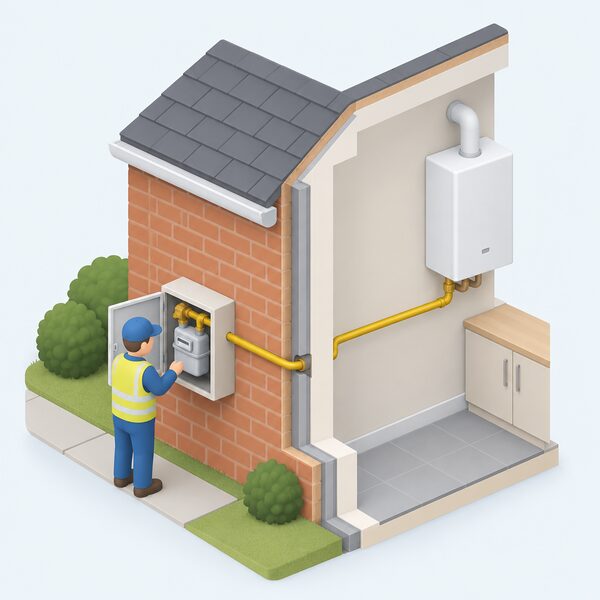
Mains gas offers the opposite trade. The household gives up the tank and the delivery, and in return gets a regulated supply. The Energy Price Guarantee for Domestic Gas Consumers in Northern Ireland was made under Section 22 of the Energy Prices Act 2022 and applies to Northern Ireland7. A second direction, Direction No.2, followed on 23 June 20238. Mains gas also carries no standing charge in Northern Ireland, though smart time-of-use tariffs are not available there9.
The catch is reach. Firmus Energy supplies townlands, and the Utility Regulator must approve any tariff changes in its ten townland networks9. Outside those networks, and outside the wider gas area, there is no gas to connect to at any price. For those homes the practical comparison is not oil against gas but oil against a heat pump, and that is where policy is heading.
Specifications: what the two systems actually require
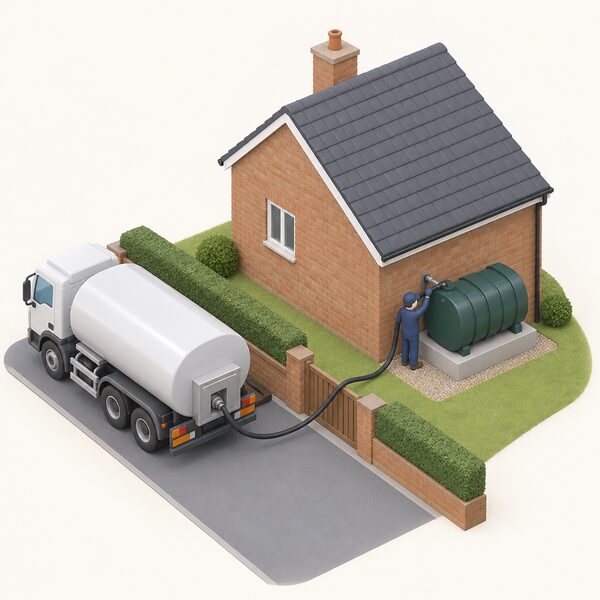
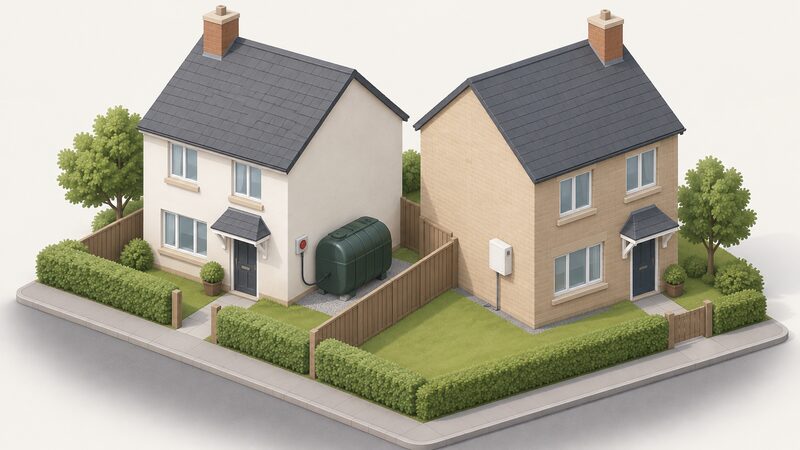
The physical difference is simple. An oil system needs a tank, a fill point, a bund or a base, and periodic delivery. A gas system needs a meter and a connection to a network that may not exist at the address. Neither is a specification a householder chooses freely; the address decides.
For anyone weighing a change, the official heat pump check asks for nation (England, Scotland, Wales or Northern Ireland), heating system type, and number of bedrooms10. That is the level of detail a suitability assessment starts from, and it applies equally to a decision about replacing an oil boiler.
Policy on new build is already moving away from both fuels in Scotland, which shows the direction of travel across the UK. The New Build Heat Standard requires new buildings to install climate friendly heating systems instead of oil and gas boilers, introduced through standard 6.11 of schedule 5 of the Building (Scotland) Regulations 200411. Northern Ireland has consulted separately on support for low carbon heating in residential buildings13.
| Heating oil | Mains gas | |
|---|---|---|
| Households using it (Census 2021) | 63%1 | 33%1 |
| Existing dwellings relying on it | 68%3 | Not stated in the same source |
| Price protection | None | Energy Price Guarantee directions apply7 |
| Network requirement | None; tank on site | Mains connection required |
| Cost to heat a typical three bedroom house | Around 50% higher than mains gas4 | Baseline in that comparison4 |
| Position in new build policy | Being displaced in Scotland; under consultation in NI11 | Same |
What the support schemes cover, and what they do not
The Home Heating Oil Support Scheme exists because oil households had no equivalent of the gas price guarantee. On 16 April 2026 the Northern Ireland Executive agreed proposals for a Home Heating Oil Support Scheme to provide financial assistance to households impacted by rising home heating oil costs14. The support package was £36.4 million2.
Eligibility was broad but not universal. The scheme opened for around 340,000 eligible households across Northern Ireland5, and the £100 voucher scheme began taking applications on 9 September 20265. The Home Heating Oil (Temporary Financial Assistance) Regulations (Northern Ireland) 2026 were screened, with no full equality impact assessment recommended, and £17.2 million was allocated to Northern Ireland for 2026 to 202715.
The Energy Price Guarantee, by contrast, never covered oil. Its directions apply to Northern Ireland and cover domestic gas consumers7, with a scheme document written for domestic gas consumers in Northern Ireland18. That is the structural gap: a regulated fuel got a guarantee, an unregulated fuel got a discretionary support scheme with a budget and a closing date.
For households in arrears or struggling with bills, the Consumer Council offers an energy price comparison tool to compare electricity and gas tariffs for all suppliers in Northern Ireland19. That tool covers gas and electricity, not oil, which again reflects the split in how the two fuels are regulated.
What it costs, and why the figures differ
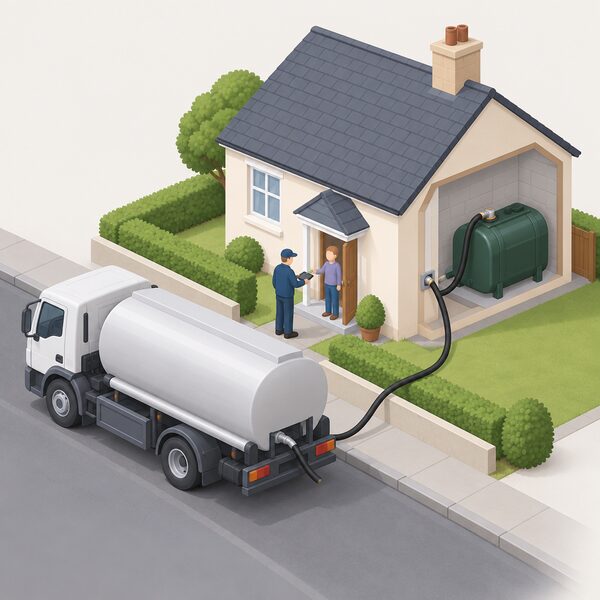
The headline comparison is a 50% premium. The UK average cost of heating a typical three bedroom house is around 50% higher with heating oil than with mains gas4. That is an average across the UK, and it is a modelled comparison rather than a bill any one household receives.
The 2026 price movement is the sharper figure. Consumer Council data recorded the average price of home heating oil in Northern Ireland rising by approximately 85 to 95% between the end of February and mid-March 20264. The Executive's own statement described recent price increases of nearly 100% in just a few weeks2. The two figures describe the same period and differ in precision; both are given here.
The reason oil moves like this is that it is bought, not supplied. A gas customer pays a unit rate set under a regulatory framework with a guarantee behind it. An oil customer pays whatever the local distributor charges on the day of delivery, and the price reflects international crude and refined product markets, haulage, and the timing of the order. Nothing in the Northern Ireland framework caps it.
"the average price of home heating oil in Northern Ireland increased by approximately 85 to 95%"
What a household should expect in practice is a cost that is higher than gas on average and far more volatile than gas at the extremes. The support schemes soften the spike for eligible households, but they are one-off payments against a price that can move by most of its value in a fortnight.
Where the network does not reach
The comparison only applies where there is a choice. Mains gas reaches 33% of households1. For the rest, the realistic alternatives to oil are a heat pump, a biomass system, or continued oil use.
The 2023 Building Regulations Phase 3 discussion document set out two options for new homes. Under Option 1, heat pumps or alternative solutions, potentially biofuel, would be required in areas without access to mains gas3. The same document concluded that a significant increase in the uptake of heat pumps is likely under both Options 1 and 2 in new homes off the gas grid, if oil heating is no longer viable3.
That is a statement about new homes, not about the existing stock. The existing stock is where the 68% oil reliance sits3, and retrofitting it is a different problem from specifying a new build. The Department for the Economy has consulted on support for low carbon heating in residential buildings in Northern Ireland13, which is the route by which existing oil households would be addressed.
The Climate Change Committee's view is that the transition should be rapid. It states that with the majority of homes heated by highly emitting oil boilers, Northern Ireland should rapidly transition to low carbon heating6. Its projection is that by 2040, more than two thirds of homes in Northern Ireland are heated by low carbon electric heating, predominantly heat pumps6. Northern Ireland has committed to reaching net zero by 205020.
For a household, that means the oil boiler is not the long term answer in policy terms, but it remains the present answer for most homes off the gas grid. The independence it gives is real and immediate; the dependence it creates is on a fuel with no price protection and a policy direction running against it.
The companies and services in this market
The Northern Ireland energy market has a small number of named participants, and their status matters to a household deciding who to deal with.
Firmus Energy supplies townlands, and the Utility Regulator must approve any tariff changes in its ten townland networks9. That regulatory step is the main protection a gas customer in those areas has.
Several energy services firms appear in the Energy Ombudsman's dispute listings, which record their status. Northstar Utility Group Limited is listed as Active21. Energy Optimise Service is listed as Active22. Nicolson Energy Solutions Ltd is listed as Active23. LT Energy Consultants Ltd is listed as Active24. Go Compare Energy Ltd is listed as Active25. Energy Swap is listed as Active26. Highland Electricity Limited is listed as an Energy Supplier27.
On the technology side, the Heat Pump Ready programme's Newcastle project lists E.ON Energy Solutions Limited as its lead organisation28. That is a funded project rather than a product warranty, and it indicates where installer capacity is being developed.
What this means for household energy independence
Oil gives a Northern Ireland household something gas cannot: it works when the network does not reach, and it keeps working through a supply interruption. A tank on site is stored energy, and stored energy is independence of a kind.
What it does not give is independence from price. The 85 to 95% movement recorded between late February and mid-March 20264, and the near 100% figure the Executive used2, are the clearest evidence that an oil household carries the full market risk. There is no cap, no guarantee and no regulator setting the price. The support schemes are discretionary, budgeted and time limited.
Gas offers price protection but only where the pipes run, and that is 33% of households1. The Energy Price Guarantee directions apply to Northern Ireland and cover domestic gas consumers7, which is a meaningful protection for that third of homes and nothing at all for the other two thirds.
The remaining dependence for an oil household is on the distributor, the delivery schedule and the world price. For a gas household it is on the network, the supplier and the regulator. Neither is self-sufficiency. The policy direction, more than two thirds of homes on low carbon electric heating by 20406, points to a third model in which the dependence shifts to the electricity network and to whatever generates the power.
For related detail, see how Northern Ireland homes are heated, the Home Heating Oil Scheme in Northern Ireland, fuel poverty in Northern Ireland, and the pillar guide to home energy across the UK nations.
Sources28 cited
- Research briefing CBP-9838: Heating and energy in Northern Ireland, House of Commons Library
- Lyons announces agreement on Home Heating Oil Support, Department for Communities, 2026-04-16
- Building Regulations discussion document 2023, Department of Finance, 2023-10-11
- Research briefing SN05806: Heating oil prices and support, House of Commons Library, 2026
- Lyons announces opening date for Home Heating Oil Support Scheme, Department for Communities, 2026-08-26
- Electric technologies will benefit Northern Ireland, Climate Change Committee, 2025-03-19
- Energy Price Guarantee for Domestic Gas Consumers in Northern Ireland, Direction No.1, GOV.UK, 2022-12-19
- Energy Price Guarantee for Domestic Gas Consumers in Northern Ireland, Direction No.2, GOV.UK, 2023-06-23
- Energy Prices (Domestic Supply) (Northern Ireland) Regulations 2022(NorthernIreland)Regulations2022), Hansard, 2022-11-16
- Check if a heat pump could be suitable for you, GOV.UK, 2026-09-17
- New Build Heat Standard factsheet, Scottish Government, 2025-01-01
- New Build Heat Standard direction, Scottish Government, 2024-09-19
- Consultation on support for low carbon heating in residential buildings, Department for the Economy, 2026-09-19
- Home Heating Oil Support Scheme FAQs, Department for Communities, 2026-04-16
- Home Heating Oil (Temporary Financial Assistance) Regulations (Northern Ireland) 2026 screening, Department for Communities, 2026-09-03
- Home heating oil support, nidirect, 2026-09-17
- Energy Price Guarantee for domestic energy consumers in Northern Ireland: ministerial directions, GOV.UK, 2023-01-04
- Energy Price Guarantee scheme documents, GOV.UK, 2022-10-31
- Advice if you're struggling to pay your energy bills, nidirect, 2026-09-17
- Research briefing CBP-9888: Net zero and climate targets, House of Commons Library, 2026-07-10
- Northstar Utility Group Limited, Energy Ombudsman, 2026-09-19
- Energy Optimise Service, Energy Ombudsman, 2026-09-19
- Nicolson Energy Solutions Ltd, Energy Ombudsman, 2026-09-19
- LT Energy Consultants Ltd, Energy Ombudsman, 2026-09-19
- Go Compare Energy Ltd, Energy Ombudsman, 2026-09-19
- Energy Swap, Energy Ombudsman, 2026-09-19
- Highland Electricity Limited, Energy Ombudsman, 2026-09-19
- Heat Pump Ready Programme Stream 1 Phase 1 projects, GOV.UK, 2026-05-28
 Home HeatingWhy do so many homes in Northern Ireland run on heating oil, and will that ever change?
 Housing Stock Data for NIMost homes in Northern Ireland heat with oil, so why are the grants and help different from the rest of the UK?
 Fuel PovertyWhy does Northern Ireland have such a high rate of fuel poverty, and how many households are affected?
 Housing Stock and EPCsNorthern Ireland's homes score best in the UK for energy efficiency, yet most run on heating oil.
 Climate TargetsNorthern Ireland has committed to cutting its greenhouse gas emissions to almost nothing by 2050, with a big reduction due by 2030.
 Tariffs in Northern IrelandWhy does Northern Ireland have its own energy tariffs instead of the Ofgem price cap?