In this guide
Northern Ireland's homes have the highest average energy efficiency rating of the four UK nations, and that headline hides the most oil-dependent housing stock in the country. At Census 2021, 63% of households used heating oil and 33% used mains gas1. The comparable data shows Northern Ireland at the top of the four-nation ranking, followed by Scotland and England, with the lowest average rating in Wales2.
The practical consequence is that a Northern Ireland EPC is measuring a housing stock built around a fuel that scores badly on cost. EPC ratings are based on the costs of home heating, rather than its carbon footprint, which means that cheaper heating scores better3. Oil is not the cheap option it once was, and the ratings reflect that.
This page sets out what the EPC data for Northern Ireland covers, the average rating and how it compares, the age, type and fuel mix behind it, the rural and urban split, what a band means for a householder, and the schemes that can move a rating. It also covers the smart meter gap, which is unique to Northern Ireland among the four nations.
What the EPC data for Northern Ireland covers
The Energy Rating of Housing in Northern Ireland is an annual publication produced by the Analytics Division, and it holds the status of Official Statistics in Development4. That status matters: it means the figures are published to official standards but are still being developed, and the producer must adhere to the Code of Practice for Official Statistics as enforced by the UK Statistics Authority4.
Alongside that publication, the Northern Ireland Statistics and Research Agency publishes Census 2021 tables that classify households by EPC band. One table covers EPC band by household tenure by resident characteristics, and another covers EPC band by household characteristics7. These are census estimates rather than live certificate data, so they describe the stock as it stood at the census rather than the certificates lodged since.
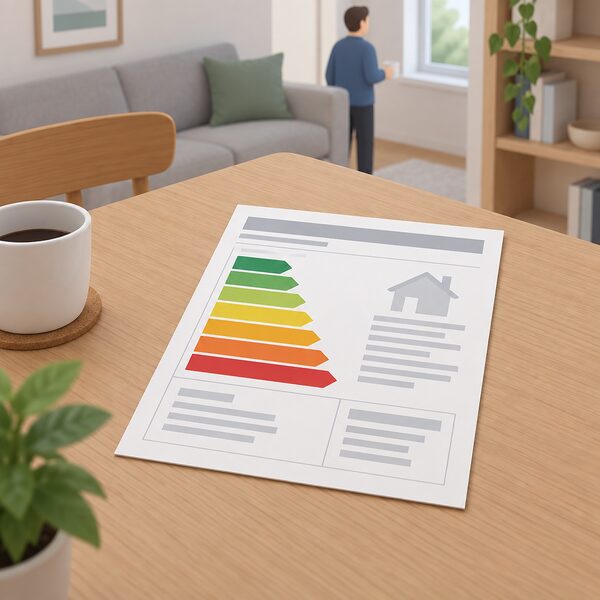
The certificate itself is a familiar document. An EPC carries a rating on an A to G scale, and the score behind it typically ranges from 1 to 1009.
| Band | Score | Position on the scale |
|---|---|---|
| A | 92 plus | Most efficient |
| C | 69 to 80 | Above the proposed rented minimum |
| D | 55 to 68 | Where the Northern Ireland average sits |
| E | 39 to 54 | Current minimum for certain rented property in England and Wales |
| G | 1 to 20 | Least efficient |
What the rating measures is cost, not carbon. The official position is that EPC ratings are based on the costs of home heating, rather than its carbon footprint, which means that cheaper heating scores better3. That single design choice explains much of the Northern Ireland picture, because it means a home's band responds to the price of its fuel as well as to its insulation and glazing.
Average EPC rating in Northern Ireland: the headline figure
The headline is a ranking rather than a single number. The latest comparable data shows that homes in Northern Ireland had the highest average energy efficiency rating of the four nations, followed by Scotland and England, with the lowest average rating in Wales2. That is the figure to quote, and it is the one the Climate Change Committee and the Commons Library both use.
The underlying scores are harder to pin down because the sources measure different things. Northern Ireland Housing Statistics 2023-24 records a SAP rating of 65.11 for owner occupied dwellings, with the private rented sector at 65.3310. Those are SAP points on the same broad scale as the EPC score, and they sit in band D territory, which runs from 55 to 689.
The Scottish House Condition Survey offers a useful cross-check on what different fuels deliver, because it reports mean ratings by heating fuel.
| Heating fuel | Mean energy efficiency rating | Share in band C or better |
|---|---|---|
| Mains gas | 70 | 61% |
| Other fuels | 64.7 | Not given |
| Electric | 60.5 | Not given |
| Oil | 55.8 | Not given |
Those are Scottish figures, and they are the closest published breakdown of the fuel effect available11.
Put together, the picture is a stock that ranks first among the four nations on average but still clusters in the middle bands, held back by a fuel mix that scores poorly on cost. The ranking is real, and so is the gap to band C.
How Northern Ireland compares with England, Scotland and Wales
The four-nation comparison is more complicated than a single league table, because each nation publishes on its own cycle and its own basis.
The ranking itself is clear: Northern Ireland first, then Scotland and England, with Wales lowest2. That is the comparable data, and it is the figure to use when the question is which nation's homes rate best on average.
The reasons behind the ranking are less flattering. Northern Ireland and Wales spent three times and twice as much respectively per capita on energy efficiency in 2017, which suggests a stock that needed more work rather than one that was already efficient12. Older evidence on non-gas heated homes found that 60% of non-gas heated homes in Wales and 22% in Scotland were F and G rated, compared to less than 10% of gas-heated homes3. That is a 2011 to 2012 figure, but it shows the mechanism: off the gas grid, ratings fall.
England and Wales now publish combined energy efficiency statistics, and those show how far the top of the scale is from the average. Just over 65% of local authority areas, 207 out of 318, had more than half of their housing in band C or higher, an EPC score of 69 or above9. New builds in urban, larger rural and smaller rural areas all had a median EPC rating of 84 in England and Wales9.
Scotland's non-domestic stock shows the same pattern from the other direction: nearly 70% of all non-domestic premises have an EPC rating of E or worse13. Scotland also publishes a comparative assessment on its non-domestic certificates, showing the rating that would be obtained if the methodology used in England and Wales was applied with Scottish climate data14.
For a household, the comparison is a reminder that the four nations run separate EPC systems with separate enforcement, and that a certificate does not travel. The full guide to how the four nations differ sets out the wider picture.
Housing stock: age, type and heating fuel behind the ratings
Age is the strongest single predictor of a rating. Around 95% of gas consuming properties built from 2000 onwards have EPC ratings A to C, compared with around a quarter of those built before 194515. That is a gap of roughly seventy percentage points between the newest and oldest cohorts, and it is the clearest statement of how much the age of the stock drives the average.
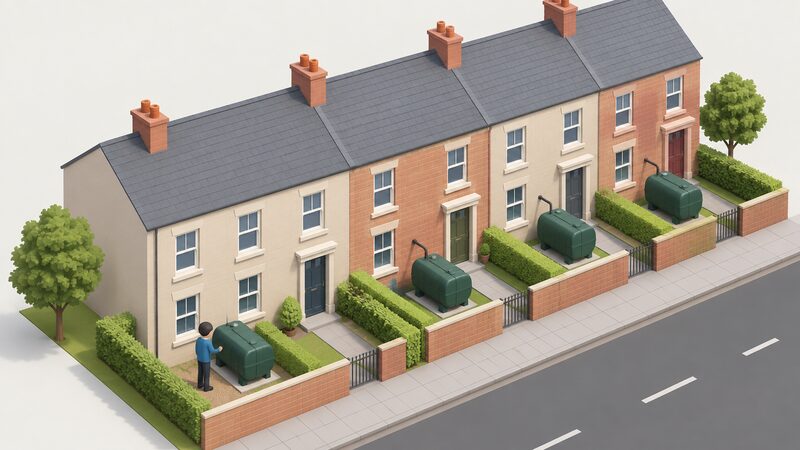
Fuel is the second. At Census 2021, 63% of households used heating oil and 33% mains gas1. For existing dwellings the oil reliance is higher still, at 68%4. That is the structural fact behind the ratings: a stock where two thirds of homes burn a fuel that scores badly on a cost-based rating.
The fuel effect shows up directly in the mean ratings. Properties heated by mains gas average 70 on the energy efficiency rating, with 61% in band C or better, while oil averages 55.8, electric 60.5 and other fuels 64.711. Gas-heated homes are more than fourteen points ahead of oil-heated homes on that measure.
Dwelling type matters too. Houses average 62.4 on the environmental impact rating and flats 69.4, with 35% of houses and 61% of flats in the better bands11. Flats are smaller and easier to heat, which lifts their scores.
New build ratings are the exception that proves the rule. New builds in urban, larger rural and smaller rural areas all had a median EPC rating of 84 in England and Wales9. But Northern Ireland is still building oil-heated homes: EPC data suggests that some 30% or more of new dwellings here are still being constructed using home heating oil4. A new home on oil starts its life with a rating handicap that no amount of modern fabric fully removes.
Why oil heating holds ratings back
The mechanism is straightforward once the cost basis is understood. Because EPC ratings are based on the costs of home heating rather than carbon, a fuel that has become expensive drags a rating down even where the building fabric is sound3. Oil has become expensive: Northern Ireland saw recent price increases of nearly 100% in just a few weeks16.
The scale of exposure is large. Approximately 500,000 homes in Northern Ireland rely on oil as a primary heating source, and roughly two thirds of homes rely on oil heating16. In parliamentary debate the figure was put at over 60% of homes relying on oil for heat, and separately at almost two thirds17. The documents give slightly different shares, from over 60% to roughly two thirds, and they are not reconciled.
The archetype work behind Ofgem's modelling identifies the same pattern in a different dataset: rural dwellings heated mainly by oil have poor EPC ratings of E to G18. That is a modelled archetype rather than a Northern Ireland measurement, but it matches the fuel-by-fuel ratings and the census fuel shares.
What this means for a household is that the fuel decision and the rating are linked. A home on oil can be improved through insulation, glazing and heating controls, and the rating will rise, but the fuel itself sets a ceiling that gas-heated homes do not face. The oil question in Northern Ireland is covered in more detail elsewhere on this site.
Rural versus urban ratings

Rural homes rate worse than urban ones, and the gap is consistent across the datasets.
In Scotland, the mean energy efficiency rating is 69.5 for dwellings in urban areas, with 60% in band C or above, against 61.4 for rural dwellings11. That is an eight-point gap on the same scale.
In England, smaller rural areas have a lower median score of 63, compared with urban or larger rural areas, both scoring 699. Existing smaller rural properties were much lower, at 59, while existing urban properties had a median EPC of 68 and existing larger rural properties 679. The pattern is that small rural homes do worst, larger rural homes do better, and urban homes sit in between.
The Ofgem archetype work adds a Northern Ireland-relevant detail: in one rural archetype, 51% are rural households with EPC ratings of D, against a Great Britain average of 22%18. That is a modelled archetype, not a measured Northern Ireland figure, but it describes the same off-gas-grid rural household that dominates the Northern Ireland stock.
The reason rural ratings lag is the fuel, not the postcode. Rural homes are the ones off the gas grid, and off-gas-grid homes are the ones on oil. The 2011 to 2012 evidence found that 60% of non-gas heated homes in Wales and 22% in Scotland were F and G rated, compared to less than 10% of gas-heated homes3. Rural Northern Ireland sits in that same off-grid category, and the rural and urban fuel poverty split shows how the pattern plays out for households.
What an EPC band means for householders
A band is a position on a scale, and the scale is fixed. Band G runs from 1 to 20 and is the least efficient, band E from 39 to 54, band D from 55 to 68, band C from 69 to 80, and band A from 92 plus9. The score behind the band typically ranges from 1 to 1009.
The band matters because policy attaches to it. The UK Government has proposed raising the minimum EPC standard for domestic private rented properties to band C by 2030, but this is proposed and not yet in force19. In England and Wales the current minimum standard for certain domestic rented property is a rating of E or above19. Northern Ireland's private rented sector is governed by its own regulations, and the proposed band C standard is a Great Britain proposal.
For social housing, the Warm Homes: Social Housing Fund targets Energy Performance Certificate band C for social housing stock currently below that standard20. That is a funding programme rather than a Northern Ireland standard, but it shows the direction of travel across the UK.
For an owner occupier, the band is mainly a signal about running costs and about what a future buyer or tenant will see. It is also a signal about what retrofit would achieve: in the Home Upgrade Grant Phase 2, the average EPC improved by one band, with 60% of homes upgraded to band C or higher20. One band is the realistic expectation from a funded retrofit package, not three.
Do I need an EPC to sell or rent a home in Northern Ireland?

Yes. An EPC must be made available to a buyer or a new tenant, and district councils are the enforcing authority in Northern Ireland21. That is the enforcement route, and it is separate from the English and Welsh system.
If a certificate has not been made available, the official guidance is to contact your local district council building control for advice21. That is the practical step for a buyer or tenant who has not received one.
The Northern Ireland rules sit alongside the wider UK requirement for a certificate whenever a property is marketed for sale or rent or is newly built21. An EPC is a legal requirement when selling, renting or building a home in the UK, and landlords must hold one with a minimum rating of E. Where a certificate has not been made available to a buyer or new tenant in Northern Ireland, the route for advice is the local district council building control21.
For a householder, the practical points are that a certificate is required at sale or let, that the district council enforces it, and that the certificate is based on cost rather than carbon. The Northern Ireland EPC average page covers the typical rating in more detail.
Smart meters: why Northern Ireland differs
Northern Ireland is the one UK nation where the smart meter rollout has not started. As of early 2026 no smart electricity meters have been installed in homes in Northern Ireland, according to the Consumer Council6. The Department for the Economy has announced plans for the rollout of smart meters for all homes in Northern Ireland starting in 20286.
That gap matters for energy independence because a smart meter is the device that makes time-of-use tariffs, export payments and detailed consumption data possible. Without one, a household's ability to respond to prices or to measure its own use is limited to manual readings and the existing meter replacement programme. The NIE Networks meter replacement programme covers the current arrangements, and the smart meter question covers what households can do in the meantime.
The electricity market itself is also distinct. Smart electricity meters are not currently available in Northern Ireland, and as of early 2026 none had been installed in homes there, while they have already been rolled out in Great Britain and the Republic of Ireland. All meters in the planned rollout are to be provided by NIE Networks, which would receive consumption information at regular intervals. Among Northern Ireland consumers aware of smart electricity meters, 46% felt positive about the rollout, 31% were neutral and 18% negative.
NISEP and schemes that can improve your rating

The Northern Ireland Sustainable Energy Programme is the main energy efficiency programme for domestic and non-domestic customers22. In 2024/2025 it treated 2,484 domestic properties22. The Utility Regulator approved the list of schemes for 2026/2027 and published the full list23, and the programme has been extended for two years to March 2029 with a new break clause, running from 1 April 2027 to 31 March 2029 and closable after the first year if the Department for the Economy's successor scheme is fully developed24.
The Priority PV Scheme is one of the schemes on the list, and its eligibility is narrow:
- Northern Ireland Housing Executive tenants only
- Outside a natural gas area
- A single storey Housing Executive property with oil or electric heating
- A couple or single parent family with an income or pension less than £35,000 gross23
The Home Heating Oil Support Scheme is open to households who use oil as their primary source of heating, are resident in Northern Ireland, and, in either of the qualifying months, are in receipt of a qualifying benefit, or a single person or couple, including pensioners, with an annual income of less than £30,000 net of allowable deductions25. A £100 home heating oil support voucher scheme began taking applications on 9 September 2026 for 340,000 eligible households in Northern Ireland16.
For a householder, the schemes are the practical route to a better rating, and the NISEP page and the Home Heating Oil Scheme page set out the detail. The Affordable Warmth Scheme is the other main route.
How the Energy Rating user engagement survey informs policy
The Energy Rating of Housing in Northern Ireland User Engagement Survey opened on 10 July 2024 and closes on 12 July 20284. It is run by the Analytics Division, and its stated purpose is to better understand how the statistics are being used and whether there are any improvements we can implement to better meet user's needs4.
The audiences it is aimed at are wide: academia, business, Department for Communities staff, electricity generators, energy consumers, energy suppliers, government departments, industry, local government, the private sector and research4. That breadth is a signal that the publication is used well beyond government, by suppliers, generators and researchers.
The survey matters because the EPC metrics themselves are under review. The Climate Change Committee has stated that the current EPC rating metrics do not accurately incentivise the energy efficiency and heating solutions required to deliver Net Zero homes26. Separately, the Northern Ireland Department expects to adopt a primary energy assessment in kWhPE/m2 alongside the current emissions assessment4. Scotland has already consulted on EPC reform, and its consultation response sets out the direction of that work27.
For a household, the practical implication is that the rating on a certificate today may not be the rating on the same home in a few years, because the metric behind it is being reconsidered. The Northern Ireland climate targets set the context for that reform.
Sources27 cited
- Northern Ireland heating fuel usage, House of Commons Library, 2021
- Energy efficiency of housing across the UK nations, House of Commons Library, 2026-09-17
- Energy Performance Certificates and fuel poverty, Parliament, 2011-12-30
- Northern Ireland energy efficiency of housing consultation, Department for the Economy, 2023-10-11
- Five top tips to cut your energy bills, Welsh Government, 2026-03-18
- Smart meters in Northern Ireland, Consumer Council, 2026-04
- CT0059: EPC band by household tenure by resident characteristics, NISRA, 2024-12-13
- CT0062: EPC band by household characteristics, NISRA, 2024-12-13
- Energy efficiency of housing in England and Wales, ONS, 2025-03
- Northern Ireland Housing Statistics 2023-24, NISRA, 2024
- Scottish House Condition Survey 2024 key findings, Scottish Government, 2026-02
- Written evidence on energy efficiency spend, Parliament, 2017
- Heat in buildings bill business and regulatory impact assessment, Scottish Government, 2023-11-28
- EPC reform consultation, Scottish Government, 2023-07-25
- NEED report: summary of analysis 2026, GOV.UK, 2026-06-11
- Lyons announces agreement on home heating oil support, Department for Communities, 2026-04-16
- Heating Oil Support debate, Hansard, 2026-03-16
- Ofgem archetypes update 2024, Ofgem, 2024-02
- Trading standards guidance on minimum EPC standards, Isle of Anglesey County Council, 2026-05
- Warm Homes: Social Housing Fund Wave 3 budget allocation, GOV.UK, 2024-11-21
- Energy Performance Certificates, nidirect, 2026-02-26
- NISEP 2024/2025 annual report published, Utility Regulator, 2026-07-03
- NISEP list of schemes 2026-27, Utility Regulator, 2026-04
- NISEP extension announced, Utility Regulator, 2026-04-02
- Home Heating Oil Support Scheme, Department for Communities, 2026-09-17
- Letter on reform of domestic EPC rating metrics, Climate Change Committee, 2026-09-19
- EPC reform consultation: government response, Scottish Government, 2025-01
 Housing Stock Data for NIMost homes in Northern Ireland heat with oil, so why are the grants and help different from the rest of the UK?
 New Build Energy PerformanceHow energy efficient are new build homes compared with older ones?
 Home HeatingWhy do so many homes in Northern Ireland run on heating oil, and will that ever change?
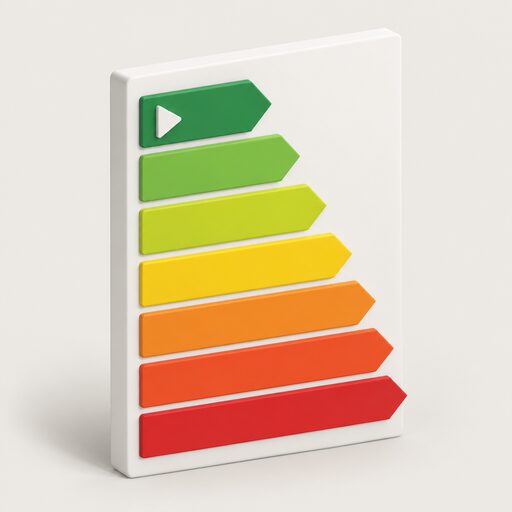 Energy Performance CertificatesAn Energy Performance Certificate rates how energy efficient your home is, from A down to G.
 Housing Stock and EPCsHow energy efficient are Scottish homes, and how many reach a good rating?
 Housing Stock Data for EnglandHow energy efficient are English homes, and how many have insulation or low carbon heating?