
In this guide
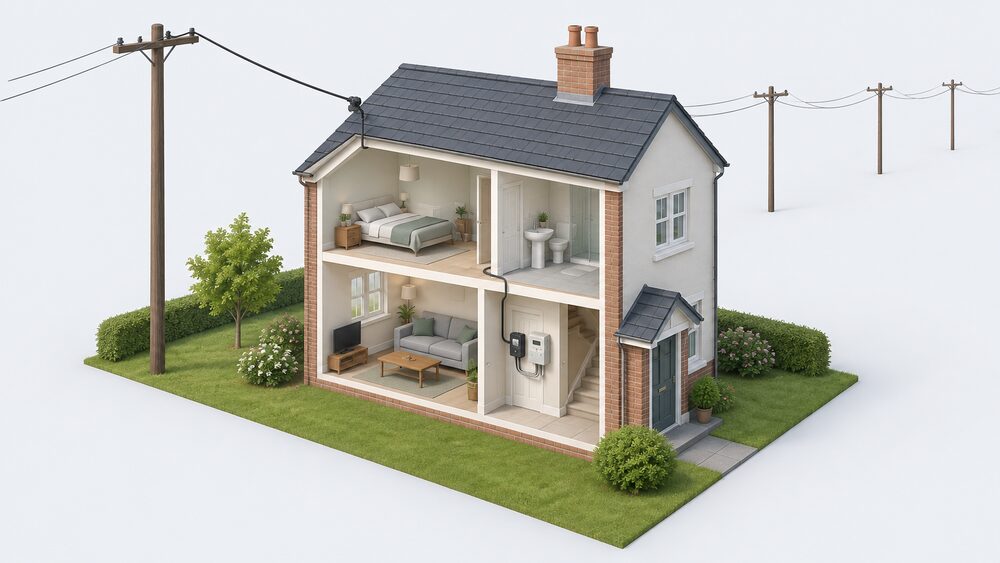
NIE Networks owns the electricity transmission and distribution network in Northern Ireland, and it owns every electricity meter in the province, both credit meters and keypad meters1. It transports electricity from where it is generated to over 910,000 customers including homes, businesses and farms3. There is no second distribution network operator to choose between: if a property in Northern Ireland has an electricity supply, NIE Networks is the network behind it, whoever sends the bill.
That single-operator structure shapes what a household can and cannot control. A home can choose its electricity supplier, but the wires, the meter, the cut-out and the connection to the wider network all sit with NIE Networks. The same company maintains meters at the properties of all customers across Northern Ireland no matter who the supplier is4. For a household thinking about energy independence, this is the boundary: solar panels, a battery or an EV charger change what a home consumes and exports, but every one of those changes runs through a NIE Networks application and, in some cases, a network check or an upgrade.
This page sets out what NIE Networks owns and serves, how power cuts and planned outages work, how to get connected or upgrade a supply, how generation and low-carbon technology applications are handled, the safety rules around working near the network, and how to contact the company or complain.
What NIE Networks owns and who it serves
NIE Networks owns the electricity transmission and distribution network, which means it is responsible for both the high-voltage system that moves power around Northern Ireland and the lower-voltage wires that reach individual properties1. It also owns all electricity meters in Northern Ireland, including both credit meters and keypad meters2. The meter replacement programme covers all customers across Northern Ireland no matter who your supplier is, and NIE Networks maintains the meters at the properties of all customers across Northern Ireland4.
The customer base runs to over 910,000 homes, businesses and farms3. The connections side of the business covers new supplies and upgrades, moves and disconnections, changes to connection size, microgeneration, small and large scale generation, and moving NIE Networks equipment11. It also connects businesses or farms and handles solar, wind and other generation connections9.
Northern Ireland is a peer nation within the UK but sits outside the Great Britain regulatory and market arrangements. The network here is a single monopoly, and the connection charging methodology changed on 1 July 2026: applications received after that date no longer pay for wider network reinforcement, which is socialised across all electricity consumers up to High Cost Caps. That change matters for anyone weighing a generation connection, because it shifts a share of the cost from the connecting party to the wider customer base.
For a household, the practical consequence is that independence from the grid is not on offer in the way it is in Great Britain. There is no competing distribution network to switch to, and no alternative wire to a property. What a home can do is reduce what it draws through that wire, and where it exports, work within the connection rules NIE Networks sets. The wider context of Northern Ireland's single electricity market and gas network is covered in Energy Supply in Northern Ireland.
Power cuts and storm response: what happens and who to call
NIE Networks aims to reconnect 87% of customers affected by a power cut, due to a fault on its distribution system, within 3 hours, and all customers within 24 hours9. Those are targets rather than guarantees, and they apply to faults on the distribution system rather than to every interruption.
Report a power cut via nienetworks.co.uk, WhatsApp, Facebook or by calling the helpline on 03457 643 6435. The helpline is the same number used for general customer service, connection enquiries and safe isolation7. Phone and online support for power cuts runs 24 hours a day, while WhatsApp and Facebook support runs Monday to Sunday 07.30 to 23.303.
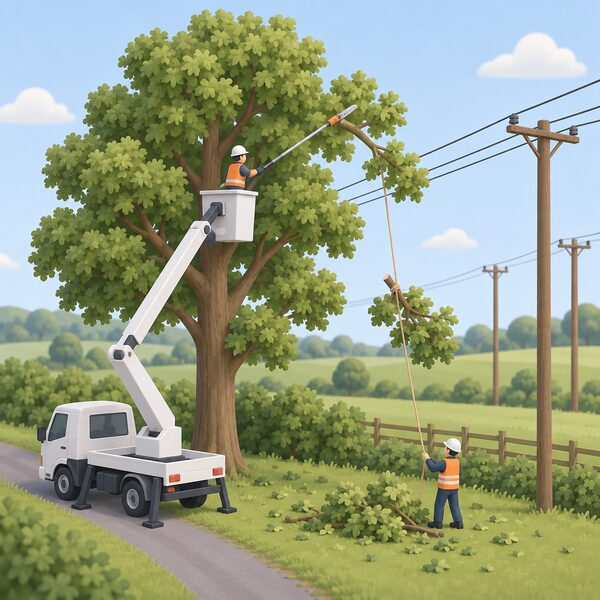
During a storm, the Energy Networks Association co-ordinates a joint response from across the energy networks, collating information from its members and sharing updates through the news and social media13. Trees are trimmed all year round to cut the risk of them falling or their branches touching power cables or other infrastructure, and shifts are planned for winter so extra emergency teams are available around the clock13.
Customers on the Customer Care Register receive extra support during a power cut, including up-to-date information by phone during a power cut or a planned interruption to supply14. NIE Networks contacts those customers regularly during the power cut with up-to-date information14. Registration can be done online, via WhatsApp, Facebook Live Chat or the Customer Helpline, or by downloading a registration form and returning it by post15.
Planned outages: notice, reasons and what to do
NIE Networks gives a minimum of three days notice before turning off electricity for planned work, and notifies homes and businesses affected by planned work8. The notification method is a postcard providing the times and dates of the planned work16. Customers on the Customer Care Register are contacted at least three days beforehand and told the expected duration of the interruption14.
Planned outages are usually due to two main reasons: works related to The Big Network Rebuild, and customers requesting a new connection or a change to their supply8. The Big Network Rebuild is the programme of work upgrading the network, and it is the single largest source of planned interruptions for households that are not themselves connecting anything.
For a household, the practical preparation is straightforward. A planned outage with three days notice allows time to charge devices, plan around medical equipment that depends on mains power, and check whether anyone in the property should be on the Customer Care Register. The register exists precisely for households where an unplanned loss of supply carries a higher risk, and it also covers planned interruptions14.
The distinction between planned and unplanned matters for what a household can expect. Planned work comes with a postcard and a date. Faults and storms do not, and the reconnection targets of 87% within 3 hours and all customers within 24 hours are the relevant figures there9. More on how notice periods compare across the UK is at How much notice would I get before a planned power cut?.
Getting connected: new supplies, upgrades and generation connections
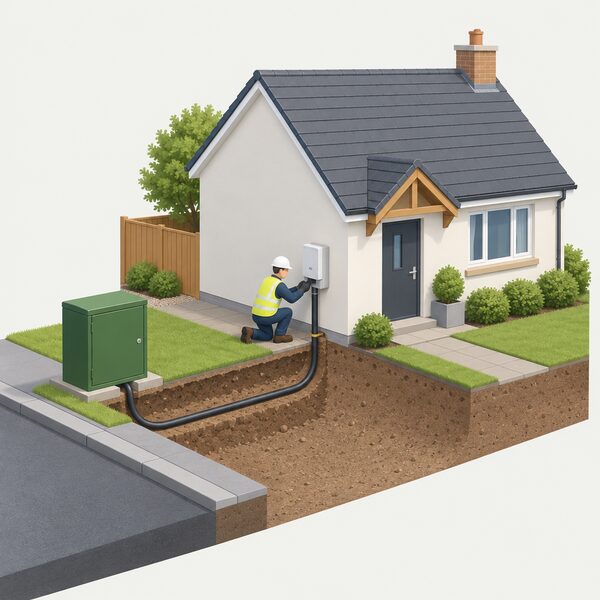
NIE Networks handles upgrades to an existing supply and new supplies, along with moving a supply (a service alteration), disconnecting a supply, changing the size of a connection, connecting microgeneration under G98/NI, connecting small or large scale generation under G99/NI or G99/NI Fast Track, and moving NIE Networks equipment11. New connection categories include a new single domestic connection, a new single business connection, new multiple home connections, new multiple business connections, a micro generation connection (G98/NI), and a small or large scale generation connection (G99/NI or G99/NI Fast Track)11.
A quick, high-level cost estimate tool is available for a new domestic or small commercial connection, though it does not cover all postcodes yet7. For a single house, NIE Networks needs key details in the application form, including the size of the generation system, the type of equipment, and information about your installer17. Where an application includes generation equipment, all generation details must be provided before the new supply can be energised18.
The connections process runs in stages, with payment for the connection at Stage 3, and paying online is faster and the preferred method7. For generation connections, once NIE Networks has received the application and supporting information, along with the connection application fee, the job enters the Generation queue19. NIE Networks will process all applications and provide a quote, which will outline the work required to connect you, within 90 days of receiving the application and all supporting documentation and fee19.
NIE Networks gives two different timescales for delivering a new connection: one of its pages states within 30 working days, another states within 40 working days. Which applies to a given job is not settled by either page, so the timescale confirmed in the connection offer is the one that governs.
For a household, the connection route is the gate to almost every form of energy independence. A new supply, an upgrade, or a generation connection all run through the same application and the same fee. The wider process for a new or upgraded supply is set out at Getting a New or Upgraded Electricity Connection.
Connection size bands: microgeneration, small scale and large scale
NIE Networks separates generation connections into bands. Microgeneration is handled under G98/NI, while small and large scale generation is handled under G99/NI or G99/NI Fast Track11. The Fast Track route is a distinct application path, and its parameters changed on 1 May 2026: installations of up to 60A per phase can be applied for, with the export limit remaining at 16A per phase.
A small scale generation connection application must contain a set of documents. These are a completed generation questionnaire, a cheque for the Connection Application fee made out to NIE Networks Ltd, location details including a site map, planning details with a planning reference number if submitted or approved, a generator technical specification, and a 1:2500 and 1:500 scale site location plan20. The technical specification needs a single line diagram, flicker co-efficient, starting currents and type of starter, and a harmonics report up to the 50th harmonic for inverter connected generators19.
For areas which require maps larger than 1250 scale, a separate request must be sent by email or post21. The design stage can include a network study, harmonic assessments and possibly a site visit to assess the connection19.
| Band | Route | Key parameter |
|---|---|---|
| Microgeneration | G98/NI | Domestic-scale generation11 |
| Small or large scale | G99/NI | Standard generation connection11 |
| Small or large scale | G99/NI Fast Track | Up to 60A per phase, export limit 16A per phase22 |
The bands matter because they determine which application form, which technical documentation and which assessment route apply. A household installing a modest solar array sits in the microgeneration band; a farm or business installing a larger generator moves into the G99/NI territory, with the fuller documentation set that goes with it. The connection queue and reform context across the UK is covered at The Grid Connection Queue and Connections Reform.
EV charge points and heat pumps: the application process and network checks
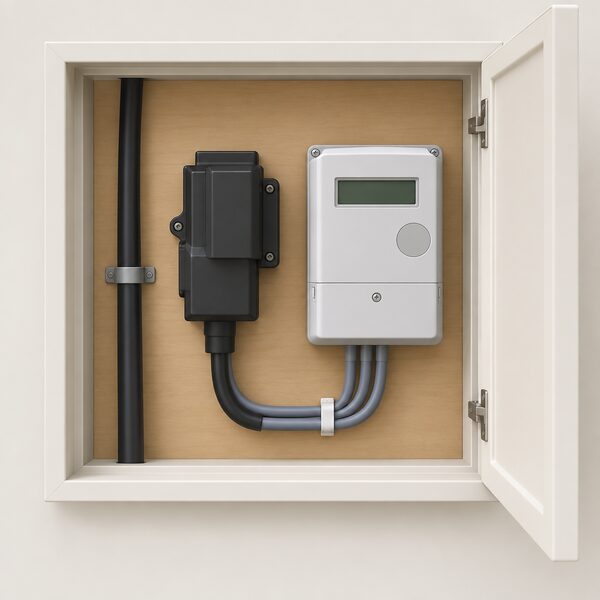
An application must be sent before installing the equipment so NIE Networks can check the supply can handle the new electrical loading23. Homeowners or property owners must choose the equipment and nominate an EV Charge Point or Heat Pump installer, who carries out checks and submits the application on their behalf23. Installers must submit all applications through the ENA's Connect Direct website, and the installer's responsibility to inform NIE Networks is met by submitting an online application23.
The installer needs the customer's MPRN, the full installation address, and the meter number with a clear photo of the cut-out and meter23. The MPRN is an 11-digit number that begins with 81 and can be found on the electricity bill24. Where the application is for Air Source or Ground Source Heat Pumps or EV Chargers, the Make and Model must be provided in the 'Type of appliance' field so NIE Networks can check the appliance has been certified for use in Northern Ireland18.
If EV chargers or other low-carbon technologies push demand above the available supply, an upgrade may be required, and NIE Networks will assess the work and provide costs before proceeding23. Where an upgrade is needed, NIE Networks outlines the work including any network reinforcement and provides a formal quotation; no work proceeds until the quote is accepted23. Certain older cut-outs would not be capable of the increased supply required following the connection of an EV charger or heat pump and will need to be upgraded by NIE Networks25.
A cut-out is a piece of electrical equipment that forms the link between the NIE Networks electricity cable and the internal wires in your property25. It is the physical boundary between the network and the home's own installation, and it is the component most often found wanting when a heat pump or charger is added to an older property.
A home connection application can include the new connection as well as an EV charger, solar panels, battery storage or heat pump6. That bundling matters for a household planning several changes at once: it brings them into a single application rather than a sequence of separate ones. The demand-side context is covered at Rising Electricity Demand: EVs, Heat Pumps and Data Centres.
Working near the network: safe isolation, cut-outs and tree cutting
NIE Networks offers two safe isolation options: a Stay-on-site service, where engineers disconnect power and remain while work is completed, and a Two-visit service27. The Stay-on-site service sees NIE Networks arrive on site to de-energise equipment, allowing an electrical contractor to install a suitable means of isolation between the meter and consumer unit, remaining on site until it is safe to re-energise12.
The safe isolation service applies where work involves the electrical installation, such as replacing or upgrading a consumer unit, installing EV chargers, solar panels or heat pumps, a rewire or extension, or repairing damage after a fault or flooding27. Unauthorised work on the meter and the electricity network is dangerous for both the installer and the customer and is in breach of current Health and Safety legislation12.
On trees, the higher the voltage, the greater the safety clearance required21. Tree cutting issues can be reported to NIE Networks, along with street lighting faults and vandalism10. The network's own storm preparation includes trimming trees all year round to cut the risk of them falling or their branches touching power cables or other infrastructure13.
NIE Networks employees and anyone working on its behalf, including tree cutters, meter readers, engineers and meter replacement contractors, will always carry proof of identification28. If someone claiming to be from NIE Networks cannot show identification, the advice is to hang up and call the company directly on 03457 643 64328.
"Unauthorised work on the meter and the electricity network is dangerous for both the installer and the customer and is in breach of current Health and Safety legislation"
For a household, the safe isolation service is the mechanism that makes a solar, battery or heat pump installation lawful and safe. It is not optional where the work touches the installation, and it is the point at which the network operator and the household's own contractor meet. The safety rules around overhead lines are covered at What safety precautions apply near overhead power lines?.
Contacting NIE Networks and complaining

The customer helpline number is 03457 643 643, used for general customer service, connection enquiries, power cut reporting and safe isolation7. The customer service team is available between 8.30am and 5.00pm Monday to Friday, excluding public and bank holidays6. WhatsApp and Facebook support runs from 7.30am to 11.30pm, seven days a week, including public and bank holidays7. Power cut reporting by phone and online runs 24 hours a day3.
Complaints can be made via WhatsApp or Facebook Live Chat, through the online complaint form, or by post29. NIE Networks advises within 10 working days on complaints needing further investigation, and replies to letters and emails within 10 working days9. The purpose of a complaint is usually to get answers about what went wrong, and may also be to seek an apology or be told that changes will be made to stop recurrence29.
By post, write to the Customer Relations Manager at NIE Networks, Carn Industrial Estate, Portadown, BT63 5QJ29. If you are unhappy with the outcome, you can escalate to the Managing Director at NIE Networks, 120 Malone Road, Belfast, BT9 5HT, and NIE Networks will reply to all complaints received within 10 working days29.
Issues about an electricity bill or keypad credit are routed to the electricity supplier rather than NIE Networks29. Damage to the network, such as street lighting, vandalism or tree cutting issues, can be reported through the same contact channels10. Meter replacement appointments can be booked on 028 9575 7283, with three time bands available: AM, PM or All day, Monday to Friday4.
For a household, the split between network and supplier is the thing to hold on to. NIE Networks owns the wires and the meter; the supplier owns the bill and the tariff. A complaint about a meter fault or a connection goes to NIE Networks; a complaint about a charge goes to the supplier. The consumer body's guidance on bills and metering is at the Consumer Council for Northern Ireland2.
Sources30 cited
- Connections FAQs, NIE Networks, 2026-09-19
- Bills and metering, Consumer Council for Northern Ireland, 2026
- Emergency power cuts, NIE Networks, 2026-09-19
- Meter replacements, NIE Networks, 2026-09-19
- Power cut help, NIE Networks, 2026-09-20
- Home connection, NIE Networks, 2026-09-20
- Connections help and guidance, NIE Networks, 2026-09-19
- Planned power cuts, NIE Networks, 2026-09-20
- Connections, NIE Networks, 2026-09-19
- Help and advice, NIE Networks, 2026-09-19
- Help to select, NIE Networks, 2026-09-19
- Safe isolation, NIE Networks, 2026-09-19
- Storms and bad weather, Energy Networks Association, 2026-09-17
- Customer Care Register, NIE Networks, 2026-09-19
- Critical care register, NIE Networks, 2026-09-19
- Planned work FAQs, NIE Networks, 2026-09-19
- Application help for a single house, NIE Networks, 2026-09-19
- Application help for multiple houses, NIE Networks, 2026-09-19
- Generation connections FAQs, NIE Networks, 2026-09-19
- Documentation to send with small scale generation, NIE Networks, 2026-09-19
- Safety FAQs, NIE Networks, 2026-09-19
- G99/NI Fast Track installations, NIE Networks, 2026-09-19
- EVs and heat pumps, NIE Networks, 2026-09-19
- Apply now, NIE Networks, 2026-09-19
- EVs and heat pumps FAQs, NIE Networks, 2026-09-19
- What is a cut-out, NIE Networks, 2026-09-20
- Safe isolation FAQs, NIE Networks, 2026-09-19
- When we come to your home, NIE Networks, 2026-09-20
- Claims and complaints, NIE Networks, 2026-09-19
- Overall standards, NIE Networks, 2026-09-19