
In this guide
NIE Networks runs an ongoing meter replacement programme across Northern Ireland, replacing all types of domestic and commercial electricity meters after a prescribed period of time1. The work is carried out by NIE Networks staff, and the meters being installed are digital display meters approved to European Standards1. Because NIE Networks owns every electricity meter in Northern Ireland, including both credit meters and keypad meters, the programme applies to all customers no matter who their supplier is2.
The practical shape of a visit is short. NIE Networks states that replacing the meter and carrying out all relevant safety checks takes approximately 30 minutes to one hour, and that power to the property is switched off for approximately 20 minutes of that1. Appointments are offered in three bands, AM, PM or All day, Monday to Friday, and are booked on 028 9575 72831.
The programme is not the smart meter rollout. There are currently no smart electricity meters in Northern Ireland, though they have already been rolled out in Great Britain and the Republic of Ireland, and the Department for the Economy has announced plans for a rollout to all homes starting in 20283. Until then, the meter on the wall is a conventional digital meter that is read, tested and inspected by NIE Networks Meter Readers every three months4.
What the NIE Networks meter replacement programme is
The programme is a maintenance obligation rather than a customer upgrade. NIE Networks states plainly that it replaces all types of domestic and commercial meters after a prescribed period of time, and that different types of meter are required to be changed at different intervals1. The trigger is the age and type of the asset, not a request from the householder and not a change of supplier.
The work is done in house. NIE Networks staff carry out the replacements, and all meter installers have completed comprehensive training and are fully qualified electricians1. The company also states that all employees of NIE Networks will carry identification, wear identifiable uniforms and drive marked vehicles1. That matters for verification: the person at the door is not a subcontractor working from a list of addresses, but an employee of the network operator that owns the meter.
The programme sits alongside a wider metering service. NIE Networks reads, tests and inspects the meters of all electricity customers in Northern Ireland every three months, and it provides that service to all electricity suppliers in Northern Ireland4. Meter Readers will read, test and inspect all electricity meters in Northern Ireland even if customers submit their own readings, so a household that sends in its own figures does not remove the visit5. The inspections exist to make sure the equipment is safe and that meters are giving accurate, up to date information5.
For a household, the independence question here is narrow but real. The meter is the point at which the home connects to the NIE Networks electricity network, and it is owned by the network rather than the occupant7. A household cannot choose its meter, cannot buy a replacement, and cannot opt out of the inspection cycle. What the programme does deliver is a metering point kept within its prescribed life and checked for safety and accuracy on a fixed cycle, which is the foundation any later decision about tariffs, generation or storage rests on. The dependence that remains is on the network operator and on the supplier that issues the bill, since NIE Networks passes the reading to the supplier and the supplier issues the bill4.
Who is covered: all customers, whatever your supplier
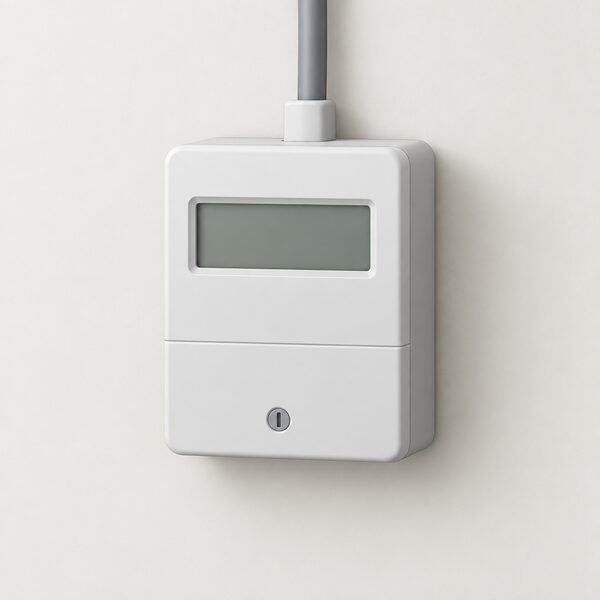
Coverage is universal. NIE Networks maintains the meters at the properties of all customers across Northern Ireland no matter who the supplier is, and the replacement programme replaces all types of domestic and commercial meters1. The Consumer Council is equally direct: NIE Networks owns all electricity meters in Northern Ireland, including both credit meters and keypad meters2.
That ownership model explains why the programme is not something a household signs up to. There is no application, no eligibility test and no supplier involvement in the decision to replace. The supplier's role appears at the edges: where a new tariff needs a new meter, NIE Networks will change the meter within 10 working days of being notified by the supplier8.
| Meter type | Who owns it | Read and inspected | Replaced under the programme |
|---|---|---|---|
| Credit meter | NIE Networks2 | Every three months4 | Yes, after a prescribed period1 |
| Keypad (pay as you go) meter | NIE Networks2 | Every three months4 | Yes, after a prescribed period1 |
| Domestic meter generally | NIE Networks2 | Every three months4 | Yes, all types1 |
Keypad customers are not excluded, and the reading arrangements differ rather than the replacement arrangements. Customers may submit their own meter readings for credit and keypad meters, but the inspection visits continue regardless5. For keypad customers the reading line is 03456 09303010.
The Consumer Council's guidance on bills and metering adds a useful cross check for anyone worried about a caller: all energy companies are part of Quick Check 101, which allows a householder to call and check the identity of someone calling about gas, electricity or water supplies2. That is a Northern Ireland arrangement and it covers the whole sector, not just the network operator.
Why meters are replaced: intervals by meter type
The rule is stated in general terms rather than as a single number. NIE Networks says that different types of meter are required to be changed at different intervals, and that it replaces all types of domestic and commercial meters after a prescribed period of time1. The programme is therefore driven by the certified life of each meter family, which is why a street can see replacements at different times and why a household cannot predict its own date from a neighbour's.
Two things sit behind the interval. The first is safety and accuracy: inspections are required to make sure the equipment is safe and that meters are giving accurate, up to date information5. The second is billing integrity. The Energy Ombudsman has published a case study in which incorrect estimated billing followed a meter exchange, with the root cause recorded as a delay in the supplier updating its systems after the exchange11. That is a supplier-side failure rather than a metering failure, but it shows what can go wrong at the handover point and why the reading taken at the swap matters.
Meters themselves are certified products. Government guidance on MID approved meters describes the markings a compliant meter carries: the CE marking, the MID marking made up of the letter M and the year of manufacture, for example M11 for 2011, and a four digit code identifying the EU Notified Body12. A householder who wants to know what has been fitted can look for those marks rather than relying on the installer's word.
Where accuracy is disputed, there is a formal route. Government guidance on electricity meter accuracy disputes sets out the process: the meter is removed by the operative and a replacement installed, and the removed meter is taken away by the examiner to an approved laboratory for further testing13. That is a different procedure from the routine replacement programme, but it explains why a meter can leave a property and why a replacement appears in its place.
What meter you will get: European Standard digital display meters
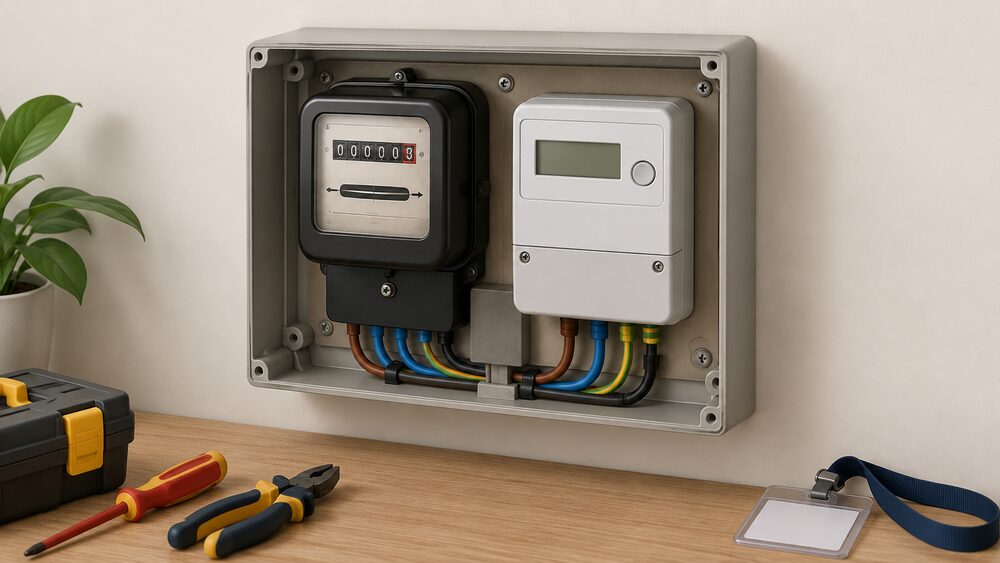
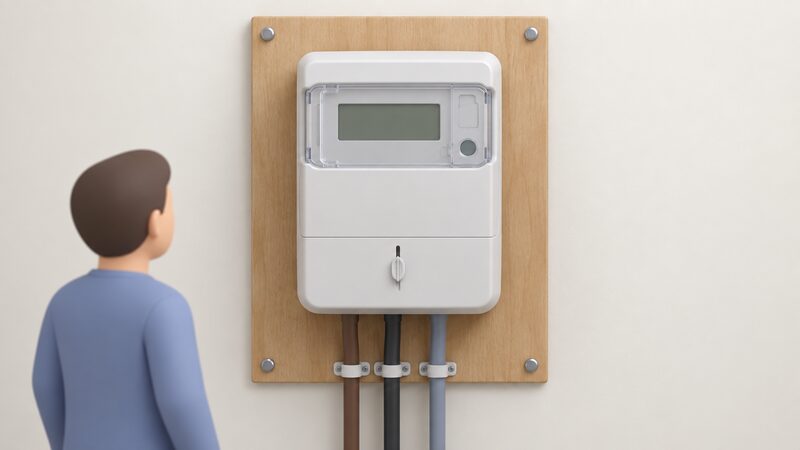
The replacement is a like-for-like modernisation, not an upgrade to smart metering. NIE Networks states that the meters being installed are digital display meters that are approved to European Standards1. There is no communications module, no in-home display and no remote reading in the current programme.
That distinction is worth holding on to, because the vocabulary around metering is loose. Official statistics classify electricity meters as domestic meters based on their tariff type rather than on their technology3. A digital display meter on a domestic tariff is a domestic meter; it is not a smart meter, and it does not send readings anywhere.
What the household gets in practice is a meter with a digital register, read by a Meter Reader on the three monthly cycle, with the reading passed to the supplier for billing4. The meter remains the property of NIE Networks2. The installer will show the householder how to read and use the new meter once the work is complete1.
For energy independence, the honest position is that this changes nothing about where the electricity comes from or who bills for it. The meter is a measuring device owned by the network, and the household's relationship with it is one of access and inspection rather than control. What the programme does secure is that the measuring point stays within its certified life and is checked for safety, which is the precondition for any later step a household takes, whether that is a tariff change, a heat pump connection or an EV charger. Those connections have their own process: an application must be sent to NIE Networks before installing the equipment so the supply can be checked for the new electrical loading, and installers must inform NIE Networks when making modifications under Wiring Regulations BS7671 132.1614.
Who will call at your door and how to verify them
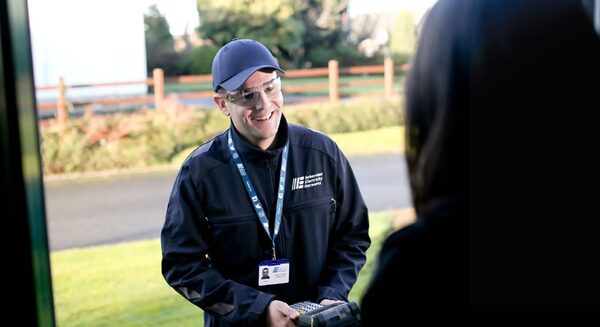
NIE Networks is explicit about who may turn up and what they will look like. Employees and anyone working on its behalf, including tree cutters, meter readers, engineers and meter replacement contractors, will always carry proof of identification15. All employees of NIE Networks will carry identification, wear identifiable uniforms and drive marked vehicles1.
The verification route is the PSNI's Quick Check scheme. NIE Networks advises that if a householder is unsure and wants to confirm the identity of a meter installer, they should use the PSNI's Quick Check service1. The mechanics are set out in the company's vulnerable customer guidance: the householder can ring the PSNI Quick Check service on 101 to confirm the caller works at NIE Networks, and the meter reader or engineer will wait or give a card to come back later15. The Consumer Council confirms that all energy companies are part of Quick Check 101, which allows a call to check the identity of someone calling about gas, electricity or water supplies2.
"You can then ring the PSNI Quick Check service on 101 to confirm they work at NIE Networks. Our meter reader or engineer will wait or give a card to come back later."
Reading visits have their own rhythm, and knowing it helps a householder judge whether a caller is plausible. NIE Networks meter readers may visit a property between 8am and 8pm Monday to Friday or 9am to 1pm on Saturdays4. The Consumer Council records that NIE Networks will visit the home four times per year to read the electricity meter2, while NIE Networks' own material describes the cycle as every three months4. If nobody is at home when the reader calls, a card is left advising when the reader will next be in the area4. Where the meter is easily accessible from outside the property, the read and the meter safety inspection are carried out without the householder being present4.
Appointments are available for those who need them. The metering team can make an appointment for customers who are vulnerable, need more time or would like to have someone with them while the meter is read10.
The appointment: booking, time bands and how long it takes
Booking is direct. To book an appointment, NIE Networks asks customers to call 028 9575 72831. Three time bands are offered, AM, PM or All day, Monday to Friday1.
The guaranteed standards give the appointment a backstop. NIE Networks states that it will install a meter within 2 days at a home or within 4 days at a business6. Where a new tariff requires a new meter, the meter will be changed within 10 working days of being notified by the supplier8. Repositioning a meter on the meter board is carried out within 15 working days of a quotation being accepted9.
Missed appointments carry fixed payments. If NIE Networks does not contact the customer or does not keep an agreed appointment, £25 is payable6. If an agreed meter installation appointment is not kept, the payment is £50, or £125 for other premises6. Where there is something wrong with how a meter is recording, NIE Networks will say within 5 days what it intends to do, or within 7 days if a visit is needed to investigate further6.
| Standard | Commitment |
|---|---|
| Meter installation | Within 2 days at a home, 4 days at a business6 |
| Meter change for a new tariff | Within 10 working days of supplier notification8 |
| Meter repositioning on the board | Within 15 working days of quotation acceptance8 |
| Missed contact or appointment | £256 |
| Missed meter installation appointment | £50, or £125 for other premises6 |
| Meter recording problem | Response within 5 days, or 7 days if a visit is needed6 |
Other standards sit around the metering work and are worth knowing because they show the same service framework. NIE Networks aims to reconnect 87% of customers affected by a power cut due to a fault on its distribution system within 3 hours, and all customers within 24 hours8. It will restore electricity within 24 hours of a power cut, replace a main fuse within 3 hours on a working day or 4 hours on other days, and investigate a prepayment meter problem within 3 hours on a working day or 4 hours on other days6. Where a planned interruption to supply is needed, at least 3 days' notice is given6.
What happens during the visit: power off, the swap and the walkthrough
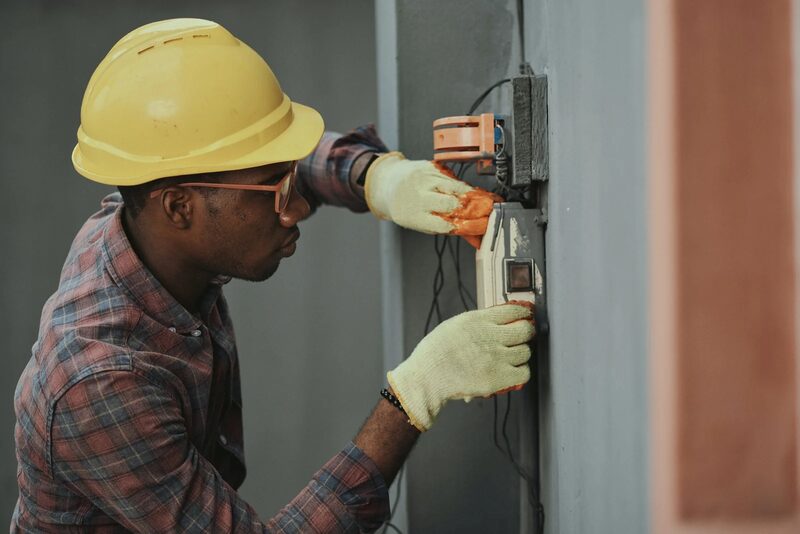
The visit follows a fixed sequence. The installer asks the householder to turn off all electrical appliances before switching off power to the home for approximately 20 minutes1. The meter is then replaced and the relevant safety checks are carried out, with the whole job taking approximately 30 minutes to one hour1. When the work is complete, the installer shows the householder how to read and use the new meter1.
The safety checks are not decorative. NIE Networks operates a safe isolation service for situations where the supply must be de-energised so that an electrical contractor can work, and it offers two options16. In the stay-on-site service, engineers disconnect power and remain while the work is completed16. In the two-visit service, power is disconnected on a morning visit and restored on an afternoon visit after the work is completed16. The same logic governs whether NIE Networks needs to attend at all: if an isolator is present between the metering equipment and the fuse board, NIE Networks does not have to attend and the electrical contractor can continue, unless the isolator is the equipment being replaced7. If the meter is inside the property, or does not match the example isolators, NIE Networks will have to attend to facilitate a private contractor installing a point of isolation7.
For the replacement visit itself, the householder's part is preparation rather than participation. The area around the meter needs to be clear with good access, and appliances need to be switched off before the supply goes down1. The meter number and access to the meter position matter for related work: for an EV charger or heat pump connection, the installer needs the customer's MPRN, the full installation address, and the meter number with a clear photo of the cut-out and meter14.
How to prepare before the installer arrives
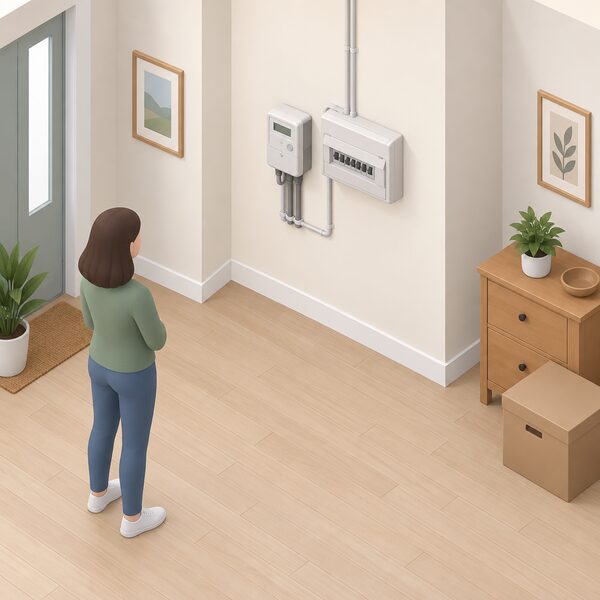
Preparation is short and practical. Clear the area around the meter and make sure there is good access to it1. Turn off all electrical appliances before the power is switched off1. Expect the supply to be down for approximately 20 minutes, within a visit of approximately 30 minutes to one hour1.
A few conditions change the shape of the day. If the meter is inside the property, or does not look like the example isolators NIE Networks publishes, the network operator will have to attend to facilitate a private contractor installing a point of isolation7. If an isolator is already present between the metering equipment and the fuse board, NIE Networks does not have to attend and the contractor can continue, unless that isolator is the equipment being replaced7.
Households with access difficulties have a separate route. The Utility Regulator's factsheet on the code of practice for consumers in vulnerable circumstances records that the electricity or gas supplier, or NIE Networks, may be able to change the position of the meter, or provide special controls and adaptors free of charge17. That is aimed at consumers who have difficulty accessing their meter, and it sits alongside the appointment option for customers who are vulnerable, need more time or would like someone with them10.
Where a prepayment meter is being installed without the customer's permission, the supplier has duties before the visit: it should explain why it made the decision, tell the customer when it plans to install the meter, explain what will happen during the installation, and tell the customer how to make contact if circumstances have changed or the decision is thought to be wrong18. That is a different situation from the routine replacement programme, but it is the framework that applies when a meter change is not the householder's idea.
Smart meters in Northern Ireland: not yet, but a rollout is planned
Northern Ireland does not have smart electricity meters in service. The Consumer Council states that there are currently no smart electricity meters in Northern Ireland, but they have already been rolled out in Great Britain and the Republic of Ireland3. Which? records that smart meters are not currently being installed in Northern Ireland, but that this is set to change19.
The plan is dated. The Department for the Economy has announced plans for the rollout of smart meters for all homes in Northern Ireland starting in 2028, and businesses, including small and medium sized firms, will also be covered3. The Consumer Council's factsheet on smart electricity meters says initial installations are expected to begin in early 20283. Which? reports that analysis recommends a rollout over six years, starting in 2027, would be most cost-effective19. The two documents give different start years, 2027 and 2028, and the difference is not resolved here.
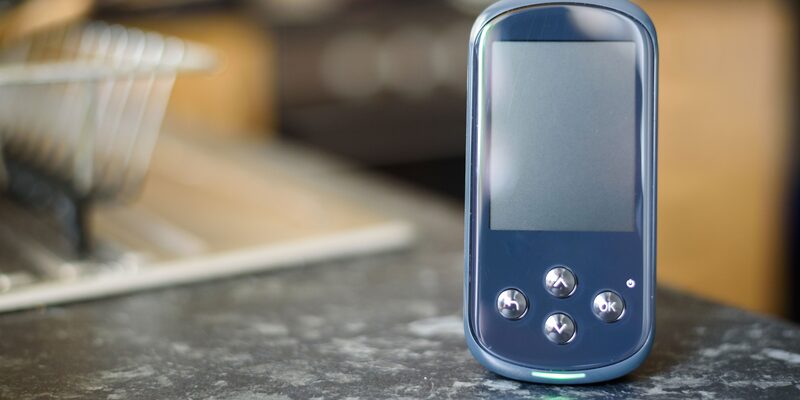
The stated benefits are a mix of household and system effects: reducing electricity costs, more accurate bills, support for a more reliable electricity network, and a role in helping Northern Ireland meet its net zero emissions targets3. Smart meters record electricity usage in much the same way as a traditional meter but can automatically send consumption information at regular intervals3.
What a smart meter would change for a household is mostly about reading and billing. Ofgem's consumer guidance states that smart meter customers do not need to submit meter readings themselves20. No wi-fi or broadband connection is needed in the home, because meters communicate through a home area network and a secure national wireless network used only by smart meters19. On the network side, the Data Communications Company describes full interoperability between energy suppliers on its network, meaning the meter does not need to be replaced when a customer switches21.
What the smart meter rollout would mean for households
The rollout would move Northern Ireland onto the same footing as Great Britain, where smart meters are replacing analogue gas and electricity meters as part of the national infrastructure upgrade to improve and modernise the energy system22. The programme there is a government one, intended to replace all old meters with new smart meters, including prepayment versions23.
The scale of the task is documented, and so are its difficulties. The Public Accounts Committee reported that an estimated seven million communications hubs, part of the electricity smart meters, will also need to be replaced because they will lose functionality when the 2G and 3G mobile communications networks are closed24. The same committee found that the delayed smart meter programme had failed to hit targets and secure public support24. Suppliers' regulatory framework only requires them to take all reasonable steps to replace non-functioning smart meters, and doing so does not count towards their binding targets25.
Coverage projections for Great Britain give a sense of pace. Maintaining current levels of conversion would see coverage reach 85% to 87% by 2030, and maintaining current volumes of new installations would see coverage reach 92% to 96%26. Non-domestic meters represent only 6% of the smart meter rollout, and at the end of Q1 2025, 63% of non-domestic meters were smart or advanced meters26.
For a Northern Ireland household, the practical implications are these. Nothing is required of the occupant to receive a smart meter: consumers do not have to do anything, and NIE Networks and electricity suppliers will contact consumers when it is time for installation3. There are no plans to install smart gas meters19. Switching supplier with a smart meter is possible, but the new supplier might not offer all smart meter services such as remote meter readings, and the meter may need replacing27. Guaranteed standards for failed smart meter installation appointments apply to all such appointments, whether a first-time installation or the replacement of an existing smart meter, including work by third-party engineers contracted through Meter Operators28.
The independence picture is mixed and worth stating plainly. A smart meter removes the manual reading cycle and the estimated bill that can follow a missed read, and it gives the household a live view of its own consumption. It does not change who owns the meter, who operates the communications network, or who issues the bill. The meter would still belong to NIE Networks, the data would travel over a national network, and the supplier relationship would remain. Households that want to know what to do in the meantime can read Do I have to do anything to get a smart meter in Northern Ireland?, and those interested in who will carry out the work can read Who will install smart meters in Northern Ireland?.
Sources28 cited
- Meter replacements, NIE Networks, 2026
- Bills and metering, Consumer Council, 2026
- Smart meters, Consumer Council, 2026
- Meter reading for credit customers, NIE Networks, 2026
- Why do we need to read your meter, NIE Networks, 2026
- Customer standards, NIE Networks, 2026
- Safe isolation, NIE Networks, 2026
- Overall standards, NIE Networks, 2026
- Customer standards, NIE Networks, 2026
- Meter reading and keypads, NIE Networks, 2026
- Incorrect estimated billing, Energy Ombudsman, 2026
- MID approved gas and electricity meters, GOV.UK, 2025
- Electricity meter accuracy disputes, GOV.UK, 2014
- EVs and heat pumps, NIE Networks, 2026
- When we come to your home, NIE Networks, 2026
- Safe isolation FAQs, NIE Networks, 2026
- Code of Practice for Consumers in Vulnerable Circumstances factsheet, Utility Regulator, 2025
- Installing a prepayment meter without your permission, Ofgem, 2026
- What is a smart meter, Which?, 2026
- Get help with your smart meter, Ofgem, 2026
- What happens to my smart meter when I change supplier, Smart DCC, 2026
- Smart meters: your rights and expectations, GOV.UK, 2025
- Smart metering policy framework post 2025 consultation, Department for Energy Security and Net Zero, 2025
- Delayed smart meter programme fails to hit targets, Public Accounts Committee, 2023
- Smart Meter Guaranteed Standard statutory consultation, Ofgem, 2025
- Final decision on smart meter GSOPs, Ofgem, 2026
- Problems with services, Isle of Anglesey County Council, 2026
- Domestic and homeowners connections help, NESO, 2026
 Keypad Meters in NICovers the pay as you go keypad metering used across Northern Ireland, topping up by card, app and online, and emergency credit and debt recovery settings.
 Power Cuts in Northern IrelandNorthern Ireland has a single electricity distribution network, run by NIE Networks, and its own reporting number, registers and compensation arrangements.
 Suppliers in Northern IrelandNorthern Ireland runs its own energy market, with its own regulator, its own suppliers and no price cap.
 Energy Bills in Northern IrelandNorthern Ireland has no price cap.
 Installer in Northern IrelandHow do you check an installer in Northern Ireland is properly registered, and who do you complain to if the work goes wrong?
 Switch Energy SupplierThe practical sequence of a domestic energy switch: the details and readings needed, the five working day transfer, cooling-off periods, exit fees and the final bill.