
In this guide
In Northern Ireland, a power cut is reported to Northern Ireland Electricity Networks (NIE Networks) on 03457 643 643, a number answered 24 hours a day, seven days a week1. The same number covers damaged lines and equipment, arranging a new supply and any physical supply matter. Cuts can also be reported online through Power Check at powercheck.nienetworks.co.uk, or by WhatsApp and Facebook Live Chat3. The 105 number used across England, Scotland and Wales does not work here4.
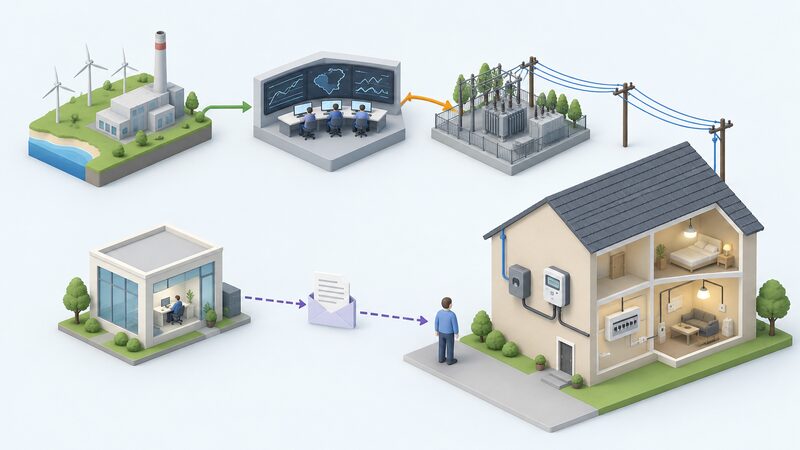
Northern Ireland differs from Great Britain in structure as well as in phone number. There is one distribution network, not fourteen: NIE Networks owns the electricity transmission and distribution network and operates the distribution network, serving over 910,000 customers including homes, businesses and farms. It does not bill anyone for electricity, and it is a separate organisation from Power NI and from the other licensed suppliers. It also owns every electricity meter in Northern Ireland, credit and keypad alike. The grid is balanced by a third body, SONI, which can instruct NIE Networks to switch off blocks of customers when generation runs short.
If the power goes off, the first check is your own trip switches, because a fault inside the property looks identical from the kitchen5. If neighbours are also off, or the trip switch is not the cause, Power Check will show whether the fault is already known. NIE Networks states that it will restore electricity within 24 hours of a power cut, and aims to reconnect 87% of customers affected by a distribution fault within 3 hours.
Who to call: the 24-hour NIE Networks helpline
The single number for loss of supply in Northern Ireland is 03457 643 6431. It is staffed around the clock, and NIE Networks states that its power cut support team is available at all hours3. It is also the number to use for damaged equipment, for arranging a new electricity supply, for alterations to lines and equipment, and for any physical supply matter11.
Other NIE Networks contact routes run to their own hours. The WhatsApp channel operates from 7.30am to 11.30pm, seven days a week, 365 days a year, including public and bank holidays12. The connections customer service team is available 8.30am to 5.00pm Monday to Friday, excluding public and bank holidays13. The company's postal address is NIE Networks, 120 Malone Road, Belfast, BT9 5HT11.
For how long to wait before calling: NIE Networks states that if a supply has not been restored after four hours, contact the helpline14. Where a planned interruption is involved and power is not back within an hour of the scheduled time, the advice is to visit Power Check for more information and report the cut15. These are different thresholds for different situations, and both sit alongside the general advice to check the fault map first.
Separately, the Northern Ireland Energy Advice Service, a free service on 0800 111 4455 open 9am to 5pm Monday to Friday, gives advice and support on saving energy in the home and on eligibility for help to improve energy efficiency16. It is not a power cut line.
What NIE Networks does, and how it differs from Power NI and SONI
Three organisations matter during a power cut in Northern Ireland, and householders often contact the wrong one.
| Body | Role | Contact for power cuts |
|---|---|---|
| NIE Networks | Owns the transmission and distribution network, operates the distribution network, owns and reads all meters18 | 03457 643 6431 |
| Power NI and other suppliers | Sell electricity and bill customers; a separate company from NIE Networks19 | Not the fault line |
| SONI | Manages the grid, balancing demand and generation; plans and upgrades the grid; can instruct NIE Networks to reduce demand6 | Not a customer-facing line |
NIE Networks does not bill customers directly for electricity20. Whoever a household buys from, the wires, poles, substations and meter belong to NIE Networks, and it maintains the meters at the properties of all customers across Northern Ireland no matter who the supplier is21. It reads meters on behalf of all electricity suppliers in Northern Ireland, attempting a reading once a quarter, every three months, which doubles as a safety check to make sure the meter is working correctly19. The cut-out, the piece of equipment linking the NIE Networks cable to the internal wires of a property, is also network equipment rather than household equipment.
SONI's role is distinct again: balancing generation with demand so electricity can flow from where it is made to where it is used, and planning and upgrading the grid6. When generation falls short, SONI, not NIE Networks, makes the call, and NIE Networks is legally required to implement power cuts when instructed by SONI6.
For a household thinking about independence, the practical point is that there is no alternative network operator here and no choice of wires company. Switching supplier changes the bill, not the supply route, the meter or the restoration time. Connection arrangements also differ from Great Britain, so generation and storage equipment connected at home follows Northern Ireland's own rules rather than the GB process described on generator grid connection notification.
First checks when the power goes off
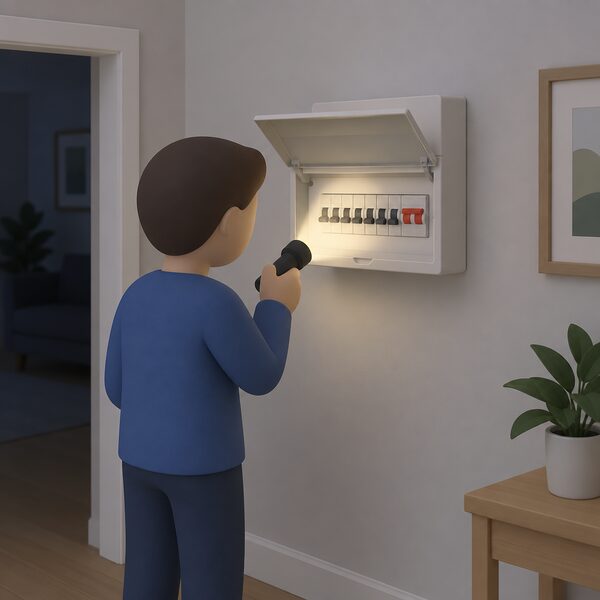
NIE Networks sets out a short sequence before reporting5:
- Check your trip switch, which shows whether the problem is with the electrics inside your property.
- Look at whether neighbouring properties are also without power.
- Check Power Check, the real-time fault information map, to see if the cut already appears.
- Report it online, by WhatsApp or by phone if it is not on the map.
Have your Meter Point Reference Number (MPRN), or your postcode and house number, to hand when reporting5. Lightning is a common cause of localised cuts: NIE Networks explains that when the system is hit by lightning, heavy-duty protection devices activate and shut down sections of the network, essentially fuses and trips mounted on poles and at substations. Lightning often affects supplies to individual properties or small numbers of properties, so if neighbours are still on, the company may not yet know23. That is also why the trip switch check comes first.
Power Check provides real-time fault information on a map of Northern Ireland24. Checking it first answers the common question of whether the problem is just your property or the local area, and avoids a call that adds nothing to what the control room already knows. Where damage has been seen, though, a call is valuable: NIE Networks states it relies on members of the public to call with information about the location of the damage25.
Staying safe during a power cut
The safety rules NIE Networks publishes are short and firm. Never touch damaged electricity equipment, and never approach broken lines or damaged poles26. Beyond that, its during-the-cut advice covers checking on vulnerable family and friends, keeping the freezer door closed, reporting the cut, and turning off cookers, heaters and sensitive equipment26.
Specifically, NIE Networks advises switching off electric heaters and cookers to avoid a fire risk when the power is restored, and switching off and unplugging equipment including satellite receivers, televisions and computer equipment27. Leaving one light switched on gives a visible signal that supply has returned26. A battery back-up alarm clock is suggested as useful for overnight or early morning interruptions27. To keep warm, the company's advice is to stay in one room, or even in bed27. More detail on that sits on keeping warm during a power cut, and on protecting equipment at how to protect appliances during a power cut.
On food, NIE Networks advises keeping fridge and freezer doors closed, and states that contents should be safe for many hours but that food should be disposed of if in any doubt where it appears to have defrosted27. Its published times are 4 to 6 hours in the fridge and 15 to 24 hours in the freezer if the door is not opened6, and separately that a full freezer will keep temperature for about 48 hours, or 24 hours if half-full25. Other UK network guidance gives around 4 hours for a fridge if left unopened. The numbers vary with how full the appliance is and how often it is opened, which is why the guidance is a range rather than a limit. Power cut food safety covers the detail.
How NIE Networks restores power after a storm
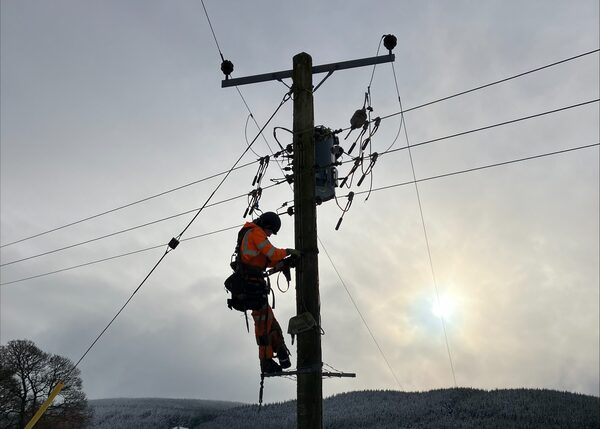
NIE Networks names three main priorities when responding to severe weather: public safety, providing information, and restoring power25. Restoration is not first-come, first-served. The published order of work is:
- First, damage that has caused a loss of power to critical national infrastructure, for example hospitals, airports, and water pumping and treatment sites25.
- Then faults affecting the largest number of homes and businesses25.
- The Medical Care Register is checked so that those with the greatest need for electricity get it back as quickly as possible25.
- Then methodical restoration across the remaining network25.
A central control centre co-ordinates the restoration process and provides up to date information for customers, and the company states it has regularly reviewed plans in place to respond to severe weather28. During Storm Éowyn, its Emergency Response Plan was in effect from 23 January until power was restored to all homes and businesses29, and 420 people were brought from consortium companies in Europe, the UK and Ireland to help restore supply25. Mutual aid on that scale is the reality behind a headline restoration target: a single network with one workforce cannot clear thousands of faults at once.
The published standards are that NIE Networks aims to reconnect 87% of customers affected by a power cut due to a fault on its distribution system within 3 hours, and all customers within 24 hours7. A separate standard covers customers cut off due to debt: once an agreement is made with the supplier and the supplier notifies NIE Networks, supply is restored within 24 hours of a working day7.
For a household, the practical reading is that a routine fault is usually a matter of hours, while a named storm can mean days, and no register or payment changes that. That gap is the case for on-site backup power, whether a portable power station or a standby generator.
Planned emergency power cuts: three-hour rota periods
Planned emergency power cuts are a different thing from storm damage. They are used in response to a severe shortage of electricity generation in Northern Ireland6. Where there is a shortfall, SONI may instruct NIE Networks to disconnect blocks of customers for periods of up to 3 hours according to predefined lists, to protect grid integrity31. NIE Networks states they are only implemented to protect the electricity network from more damage, which would be more disruptive to customers for a much longer period32.
The mechanism is the block letter. The network is sectioned into blocks that can be temporarily switched on and off, typically for three-hour periods, until the shortage passes, and different block letters are timetabled to be without power for around three hours once or twice a day8. Planned emergency power cuts mean switching power off to at least 5% of NI households at once6. When a planned emergency power cut starts, the rota is published on the NIE Networks website15.
On notice: the aim would be to notify customers via media and social media channels before a planned emergency power cut is undertaken, but they can take place without warning if SONI instructs NIE Networks to reduce demand immediately to protect the electricity system and avert longer term issues33. Only a very limited number of sites are protected from emergency power cuts34.
"residential customers, including those on the NIE Networks Medical Customer Care Register and businesses without backup"
This is the sharpest limit on what a register can do. Being on the Medical Customer Care Register brings information and priority in the queue, not an exemption from a rota disconnection. The equivalent arrangements across the rest of the UK are set out on rota power cuts. Where a planned emergency cut is the cause, compensation rules elsewhere in the UK exclude blackouts caused by a national power shortage35.
The Customer Care Register for medical and vulnerable customers
Northern Ireland runs two related things under similar names, and it helps to keep them apart. Electricity suppliers, gas suppliers and NI Water hold Customer Care Registers for consumers in vulnerable circumstances, and NIE Networks holds a Medical Care Register for those who rely on electricity for healthcare needs36. All electricity and gas suppliers in Northern Ireland must keep a Customer Care Register with the details and special needs of customers who are of pensionable age, disabled (by virtue of being blind, partially sighted, deaf or hearing impaired) or chronically sick37.
The NIE Networks Medical Customer Care Register is for anyone who relies on electricity for healthcare needs, including medical equipment such as specialised mattresses, feeding systems or lifting equipment24. What it provides is:
- Up-to-date information by phone during a power cut or a planned interruption to supply38.
- Regular contact during the power cut with up-to-date information39.
- Priority for calls to the helpline from registered customers during a power cut39.
- A check of the Medical Care Register during storm restoration, so that those with the greatest need for electricity get it back as quickly as possible25.
NIE Networks also runs a Critical Care information service for vulnerable customers26. What the register does not do is supply equipment or guarantee continuity: registration does not exempt a household from emergency power cuts34, and elsewhere in the UK the equivalent scheme, the Priority Services Register, is a free service providing extra support rather than a power supply. Some GB operators go further during long cuts, with hot food and drinks or, where appropriate, overnight accommodation, but that is a Great Britain arrangement rather than a Northern Ireland one. A household dependent on mains electricity for medical equipment therefore still needs its own answer, covered on help during a power cut if you rely on medical equipment and in more detail for the region on priority services in Northern Ireland.
Compensation for long or repeated power cuts
The Guaranteed Standards of Performance that set payment levels in Great Britain explicitly cover England, Scotland and Wales35. Northern Ireland sits outside them and has its own arrangements administered by NIE Networks, whose published standard is that it will restore electricity within 24 hours of a power cut30.
The GB amounts are useful context for the scale of payments, and are reviewed and updated each year based on inflation35:
| GB Guaranteed Standard | Payment |
|---|---|
| Fewer than 5,000 properties off for more than 12 hours, or more than 5,000 off for more than 24 hours | £100 homes, £195 businesses35 |
| Each additional 12-hour period without electricity | extra £4535 |
| Maximum where 5,000 or more properties affected | £40035 |
| Power off more than 4 times between 1 April and 31 March, each cut at least 3 hours | extra £100, claim required35 |
Restoration deadlines under those GB standards are 12 hours outside severe weather, 24 hours in severe storm category 1 weather and 48 hours in severe storm category 2 weather40. Payments are excluded for blackouts caused by a national power shortage, for damage to electrical equipment or appliances, and for a low supply after a power cut35.
For Northern Ireland specifically, independent consumer guidance reports that where supply is turned off for planned reasons, three days' notice must be given, and if it is not, £25 per home can be claimed, with a claim deadline of within one month of the day of the power interruption41. The same guidance reports a further £95 claimable for repeated cuts, while the GB figure for four or more cuts of three hours or more in a financial year is £10041. The documents give different figures for the repeated-cuts payment, and the Northern Ireland and Great Britain schemes are not the same scheme, so the amounts should be checked with NIE Networks before claiming.
Ofgem research found low awareness of Guaranteed Standards of Performance among participants, with service failings related to loss of supply typically seen as the most severe and widespread agreement that compensation is an important element of responding to service failings, although views on the appropriate level varied widely43. Claims are not always automatic, and the deadline is short. See power cut compensation in Northern Ireland and the wider Guaranteed Standards page.
Preparing your home for the next cut

Nothing in the arrangements above keeps the lights on. The registers deliver information and queue position; compensation arrives afterwards and is capped; and a rota disconnection can be imposed without warning on at least 5% of households at once6. What a household controls is what happens in its own building for the three hours, or the three days, that the supply is gone.
NIE Networks' own preparation list is modest and worth doing first: a torch and batteries kept in the house, knowing where the fuse box is, being able to open electric gates without power, keeping an EV battery charged, and registering on the medical care register where relevant26. Wider network guidance adds keeping a mobile phone fully charged so it can be used for updates or calls, keeping a torch handy, having warm clothes, blankets and food that does not need heating accessible, and following the network operator on social media for local updates44. For planned emergency cuts, NIE Networks specifically advises having warm clothes and blankets accessible in case of a prolonged cut, and checking on elderly or vulnerable neighbours, family and friends and making them aware of the cuts45.
Beyond that, the choices are equipment-shaped and cost-shaped: what you want to keep running, and for how long. Essential loads and backup circuits sets out how households decide what stays on, backup power costs compared sets the options against each other, and keeping heating running in a power cut covers the load that matters most in a Northern Ireland winter. One dependency does not go away: with a single distribution network, one 24-hour number and one system operator, restoration timing is not a household decision. Only stored or self-generated energy on site changes that.
Sources45 cited
- Power cuts help, NIE Networks, 2026-09-20
- Register a keypad meter, Power NI, 2026-09-20
- Power cut support contacts, NIE Networks, 2026-09-19
- What to do in a power cut, Energy Networks Association, 2026-09-17
- I have a power cut, what should I do, NIE Networks, 2026-09-19
- Emergency power cuts, NIE Networks, 2026-09-19
- Overall standards, NIE Networks, 2026-09-20
- How do planned emergency power cuts work, NIE Networks, 2026-09-19
- Additional works and emergencies, NIE Networks, 2026-09-19
- Winter ready, NIE Networks, 2026-09-19
- Loss of power supply, Power NI, 2026-09-20
- Who is my gas and electricity supplier, Confused.com, 2026-07-03
- New electricity supply for 1 to 11 houses, NIE Networks, 2026-09-19
- What do I do if my electricity does not come back, NIE Networks, 2026-09-19
- How do I know if or when my power will be switched off, NIE Networks, 2026-09-19
- NISEP list of schemes 2026-27, Utility Regulator, 2026-04
- Energy grants in Northern Ireland, Energy Saving Trust, 2026-09-17
- Electricity providers in Northern Ireland, Power NI, 2022-01-24
- Why are NIE Networks reading my meter, Power NI, 2026-09-20
- Wayleave payments and electricity bills, NIE Networks, 2026-09-20
- Meter replacements, NIE Networks, 2026-09-19
- How often is my meter read, Power NI, 2026-09-20
- Severe weather, NIE Networks, 2026-09-19
- Keypad meter overload message, Power NI, 2026-09-20
- Unplanned power cuts FAQs, NIE Networks, 2026-09-20
- Power cut advice, NIE Networks, 2026-09-19
- Action to take when power is disconnected, NIE Networks, 2026-09-19
- Response to storms, NIE Networks, 2026-09-19
- How do you prepare for a storm, NIE Networks, 2026-09-19
- Customer standards, NIE Networks, 2026-09-19
- Planned emergency power cuts, NIE Networks, 2026-09-19
- Why would emergency power cuts happen, NIE Networks, 2026-09-19
- How much notice will be given, NIE Networks, 2026-09-19
- Are any sites protected from the power cuts, NIE Networks, 2026-09-20
- Check if you can get a payment for a power cut, Ofgem, 2026
- Code of Practice for Consumers in Vulnerable Circumstances factsheet, Utility Regulator, 2025
- Electricity and gas consumer protection, Consumer Council for Northern Ireland, 2026
- Critical care register, NIE Networks, 2026-09-20
- Customer Care Register, NIE Networks, 2026-09-19
- Plan for a power cut, Ofgem, 2026
- How to find out if there's a power cut, Which?, 2026-06-04
- Get compensation if you have a power cut, Citizens Advice, 2026-09-17
- Energy consumer experiences of customer service standards, Ofgem, 2026-06-23
- What happens in an energy shortage, Energy Networks Association, 2026-09-17
- Action to take in preparation, NIE Networks, 2026-09-20
 Suppliers in Northern IrelandNorthern Ireland runs its own energy market, with its own regulator, its own suppliers and no price cap.
 Energy Supply in NICan you get gas where you live in Northern Ireland, and what happens if your power goes off?
 Rota Power Cuts ExplainedIf electricity runs short, could your home be switched off for three hours at a time?
 NIE Networks Meter ReplacementExplains the programme replacing electricity meters across Northern Ireland, who carries out the work and how appointments are made.
 Utility Regulator NIWho sets your energy prices in Northern Ireland and who can you complain to?
 Energy Bills in Northern IrelandNorthern Ireland has no price cap.