In this guide
A portable power station is sized in two numbers: capacity in watt-hours (Wh), which sets how long it runs, and continuous output in watts (W), which sets what it can run at once. For phones, laptops, cameras and LED lights on a day trip or a short night away, 300 to 700Wh is the range makers give. For a caravan, work tools or a short household power cut with several essentials running together, the guidance moves to 1,500 to 2,500Wh, and heavier home backup starts at 2,500Wh and above1.
The quickest estimate is to add up the watt-hours the chosen devices use in a day and divide by about 0.85 to allow for conversion losses in the inverter. One maker's worked example turns 920Wh of daily use into a required capacity of about 1,080Wh1. On runtime, a 2kWh-class station is stated to run a 100W device for around 16 to 18 hours, a 500W appliance for about 3 to 4 hours and a 1,000W device for roughly 1.5 to 2 hours2.
For a household's independence, a power station covers the gap in a power cut without fuel, fumes or an installer. What it does not do is generate energy: it stores what the grid, a car or solar panels put into it, and once empty it depends on one of those again.
What a portable power station is and what it powers
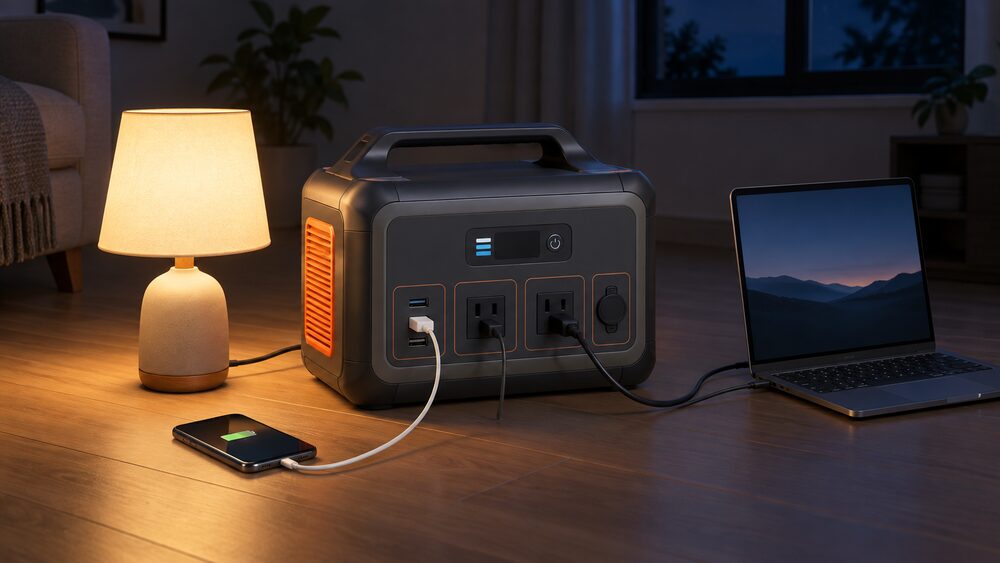
A portable power station is a large rechargeable battery with built-in outlets. Makers describe it as "essentially a big battery that stores energy from the grid (wall plug, car alternator, etc.)": it stores energy but does not generate it4. Inside are three main parts working together, a battery, an inverter and a charge controller, and the inverter's job is to convert the direct current (DC) held in the battery into the alternating current (AC) that household plugs expect5.
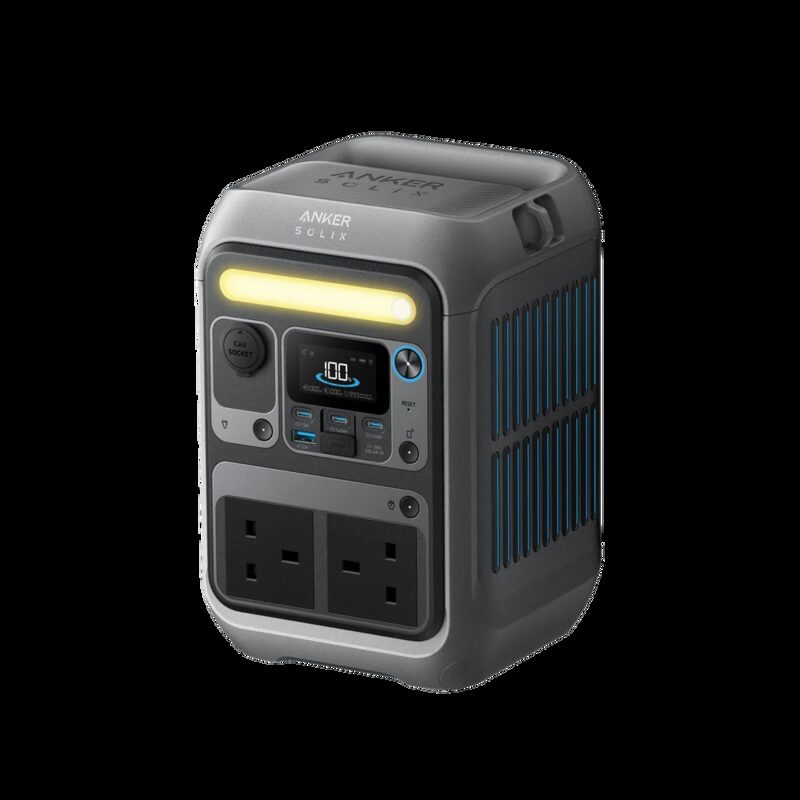
The outlets usually include AC sockets, USB ports for phones and tablets, and DC outlets6. That mix means one unit can charge a phone by USB while running a lamp or a small fridge from an AC socket.
Makers list a wide spread of uses6:
- charging devices, running lights and powering small appliances when camping off the grid
- charging devices and using small appliances in a vehicle or at a destination
- keeping a laptop and other devices running for remote work
- emergency backup during blackouts and natural disasters
- running electric coolers and medical equipment
That breadth is why one maker calls them "ideal for recreational activities as well as home backup solutions"4. The difference from a phone power bank is scale: independent guidance notes a power bank can charge a mobile several times, while a power station can run mains appliances. A fuller explanation of the internals sits on the page about portable power stations, and the wider options are set out under backup power.
Match capacity to your devices: the sizing method
Two limits apply at the same time. Capacity (Wh) must cover the energy used over the whole period without mains power; continuous output (W) must cover the combined draw of everything switched on at once. A unit with plenty of watt-hours but a small inverter cannot start a kettle; a unit with a big inverter but few watt-hours will run it only briefly. Makers' own buying advice is to "determine the battery capacity you need based on the devices you plan to power" and to "check the inverter's quality and capacity to handle the devices you want to power"6.
The working method runs in order:
- List each device and its power draw in watts.
- Multiply each by the hours it will run, to get watt-hours.
- Add the watt-hours together for the daily total.
- Divide by about 0.85 to allow for conversion losses: 920Wh of use becomes roughly 1,080Wh of required capacity1.
- Add up the watts of everything that could run together, and check that against the station's continuous output.
The 0.85 figure reflects the energy lost as the inverter turns stored DC into AC; it is why a 2kWh unit does not deliver a full 2,000Wh to a mains appliance, and why maker runtime figures quote hours "after normal power conversion losses"2. Keeping the battery out of its very top and bottom range, as some makers suggest for battery care, reduces usable energy further in practice.
Maker guidance sets the capacity bands shown below1:
| Capacity | What it suits |
|---|---|
| 300 to 700Wh | Phones, tablets, cameras, laptops, LED lights on day trips or short overnights |
| 800 to 1,200Wh | Weekend camping with a compressor fridge, electronics, lighting |
| 1,500 to 2,500Wh | Caravans, work equipment, short household outages |
| 2,500Wh and above | Heavier home backup and longer off-grid stays |
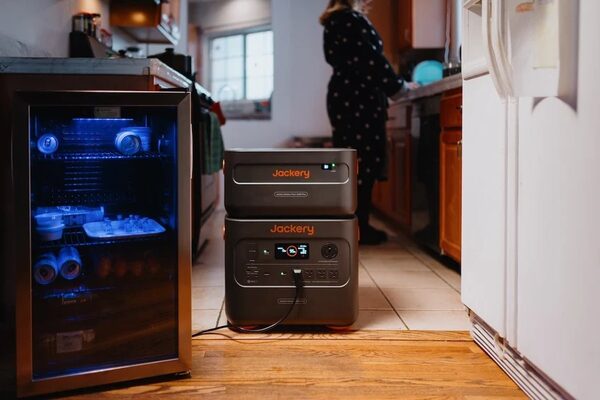
For fridge backup specifically, one maker advises at least 1,000Wh of capacity and a pure sine wave AC output7, and another states that around 1,000W of output or above is usually more practical than a very small unit8. Deciding which circuits and devices matter most is covered under essential loads and backup circuits.
Small units: 300 to 700Wh for day trips and short overnights
The smallest stations are built for low-power electronics: phones, tablets, cameras, laptops and LED lighting, over a day or a single night1. At this scale the job is keeping devices charged rather than running appliances.
Two examples show the range in one maker's line. The EB3A is listed at 268Wh with 600W output, and the AC180 at 1,152Wh with 1,800W output9. The EB3A falls below the 300 to 700Wh band; the AC180 sits above it, in the weekend-camping range. A different maker describes 1,000W-class stations as usually holding between 700Wh and 1,000Wh10.
Output matters as much as capacity at this end. Inverter guidance states that if the only needs are charging phones and running a small TV in a camper, a 1,000W inverter may suffice11. Anything with a heating element (a kettle, a hairdryer, a heater) needs far more output than a small station provides, and would drain its capacity quickly even if it could start.
For home use, a unit in this band keeps a household connected in a power cut: phones charged, a laptop running, a lamp on, possibly a broadband router. It will not keep food cold overnight on its own. A step up to 800 to 1,200Wh brings a compressor fridge within reach for a weekend1, which is the smallest size that begins to protect food in an outage. The Wi-Fi during a power cut page explains what else is needed for broadband to keep working.
Larger units: what a 2kWh-class station can run and for how long
The 2kWh class is where a power station becomes realistic home backup for a short outage. A "2,000W" station usually means around 2,000W of continuous output, with many models at 2,200W or 2,400W and others about 1,800W, and it often has a battery of around 2,000Wh as well12.
One maker's runtime figures for a 2kWh model, allowing for conversion losses, give a clear picture2:
| Load on a 2kWh station | Stated runtime |
|---|---|
| 100W device or efficient 100W TV | around 16 to 18 hours |
| Larger 200W TV | around 8 to 9 hours |
| 500W appliance | about 3 to 4 hours |
| 1,000W device | roughly 1.5 to 2 hours |
The pattern is simple: halve the load and runtime roughly doubles. A fridge is not a constant load, since its compressor cycles on and off, so its real runtime depends on the model and how often the door is opened. What these figures show is that a 2kWh station comfortably spans an evening and night for lights, a router, a TV and a fridge, but runs a heater or cooker for only an hour or two.
Output limits also bite here. One maker's example puts a 1,500W kettle plus a 200W fridge plus 100W of electronics at 1,800W, calling at least 1,800W continuous "the practical minimum" for that combination1. Motors such as fridge compressors also briefly draw more than their running power as they start, which is why makers stress the inverter's capacity alongside capacity in watt-hours. Inverter guidance puts home backup at 1,500W to 3,000W or more11.
Many 2kWh-class stations accept extra batteries. The Anker SOLIX C1000 (1,056Wh) reaches 2kWh with an added battery13; the EcoFlow DELTA 2 can reach up to 3,040Wh; and the EcoFlow DELTA 2 Max expands to up to 6kWh14. The BLUETTI Elite 200 V2 is listed at 2,073.6Wh and 2,600W9. Microwave loads are covered in detail on whether a power station can run a microwave.
Beyond 2kWh: multi-day and whole-day backup
Some households want more than an evening's cover. Maker guidance treats 2,500Wh and above as the band for heavier home backup1. Expandable systems reach well past that: the EcoFlow DELTA 3 to up to 5kWh, the EcoFlow DELTA Pro 3 up to 12kWh or more with chaining15, and the BLUETTI AC200L to 7,577.6Wh. The two maker descriptions of the DELTA Pro 3 differ slightly, one giving a range of 4kWh to 12kWh and the other simply up to 12kWh; both agree on the 12kWh ceiling16.
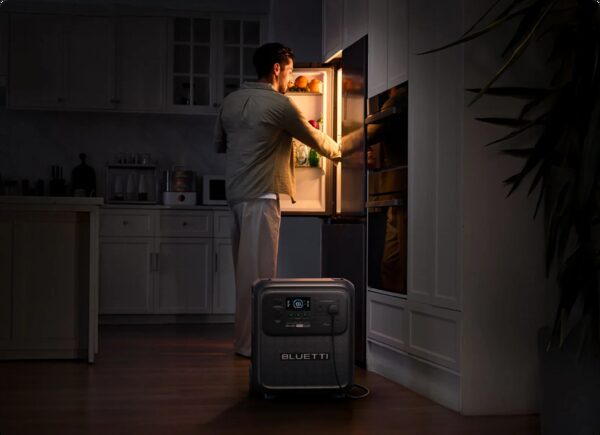
One maker states that its fridge backup system, with capacity expandable up to 8,064Wh, can deliver refrigerator backup for up to 4 days17. That is a maker claim for its own product.
For comparison, a maker of home batteries suggests that without solar, 2 to 5kWh should suffice for basic survival needs such as a fridge, Wi-Fi and LED lights during an outage, while keeping a normal level of living (TV, microwave, hot shower) needs 10 to 13.5kWh as a basic minimum. The same guidance suggests 4 to 5kWh for small homes of 1 to 2 bedrooms and 5 to 8kWh for 3 to 4 bedrooms18. At that scale a power station begins to overlap with a fixed battery, weighed on home battery vs portable power station.
Capacity, inverter and ports: the four things to check before buying
Makers' own checklists come down to four points6:
- Capacity (Wh): "The battery's capacity determines how much power the unit can store and deliver." Higher-capacity models offer more runtime.
- Inverter output (W): the inverter's quality and continuous rating must handle the devices to be powered, including any that start together.
- Ports: "Ensure the power station has the right types and number of output ports for your devices."
- Size and weight: "Evaluate the unit's size and weight to ensure it's suitable for your intended use and easy to transport."
On ports, BLUETTI states its stations offer AC, DC and USB outputs19, and larger units add more: the BLUETTI Elite 400 is described as able to power up to 7 devices at once3. USB-C matters for laptops: the Jackery Explorer 1000 v2 is listed with USB-A and USB-C connections and up to 100W dual PD charging. For fridges and anything with a motor, a pure sine wave AC output is the specification makers point to7.
The inverter figure deserves the closest reading. A station's watt-hours say nothing about whether it can start a given appliance: that is the job of the continuous and surge output. How inverter ratings work is set out under inverters and inverter-chargers and what size inverter a battery backup needs.
Recharging: wall outlet, car adaptor or solar panels
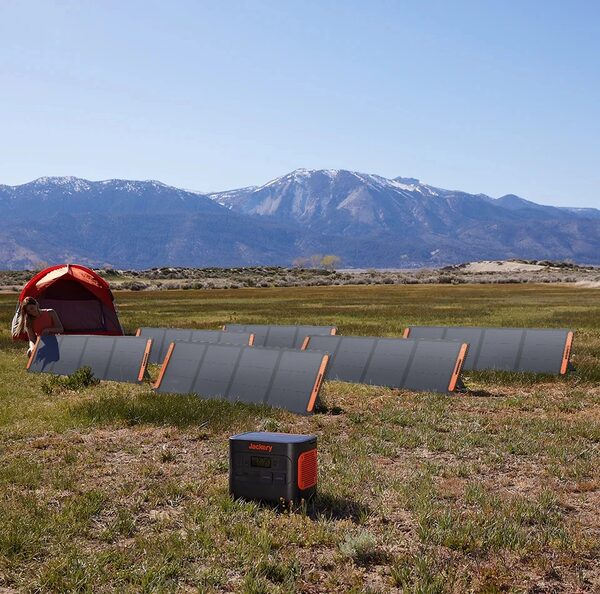
A power station is only as independent as its recharging. Once empty it needs the mains, a vehicle or solar panels. Most support all three: BLUETTI states its stations recharge by wall charger, solar charger and car charger19, and the Anker SOLIX C300 lists four routes (wall outlet, solar panels, car, or its PD 3.1 USB-C port), with the maker stating it recharges to 80% in 50 minutes from a wall outlet20.
Makers describe attaching solar panels as turning a power station into a "solar generator"4, meaning it can recharge with no outlet at all5. Compatibility is specific to each model. The Anker SOLIX C300 accepts solar panels between 11 and 28V with an XT60 connector and is not compatible with 5V USB-C solar panels21. The C300 DC tops out at 100W of solar recharging22. The EcoFlow DELTA 2 is stated to accept 110W, 160W, 220W and 400W panels without losing charge speed14.
Panel size is a practical constraint: independent guidance notes that plug-in solar panels are often around 1m x 2m and weigh more than 20kg23. Solar output also varies with weather and season, so recharging in a British winter is slower and less predictable than the panel rating suggests.
In a long outage, the recharging route decides how independent the household is. Wall charging returns the dependence to the grid; car charging depends on fuel; solar is the only route that needs neither, and it depends on daylight. More detail is on charging a portable power station from solar panels.
Indoor-safe backup: no fumes, no ventilation, very quiet
The main difference from a generator is where it can run. Makers state that a power station "is safe to use indoors or outdoors as there are no emissions of any kind, including carbon monoxide gas"4, and that when running an electric heater "there's no need to worry about ventilation, either since the power is clean and without fumes"24.
"a battery-powered alternative to a gas generator that can be used inside (or outside) during a blackout"
This matters because fuel generators cannot run indoors at all: their exhaust contains carbon monoxide, covered on generator safety. A power station sits next to the appliance it runs, with a plug-in lead and no transfer switch or wiring change.
Noise is the other benefit. Makers describe power stations as extremely quiet, quieter even than inverter generators4, with published figures below:
| Model | Stated noise |
|---|---|
| Anker SOLIX C300 | 25dB from 1m20 |
| EcoFlow DELTA 2 Max | 30dB, against 55dB or higher for other units14 |
| EcoFlow DELTA Pro 3 | 30dB16 |
These are makers' own figures; one EcoFlow source gives the DELTA Pro 3's 30dB at 2,000W and another "as low as 30dB under moderate loads", so the documents differ on the conditions. Fans run faster under heavy loads and during fast charging.
Size, weight and portability: from drink-cooler scale to wheeled units
Makers describe the typical power station as light and about the size of a small drink cooler, many with handles or wheels4. Weight rises with capacity. Independent guidance cites an Anker power station at 3.7kg; a 1,000W-class station often weighs 10 to 14kg10; and the EcoFlow DELTA 3 is listed at up to 12.5kg in an IP65-rated case15.
Above about 2kWh, portability becomes relative. BLUETTI describes its Elite 300 as the smallest 3kWh portable power station, citing a Frost & Sullivan certification, and sells a trolley for its larger units. Expandable systems add a separate battery for each step up in capacity, so a 5kWh or 12kWh set-up is a floor-standing system rather than something carried between rooms.
In practice this shapes how a unit is used in a power cut. A small unit moves easily from kitchen to bedroom; a 2kWh-class station is usually parked beside the fridge; a multi-battery system stays in one place like a fixed battery. Makers' advice is to judge size and weight against how the unit will be used and moved6.
What a portable power station costs in the UK
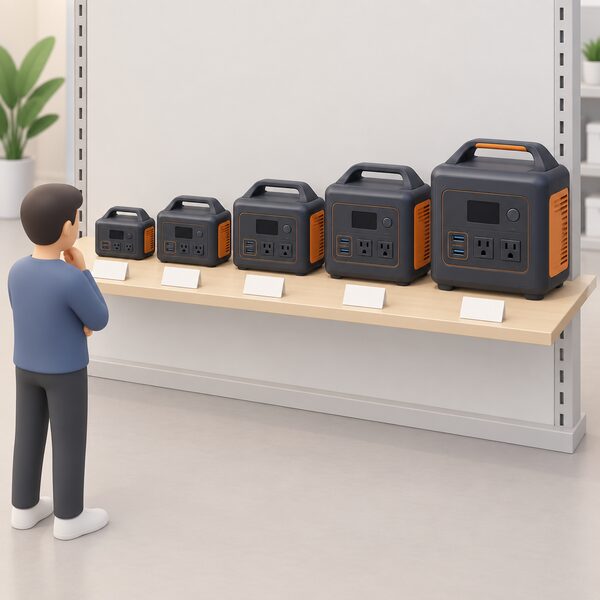
Prices below were read on BLUETTI's UK shop on 19 September 2026, in GBP as shown to UK consumers (including VAT). They show how price tracks size within one maker's range and are not a comparison between brands.
| Model | Capacity / output (where given) | Price |
|---|---|---|
| BLUETTI AC2A | £189.003 | |
| BLUETTI Elite 30 V2 | £199.00 | |
| BLUETTI EB3A | 268Wh, 600W | £219.003 |
| BLUETTI AC2P | £249.003 | |
| BLUETTI AC50B | £349.00 | |
| BLUETTI AC70 | £419.0025 | |
| BLUETTI Elite 100 V2 | £469.003 | |
| BLUETTI AC180 | 1,152Wh, 1,800W | £599.0026 |
| BLUETTI Premium 100 V2 | £619.0027 | |
| BLUETTI AC180P | £799.00 (list £1,399.00)28 | |
| BLUETTI AC200P | £999.0026 | |
| BLUETTI Premium 200 V2 | £1,319.0027 | |
| BLUETTI AC240 | £1,699.003 | |
| BLUETTI Elite 400 | nearly 4kWh | £1,799.003 |
| BLUETTI AC240P | 1,843Wh, 2,400W | £1,899.0028 |
Maker guidance puts the typical UK range at £400 to £3,000 or more8, and describes power stations as "on the pricey side, often costing as much as an inverter generator"4. Independent guidance puts portable generators at around £160 up to £2,000 or more, with hire of a 1.6kVA generator around £76 for a day or £110 for a week29. A fixed domestic battery of 4 to 10kWh usually costs £2,500 to £10,000 fully installed30, and official guidance cites a typical 5kWh system at around £4,60031.
Prices change often and sale prices vary. A fuller breakdown is on how much a portable power station costs and backup power costs compared.
Battery chemistry and cycle life: what determines how long it lasts
Power stations use lithium batteries, which makers describe as lightweight, more efficient and safe to discharge to a lower voltage without damage5. Most current models use lithium iron phosphate (LiFePO4), rated for roughly 3,000 to 6,000 cycles before falling to about 80% of original capacity1.
Independent guidance states that with around 4,000 charging cycles a lithium-ion battery can typically last 10 years or more30, and official guidance gives domestic battery storage a lifetime of around 10 to 15 years31. Maker figures for their own ranges sit within this spread: BLUETTI states 2,500 to 6,000+ cycles for its LiFePO4 batteries, and the AC200L "lasts over 10 years with 4,000+ cycles"32.
What drives the difference, in the words of the independent certification body, is that "a battery's lifespan depends on its type and how often it's charged and discharged fully"33. A unit kept as emergency backup, rarely cycled, wears slowly; one used every day on a boat or in a caravan uses up its rating faster. One maker notes that LiFePO4 batteries in newer models prefer staying between roughly 20 and 80% charge most of the time12, which in turn trims usable capacity. The same body advises checking the lifespan of the specific model before buying, since it varies by model33.
For independence, the battery is the part that ages; the household also depends on the maker for firmware, spare parts and warranty support. More on chemistries is on portable power station batteries.
Sources33 cited
- Best portable power stations buying guide, BLUETTI, 2026-08-31
- 2000W portable power stations, Anker SOLIX
- Coupon products, BLUETTI, 2026-09-19
- Inverter generators vs portable power stations, EcoFlow, 2025-06-16
- Portable power station vs power bank, EcoFlow, 2025-06-16
- Portable power station: power at your fingertips, AlphaESS, 2023-08-25
- Emergency power supply, SolaX Power, 2026-08-05
- Guide to emergency generators, Jackery, 2026-06-03
- Canal boat power solution, BLUETTI, 2026-09-19
- 1000W portable power stations, EcoFlow, 2025-10-30
- What size inverter do I need?, SolaX Power, 2026-05-13
- 2000W portable power stations, EcoFlow, 2025-10-24
- Anker SOLIX C1000, Anker SOLIX, 2026-09-19
- Best portable power station, EcoFlow, 2025-08-26
- EcoFlow DELTA 2 vs DELTA 3, EcoFlow, 2025-06-25
- How much does an electric heater cost to run?, EcoFlow, 2025-11-17
- FridgePower, BLUETTI, 2026-09-19
- Home battery storage in the UK without solar, Jackery, 2026-05-29
- FAQ, BLUETTI, 2026-09-19
- Anker SOLIX C300, Anker SOLIX, 2026-09-19
- Anker SOLIX C300 product page, Anker SOLIX, 2026-09-19
- Anker SOLIX C300 DC, Anker SOLIX, 2026-09-19
- Plug-in solar consumer guide, Electrical Safety First, 2026-08
- Prepare for a winter power outage, EcoFlow, 2025-06-16
- Less than 1kWh, BLUETTI, 2026-09-19
- Best sellers, BLUETTI, 2026-09-19
- 1 to 2kWh, BLUETTI, 2026-09-19
- Premium series, BLUETTI, 2026-09-19
- How to buy the best generator, Which?, 2026-01-20
- Everything you need to know about battery storage, Plymouth Energy Community, 2026-09-20
- POSTnote 771, UK Parliament POST, 2026-06-25
- Black Friday, BLUETTI, 2026-09-19
- Battery storage, MCS, 2026-09-17
 Portable Power Station CostHow much does a portable power station cost in the UK, and what does the money actually buy?
 Portable Power StationsWhat can a portable power station actually keep going in a power cut, and for how long?
 Power Station BatteriesWhat kind of battery is inside a portable power station, and does it matter?
 Home Battery CostA home battery usually costs between one and a half and ten thousand pounds fitted, depending on size.
 Portable Generators for HomesWhat can a portable generator actually run in a power cut, and for how long?
 What Size Battery?How much electricity does your home use in a day, and how much of that falls in the hours when power is cheap or your solar panels are generating?