
In this answer
Short answer
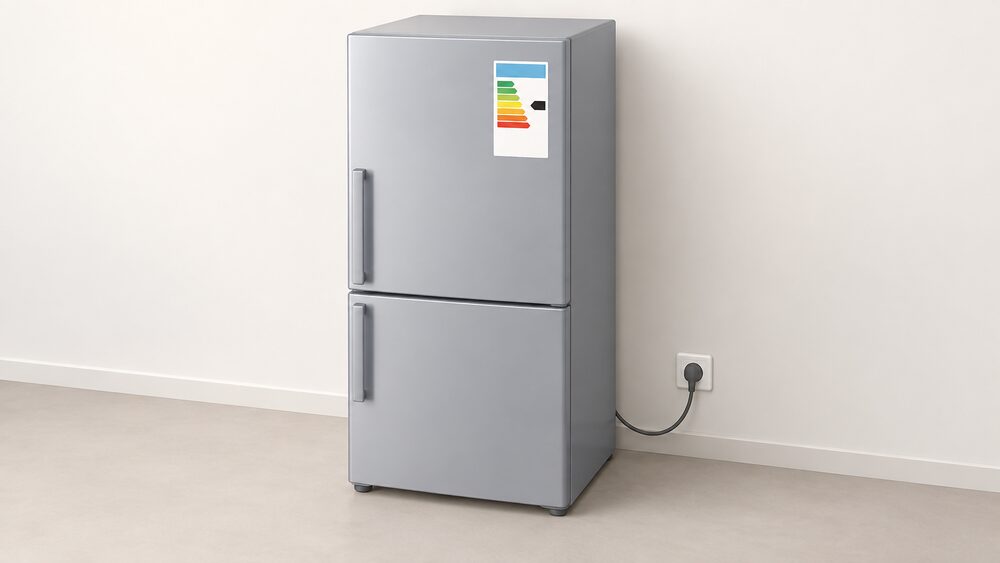
A fridge freezer is the one appliance in a UK home that never gets a day off. It runs through the night, through holidays, through every hour you are asleep. So the question of what it uses in 24 hours is really a question about the one running cost you cannot switch off.
The short answer is that a modern fridge freezer typically uses around 1 kWh of electricity per day, which is about 30 kWh a month1. A typical A-rated unit falls between 0.8 kWh and 1.2 kWh a day2. That is the figure most households should expect, and it is modest: some air conditioners can use in one hour what a fridge uses in a day3.
But the range across real appliances is wide. At the low end, a small 85 litre freezer rated E uses 0.52 kWh per day1. At the high end, a 150 watt fridge running continuously works out at 3.6 kWh per day4. The gap between those two figures is not random: it comes down to size, energy rating, age and how the appliance is used.
Daily use in kWh: the full range, from 0.52 to 3.6 kWh
The spread of daily figures is wider than most households expect, and the reasons are worth understanding because they explain why two neighbours with similar kitchens can have very different bills.
At the bottom of the range, a small 85 litre freezer rated E uses 0.52 kWh per day1. A 250 kWh a year model averages about 0.68 kWh a day1. These are small or highly efficient appliances, and they represent the realistic floor for a working fridge freezer in a UK home.
In the middle, a modern fridge freezer sits at around 1 kWh a day, or 30 kWh a month1. A typical A-rated unit uses 0.8 to 1.2 kWh a day2. A fridge freezer with a 267 litre total capacity and a 74 litre freezer compartment is rated at 231 kWh a year1. A household fridge generally falls in the 1 to 2 kWh a day band over 24 hours4.
At the top, a 150 watt fridge used 24 hours a day will use 3.6 kWh of electricity per day4. That is the figure for an appliance drawing its full rated power continuously, which is unusual in practice but shows how quickly the numbers climb with wattage.
One maker datasheet gives a fridge freezer at 0.93 kWh per day and 340 kWh a year6. Another gives 0.23 kWh per day for an A-rated machine7. The two documents disagree on the daily figure, and the discrepancy is not resolved. Where a single number is needed, the annual kWh figure on the energy label is the more dependable guide.
What a 24-hour figure means for a fridge that runs all day
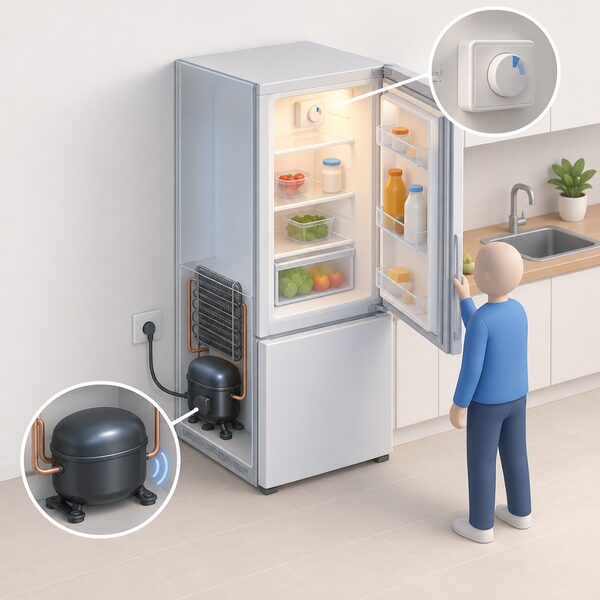
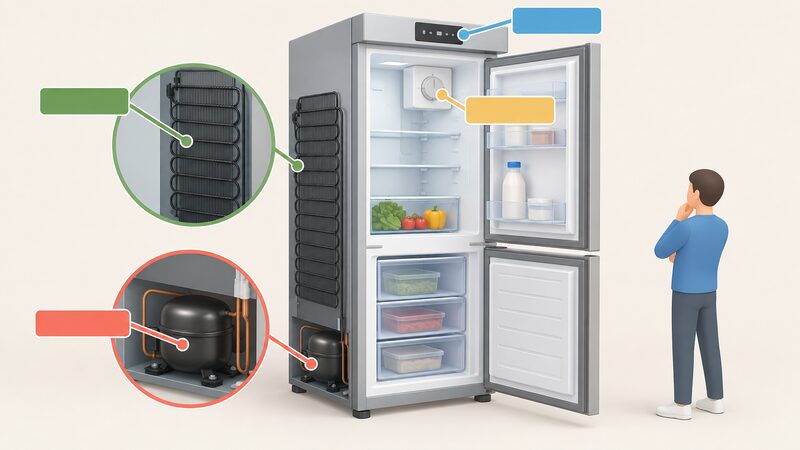
A fridge freezer does not draw a steady current. The compressor cycles on and off as the thermostat calls for cooling, so the appliance's actual consumption over 24 hours is lower than its rated wattage multiplied by 24 would suggest. This is why a 150 watt appliance does not necessarily use 3.6 kWh a day in normal operation, even though the arithmetic says it would4.
The appliance still draws power when the compressor is off. The thermostat, any interior light when the door opens, and display or smart features all take a small continuous current. That standby draw is part of the daily figure and part of why the annual kWh rating is more accurate than a simple wattage calculation.
The 24-hour framing also matters because it is the unit of time over which a fridge freezer's job is measured. Food safety guidance is written in hours, not kilowatt hours. A full freezer will keep its temperature for about 48 hours, or 24 hours if half-full, with the door kept closed8. Freezers generally stay cold for 24 to 48 hours during a power cut9. Food should keep for about eight hours without power in a fridge freezer10.
That gives a household a useful way to think about the daily figure: the electricity a fridge freezer uses in 24 hours is also the electricity it needs to protect your food for 24 hours. The two are the same measurement seen from different ends.
"A full freezer will keep temperature for about 48 hours (24 hours if half-full)."
Running cost per day and per year at current rates
Turning kWh into pounds depends on the unit rate you pay, and rates have moved sharply in recent years. Which? found that household appliance running costs rose nearly 60 per cent during the cost of living crisis11.
At 26.11p per kWh, a freezer using 190 kWh a year works out at roughly £4.13 per average month, or 13.6p per day, excluding the standing charge1. A fridge freezer on a standard variable tariff has been put at £5.39 a month2.
Annual figures from Which? give a clearer picture of the spread:
| Appliance | Annual running cost | Date |
|---|---|---|
| Fridge freezer (integrated) | £78 | 2026-10-012 |
| Fridge freezer (freestanding) | £79 | 2026-10-012 |
| F-rated fridge freezer | £93.50 | 2026-09-2012 |
| American-style fridge freezer | at least £115 | 2026-08-273 |
Older figures show how much costs have risen. In October 2021, a freestanding fridge freezer cost £48.17 a year to run and an American model £103.0711. By April 2023, those figures had reached £165.36 and £211.84 respectively11. A September 2022 projection put freestanding and American models at £84 and £120, rising to £155 and £222 a year under the new price cap13.
Which? also found one Hisense model, the RB327N4WW1, would cost £113.12 a year to run when the average for a freestanding model was £8114. That is a useful reminder that two appliances of the same type can differ by £30 or more a year.
VAT on electricity was reduced from 5 per cent to 0 per cent from 1 October 2026, and the typical cost figures shown already reflect that change2.
Why size, rating and age change the daily figure
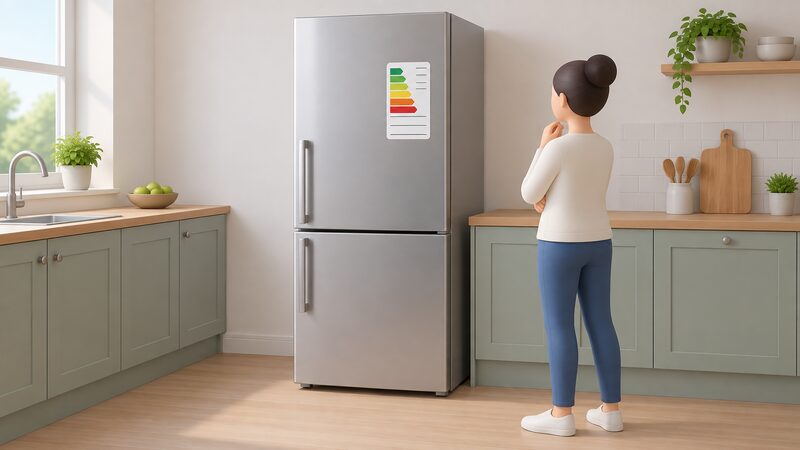
The energy rating is generally linked to size, so a bigger A-rated product of the same type uses more energy than a smaller one15. That is the single most important thing to understand about the label: A does not mean low consumption in absolute terms, it means efficient for the appliance's size.
Energy labels rate appliances A as most efficient for their size and print suggested kWh usage per annum for each appliance16. To compare between differently sized appliances, the label's annual kWh figure is the number to use, not the letter grade16.
Age matters too. The Which? figures show running costs for freestanding fridge freezers rising from £48.17 a year in October 2021 to £165.36 in April 2023, though much of that increase reflects higher unit rates rather than the appliances themselves11. An older appliance with a lower efficiency rating will use more kWh for the same cooling.
Size shows up in the daily figures directly. A small 85 litre freezer uses 0.52 kWh a day1. A fridge freezer with a 267 litre total capacity is rated at 231 kWh a year1. American-style fridge freezers are consistently the heaviest users, adding at least £115 per year in electricity on average3.
Usage patterns also shape the daily figure. Household electricity consumption typically shows an increase in the morning, a smaller peak around lunchtime, and the highest peak after 6pm17. A fridge freezer runs through all of those peaks, which is why it contributes to the base load rather than the peaks.
Fridge freezer use in the context of household bills

Fridges and freezers account for around 13 per cent of the average household's energy bill5. That is a significant share for an appliance most people never think about, and it is higher than many households would guess.
For context, Ofgem's typical domestic consumption values put a medium dual-fuel household at 2,500 kWh of electricity a year, with low usage at 1,600 kWh and high usage at 3,800 kWh, from 1 July 202618. A fridge freezer using 231 kWh a year is therefore roughly 9 per cent of a medium household's electricity, though the 13 per cent bill share figure reflects the fact that electricity is more expensive per kWh than gas.
The comparison with other appliances is instructive. Some air conditioners can use the same amount of energy in one hour that a fridge uses in a day3. A dehumidifier run for 24 hours will use 12 kWh of electricity19. Against those, a fridge freezer's 1 kWh a day is modest, but it is relentless: it runs every day of the year, which is what makes the annual figure add up.
For a household thinking about energy independence, the fridge freezer is a useful case study. It is the appliance most amenable to being run from a home battery or solar system, because its load is predictable and spread across the whole day rather than concentrated in the evening peak. A 100W solar panel in the UK climate typically generates about 300 to 400 Wh per day, or 0.3 to 0.4 kWh, depending on season and sunlight4. That is not enough to cover a fridge freezer on its own, but it covers a meaningful fraction of the daily figure.
The dependence that remains is the same as for any appliance: the grid, a supplier, and the unit rate you pay. A fridge freezer cannot be switched off to save money the way a tumble dryer can. It is the floor of your electricity bill, and the only way to lower it is to choose a more efficient appliance or to generate your own power. For more on how appliance costs fit into the wider bill, see appliance running costs and what makes up an energy bill.
Sources19 cited
- Freezer energy consumption, Bluetti Power UK, 2026-09-17
- How much your appliances cost to run, Which?, 2026-10-01
- 10 ways to save on energy bills, Which?, 2026-08-27
- How many solar panels do I need, EcoFlow UK, 2025-08-26
- Top five energy consuming home appliances, Energy Saving Trust, 2026-08-03
- Best battery for solar panel, Bluetti Power UK, 2026-08-31
- How many batteries does a home need, SAJ Electric, 2026-07-22
- How do I keep food safe, Northern Ireland Electricity Networks, 2026-09-19
- Tips to help you during a power cut, Electricity North West, 2026-09-19
- Planned power cuts, SSEN, 2026-09-19
- Household appliance running costs have risen nearly 60 per cent, Which?, 2023-04
- Save energy in summer, ivie, 2026-09-20
- Save on appliance running costs, Which?, 2022-09-04
- Which? warns against buying cheap appliances, Which?, 2023-11-09
- Top five tips to save energy in the kitchen, Energy Saving Trust, 2026-05-20
- How much electricity am I using?, Centre for Sustainable Energy, 2026-07
- Average daily consumption curves show distinct consumption behaviours, Nesta, 2025-08-06
- Review of typical domestic consumption values decision, Ofgem, 2026
- Ratings of electrical appliances, Electrical Safety First, 2026-09-19
 Portable Power Station SizeHow big a portable power station does a home actually need, and how long will it keep things running in a power cut?
 Running CostsA portable air conditioner costs roughly twenty to forty pence for every hour it runs, while a fixed unit uses far less electricity for the same cooling.
 What Size Battery?How much electricity does your home use in a day, and how much of that falls in the hours when power is cheap or your solar panels are generating?
 Home Battery CostA home battery usually costs between one and a half and ten thousand pounds fitted, depending on size.
 Agile and Dynamic TariffsAgile tariffs change the price of your electricity every half hour, so what you pay depends on when you use power.
 Sizing a Self-Sufficient HomeHow many solar panels and how much battery storage does a home need to stop relying on the grid?