
In this answer
Short answer
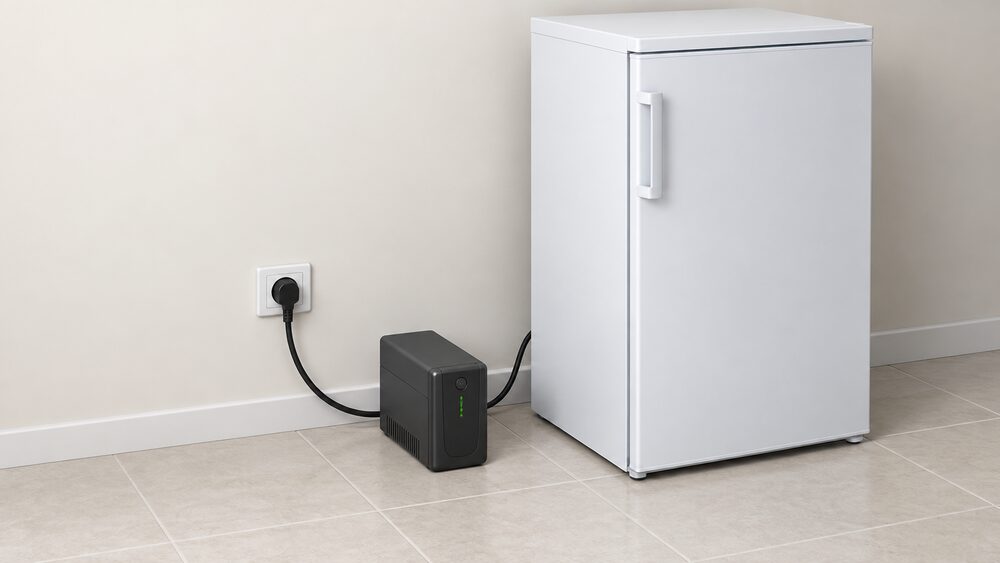
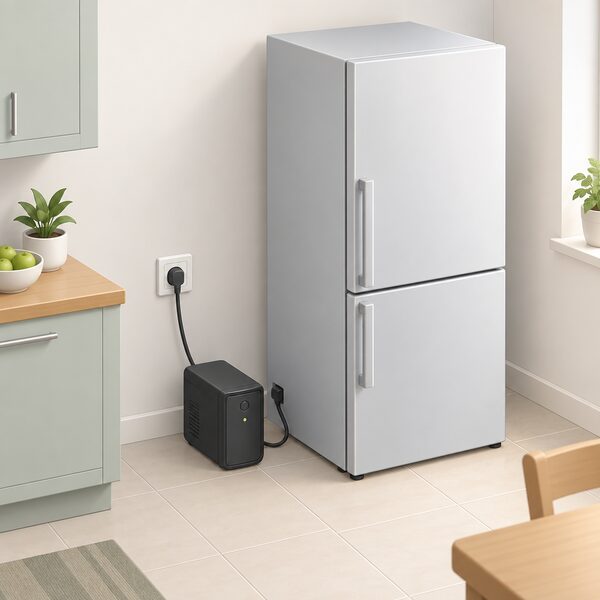
A UPS can keep a fridge or freezer running, but only for the length of a short interruption. The Energy Saving Trust notes that some appliances, like fridges and freezers, need to be on all the time1, and a UPS is the device built to bridge the gap when the mains drops. What it is not is a long-duration supply: a domestic UPS is sized in minutes, while the freezer's own cold mass is what carries a household through a multi-hour cut.
That cold mass is substantial. Electricity North West states that freezers stay cold for 24 to 48 hours, and that a full freezer may remain cold for up to 48 hours in warm weather2. UK Power Networks puts it more cautiously, saying freezers remain cold for several hours without power and advising that the door stays closed4. A UPS therefore sits at the front of a window that is already measured in hours, not at the centre of it.
The practical answer for a household is that a UPS protects the appliance and the food through brief interruptions, voltage dips and rapid restarts, and does very little in a storm-related outage that runs into the evening. For that, the relevant comparison is a home battery or a portable power station, both of which are covered elsewhere on this site.
What a UPS actually does for a fridge or freezer
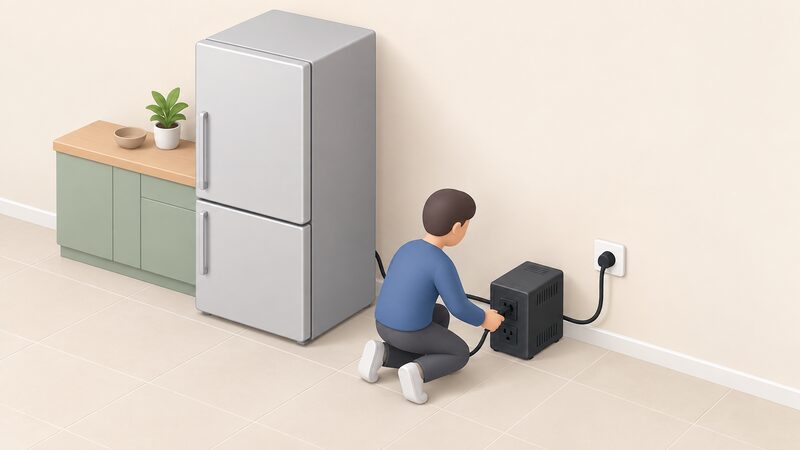
A UPS is designed for instantaneous protection of electronics, with a 0ms switch5. That figure is the whole point of the category: the transfer to battery happens fast enough that the connected equipment never sees the interruption. For a fridge or freezer, that matters less for the food than for the compressor, which is a motor load that dislikes being stopped and restarted abruptly.
The load itself is the constraint. A fridge or freezer draws a modest running current but a much larger surge when the compressor starts, and a UPS has to be sized for that surge rather than for the steady draw. Eaton's own home UPS pages describe the products by the equipment they suit: the Eaton 3S Mini UPS for routers, switches and modems, the Eaton 3S Gen2 UPS for home office equipment, NAS systems, aquariums and terrariums, cryptominers, household appliances and automatic feeder systems, and the Eaton Ellipse PRO UPS for Hi-Fi, TV, audio and gaming, with automatic voltage regulation8. Household appliances appear in that list, but as one item among several rather than as the design case.
The consequence is a runtime measured in minutes at realistic fridge loads. A UPS bought for a home office will not hold a freezer through an evening. A UPS bought specifically for a fridge or freezer will hold it through the short interruptions that are the commonest kind, and will then hand over to the freezer's own insulation.
"A UPS (Uninterruptible Power Supply) is designed for instantaneous protection of electronics (0ms switch)"
How long food actually stays safe
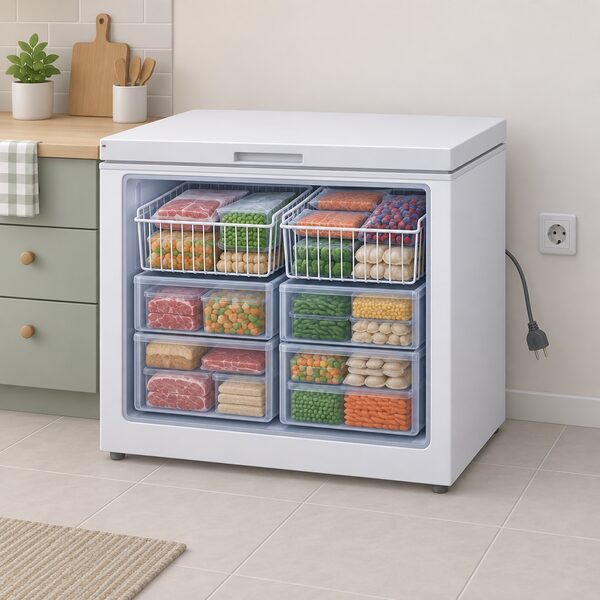
The cold-holding figures come from the network operators, who deal with the aftermath of cuts. Electricity North West advises that freezers stay cold for 24 to 48 hours, and that fridges can be kept colder for longer by adding ice and packing food tightly in the drawers2. In its summer guidance the same operator notes that a full freezer may remain cold for up to 48 hours3. UK Power Networks, preparing for named storms, states that freezers remain cold for several hours without power and that the door should be kept closed4.
Those two positions are not contradictory so much as differently framed: one gives the outer envelope for a well-packed freezer, the other the cautious working assumption. A household planning for a cut should treat the shorter figure as the planning case and the longer one as the best case.
Two further points bear on the decision. First, a fridge or freezer is not the only appliance that wants permanent power: Smart Energy GB notes that some satellite and digital TV recorders may need to be left plugged in so they can keep track of programmes9. Second, the network operator is not liable for the food. UK Power Networks states plainly that power cuts occur for many different reasons and usually without warning, so it is not liable for any loss of fridge freezer contents as a result of a power cut10. A UPS is therefore a household's own answer to a risk the network does not carry.
Eaton: a century in power management
Eaton is the maker whose home UPS range is documented most fully here, and its history is part of why it appears in domestic backup discussions. Eaton states it was founded in 19117, and describes more than 100 years of experience as a leader in building electricity and power electronics11. The company says it has been listed on the New York Stock Exchange for more than a century and serves customers in more than 160 countries7.
For a household, the relevant part of that record is the product line rather than the corporate history. Eaton's home UPS pages set out three tiers: the 3S Mini for network equipment, the 3S Gen2 as an alternating current model with a sleek design and multiple outlets, recommended for NAS systems to protect against overvoltage and undervoltage, and the Ellipse PRO with automatic voltage regulation8. The 3S Mini is described as protecting the technology managing an intelligent home against power surges and spikes8.
The company's larger storage products sit above these. The Eaton xStorage Compact is described as designed to enable a wide range of energy storage applications in residential, commercial, and light industrial buildings12, and is based on double conversion technology13. Its technical datasheet gives fuse sizes of 80 A for the 40 kW PCS rack and 40 A for the 20 kW PCS rack12. Those are commercial-scale figures, not domestic ones, and they mark the boundary between a plug-in UPS and a fixed storage installation.
| Eaton product | Stated application | Note |
|---|---|---|
| Eaton 3S Mini UPS | Routers, switches and modems | Protects against power surges and spikes8 |
| Eaton 3S Gen2 UPS | NAS systems, home office equipment, household appliances | AC model, multiple outlets8 |
| Eaton Ellipse PRO UPS | Hi-Fi, TV, audio and gaming | Automatic voltage regulation8 |
| Eaton xStorage Compact | Residential, commercial and light industrial buildings | Double conversion; 80 A fuse on 40 kW rack, 40 A on 20 kW rack13 |
Buildings as a Grid: Eaton's approach to home energy
Eaton frames its residential and commercial storage work under a single idea. The company states: "We call this approach 'Buildings as a Grid'"14, describing a strategy for converting buildings into energy hubs rather than passive consumers. That framing is what connects a plug-in UPS at one end of the range to a fixed battery system at the other.
The xStorage Hybrid is the clearest expression of it. Eaton describes it as a system that combines two or more different energy storage technologies and can manage different sources of energy at the same time, including DC current from PV panels, AC current from micro inverters, central inverters or an electrical generator, for small and medium-sized applications13. The xStorage Home range is promoted to UK customers and installers through Eaton's GB site, described as leveraging the new business opportunity afforded by energy storage15, and Eaton xStorage is described as available for households, commercial buildings and as part of bigger energy networks and data centres16.
The direction of travel in the wider market supports that framing. Solar Energy UK records deployment of energy storage to provide frequency response to the grid17, and its Watt Communities Want survey found majority support for a flexible, storage-led system18. The Scottish Government has published planning guidance for battery energy storage systems at grid scale19, and the Home Energy Model covers domestic buildings19.
For a household, the significance is that a fridge or freezer is one load inside a system that can be designed as a whole. A UPS protects it for minutes; a storage system with a grid-service role protects it for hours and earns something back in between.
UK availability and what Eaton offers households
Eaton's domestic presence in the UK runs through its GB site, which promotes the xStorage Home range to customers and installers15. The xStorage Home 3P carries CE certification11, and the page for that model is marked "To be discontinued"11, which is a material point for anyone specifying it now: a product at the end of its line has a different support horizon from one in current production.
The plug-in UPS range is the part of Eaton's catalogue that a household can buy and install without a fixed installation. The 3S Gen2 is recommended for home office equipment, NAS systems, aquariums and terrariums, cryptominers, household appliances and automatic feeder systems8, and the 3S Mini for routers, switches and modems8. The Ellipse PRO is aimed at entertainment equipment8.
Prices for these units are installer-quoted or retailer-quoted, and no published UK price is given here. The same applies to the fixed storage products: they are specified and installed rather than bought off a shelf, and the fuse ratings in the datasheet (80 A and 40 A) are installation parameters rather than consumer specifications12.
Support, partnerships and the wider ecosystem
Eaton publishes a UK technical support line: +44 (0) 1753 608 700, option 3 then 66. That is the maker's own route for product support, and it is the number to use for questions about a specific UPS rather than about the supply itself.
Around the equipment sits a wider set of publicly funded and partnership programmes that shape how households get help. The USER project, Ubiquitous Storage Empower Response, was funded by BEIS under the Domestic Demand Side Response Competition20. The Cadent hybrid heating programme is funded by Cadent and supported by Worcester Bosch, TAGGAS, YES Energy Solutions and Guidehouse21. The Carbon Monoxide Partner Ecosystem is supported by Wales and West Utilities and a growing network of partners22. Cornwall's Winter Wellbeing service is supported by Public Health, Inclusion Cornwall, the Council of the Isles of Scilly, and NHS Cornwall and Isles of Scilly23.
On the community side, Action on Energy provides communities with advice and support for improving home energy efficiency24, and Connected for Warmth is supported by the National Grid energy efficiency fund25. SSEN publishes residential emergency planning material26, and versions of a Home Emergency Plan exist for England and Scotland26.
For a household thinking about a fridge or freezer, these programmes matter less for the equipment itself than for the support that surrounds a cut. Households with a health condition or disability that needs a continuous supply of electricity, for example where a stair lift or similar equipment is used, have a route to protection through the supplier27, and that route is separate from any UPS purchase.
What a UPS-backed fridge means for energy independence
A UPS improves a household's position in one narrow respect and leaves the rest untouched. It removes the dependence on a perfectly continuous mains supply for the seconds and minutes that matter to a compressor, and it does so without a supplier, a fuel store or an app. That is genuine, if small.
The dependence that remains is larger. A UPS is charged from the grid and holds only what its battery contains, so a long cut exhausts it. The freezer then relies on its own cold mass, which is why the network operators' figures matter more than the UPS specification: 24 to 48 hours for a freezer, up to 48 hours for a full one in warm weather2. The food is protected by insulation and packing, not by the electronics.
There is also a timing effect worth understanding. Equiwatt notes that after a powerDOWN event the fridge or freezer will need to use energy to re-cool itself but will use cleaner energy during lower cost times28. The same logic applies after a cut: the appliance draws a recovery load once power returns, and that load lands whenever the supply comes back.
The wider measure of independence is self-sufficiency, defined as the percentage of electricity consumed in the property over a year which is met by either behind the meter solar or electrical energy storage29. A UPS does not move that number, because it is not a generation or storage asset in the annual sense. Solar Energy UK's position is that more homegrown energy means greater energy independence30, and EDF Energy's stated focus is helping Britain achieve Net Zero by 2050 as Britain's largest generator of zero-carbon gas and electricity31. Zero Carbon Britain targets a 50% reduction in heating demand32. Against those goals, a UPS is a reliability device, not an independence one.
For households weighing the options, the useful comparisons are set out in the pages on UPS sizing, UPS types, home UPS systems and UPS versus portable power station. Where the aim is hours rather than minutes, portable power stations and home batteries are the relevant categories, and the Eaton page covers the maker's range in more detail. Food safety during a cut is covered in how long food lasts in a fridge or freezer, and the wider picture sits on the backup power pillar.
Sources32 cited
- Quick tips to save energy, Energy Saving Trust
- Tips to prepare for a power cut, Electricity North West
- Be summer ready, Electricity North West
- Power network prepares for storms Dudley and Eunice, UK Power Networks
- Emergency power supply, Solax Power
- xStorage Hybrid, Eaton
- xStorage Hybrid launch at Intersolar, Eaton, 2024
- UPS for the home, Eaton
- Switching appliances off standby, Smart Energy GB
- Compensation: a power cut ruined food in my fridge freezer, UK Power Networks
- xStorage Home 3P, Eaton
- xStorage Compact technical datasheet, Eaton, December 2025
- Energy storage FAQ, Eaton
- Six steps to make your property ready for the energy transition, Eaton
- Home energy storage, Eaton
- xStorage Home supports the energy transition, Eaton
- Trading sunlight, Solar Energy UK
- Watt communities want, Solar Energy UK
- Energy performance of buildings Scotland: regulations 2025 update, Scottish Government
- Written evidence, UK Parliament
- Hybrid heating, Cadent
- Carbon monoxide co-awareness: COPE, Cadent
- Winter wellbeing, Cornwall Council
- Energy incentives and schemes, South Cambridgeshire District Council
- Wall insulation, AgilityEco
- Emergency planning portal: residential, SSEN
- Stop your energy supplier installing a prepayment meter, Citizens Advice
- Will my fridge or freezer use more energy to cool again after an equievent?, equiwatt
- MCS 032 2025, MCS Certified, 2025
- Solar energy Scotland manifesto, Solar Energy UK
- EDF Energy, Energy Helpline
- Windows, CAT
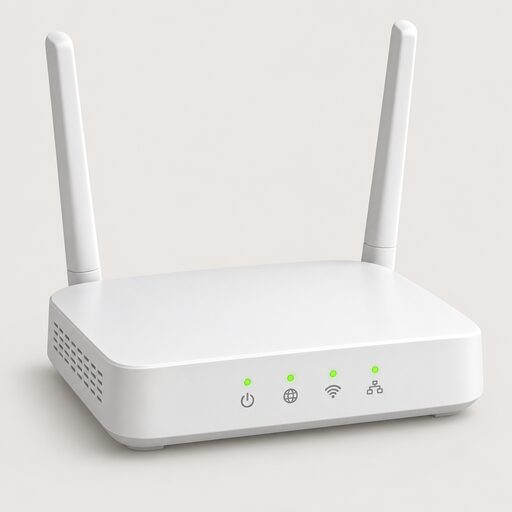 Home UPS SystemsA home UPS keeps your broadband, computer or boiler running through short power cuts and flickers, switching over instantly rather than after a second or two.
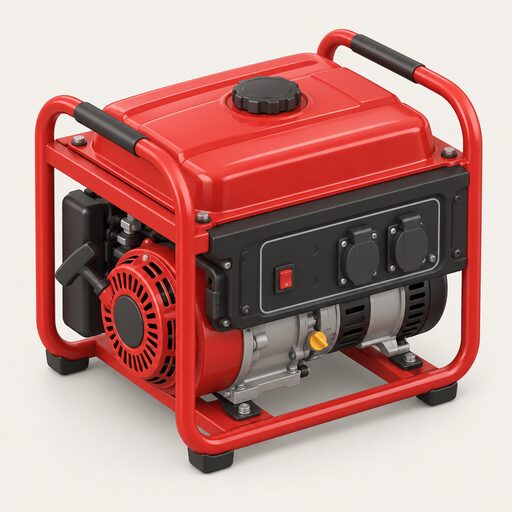 The Full Backup Power GuideHow long do UK power cuts usually last, and what can keep your fridge, heating or phone going until the power comes back?
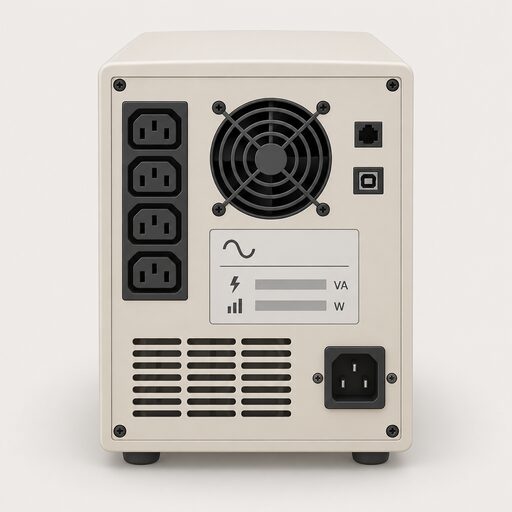 UPS Sizing ExplainedWhat size uninterruptible power supply do you need, and how long will it keep your devices running in a power cut?
 Portable Power StationsWhat can a portable power station actually keep going in a power cut, and for how long?
 Backup Power and EPSWill your lights stay on when the power goes out?
 Portable Power Station SizeHow big a portable power station does a home actually need, and how long will it keep things running in a power cut?