
In this answer
Short answer
The return window for a faulty Fronius part is 60 days. The Fronius warranty terms state that if the faulty part or device is not received within 60 days, the warranty holder will be charged for the part or device at the current price for a new part or device1. That is a charge under the maker's warranty, not a consumer right, and it sits alongside a separate 14-day cancellation right on a paid warranty extension bought from Fronius, where a return is possible within 14 days of purchase2.
The warranty period the return sits inside is two years as standard. The Fronius International GmbH limited warranty states that the warranty period is two years, unless a longer period applies by country1. For inverters in the country group that covers the UK, the period is 10 years in total, made up of 5 years Fronius Warranty Plus and 5 years Fronius Warranty thereafter, for units from 0 to 49 kW1. Fronius also states that the warranty term and services may vary depending on your country and region2.
What this means for a household is that the return clock is short and the warranty clock is long, and they are not the same clock. A fault discovered in year eight of a ten-year inverter warranty still has to be notified in writing immediately after discovery and in any case before the warranty period expires, and the faulty unit still has to reach Fronius within 60 days of the return arrangement1. The dependence that remains is on the maker's own system of record, on a specialist installer to remove and refit the unit, and on shipping that the standard warranty does not pay for.
How the return process works step by step
The process starts with notification, not with a parcel. The Fronius International GmbH limited warranty requires the warranty holder to notify Fronius in writing, and email is sufficient, of the occurrence of a covered defect immediately after its discovery and in any case before expiry of the warranty period1. Nothing in the terms allows a fault to be held back until it is convenient to deal with.
The claim then has to be documented. Fronius asks for the commissioning protocol, including the date of acceptance, the commissioning date and the report from the energy supply company, an invoice including the serial number, and a photo with a fully legible rating plate, plus any further information Fronius requests1. The warranty certificate is not the document that decides the claim: Fronius states that when verifying whether a warranty exists for a product, the information in the Fronius system is relevant and not the warranty certificate, and that the warranty certificate is no longer valid after return2.
Once a return is agreed, the 60-day clock governs the physical movement of the part. If the faulty part or device is not received within 60 days, the warranty holder will be charged for the part or device at the current price for a new part or device1. The terms do not publish a delivery time for the replacement, so a household cannot plan around a stated arrival date.
Who to contact in the UK: installer, distributor or Fronius
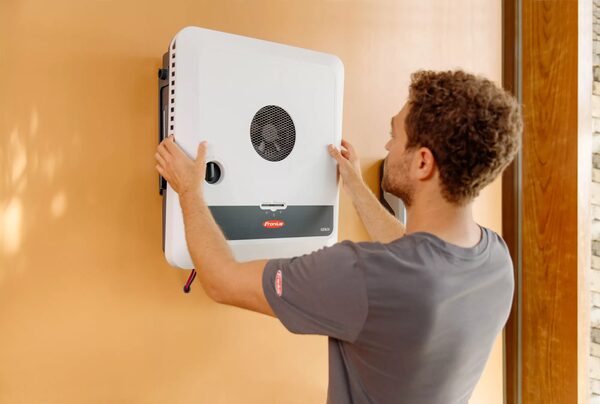
The warranty is written around a specialist installer rather than a household. The warranty period for the Fronius Ohmpilot and the Fronius Wattpilot runs with the date of the commissioning protocol of the specialised installer, or in its absence with the date of first delivery ex works1. The Fronius Datamanager imports the warranty period of the Fronius inverter it is installed in, or runs from first delivery ex works if bought separately1. The installer is therefore the person who fixes the start date of the cover in the first place.
Fronius maintains a certified installer network for exactly this reason. Fronius System Partners are described as trained and certified partner installers offering individual and expert advice, and the maker's partner network consists of over 6000 expert installers around the world4. Fronius Warranty Plus covers the labour costs directly associated with removal and replacement of the covered product when carried out by Fronius or a commissioned specialist installer1.
For the claim itself, the contact route is Fronius. Notices under the battery warranty terms are sent to support@fronius.com or to Fronius International GmbH, Froniusplatz 1, 4600 Wels, Austria, and the same address and email appear in the limited warranty6. A UK household can therefore route the paperwork through its installer while the notification and the decision sit with the maker. The dependence that remains is on a third party to physically remove and refit the unit, and on the maker's own records to establish that cover exists.
How Fronius warranty terms fit the return rules
The return rules only make sense against the warranty structure they sit in. The base period is two years, unless a longer period applies by country1. For inverters from 0 to 49 kW in the country group covering the UK, the period is 10 years in total, being 5 years Fronius Warranty Plus and 5 years Fronius Warranty thereafter1. Fronius guidance separately states that registration secures 10 years of free and reliable warranty cover for inverters under 50 kW, and that the warranty term and services may vary depending on your country and region2.
Registration is the condition that holds the extension in place. Inverters must be properly registered at solarweb.com within thirty (30) months of the initial delivery by Fronius ex works1. Fronius states that to qualify for the free warranty extension, new Fronius inverters commissioned on or after 1 June 2026 must be registered in Fronius Solar.web2. Registration is done with the inverter serial number7.
Two things do not restart when a claim is settled. If a covered product is replaced or repaired, the remainder of the original warranty period applies to the replaced or repaired product and does not restart or extend1. And the warranty certificate is no longer valid after return2.
| Product | Warranty term | Source |
|---|---|---|
| Fronius inverters, 0 to 49 kW, country group 1 | 10 years in total (5 years Fronius Warranty Plus plus 5 years Fronius Warranty thereafter) | 1 |
| Fronius inverters, under 50 kW | Up to 10 years free cover on registration | 2 |
| Fronius Reserva battery | 10 years, 80% usable capacity | 9 |
| Fronius Reserva Pro | 10 years (80% SOH) | 10 |
| Fronius Verto, inverters from 13 kW | Option 1: 2-year Fronius Warranty Plus plus 3-year Fronius Warranty Plus on registration | 11 |
The Verto terms are not settled in one direction. The product page lists Option 1 as a 2-year Fronius Warranty Plus plus a 3-year Fronius Warranty Plus upon registration, and Option 2 as a 2-year Fronius Warranty Plus plus a 5-year Fronius Warranty upon registration, for inverters from 13 kW12. The two options are given without a ruling, so a buyer reading the page sees both.
Who pays for shipping a faulty Fronius part back

Shipping is where the two warranty tiers diverge most sharply, and it is the cost a household is most likely to meet. Under Fronius Warranty Plus, Fronius bears the costs of standard national shipping, excluding express shipping and excluding air or sea transport, of products to the nearest Fronius Repair Centre and of spare parts or replacement devices to the warranty holder or specialist installer6. The same tier covers the labour costs directly associated with removal and replacement when carried out by Fronius or a commissioned specialist installer1.
Under the standard Fronius Warranty, the position is the reverse. On-site repair costs incurred in connection with the repair or provision of a spare part or replacement device, covering travel, installation and removal, and working hours, are excluded, as are the costs of shipment or transport including customs duties and export certificates1. A household whose cover has moved from the Plus tier into the standard tier therefore carries the movement costs itself.
The practical effect is that the first five years of a registered inverter warranty are materially better protected than the second five. That is a fact of the warranty structure rather than a judgement on it, and it is the reason the registration deadline matters: the extension is what puts the unit into the tier that pays for shipping and labour in the first place1.
Where the serial number and registration sit
The serial number is the thread that runs through registration, the claim and the physical identification of the unit. Fronius Solar.web registration is done with the inverter serial number, and the maker's own instruction is to register easily and free of charge at www.solarweb.com with your inverter serial number7. The same number appears on the rating plate, which is the plate a claim photo must show fully legibly1.
Registration is not optional for the extension. Inverters must be properly registered at solarweb.com within thirty (30) months of the initial delivery by Fronius ex works1, and new inverters commissioned on or after 1 June 2026 must be registered in Fronius Solar.web to qualify for the free warranty extension2. The Datamanager takes its warranty period from the inverter it is installed in when the two are bought together, and otherwise from first delivery ex works1.
For a household, this is the point where energy independence meets a manufacturer's cloud. Solar.web is the system of record for whether cover exists, and Fronius states plainly that the information in the Fronius system is relevant and not the warranty certificate2. A self-generating home that wants to keep its inverter covered is therefore dependent on an account with the maker, kept current, and on a serial number that can be read off the unit when a claim is made.
What if the 60-day deadline is missed
Missing the 60-day return window does not end the matter, but it changes the cost. The Fronius warranty terms state that if the faulty part or device is not received within 60 days, the warranty holder will be charged for the part or device at the current price for a new part or device1. The charge is set at the current price for a new unit rather than at a depreciated value, and the terms do not publish a figure, so the amount is whatever the current price is at the time.
Separately from the maker's warranty, consumer rights run against the trader who sold the goods. Under the Consumer Rights Act 2015, a refund under the relevant section must be given without undue delay, and in any event within 14 days beginning with the day on which the trader agrees that the consumer is entitled to a refund13. Independent guidance states that a consumer has 30 days from taking ownership of a product to claim a refund if it is faulty14. These rights operate on their own timetable and are not governed by the 60-day return condition in the Fronius terms.
Where a warranty is bought as an add-on, cancellation follows a different rule again. After the first 45 days a consumer can still cancel the warranty, but will only get a partial refund, with the amount depending on how long ago the warranty was taken out15. That is a cancellation right on the warranty product, not a return right on a faulty part, and the two should not be conflated.
Fronius as a manufacturer: what stands behind the warranty
Fronius is an Austrian family-owned enterprise, founded more than seven decades ago by Günter Fronius, now with a team of 5,000+ people10. The company states that all Fronius products are developed in Austria and that more than 90% of them are also manufactured there, and that it has been developing solutions for solar energy since 199211. It describes itself as solar pioneers with more than 30 years of experience, producing inverters in compliance with strict quality guidelines in Europe5.
The warranty is issued by Fronius International GmbH, and cover requires that the product was purchased from Fronius or from a dealer authorised by Fronius or a professional installer as a new device1. That condition is what ties the return process back to the supply chain: a unit bought outside the authorised route does not meet the warranty's own purchase requirement, whatever its condition.
For a household weighing energy independence, the relevant point is that the hardware is European-made and the warranty is issued by a company that has been trading for decades, while the cover itself is administered through an online account, a certified installer and a return process with a hard 60-day limit. The independence the equipment delivers at the meter is not matched by independence from the maker's claims system.
Sources15 cited
- Fronius International GmbH limited warranty terms, Fronius, 2026-09-17
- Solar inverter warranty help centre, Fronius, 2026-09-17
- Fronius warranty terms and exclusions, Solarwatt, 2018-01-01
- Heating with PV and Fronius System Partners, Fronius, 2026-09-17
- GEN24 UL inverter for PV system backup power, Fronius, 2026-09-17
- Fronius battery warranty terms, Fronius, 2026-09-17
- Solar monitoring and Solar.web registration, Fronius, 2026-09-17
- Solar monitoring and Solar.web registration, Fronius, 2026-09-17
- Introducing the Fronius Reserva battery, Wind & Sun, 2025-04-01
- Storing solar power with a Fronius partner, Fronius, 2026-09-17
- E-mobility and Fronius product development, Fronius, 2026-09-17
- Fronius Verto, Wind & Sun, 2026-09-20
- Consumer Rights Act 2015, Part 1, Chapter 4, legislation.gov.uk, 2026-09-17
- Why your energy company isn't fixing your smart meter monitor, Which?, 2024-09-05
- Claim using a warranty or guarantee, Citizens Advice, 2026-09-17
 Warranties and DegradationHow long do solar panels actually last, and what do the warranties really cover?
 Home Battery WarrantiesHow long does a home battery warranty really last, and what does it actually promise?
 Boiler WarrantiesHow long does a boiler warranty actually last, and what do you have to do to keep it?
 Solar InvertersWhat does the box on the wall next to your solar panels do, and how long will it last?
 Cycle Life and DegradationHow long will a home battery actually last, and what decides that?
 Manufacturer WarrantiesHow long does a boiler, heat pump or solar panel warranty actually last, and what do you have to do to keep it valid?