
In this answer
Short answer
Food in a fridge stays safe for about four to six hours during a power cut, provided the door stays closed. A full freezer holds a safe temperature for up to 48 hours, and a half-full one for about 24 hours. Those are the two figures that matter most, and both assume the doors are not opened.
The fridge figure is the tighter of the two and the one most households run into. Which? puts the safe window at four to six hours with the doors closed1, while the Food Standards Agency figure cited by National Grid is up to four hours2. NIE Networks gives about four hours for a refrigerator3, and UK Power Networks gives up to four hours4. The range across the sources is four to six hours, and the difference comes down to how full the fridge is, how cold it was running and how often it is opened.
The freezer figure is more generous but more dependent on how much is inside. A full freezer holds for up to 48 hours and a half-full one for about 24 hours, a split repeated by ScottishPower5, NIE Networks3 and Electricity North West6. Northern Ireland's network operator gives a narrower band for planned emergency cuts, 15 to 24 hours in the freezer and four to six hours in the fridge if it is not opened7.
Why the door is the whole game
Keeping the refrigerator and freezer doors closed is described by NIE Networks as the most important thing to remember3. Every opening exchanges the cold air inside for warmer air from the room, and the appliance cannot replace that cold while the power is off. The four to six hour and 48 hour figures are both conditional on the doors staying shut, so a household that opens the fridge to check on things is spending the very reserve the guidance is describing.
The same logic applies to the freezer, where the frozen contents themselves are the cold store. UK Power Networks advises keeping the doors closed as much as possible to keep the cold air within them4, and NIE Networks advises keeping the freezer door closed to help preserve the food10.
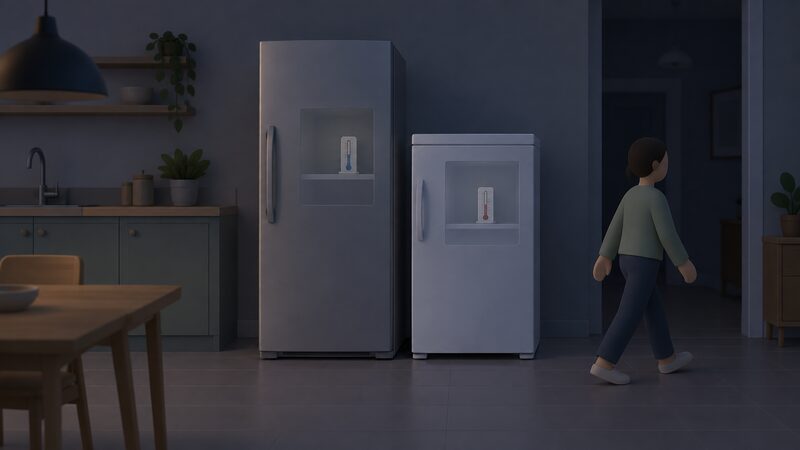
Freezer: up to 48 hours if full, 24 if half full
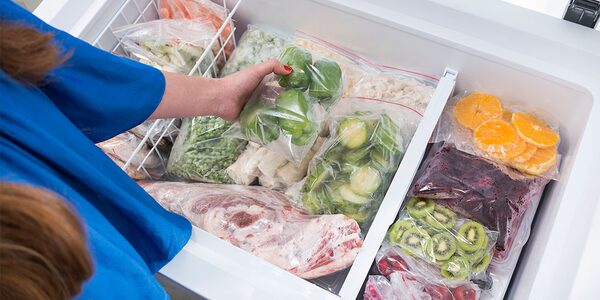
The fill level of a freezer is the single biggest variable in how long its contents survive. A full freezer holds a safe temperature for approximately 48 hours, and a half-full one for about 24 hours, according to the Food Standards Agency guidance cited by National Grid2. ScottishPower repeats the same split5, as does NIE Networks3. Electricity North West gives a broader band of 24 to 48 hours for freezers generally11, and EcoFlow states that a full freezer can keep items frozen for 24 to 48 hours8.
The reason a full freezer lasts longer is that frozen food is itself a thermal mass. The more of it there is, the more cold is stored and the slower the cabinet warms once the compressor stops. That is why the advice for a freezer that is not full is to group packages so they form an igloo to protect each other, placed to one side or on a tray so that thawing juices do not get onto other foods3. Renters' guidance from the Centre for Sustainable Energy suggests keeping a freezer two-thirds full, since lots of frozen items keep each other cold12.
For a household thinking about independence, this is the point at which a freezer stops being a passive appliance and becomes a small cold store with a known reserve. The reserve is measured in hours, not days, and it is set by how much is inside rather than by anything the household can switch on.
Warm weather, long cuts and a shrinking window
The published windows assume ordinary conditions. In warm weather the cabinet warms faster, and Electricity North West notes that a full freezer may remain cold for up to 48 hours, framing that as the summer position rather than a year-round guarantee6. A kitchen that is already warm, or a freezer standing in a hot utility room, will lose its cold store sooner than the headline figure suggests.
Long cuts are the other pressure. Power cuts happen especially when cables and equipment become damaged, and during storms4. A cut that runs past the four to six hour fridge window puts the contents beyond the safe range, and one that runs past 24 hours puts a half-full freezer at risk. Where a cut continues over a long period, Electricity North West can provide hot food and drinks, or overnight accommodation where appropriate, for customers with poor mobility9.
The practical position is that the safe window is a best case, not a promise. A household that knows a cut is coming, or that lives somewhere storms regularly interrupt supply, is working with a shorter effective window than the published figures.
Planned emergency power cuts and rota disconnection
Rota load disconnection is the emergency measure in which blocks of customers are taken off supply in turn. Electricity North West states that no emergency power cuts are currently planned and that these measures would only be used in emergencies, and that they are unlikely this winter9. Households and businesses cannot opt out or be specially treated9. Certain customers who meet strict criteria, such as hospitals and emergency services, qualify to have their supplies protected and will not experience disruption13.
For food safety, the shape of a rota cut matters more than its existence. Different block letters are timetabled to be without power for typically around three hours, once or twice a day, and customers who have been subject to a rota cut will not normally suffer a second one for several days9. A three hour cut sits comfortably inside both the fridge and freezer windows, and the several-day gap between cuts gives a freezer time to recover its temperature before the next one.
Northern Ireland's operator gives a slightly different framing for planned emergency cuts, putting food safety at four to six hours in the fridge and 15 to 24 hours in the freezer if the door is avoided7. That freezer band is narrower than the 48 hour figure for a full freezer, which reflects the assumption that a planned emergency cut may be longer or less predictable than a single rota block.
Preparing the fridge and freezer before a cut
For a planned cut, Electricity North West advises turning the temperature settings down a couple of hours before the power is due to be switched off11. That pre-cools the cabinet and its contents, buying extra time once the compressor stops. It is the one preparation step that directly extends the safe window.
The rest of the preparation is about not wasting the reserve. Keep a torch and batteries in the house10, and keep torches, a battery-powered radio and spare batteries for power cuts14. Switch off all electrical appliances that are not designed to run unattended, such as cookers, grills, chip pans, hair straighteners and electric fires15.
When to throw food away after power comes back
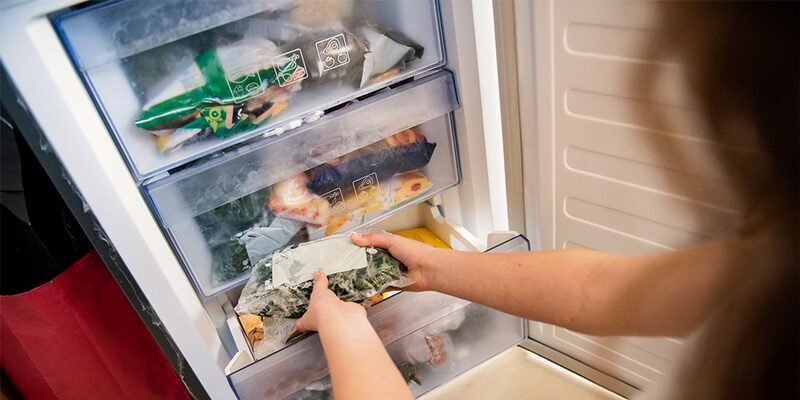
The clearest discard rule in the guidance is a temperature threshold: discard anything above 5°C for more than two hours to avoid foodborne illness8. That applies to fridge contents once the four to six hour window has passed, and to anything that has thawed in a freezer that ran past its hold time.
On the way back, switch off appliances at the plug during a power cut to protect against power surges when electricity is restored16, and switch off electrical appliances so they are not damaged by the surge when the supply returns17. Leave on a light so that it is obvious when the power is back10. Power should return automatically and, for a planned cut, within one hour after the expected time of reconnection18. Low carbon technology such as solar panels, heat pumps, EV chargers and batteries should not be damaged and will be ready to use again once power is restored13.
Leftover food that is still good should go back into the fridge, with anything not eaten within two days frozen, and reheated food brought to steaming hot19.
Who pays for spoiled food
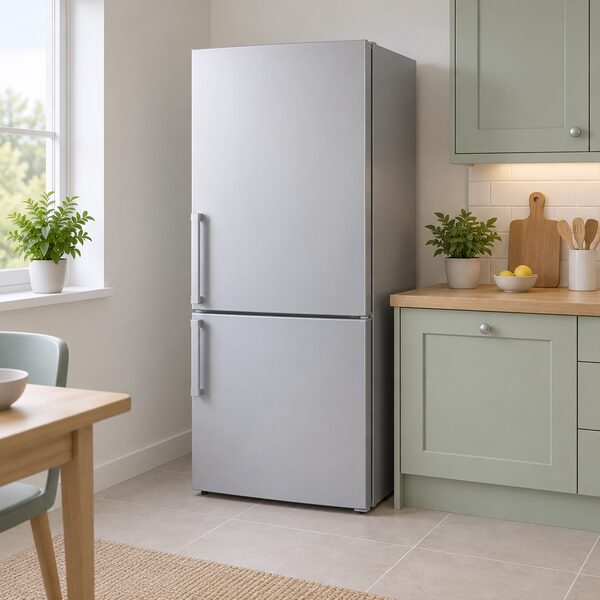
Neither the network operator nor the compensation scheme covers the contents of a fridge or freezer. Electricity North West states that it is unable to reimburse customers for food lost during a power cut6. UK Power Networks states that it is not liable for any loss of fridge freezer contents as a result of a power cut20. The compensation scheme position is the same: there is no specific claim for compensation if refrigerated or frozen food spoils because of a power outage21.
That leaves the loss with the household, which is the clearest dependence in this subject. The grid supplies the cold, the household carries the risk when it stops, and no scheme transfers that risk back. A backup supply that keeps a fridge or freezer running is the only route to closing the gap, and the sizing question is covered in Can a UPS keep my fridge or freezer running? and What size portable power station do you need?. For the wider picture of what keeps a home running through a cut, see Backup Power for UK Homes.
Sources21 cited
- What to do in a power cut, Which?, 2026-06-04
- Standards of performance, National Grid Electricity Distribution, 2026-09-17
- How do I keep food safe?, NIE Networks, 2026-09-19
- Power cut, Energy Networks Association, 2026-09-17
- Power cuts and blackouts, ScottishPower, 2025-09-26
- Be summer ready, Electricity North West, 2026-09-19
- Emergency power cuts, NIE Networks, 2026-09-19
- What do I do if there's a power cut?, EDF Energy, 2026-09-17
- Emergency power cuts, Electricity North West, 2026-09-19
- Power cuts help, NIE Networks, 2026-09-20
- Tips to prepare for a power cut, Electricity North West, 2026-09-19
- Energy saving advice for renters, Centre for Sustainable Energy, 2026-08
- Emergency planning portal for residential customers, SSEN Distribution, 2026-09-19
- Stay safe, warm and connected this winter, Cadent Gas, 2026-09-20
- Tips to help you during a power cut, Electricity North West, 2026-09-19
- FAQs, Electricity North West, 2026-09-20
- How to get power cut compensation, Uswitch, 2025-06-23
- Preparing for a power cut, Centre for Sustainable Energy, 2026-08
- Tips to save energy this Christmas, Centre for Sustainable Energy, 2025-12-16
- Compensation: a power cut ruined food in my fridge freezer, UK Power Networks, 2026-09-17
- Power network prepares for storms Dudley and Eunice, UK Power Networks, 2026-09-17
 The Full Backup Power GuideHow long do UK power cuts usually last, and what can keep your fridge, heating or phone going until the power comes back?
 Backup Power and EPSWill your lights stay on when the power goes out?
 The Full Home Batteries GuideA home battery stores cheap or solar power for later, but will it really cut your bills enough to be worth it?
 Portable Power Station SizeHow big a portable power station does a home actually need, and how long will it keep things running in a power cut?
 Prepare a Home for a Power CutA household checklist for before, during and after an outage: what to keep charged and to hand, which appliances to switch off, how long food stays safe and what to do about medical equipment.
 Cycle Life and DegradationHow long will a home battery actually last, and what decides that?