
In this answer
Short answer
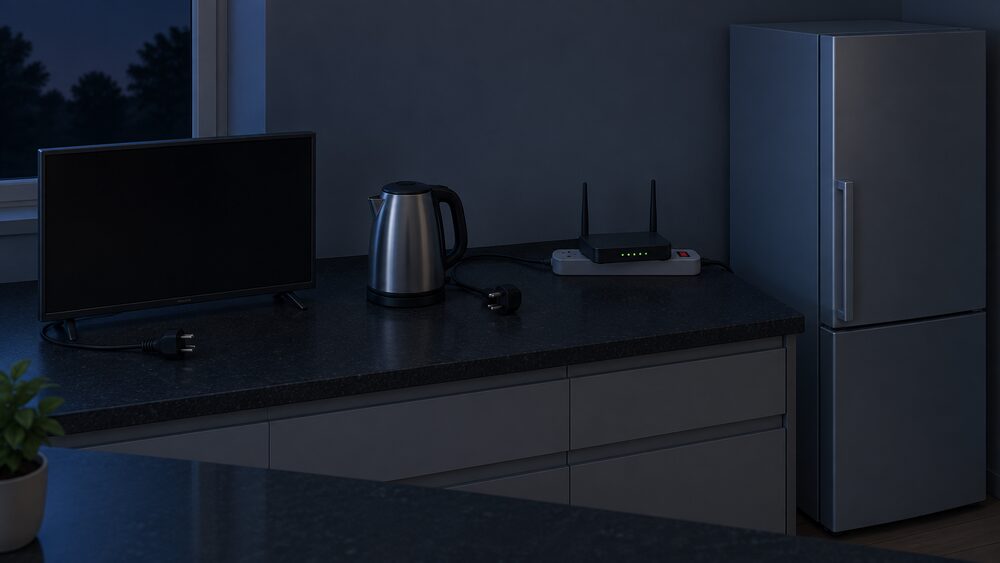
The main risk to appliances is not the outage itself but the moment supply returns. Electricity North West states plainly that after a power cut there can be power surges when electricity is restored, which might damage your appliances, and its advice is to switch off appliances at the plug during a power cut to protect against those surges1. The same routine is set out by Northern Ireland Electricity Networks: turn off electric cookers, heaters and sensitive electrical equipment such as TVs and computers2.
The practical answer is therefore simple. Small items get unplugged or switched off at the plug. Large fixed items get switched off at their isolator or control. Fridges and freezers are the exception, because they need to stay on to prevent their contents spoiling3. Anything that must keep running, such as a router on a surge protector or a fridge on its own circuit, is a deliberate exception rather than an oversight.
What follows is the routine in order, the reasoning behind each step, and the cases where leaving something connected is the right call.
Why appliances are at risk when power is restored
A power cut is rarely a clean break. Cables and equipment become damaged, which is one of the causes of an outage in the first place5, and the network can be re-energised in stages as sections are brought back. That staging is what produces the transient overvoltages that damage electronics.
Surge protective devices exist for exactly this problem. They are used to protect the electrical installation, which consists of the consumer unit, wiring and accessories, from transient overvoltages, and they protect circuits and equipment from high-voltage power surges such as those caused by lightning6. A device fitted at the consumer unit protects the fixed wiring and everything downstream of it. A plug-in strip protects only what is plugged into it.
The distinction matters for how a household prepares. A consumer unit with surge protection reduces the exposure of the whole installation, but it does not remove the case for switching appliances off during an outage, because the surge arrives at the same moment the appliance does. The network operators' guidance to turn off electric cookers, heaters and sensitive electrical equipment such as TVs and computers is the direct mitigation2.
There is a second, quieter risk. Appliances that were running when supply failed may restart unexpectedly when it returns, particularly cookers, heaters and anything with a mechanical switch left in the on position. Electricity North West advises switching off all electrical appliances that are not designed to run unattended, giving cookers, grills, chip pans, hair straighteners and electric fires as examples7. A hair straightener left on a worktop is a fire risk the moment power returns, whether or not a surge occurs.
Unplug small appliances, switch off large ones
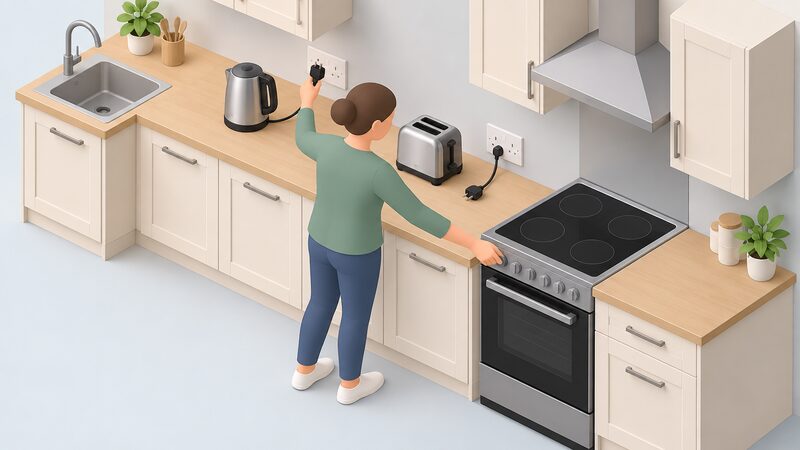
The split between small and large appliances is about access as much as risk. Small appliances sit on a worktop or shelf and can be unplugged in seconds. Large appliances are wired in or on dedicated circuits, so the practical action is to switch them off at the control rather than pull a plug.
Northern Ireland Electricity Networks' wording covers both: turn off electric cookers, heaters and sensitive electrical equipment such as TVs and computers2. Electricity North West's own tips add the specific categories to prioritise, naming cookers, grills, chip pans, hair straighteners and electric fires as appliances not designed to run unattended3. Equivent gives the same instruction in shorter form: switch off running electric appliances and avoid turning high-usage appliances on when the event starts4.
Sensitive electronics are worth treating separately from the rest. Televisions, computers and similar equipment are the items most likely to suffer from a restoration surge, and they are also the easiest to unplug. The Institution of Engineering and Technology notes that surge protective devices are used to protect sensitive electronic equipment connected to the installation, such as computers, televisions, washing machines and safety circuits such as fire detection systems and emergency lighting9. That list is a useful guide to what deserves attention first.
One piece of good news for households with modern appliances: switching off at the plug is usually harmless. The Energy Saving Trust states that you can turn almost all electrical appliances off at the plug without upsetting their programming3, and a separate smart meter guide repeats that almost all electrical appliances can be turned off at the plug without affecting their settings10. Clocks and timers may need resetting, but stored settings generally survive.
"Switch off all electrical appliances that are not designed to run unattended, for example: cookers, grills, chip pans, hair straighteners and electric fires"
What about appliances I can't switch off, like a fridge-freezer?
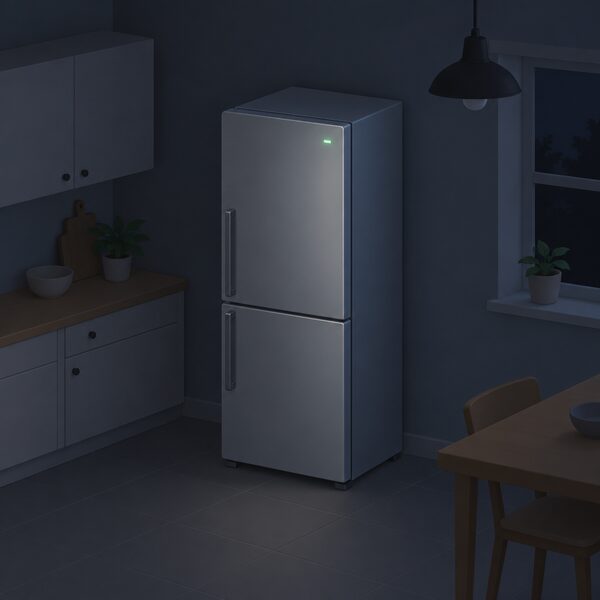
Fridges and freezers are the standard exception, and the guidance is consistent. The Energy Saving Trust states that some appliances, like fridges and freezers, need to be on all the time3, and adds that it does not advise switching off fridges or freezers as they need to stay switched on to prevent their contents from spoiling3. A smart meter guide lists satellite and digital TV recorders alongside fridge and freezer as items that may need to be left plugged in, the recorders so they can keep track of programmes you want to record10.
The protective action for a fridge is behavioural rather than electrical. Guidance for fridges and freezers during a power cut is to keep them shut and avoid opening unnecessarily to preserve contents, because you never know how long the outage may last2. A fridge should keep its contents protected for up to 4 hours during a power cut if left unopened3. That figure is the one to plan around: a short cut is a non-event for food, a long one is not.
For a planned cut there is a preparatory step. If you know you are going to experience a planned power cut, turn the temperature settings down a couple of hours before the power is due to be switched off11. Colder contents take longer to warm through, which buys time against the four-hour window.
Tropical fish tanks get their own instruction. Electricity North West advises unplugging tank filters and wrapping the tank with a blanket or foil7. The filter is unplugged because it is not designed to run unattended and restarting it dry can damage it; the wrapping is to slow heat loss.
| Appliance | Action during a cut | Reason |
|---|---|---|
| Small appliances, TVs, computers | Turn off2 | Sensitive electrical equipment |
| Electric shower, cookers, heaters | Switch off2 | Not designed to run unattended |
| Fridge and freezer | Leave on, keep door shut4 | Contents protected up to 4 hours3 |
| Satellite and digital TV recorders | May be left plugged in12 | Retain recording schedules |
| Tropical fish tank filter | Unplug, wrap tank5 | Restart damage and heat loss |
Surge protection: unplugging entirely versus surge strips
There are three layers of protection available, and they do different jobs.
The first is the consumer unit. Surge protective devices are used to protect the electrical installation, which consists of the consumer unit, wiring and accessories, from transient overvoltages9. Different types are available to protect the installation from other incoming services, such as telephone lines and cable TV9. A device fitted here covers the fixed wiring and everything connected to it, and it works whether or not anyone is at home.
The second is the plug-in strip. UK Power Networks notes that you can protect equipment such as landline phones and internet routers from voltage variations by using surge protectors13. This is the practical option for a router that needs to stay on, or for a home office where equipment is left connected.
The third is disconnection. Unplugging removes the appliance from the circuit entirely, which no device can match, because there is no path for a surge to travel. This is why the network operators' guidance leads with turning appliances off rather than with protective equipment2.
The three are complementary rather than alternatives. A consumer unit device protects the installation; a strip protects a specific item that must stay connected; unplugging protects everything else. None of them is a reason to skip the routine, and none of them is a substitute for switching off appliances that are not designed to run unattended7.
Consumer units also contain residual current devices, which immediately switch off the electricity if they detect a fault and are designed to protect people from electric shocks and earth faults6. That is a different function from surge protection, and the two are often confused. An RCD protects people; an SPD protects equipment.
What to leave connected: off-grid and backup power exceptions
Some households have a reason to keep specific equipment running, and the guidance recognises this.
An uninterruptible power supply can help keep communications platforms, like your Wi-Fi connections and computer and tablet devices, running12. That is the clearest published exception: communications equipment is the category most often kept alive through an outage, because it is how a household finds out what is happening.
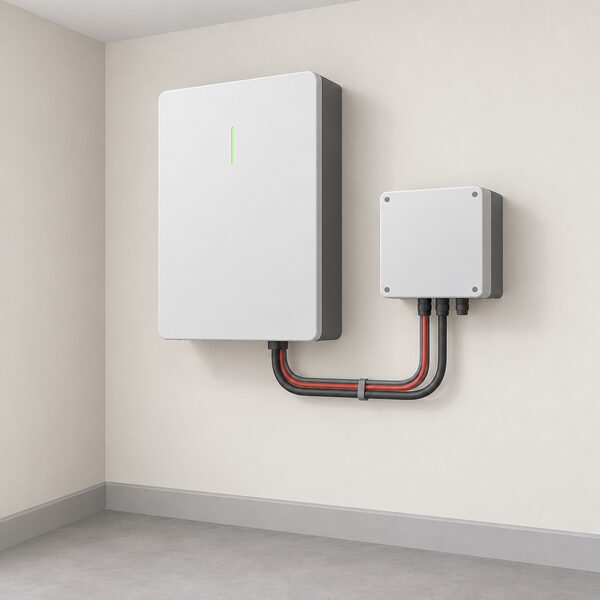
Home batteries are a more complicated case. A battery storage system does not normally provide power in a power cut unless additional equipment and configuration is included14. Not all batteries can deliver electricity during a power cut15. The more expensive battery systems can also provide electricity during a power cut16, and in some cases storage devices can provide back-up supplies for use in a power cut, but this is not always possible17. The consumer body Which? puts it directly: if you are looking to protect yourself against power cuts with a home battery, not all systems are suitable, and the installer should be asked whether a given battery will work in a power outage, and for how long18.
The practical consequence is that a household cannot assume a battery installed for bill savings will also cover an outage. Backup capability is a separate specification, and it is confirmed by the installer rather than inferred from the presence of a battery.
For households with a genuine dependency, the route is the network operator's support register rather than a protected supply. Electricity North West states that whether planned or unplanned, its customer contact team will be in touch with you throughout the power cut to make sure you are ok and have the latest information, for customers with poor mobility20. The Priority Services Register is the general mechanism, and Northern Ireland has its own arrangements through the Customer Care Register.
Before, during and after a cut: a step-by-step routine
Preparation is mostly about light, information and warmth. Keep torches, a battery-powered radio and spare batteries in case of power cuts21. SSEN's list adds charging your mobile phone, keeping a torch nearby, keeping a battery-powered radio tuned to a local station, keeping a note of key contacts, checking with neighbours, keeping warm with a thermos flask, and regularly saving your work22. Northern Ireland Electricity Networks keeps a torch and batteries in the house8, and the wider winter guidance is to keep a mobile phone fully charged, keep a torch handy, have warm clothes, blankets and food which does not need heating accessible, and follow your network operator on social media for local updates23.
The number to call is 105, the free power cut line24. The network operator for the area is who attends.
Before a planned cut
- Turn fridge and freezer temperature settings down a couple of hours beforehand11.
- Charge phones and any power banks.
- Check torches and batteries21.
- Save work on computers and shut them down.
During a cut
- Turn off sensitive electrical equipment such as TVs and computers2.
- Switch off larger appliances such as electric cookers and heaters2.
- Leave fridges, freezers and recorders connected4.
- Keep the fridge and freezer door shut2.
- Never touch damaged electricity equipment3.
- Report the cut on 1055.
After supply returns
Restoration timing is not exact. Power might be switched off or reconnected around 30 minutes before or after the published time depending on national electricity use4. Bring appliances back on once supply is steady rather than at the first flicker, and check anything that was running when the power failed before relying on it.
Storm conditions deserve their own note. Power cuts can happen during storms25, and surge protective devices are specifically designed to protect circuits and equipment from high-voltage power surges such as those caused by lightning6. During a thunderstorm the same routine applies with more emphasis on unplugging sensitive electronics rather than leaving them on a strip.
Flooding is a separate and more serious case. UK Power Networks advises switching off the electricity at the mains, if it is safe to do so, and not touching any electrical equipment, switches or sockets when standing in water or if the electrical equipment is wet, damp or has been flooded and the electricity is on26. Electrical Safety First states that no electrical appliances in the areas affected by the flood should be switched on until they have been tested and assessed as safe by a registered electrician, and that a registered electrician should be used to assess the condition and safety of the electrical wiring in the property and fixed and portable electrical appliances affected by the flood27.
If a cut has damaged something, the compensation route and the Guaranteed Standards set out what network operators will consider. For the wider picture on keeping a home running through an outage, the backup power pillar covers generators, batteries and portable stations.
Sources27 cited
- Advice and support FAQs, Electricity North West, 2026-09-20
- How to prepare for (and stay safe during) a power cut-a-power-cut), NICEIC, 2025-01-24
- Quick tips to save energy, Energy Saving Trust, 2026-08-21
- Power cuts: what to do if your power goes out, Smart Energy GB, 2026-08-19
- Power cuts and emergencies, SSEN, 2026-09-17
- Consumer units and fuse boxes, NICEIC, 2025-09
- Tips to help you during a power cut, Electricity North West, 2026-09-19
- Power cuts help, NIE Networks, 2026-09-20
- Surge protective devices, Institution of Engineering and Technology, 2026-09-17
- Switching appliances off standby, Smart Energy GB, 2026-04-22
- Tips to prepare for a power cut, Electricity North West, 2026-09-19
- What happens in an energy shortage, Energy Networks Association, 2026-09-17
- Compensation: a power cut damaged something in my home, UK Power Networks, 2026-09-17
- Solar power facts, Energy Saving Trust, 2026-08-13
- Battery storage, Centre for Sustainable Energy, 2025-10
- Making the most of your solar PV panels, Centre for Sustainable Energy, 2026-08
- Renewable energy storage, Electricity North West, 2026-09-19
- Solar panel battery storage, Which?, 2026-05-14
- Electricity Supply Emergency Code, SSEN, 2026-09-19
- Extra support for poor mobility, Electricity North West, 2026-09-20
- Winter advice, Cadent Gas, 2026-09-20
- Preparing for a power cut, SSEN, 2026-09-19
- Get winter ready resources, Energy Networks Association, 2026-09-17
- Powercut105, Powercut105, 2026-04-24
- Care and assisted living providers, Energy Networks Association, 2026-09-17
- Safety advice and resources, UK Power Networks, 2026-09-17
- Flood damage and electrical safety, Electrical Safety First, 2026-09-19
 Prepare a Home for a Power CutA household checklist for before, during and after an outage: what to keep charged and to hand, which appliances to switch off, how long food stays safe and what to do about medical equipment.
 Essential Loads and CircuitsWhich plugs and lights should stay on when the power goes off, and which can safely go without?
 The Full Backup Power GuideHow long do UK power cuts usually last, and what can keep your fridge, heating or phone going until the power comes back?
 Backup Power and EPSWill your lights stay on when the power goes out?
 Vulnerable Households EnergyIf someone in your home relies on powered medical equipment, or needs extra warmth because of a health condition, what help is available?
 Air Conditioning SafetyA safety guide to home cooling appliances: plug and circuit loading, flammable refrigerants in portable units, condensate and water damage, venting, window sealing and product recalls, with the markings to look for.