
In this guide
A power cut is fixed by your electricity network operator, not by the energy supplier whose name is on your bill. The network operator is the company responsible for fixing power cuts and for paying compensation when they run long1. In England, Scotland and Wales, calling 105 for free puts you through to that operator2. In Northern Ireland, where one company runs the network, the number is 03457 6436433.
Which operator serves a home is fixed by geography, not choice. Across the UK there are 14 operators, and the one that applies is determined by where you live; entering a postcode into the Energy Networks Association search tool identifies it4. Operators in Great Britain must restore supply within 12 hours outside severe weather, 24 hours in category 1 severe storms and 48 hours in category 2 severe storms, and they pay compensation when they miss those limits, with a possible extra £40 if a payment is missed2.
For a household's independence, this is the hard edge of relying on the grid. When the wires fail, nothing inside the home can bring them back: the repair, the timetable and the compensation all sit with a regional company the household did not choose and cannot switch. What a household can control is how quickly it reports a fault, how safely it behaves around damaged equipment, and what it has ready to get through the hours before the supply returns. The wider options for keeping essentials running are covered on the backup power pillar page.
The network operator fixes power cuts, not your supplier
The electricity system that reaches a home is run by two different kinds of company. The supplier sells the electricity and sends the bill. The distribution network operator (DNO) is responsible for maintaining the physical electricity supply to the home7. Ofgem describes a network operator as the company responsible for the pipes and wires that move energy, and the one to contact about power cuts or connection issues in the local area8.
"Your gas or electricity network operator is responsible for fixing power cuts and paying you compensation."
Network operators manage and maintain the underground cables, overhead wires and substations that bring electricity into a community, and they are different from the energy supplier9. The Energy Networks Association adds that a household does not pay its bill to them, and that they are the company to contact about energy infrastructure on your land10. Beyond power cuts, operators help connect homes to electricity and can move an electricity meter, and they fix power cuts that are not caused by a problem inside the home3. They are also responsible for upgrades to a home's supply, which matters to anyone adding a heat pump or car charger11.
The boundary between the two companies sits at a specific piece of equipment. The cut-out is the link between the network operator's cable and the internal wires in the property12. UK Power Networks states that the cut-out is the only piece of internal equipment it is responsible for, and that the meter belongs to the company the household pays its bills to13.
| Question | Supplier | Network operator |
|---|---|---|
| Who you pay for electricity | Yes | No |
| Fixes power cuts outside the home | No | Yes |
| Pays power cut compensation | No | Yes |
| Owns the meter | Yes | No (owns the cut-out) |
| Can the household choose it | Yes | No, set by location |
The table draws on Citizens Advice, UK Power Networks and the Energy Networks Association1.
The practical consequence is simple: 105 is for your network operator and not your supplier14. Age UK gives the same routing for complaints, directing people with power cut or connection problems to the distribution network operator, the company in charge of the supply to the area15. Calling a supplier during a cut costs time and reaches a company that cannot send an engineer.
105: one free number, routed to your local operator
The electricity network operators introduced 105 to give customers an easy-to-remember number that puts them through to the local people who can help during a power cut16. The technology behind it is operated by the Energy Networks Association, and the service is free16. The Powercut105 service reached its tenth anniversary on 5 September 202617.
Wherever a caller is in England, Scotland or Wales, 105 is free and connects them with the local network operator9. UK Power Networks states that it is free to call from a landline or a mobile5. It is not a general helpline: the Energy Networks Association calls it the free power cut emergency number18, and it can be used to report a cut or to get updates on one19.
105 also covers dangerous damage, not only loss of supply. SSEN states that people can call 105 immediately if they spot damage to power lines and substations that could put them, or someone else, in danger20. Where there is an immediate risk to life, the instruction changes to 999 (see the safety section below).
Northern Ireland sits outside the service. The number there is 03457 643643, which the Energy Networks Association lists alongside 105 as the power cut number to write down in advance21. Operators also point to online routes: network companies can be contacted online as well as on 10517, and in storms social media and the local operator's website are described as the best places for key updates and restoration times18. More detail on the number itself is on the 105 power cut number page.
For independence, 105 is a single dependency worth noting: it relies on a working phone. A mobile with charge, or a landline that does not need mains power, is what connects a household to its operator when the lights go out.
How to find your electricity network operator
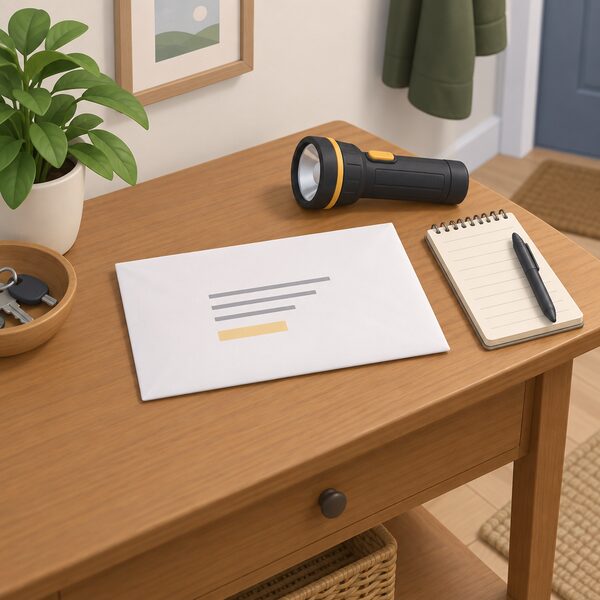
The standard route is a postcode lookup. The Energy Networks Association's "find my network operator" page asks for a postcode and returns the electricity distribution network operator for that address3. The Energy Ombudsman22 and the Met Office7 both send householders to the same tool, and Uswitch describes the result as one of 14 operators, the actual operator being determined by where you live4.
- Open the Energy Networks Association's find my network operator page3.
- Enter the postcode of the property.
- Note the operator's name, website and power cut contact details.
- Keep them with 105 (or 03457 643643 in Northern Ireland) somewhere that does not depend on mains power.
Because the operator is tied to the address, it does not change when a household switches supplier, and it only changes on moving house. That works in the other direction too: the network operator can tell a household who its supplier is. Home Energy Scotland advises people who cannot find their supplier's details to call 105 and speak to the local DNO, who can tell them23, and the Energy Saving Trust gives the same route for finding a new electricity provider after a move24.
Northern Ireland is the simple case. The Energy Networks Association's table lists Northern Ireland Electricity as the operator for the whole of Northern Ireland3, trading as NIE Networks. Scotland and Wales are served by operators that also cover parts of England, and the regional detail is set out on the pages for power cuts in Scotland, power cuts in Wales and power cuts in Northern Ireland.
Knowing the operator matters beyond emergencies. It is the operator that decides whether an existing supply can take new equipment such as heat pumps or car chargers, and NIE Networks, for example, states that it checks how much electricity an area uses and whether it can handle the new load, to avoid power cuts and keep the supply safe and steady25.
Restoration deadlines: 12, 24 or 48 hours depending on the weather
In Great Britain the time an operator has to restore supply depends on the conditions. Ofgem sets out three limits2:
| Conditions | Restoration limit |
|---|---|
| Outside severe weather | 12 hours |
| Severe storm category 1 weather | 24 hours |
| Severe storm category 2 weather | 48 hours |
The 12 hour limit is written into each operator's own standards. SSEN states that if a supply fails because of a problem in its network during normal weather, it must restore it within 12 hours27, and National Grid (NGED) gives the same wording for its network28. These are Guaranteed Standards of Performance: a missed standard triggers a payment rather than a penalty on the household's side, as the next section explains.
Northern Ireland works differently. NIE Networks' guaranteed standards promise to restore electricity within 24 hours of a power cut29, and compensation there is linked to cuts of more than 24 hours for reasons other than severe weather (see below). A household in Northern Ireland should not assume the 12 hour Great Britain figure applies.
These limits are the outer edge, not the typical wait. Electricity North West states that it works 24 hours a day, seven days a week, 365 days a year to restore supply30. In storms, operators prepare in advance: they arrange standby emergency teams and place vehicles and resources in strategic locations when a storm is forecast21. NIE Networks runs an Emergency Response Plan that comes into effect when forecasts indicate severe weather is likely, suspends all normal activities and directs all resources to Local Incident Centres in the affected areas31. During Storm Éowyn the plan was in effect from 23 January until power was restored to all homes and businesses, and the company expanded its contact centre into a second location in Belfast to take more calls31.
What the limits mean in practice is that a household in a severe storm may lawfully be without power for up to two days in Great Britain before the operator is in breach. That is the realistic planning figure for heating, food, medical equipment and communications, and it is the gap that backup power for heating and other home backup options are meant to bridge.
Compensation after a long outage: how payments work
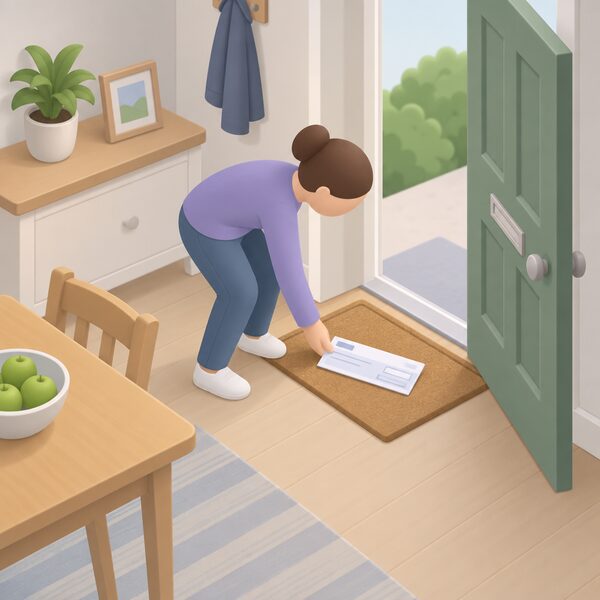
When an operator misses a guaranteed standard, the household is owed a payment, and the network operator pays it, not the supplier1. The detail is on the power cut compensation page; the mechanics are these.
Automatic payment. For unplanned cuts not caused by bad weather, Citizens Advice states that a household should get an automatic payment from its network operator within 10 working days32. Ofgem states that the operator will pay automatically if it has the household's bank details2.
How it arrives. Payment could be by cheque, cash or bank transfer2. Ofgem also describes payment through the energy supplier, added to the energy account or to a prepayment meter26.
If it does not arrive. Where a payment has been missed, the operator may owe an extra £402. Citizens Advice gives the same £40 addition where a claim has to be made1.
Storms. After storm power cuts, payment is also automatic, but Citizens Advice advises contacting the operator to make a claim if it has not paid within 4 weeks of the power coming back on32.
The trigger differs by operator and nation. UK Power Networks describes customers as potentially entitled to compensation after a power cut lasting longer than 12 continuous hours33. NIE Networks states that if power was out for more than 24 hours for reasons other than a severe weather event, the customer may be due compensation34; see power cut compensation in Northern Ireland.
The limit is worth stating plainly: compensation acknowledges a missed standard; it does not replace spoiled food, a cold house or lost work in full. It moves money back to the household after the event, not power during it.
What to do first when the power goes off
The first job is to work out whether the fault is inside the home or on the network, because only the second is the operator's to fix3. A fuse box check comes first; NIE Networks lists knowing where the fuse box is among its preparation advice35. The is it my house or the area and check for a power cut in my area pages cover this in more depth.
Once the cut looks like a network fault, NIE Networks' advice for the period of the cut is35:
- never touch damaged electricity equipment;
- check on vulnerable family and friends;
- keep the freezer door closed;
- report the power cut;
- turn off cookers, heaters and sensitive equipment;
- leave a light on, so it is obvious when power returns.
Reporting matters even when the whole street is dark. The Met Office's guidance is that where neighbours' power is also off, a household should not assume the DNO has already been notified, and should always call7. In Northern Ireland a cut can be reported via nienetworks.co.uk, WhatsApp, Facebook or the 03457 643 643 helpline36, with WhatsApp support from 7.30am to 11.30pm, seven days a week, including public and bank holidays25.
When the cut is planned: rota disconnections
Not every cut is a fault. If supply cannot meet demand, National Grid Electricity System Operator would legally instruct distribution network operators to disconnect supplies37. UK Power Networks, the operator for London, the East and South East, states that it would be legally instructed by National Grid ESO in that case38, and Electricity North West describes the ESO as responsible for ensuring there is enough power to meet demand39. In Northern Ireland, NIE Networks publishes the rota on its website when a planned emergency power cut starts, and asks customers whose power is not back within an hour of the scheduled time to check its Power Check service and report the cut40. The detail is on rota power cuts.
Food in the fridge and freezer
The guidance on food varies between sources. The Food Standards Agency, as cited by National Grid, states a fridge keeps food safe for up to four hours during an outage if the door is kept closed as much as possible28. Electricity North West gives 4 to 6 hours in the fridge and 15 to 24 hours in the freezer if they can be kept unopened39. Smart Energy GB gives up to 4 hours for an unopened fridge19. Every figure depends on the doors staying shut; more on food safety in a power cut.
Staying safe around damaged lines and equipment
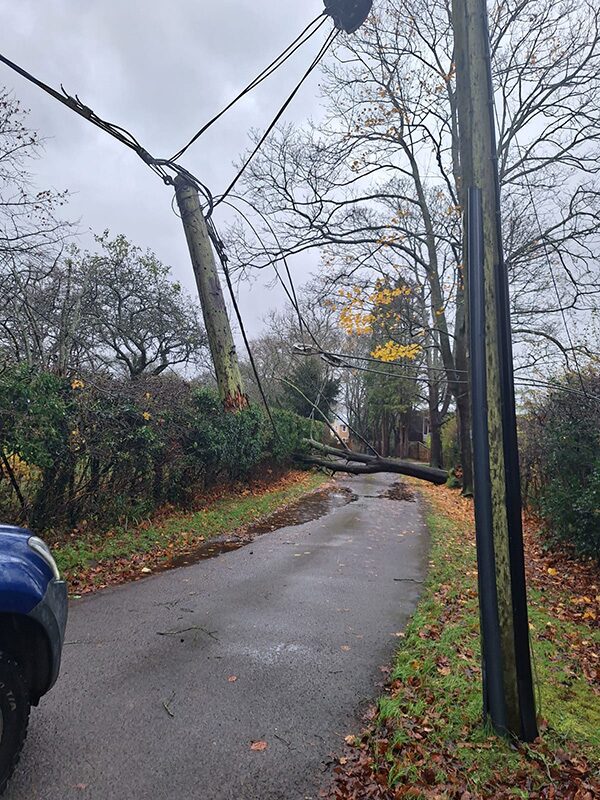
Downed or damaged lines are an emergency, not a repair request. Operators in both Great Britain and Northern Ireland give the same instruction.
NIE Networks uses the same wording about lines that are down or causing significant risk to the public, and also asks people to contact its helpline on 03457 643 64341. The Energy Networks Association states that where there is an immediate risk to life or someone is in danger, 999 is the number18. Where nobody is in immediate danger, damage to lines and substations can be reported on 10520.
Inside the home, the risks shift after floods and storms. Electrical Safety First advises using a registered electrician to assess the wiring and the fixed and portable appliances affected by a flood, and contacting the insurer (and the landlord, if applicable) to get advice and take instruction42. Wiring inside the home is not the network operator's responsibility; for tenants in England's private rented sector, government guidance lists electrical wiring among the repairs a landlord is legally responsible for43.
Backup equipment brings its own hazards. NIE Networks warns that anyone using a generator should be careful where it is sited because of carbon monoxide poisoning, and make sure there is plenty of air flow35. Generator safety and connecting a generator to a house set out the rules in full.
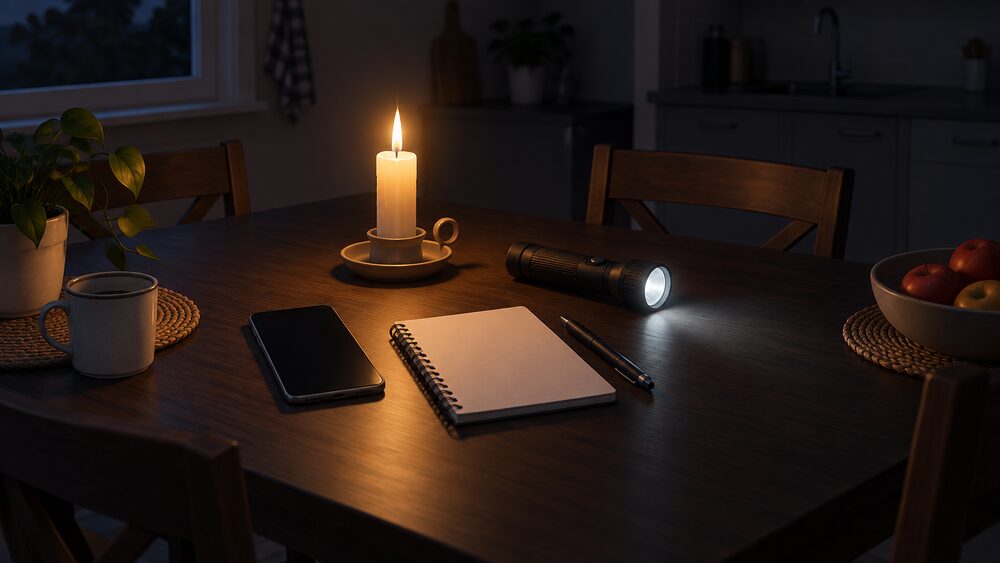
Preparing for a power cut: torches, freezers and the medical care register
Preparation is where a household's own choices count for most. NIE Networks' list is practical and short35:
- keep a torch and batteries in the house;
- know where the fuse box is;
- know how to open electric gates without power;
- keep an electric car's battery charged;
- join the medical care register if relying on electricity for medical equipment.
The Energy Networks Association adds writing down the power cut number in advance: 105 in England, Scotland and Wales, and 03457 643643 in Northern Ireland21. The winter power cut preparation page goes further.
Priority help for people who depend on electricity
Network operators run a Priority Services Register that can support households during a power cut or other energy emergency10. The Met Office advises anyone for whom electricity is crucial for medical equipment to contact their DNO at any time, as it may be able to add them to its register7. Ofgem states that for both planned and unplanned cuts, operators must offer registered customers extra help, for example battery packs so they can still charge phones or medical equipment2. See the Priority Services Register and help if you rely on medical equipment.
Northern Ireland has its own arrangement. The Utility Regulator's factsheet states that NIE Networks holds a Medical Care Register for those who rely on electricity for healthcare needs44, and NIE Networks also runs a Critical Care information service for vulnerable customers35. The details are on priority services in Northern Ireland.
The honest assessment for independence is that registers and operator battery packs reduce the harm of a cut; they do not remove the dependency. A household that needs heat, refrigeration or medical equipment through a 24 or 48 hour storm limit is relying on its own stored energy or fuel for that period, which is where portable power stations, home UPS systems and standby generators come in.
Sources44 cited
- Get compensation if you have a power cut, Citizens Advice, 2026-09-17
- Plan for a power cut, Ofgem, 2026
- Find my network operator, Energy Networks Association, 2026-09-17
- Who supplies my electricity and gas?, Uswitch, 2026-06-29
- Why we fix high voltage faults first, UK Power Networks, 2026-09-17
- Replace a power cable or power line, UK Power Networks, 2026-09-17
- What to do in a power cut, Met Office, 2026-09-20
- Complain about your energy supplier or network operator, Ofgem, 2026
- Power Cut 105, Energy Networks Association, 2026-09-17
- Customers, Energy Networks Association, 2026-09-17
- Hybrid heat pumps, Energy Saving Trust, 2026-07-16
- Connecting to the networks: FAQs, Energy Networks Association
- What is a cut-out?, UK Power Networks, 2026-09-17
- Who to call with gas or electricity issues, Energy Networks Association, 2018-03-02
- Energy complaints, Age UK, 2026-08-26
- The 105 service, Energy Networks Association, 2026-09-17
- Get winter ready, Energy Networks Association, 2026-09-17
- Power cut, Energy Networks Association, 2026-09-17
- Power cuts: what to do if your power goes out, Smart Energy GB, 2026-08-19
- Preparing for a power cut, SSEN, 2026-09-19
- Storms and bad weather, Energy Networks Association, 2026-09-17
- Network operators, Energy Ombudsman, 2026-09-20
- Radio Teleswitch switch-off, Home Energy Scotland, 2026-09-20
- Moving house energy checklist, Energy Saving Trust, 2026-05-01
- Connections, NIE Networks, 2026-09-19
- Check if you can get a payment for a power cut, Ofgem, 2026
- Performance standards, SSEN, 2026-09-17
- Standards of performance, National Grid, 2026-09-17
- Customer standards, NIE Networks, 2026-09-19
- Why do we experience power cuts?, Electricity North West, 2026-09-19
- How do you prepare for a storm?, NIE Networks, 2026-09-19
- Get compensation if you have a power cut (Wales), Citizens Advice, 2026-09-17
- Compensation for a power cut lasting more than 12 hours, UK Power Networks, 2026-09-17
- Can I claim after a power cut?, NIE Networks, 2026-09-19
- Power cut advice, NIE Networks, 2026-09-19
- Power cut help, NIE Networks, 2026-09-20
- Rota load disconnections, National Grid, 2026-09-17
- Emergency power cuts, UK Power Networks, 2026-09-17
- Emergency power cuts, Electricity North West, 2026-09-19
- How do I know when my power will be switched off?, NIE Networks, 2026-09-19
- Additional works, NIE Networks, 2026-09-19
- Flood damage and electrical safety, Electrical Safety First, 2026-09-19
- Landlord and tenant rights and responsibilities in the private rented sector, GOV.UK, 2019-04-09
- Code of Practice for Consumers in Vulnerable Circumstances factsheet, Utility Regulator, 2025
 Power Cuts in WalesWho do you call when the power goes out in Wales, and how long should it take to come back on?
 Who to Call for Energy HelpA single reference to the right contact for each situation: gas escapes, power cuts, water leaks, meter faults, billing disputes, scams and free advice.
 Power Cuts in ScotlandWho do you call when the power goes out in Scotland, and how long should it take to come back on?
 New Electricity ConnectionWho do you contact for a new or upgraded electricity connection, and what will it cost?
 Who Supplies Your Energy?Not sure who bills you for gas or electricity?
 The Full Rules and Regulation GuideConfused about who actually decides what you pay for gas and electricity, or why rules differ in Scotland and Wales?