In this guide
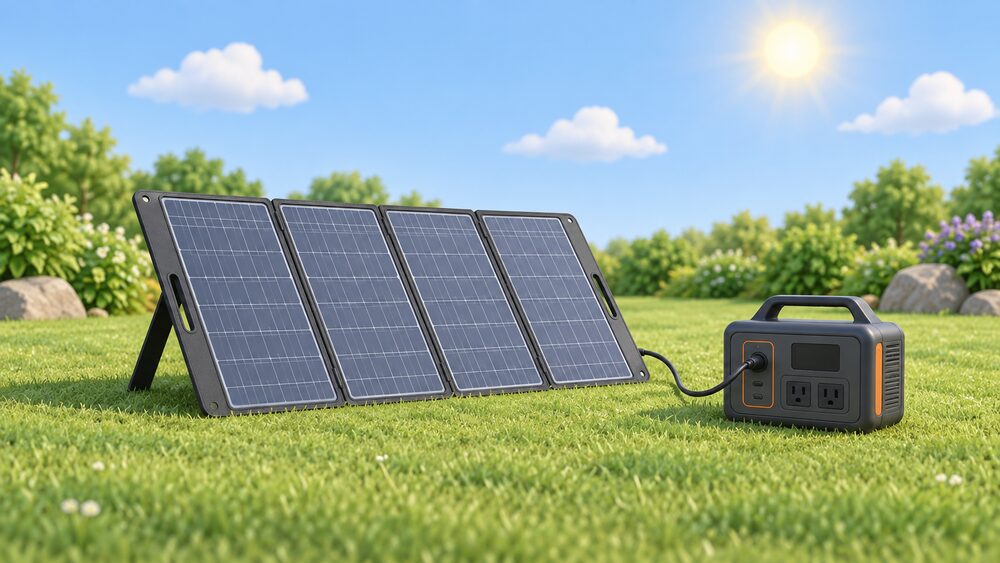
A portable power station charged from solar panels is the closest thing most UK households have to a self-contained electricity supply. The panels convert sunlight into electricity through the photovoltaic effect1, the station's built-in MPPT input conditions that electricity, and the battery stores it for use whenever it is needed. Nothing about the arrangement requires a grid connection, a supplier account or a smart meter, which is precisely why it appeals to households thinking about energy independence.
The practical numbers matter more than the principle. A 400W folding panel in real conditions typically delivers 300W to 350W, depending on the conditions2. A Jackery Explorer 2000 PRO takes 2.5 hours to fully charge via six SolarSaga 200 panels, according to the maker3. An Anker SOLIX C1000 offers up to 600W fast solar recharging, fully powering the device in just 1.8 hours4. Those are maker figures under strong sun; UK conditions stretch them considerably.
What follows covers how the connection works, how solar compares with the mains and a car socket, why panel ratings overstate real output, how to size an array, the choice between folding and fixed panels, compatibility across brands, cost and independence, warranty and refurbished stock, and the Jackery SolarSaga range sold in the UK.
How solar charging works: panels, the station and what sits between them
A solar charging setup has three parts: the panel or array, the cable and connector, and the charge controller inside the power station. The panel does the conversion. Solar panels convert the sun's energy into electricity via the photovoltaic effect1, and a photovoltaic system as a whole comprises the panels with cabling, control panel and AC/DC inverter6. In a power station, the inverter is built in, and so is the controller.
That built-in controller is the part most owners never see. It takes the variable direct current arriving from the panels and converts it to the voltage the battery needs, tracking the maximum power point as light and temperature change. Because it sits inside the station, the station's solar input has published limits: a maximum voltage, a maximum current and a maximum wattage. Panels are chosen to fall inside those limits, not the other way round.
The connection itself is simple. Jackery describes a 60-second quick setup for its folding panels7, and the panels are designed to be portable and foldable7. A single panel connects with its own cable; two or three panels can be connected in series through a solar panel connector8. Series connection adds voltage while current stays the same, which is how a small folding array reaches the input voltage a larger station expects.
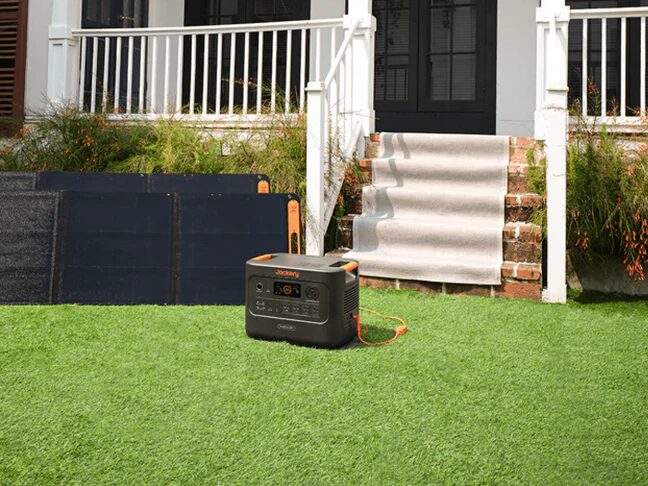
Where a household already has rooftop solar, the relationship is different. Rooftop panels generate electricity that can help power a heat pump9, and they can charge an on-site battery storage system10. A portable power station is a separate, smaller store that can be charged from a folding panel on a balcony, in a garden or on a vehicle roof, and moved with the household if it relocates11.
Charging methods compared: solar, wall socket and car
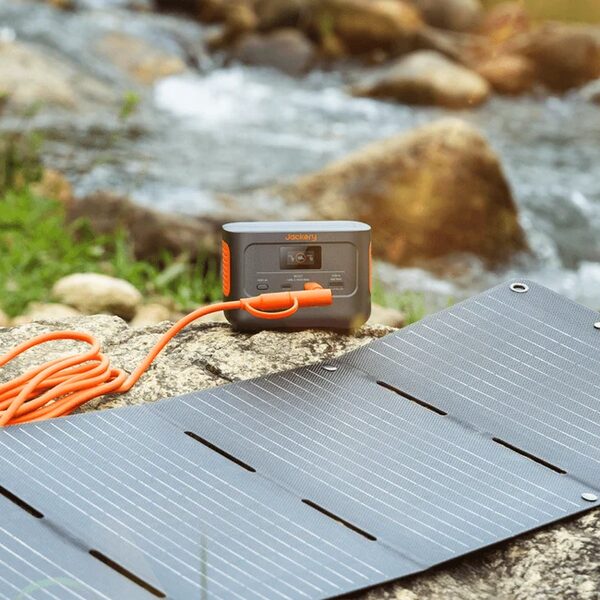
A power station can usually be refilled three ways, and they are not equivalent. The mains is fastest and always available where there is a socket. A car's 12V socket is slow but works while driving. Solar is the slowest and the most variable, and it is the only one that needs no external supply at all.
The trade is between speed and independence. Mains charging ties the station to the grid and to a supplier; a household that charges only from the wall has a battery, not an independent supply. Car charging ties it to a vehicle and its fuel. Solar charging ties it to the weather and the season, but to nothing else. For a household whose reason for buying a station is resilience during a power cut, solar is the only method that keeps working when the grid is down.
Solar also pairs with other household energy uses. Charging an electric vehicle from solar panels reduces the carbon footprint of that mileage12, and charging from your own electricity is significantly cheaper than using grid power and far cheaper than petrol or diesel over the same distance13. The same logic applies at a smaller scale to a power station: electricity generated on site and used on site avoids the import tariff entirely.
There is a limit worth stating. UK-compliant plug-in solar devices are limited to a maximum output of 800W of electricity, on average11, and that is probably not enough to power a whole house, though it covers everyday appliances while higher-use appliances still need grid electricity11. A power station charged from folding panels sits below even that ceiling. It is a resilience tool and a small-scale independence measure, not a substitute for a grid connection.
Panel output in practice: why a 100W panel rarely delivers 100W
A panel's nameplate rating is measured under standard test conditions that a UK roof or garden rarely reproduces. The gap between the label and the meter is the single most common source of disappointment, and it is worth understanding before sizing anything.
The clearest published example comes from a maker's own guidance: a 400W solar panel in actuality produces output normally ranging from 300W to 350W, depending on the conditions2. That is a shortfall against the label, and it comes from ordinary causes rather than a fault. Panel temperature above the test condition reduces output, as does any shading, dust or a mounting angle that is not square to the sun.
Cloud is the variable UK owners ask about most, and the answer is consistent across sources. Solar panels work during daylight, even when it is cloudy or overcast, as they use light, not heat, to generate energy14. Even on a cloudy day, good generation can be achieved15, and solar cells do not need direct sunlight to work, generating some electricity on a cloudy day16. Panels can still generate electricity on cloudy days and during winter17, they even work on cloudy days18, and they can power the different appliances in the home, even on cloudy days19.
What cloud changes is the quantity, not the possibility. A heavily overcast December day in northern England will produce a small fraction of a clear June day from the same panel, and the shorter daylight window compounds it. A household relying on solar charging through winter should expect to top up from the mains, and should treat the solar input as a supplement in those months rather than the primary source.
Sizing the panel to the station: capacity, recharge times and the 1.5x rule
Sizing starts with the battery, not the panel. A station's capacity in watt hours sets how much energy must be replaced, and the panel array sets how quickly that can happen in good conditions. The relationship is arithmetic, but the weather decides whether it holds.
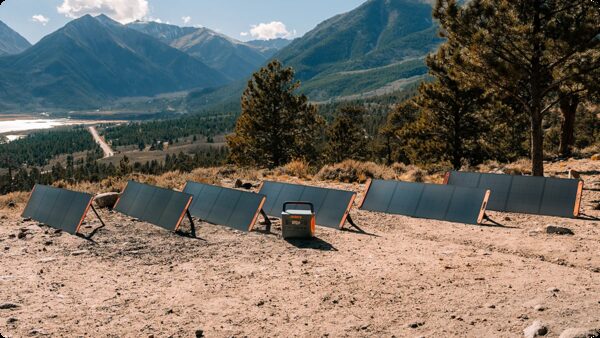
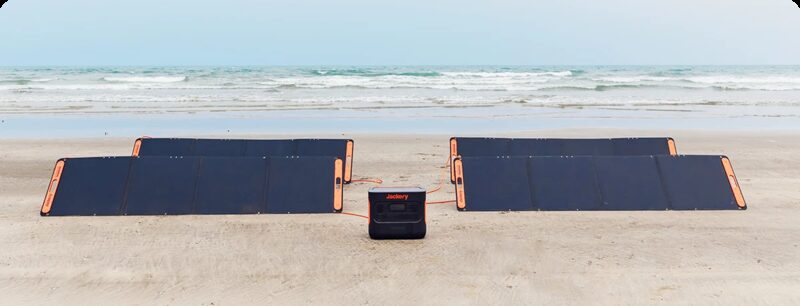
The maker figures give a sense of what is achievable with a large array. A Jackery Explorer 2000 PRO takes 2.5 hours to fully charge via six SolarSaga 200 panels3, which is 1200W of panel feeding a station of roughly 2000Wh. An Anker SOLIX C1000 offers up to 600W fast solar recharging, fully powering the device in just 1.8 hours4, and can scale to a maximum 2112Wh capacity with an expansion battery4. Both figures assume the array is delivering close to its rating.
For scale, a typical household needs a 4kW solar panel and a 5 to 10 kWh battery2. A folding array for a portable station is a fraction of that, which is the point: it is sized to refill a portable battery, not to run a home.
| Station | Maker solar charge time | Array quoted | Source |
|---|---|---|---|
| Jackery Explorer 2000 PRO | 2.5 hours | Six SolarSaga 200 panels | 3 |
| Anker SOLIX C1000 | 1.8 hours | Up to 600W input | 4 |
A working rule many owners use is to allow roughly 1.5 times the battery capacity in panel watts for a full charge across a good summer day, which accounts for the gap between rated and real output. On that basis a 1000Wh station wants about 1500W of panel, which is impractical with folding panels and rarely necessary, because most households accept a partial charge and finish on the mains. The rule is a planning aid, not a specification, and no source in this area publishes a single correct ratio.
The practical question is what the station must do and when. A household that wants a full battery by nightfall in summer can size generously. One that wants a trickle of charge through a week of camping can size modestly and accept that the battery rarely fills. Both are legitimate, and the choice belongs to the household.
Foldable portable panels vs fixed panels with an MPPT controller
Folding panels and fixed panels with a separate controller are two different products solving two different problems, and the choice follows from where the panels will live.
Folding panels are built for movement. Jackery describes its range as portable and foldable solar panels7, with a 60-second quick setup7, and sells them for camping, RV travel and home backup7. The SolarSaga 200W panel has magnetic pads that allow it to be folded up tightly and carried3. A household that wants to charge a station on a balcony, in a garden, at a campsite or from a vehicle roof is served by this type, and the trade is a higher cost per watt and a smaller array.
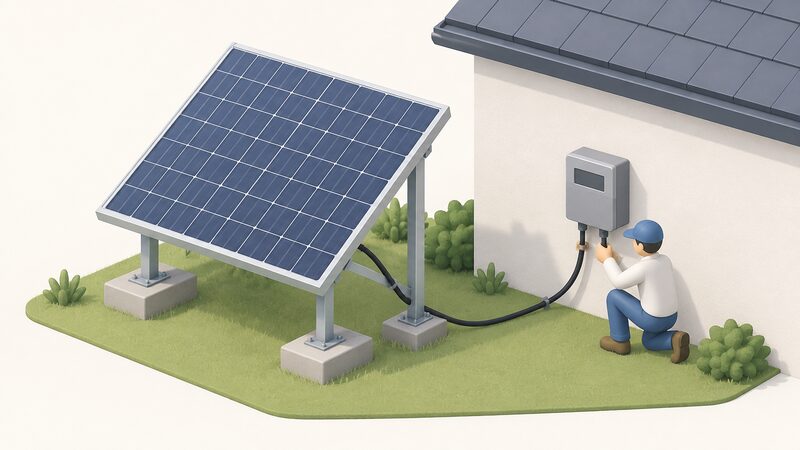
Fixed panels with a separate MPPT controller suit a permanent installation. Victron's SmartSolar MPPT range is designed for marine, off-grid systems, recreational vehicles and hybrid generators20, and the controller extracts maximum power from the panels whenever the sun shines20. It is compatible with lithium, AGM, gel and flooded batteries, offers automatic voltage selection20, switches automatically between bulk, absorption and float stages20, and its load output terminals let you power devices directly with built-in protection20. That is a different architecture from a power station: the controller is a separate box, the battery is a separate battery, and the system is assembled rather than bought whole.
For a household charging a portable power station, the folding panel is the simpler route, because the controller already exists inside the station. For a household building a permanent off-grid store, the separate controller gives more control over charge stages and battery type. Neither is better in the abstract; they match different installations.
Compatibility: which panels connect to which stations
Compatibility comes down to three numbers and one connector. The panel's open-circuit voltage must stay below the station's maximum solar input voltage, its current must stay below the input current limit, and the connector must physically mate. Brand is not one of the criteria, though makers design their own panels to sit comfortably inside their own stations' windows.
Jackery's own connector shows how arrays are built. The solar panel connector can be used for a portable power station, and two or three solar panels can be connected in series8. It is made from PC material and is durable enough to resist fire and harsh weather8. Series connection is the standard way to raise voltage to the level a larger station expects, and it is why a pair of 100W panels can feed an input that a single panel cannot reach efficiently.
The station side of the equation is where damage can occur. Exceeding the maximum input voltage on a solar input can destroy the controller, and the limit is published per model. A household matching a third-party panel to a station should read the station's solar input specification first and the panel's voltage and current second, and should not assume that a higher-voltage array is safe because the wattage looks modest.
There is a separate compatibility question for households with existing rooftop solar. Adding battery storage alongside plug-in solar panels is possible at present, but it must be permanently wired and installed by a qualified electrician21. That is a different route from a portable station, and it brings the installation under the wiring regulations rather than leaving it as a plug-in appliance.
What solar charging costs and what owning it means for independence
The economics of self-generated electricity are unusual, and they favour using the power rather than selling it. Rates for selling electricity to the grid are much lower than tariffs for using electricity from the grid22, so using solar electricity yourself is much more cost-effective than exporting it. Once the installation is paid for, the electricity it generates is free, although grid electricity used alongside it and maintenance still cost money23.
The same point is made repeatedly across sources. A household is effectively locking in a portion of its energy costs at 0p per kWh for the next 25 years24. Once the installation is paid for, the electricity generated is completely free to use19. Sunlight is free, so once the initial installation is paid for, electricity costs are lower25. For a power station charged from a folding panel, the calculation is simpler still: the panel is bought once, and every kilowatt hour that reaches the battery afterwards costs nothing.
What that buys in independence is real but bounded. A station charged from solar needs no supplier, no meter and no grid connection to refill, which is the definition of energy independence at a small scale. What remains is dependence on the weather, on the season, on daylight hours and on the panel's condition. It is also dependence on a manufacturer for the station itself, its app if it has one, and its warranty. A household that charges a station from solar has moved one part of its electricity supply off the grid, not all of it.
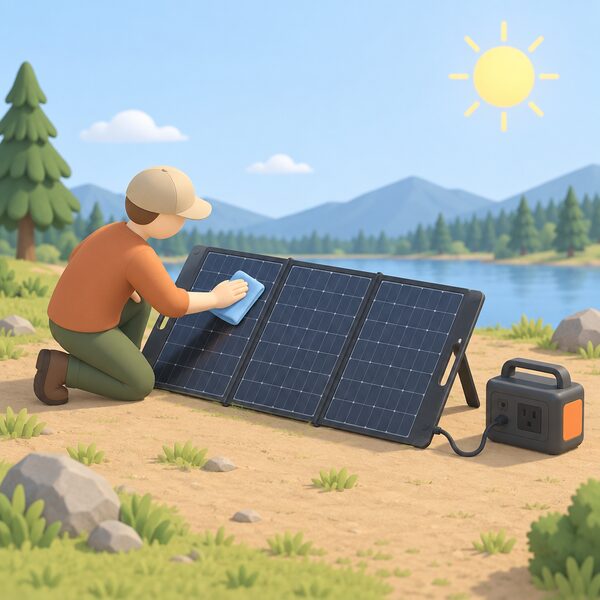
Maintenance is modest but not zero. Cleaning costs range from around £4 to £15 per panel and depend on how easy they are to access and how dirty they are14. Folding panels are usually cleaned by hand at no cost. For a household weighing the case, the honest position is that solar charging a power station is a low-cost way to keep a battery topped up without the grid, and a poor way to run a home.
Warranty, returns and buying refurbished
Warranty terms vary widely between new panels, installed systems and refurbished stock, and the difference is large enough to change the value of a discount.
New plug-in solar panels carry a typical warranty of 10 years5. The InstaGen plug-in solar kit goes further, with panels carrying a 12-year product guarantee and a 30-year power warranty, while the inverter has a 12-year warranty21. REC offers a ProTrust Warranty giving solar panel owners added protection should an REC panel need servicing, but only if it is installed by an REC Certified solar installer26. These are the terms a household should use as the benchmark when comparing any discounted or refurbished offer.
Refurbished stock is different. A refurbished Jackery SolarSaga 200W panel is backed by a 6-month warranty, and every refurbished product completes a rigorous refurbishment process that includes full functional testing3. Six months against ten years is the trade a buyer is making. The saving may still be worthwhile for a panel used occasionally for camping, and it is a much weaker proposition for a panel expected to work hard for a decade.
Returns and shipping terms matter alongside the warranty. Jackery's connector page lists a 30-day price guarantee8, a 30-day money back return8 and 2 to 5 business days free shipping8. Those terms apply to the accessory rather than to every product, and a household should check the terms attached to the specific item at the point of sale.
Jackery SolarSaga panels: the range and specifications
Jackery sells folding panels under the SolarSaga name, positioned for camping, RV travel and home backup7. The range spans small panels for charging devices on outdoor trips through to larger panels intended to refill substantial power stations, and the panels are compatible with other Jackery power stations3.
The SolarSaga 100W panel is the mid-range folding unit. Its key specifications list a power voltage of 18V and a power current of 5.5A27, with 23% cell efficiency27. The maker's own product page shows a review score of 4.7 from 24 reviews27. The SolarSaga 100 Air and SolarSaga 40 Air are described as lightweight, portable solar panels for charging devices on outdoor trips7, which places them at the smaller end of the range.
| Product | Key figures | Source |
|---|---|---|
| SolarSaga 100W | 18V, 5.5A, 23% cell efficiency | 27 |
| SolarSaga 200W (refurbished) | 6-month warranty, magnetic folding pads | 3 |
| SolarSaga 100 Air | Lightweight portable panel for outdoor trips | 7 |
| SolarSaga 40 Air | Lightweight portable panel for outdoor trips | 7 |
One specification conflict is unresolved. The SolarSaga 100W panel is listed with a power voltage of 18V on one maker page and 20V on another, both dated 2026-09-20.
The connector that joins panels into an array is sold separately. It allows two or three panels to be connected in series8, is made from PC material resistant to fire and harsh weather8, and carries the 30-day price guarantee, 30-day money back return and 2 to 5 business days free shipping terms8. For a household building an array from two or three SolarSaga panels, it is the part that makes the array possible.
Sources27 cited
- Solar panel installation, maintenance and repair, NICEIC
- Solar panel kit with battery and inverter UK, Jackery, 2026-06-04
- SolarSaga 200W Solar Panel (Refurbished), Jackery, 2026-09-19
- Anker SOLIX C1000 Refurbished, Anker SOLIX, 2026-09-19
- Plug-in solar panels vs rooftop systems, Which?, 2026-04-27
- VAT energy saving materials and grant funded heating supplies, HM Revenue and Customs, 2026-09-17
- Solar Panels, Jackery, 2026-09-19
- Solar Panel Connector, Jackery, 2026-09-19
- Heating your home, Energy Saving Trust, 2026-05-19
- Solar panels, East Herts Council, 2026-09-17
- Plug-in solar panels, Energy Saving Trust, 2026-09-17
- Understanding low carbon technology, Electricity North West
- Can solar panels charge electric cars?, The CPA, 2026-04-15
- Solar panel myths: five common concerns debunked, Which?, 2026-06-09
- How do I retrofit my home: solar panels, Oxfordshire County Council, 2026-09-17
- Research briefing CBP-8090, House of Commons Library, 2026-09-17
- Solar photovoltaic (PV), MCS Certified, 2026-07-30
- Solar panel installation, Energy Saving Trust, 2026-09-07
- How do solar panels work?, Smart Energy GB, 2026-03-16
- SmartSolar MPPT 75/10, 75/15, 100/15 & 100/20, Victron Energy, 2026-09-19
- Plug-in solar panels, Which?, 2026-09-15
- Solar panels, London Borough of Hammersmith and Fulham, 2026-09-17
- Solar power, Electricity North West, 2026-09-19
- Solar panels, Uswitch, 2026-09-16
- Generating renewable electricity, Energy Saving Trust, 2025-12-11
- REC solar panels review, Which?, 2026-08-12
- SolarSaga 100W Solar Panel, Jackery, 2026-09-20
 Charging an EV from Solar PanelsCharging your car from solar panels means using the power your roof makes instead of sending it to the grid.
 The Full Solar Panels GuideHow much do solar panels cost, and what could they save you each year?
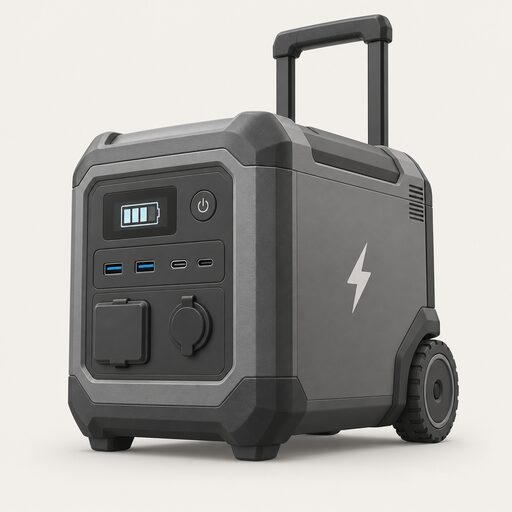 Portable Power StationsWhat can a portable power station actually keep going in a power cut, and for how long?
 Warranties and DegradationHow long do solar panels actually last, and what do the warranties really cover?
 Portable Power Station CostHow much does a portable power station cost in the UK, and what does the money actually buy?
 Solar Panel CostsA typical UK home pays somewhere between four and eleven thousand pounds for solar panels fitted, with most landing in the middle.