
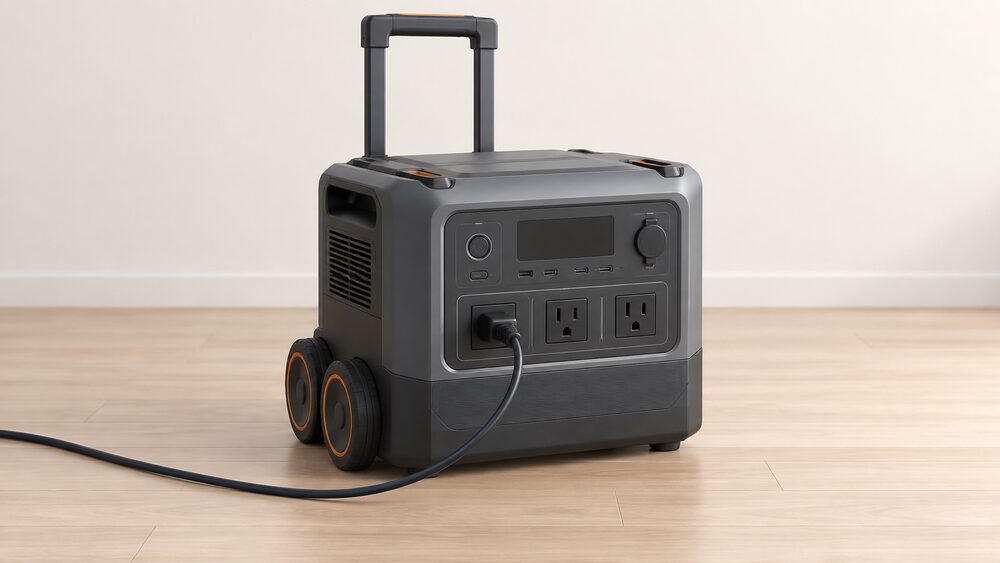
In this guide
The Jackery Explorer 2000 Plus is a 2,042.8 Wh portable power station with a 3,000 W AC output and a 6,000 W surge peak, sold in the UK at £1,999.001. It is the flagship of the Explorer Plus series, and it is the model UK householders most often search for by name when sizing backup power for a fridge, a boiler or a few essential circuits.
The most important thing to know before buying is that Jackery states the product is now discontinued, with a new and improved version expected to launch late 20261. The UK listing shows the station as sold out, with an email notification offered when it returns2. The refurbished version is also sold out3. That does not make the specification irrelevant: units remain in homes, refurbished stock appears periodically, and the replacement will be judged against these figures.
What the Explorer 2000 Plus does for a household is narrow and specific. It runs selected appliances for hours, not a whole house for days, and it does so without fuel, fumes or a fixed installation. What it does not do is remove dependence on the grid, on a supplier, or on Jackery itself for the app, the warranty and the spare battery packs.
A discontinued unit in the UK: what the status means for buyers
Jackery's own product page carries the line that the Explorer 2000 Plus is discontinued and that a new and improved version is expected late 20261. The UK store shows the station as sold out, with a notify-me option rather than a buy button2. The refurbished listing is sold out as well3. The Solar Generator 2000 Plus bundle, which pairs the station with a SolarSaga 200W panel, is also sold out2.
This is not an isolated case in the range. The Explorer 1000 Plus is marked sold out, the Explorer 300 Plus is sold out with a bundle still available, and the Explorer 2000 Pro is sold out with a pre-order notification4. Jackery's own guidance on the 2000 Pro is to shop the upgraded 2000 Plus instead, which is itself now discontinued7. The pattern matters to a buyer: stock in this category moves in and out, and a model can be superseded while remaining on sale in refurbished form.
For a household, the practical consequences are three. First, new stock may not be available at the moment of purchase, so timing is not fully in the buyer's control. Second, a discontinued model can still be a reasonable buy if the specification fits and the price reflects the status, but the add-on battery packs that make the 12 kWh expansion possible may become harder to source over time. Third, the warranty is a maker commitment that runs with the product, not with the model's current sales status, so the 3+2 year term still applies to units already sold1.
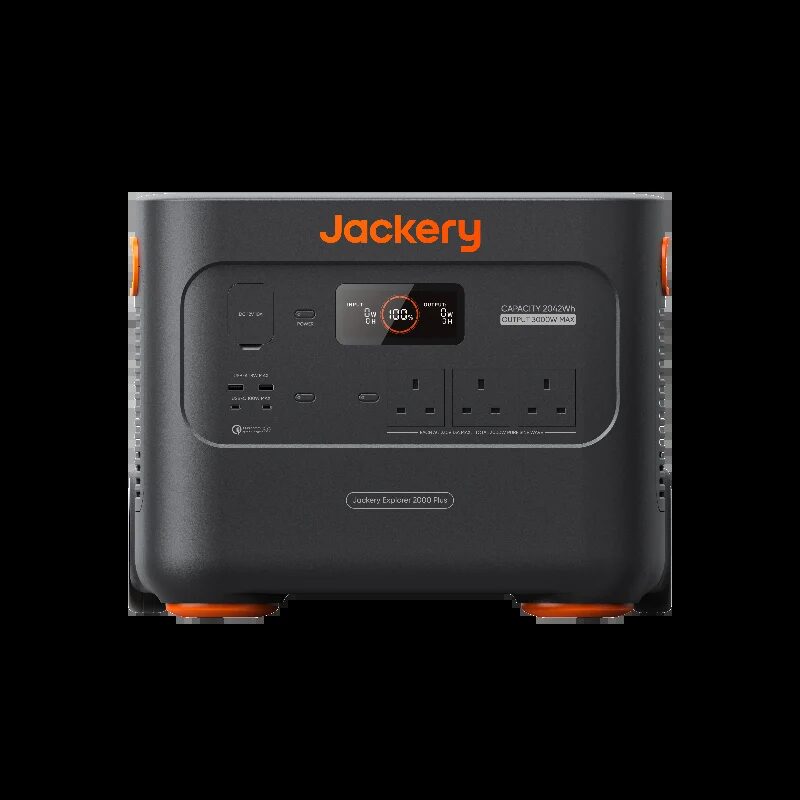
Capacity and output: 2,042.8 Wh base, 3,000 W continuous with 6,000 W surge
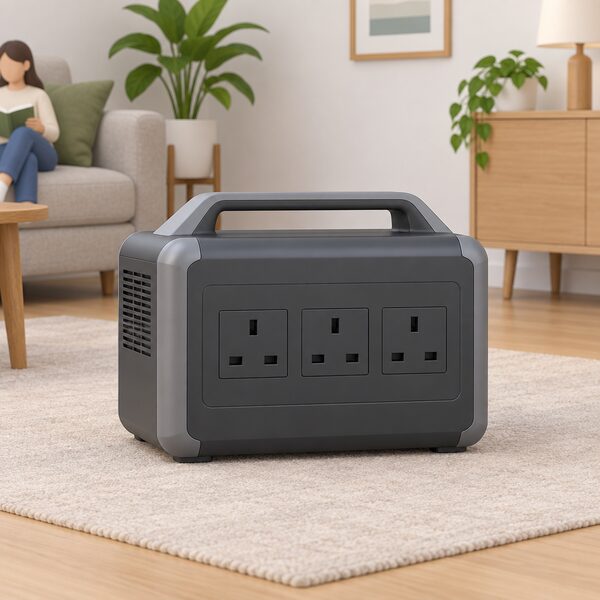
The headline figures are a 2,042.8 Wh capacity and a 3,000 W AC output, with a 6,000 W surge peak2. The AC outlets are described as three ports at 230V, 50Hz, 13A maximum, 3,000 W maximum and 6,000 W surge peak8. That is a UK-relevant specification: a 13A limit per outlet is the same ceiling as a standard domestic socket, so the station cannot deliver more through one port than a wall socket can.
On capacity, one Jackery page gives 2,042.8 Wh while another gives 2,160 Wh for the same model2. On peak output, one page describes up to 3,000 W output while another gives a 6,000 W surge peak1. The 3,000 W continuous figure is consistent across the sources; the surge and capacity figures are not. A household sizing a load should work from the lower capacity figure and the continuous output, and treat the surge as a short-duration allowance for motor start-up rather than a sustained rating.
What drives the difference between continuous and surge is the nature of the load. A fridge compressor, a microwave and a kettle all draw differently: the compressor has a brief start-up spike, the microwave draws steadily for minutes, and the kettle draws heavily for a short period. The station's inverter can absorb the spike but not sustain it. Jackery states the unit powers up to 99% of devices, and up to 18 devices with the double kit2.
For independence, the output ceiling is the real limit. A 3,000 W continuous output covers a fridge, a microwave, lights, a router and a television, but not an electric shower, an immersion heater or an oven alongside them. The station shifts which appliances a household can keep running during an outage; it does not remove the need for the grid for the heavy loads.
Expandable from 2 kWh to 12 kWh with add-on battery packs
A single Explorer 2000 Plus supports up to five add-on battery packs at a time, expanding capacity from 2 kWh to 12 kWh2. Jackery describes the same expansion on the Solar Generator 2000 Plus, and the refurbished listing repeats the five-pack limit9. The packs are sold separately, which is the point at which the cost of the system diverges from the cost of the station.
The expansion path changes what the unit is for. At 2 kWh it is a short-outage appliance station. At 12 kWh it approaches the capacity of a small home battery, and Jackery's own comparison material sets portable stations against traditional home battery backup systems on that basis10. The difference is not only capacity: a home battery is wired into the consumer unit and charges from rooftop solar or off-peak electricity, while the Explorer 2000 Plus is a portable unit charged from a wall socket, a car or solar panels.
Two units can also be connected in parallel. Jackery states that two Explorer 2000 Plus stations can be linked to expand capacity to 24 kWh, and that the system supports up to 12 kWh with a 3,000 W 120V output or 24 kWh with a 6,000 W 240V output11. The double kit contains two units and one Jackery Connect2. The 120V and 240V figures are the maker's and describe North American voltages; UK households run on 230V, so the parallel-output claim should be read as a maker specification rather than a UK installation description.
Charging times: 1.7 hours from the wall, 2 hours from six 200 W panels
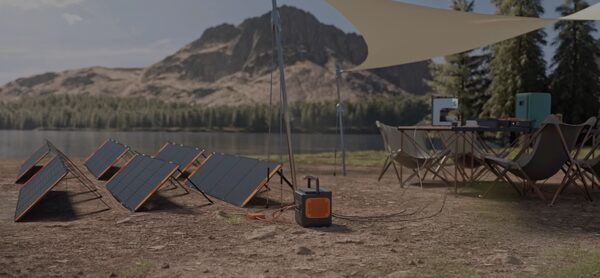
Charging speed is where the sources diverge most visibly. One Jackery page gives wall charging at 1.7 hours1, while another gives 2 hours for the same model2. The 1.7-hour figure also appears across the Explorer 2000 v2 listings, which suggests the two models are being described with the same charging claim in places12. A household should treat the wall charge as roughly two hours rather than a precise figure.
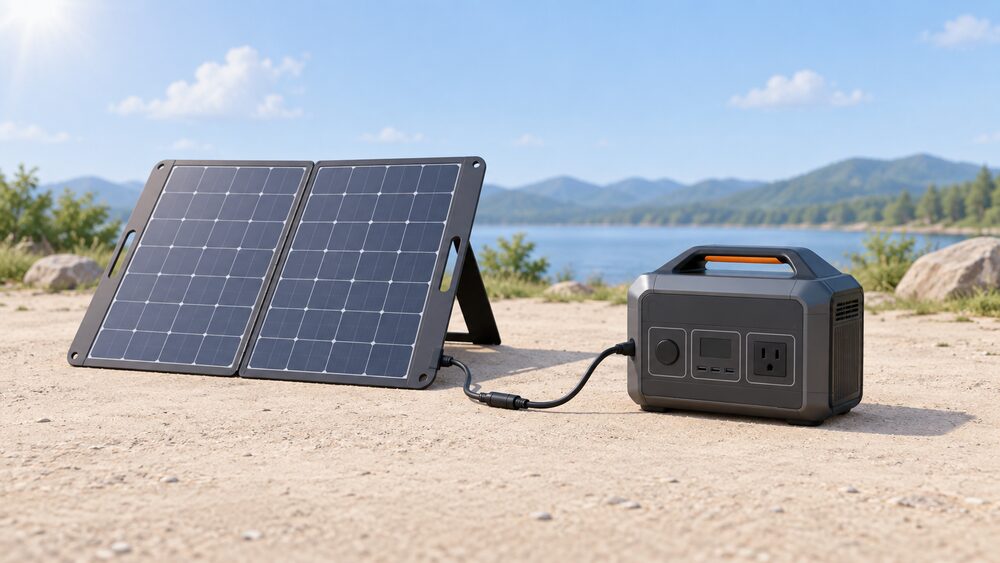
Solar charging is more consistent. Jackery states the station charges in about 2 hours using six 200W solar panels, and describes a fastest full charge of 2 hours with six 200W Jackery panels5. One page gives an average of 2.5 hours with six panels, and a stepped table gives 2 hours with six SolarSaga 200W panels and 3.8 hours with four14. The spread reflects real conditions: panel output varies with light, angle and season, so the two-hour figure is a best case and the longer figures are what a dull day produces.
Car charging is far slower. That makes the car cable a top-up route rather than a primary one. The station also supports pass-through charging on the v2 model, allowing appliances to run while the unit charges12.
For a household, the charging figures determine how the station fits a routine. A two-hour wall charge means a unit can be refilled between outages or overnight on a cheap tariff. A two-hour solar charge from six panels means a genuine off-grid option in summer, but the same array will take considerably longer in a UK winter. The dependence that remains is on the grid for the fast charge, and on daylight and panel capacity for the slow one.
What it can run: fridge, microwave, kettle and air conditioner run times
Jackery publishes run times for specific appliances, and they are the most useful figures for sizing. A 300W refrigerator runs for approximately 5.3 hours, and a 1,050 W microwave for about 1.5 hours after a full charge5. A 1,150 W portable air conditioner runs for under 2 hours15. The product page lists a fuller table: portable air conditioner at 1.9 hours, microwave at 1.5 hours, coffee maker at 2.8 hours, electric oven at 2.1 hours, hand drill at 3.1 hours and an outdoor electric grill at 1 hour7.
| Appliance | Draw | Run time |
|---|---|---|
| Refrigerator | 300W | about 5.3 hours5 |
| Microwave | 1,050W | about 1.5 hours5 |
| Portable air conditioner | 1,150W | under 2 hours15 |
| Coffee maker | 550W | 2.8 hours7 |
| Electric oven | 800W | 2.1 hours7 |
| Hand drill | 400W | 3.1 hours7 |
The pattern is straightforward: the higher the draw, the shorter the run. A fridge is the appliance most households want to keep alive, and 5.3 hours at 300W is a partial answer rather than a full one, since a fridge cycles on and off and its average draw is lower than its rated figure. Jackery's guidance for the Explorer 2000 v2, a different model, gives a fridge-freezer run of 15 to 18 hours, which shows how much the estimate depends on the assumed duty cycle16.
For independence, the run times set the boundary. The station keeps food cold, runs a microwave and boils a kettle for a short period. It does not run an electric shower, an immersion heater or a heat pump, and Jackery's own material on heat pump running costs sits outside what this unit can carry18. A household relying on electric heating should treat the Explorer 2000 Plus as a device for essentials, not for warmth.
Battery chemistry and lifespan: LiFePO4, 4,000 cycles, 70% capacity after 10 years
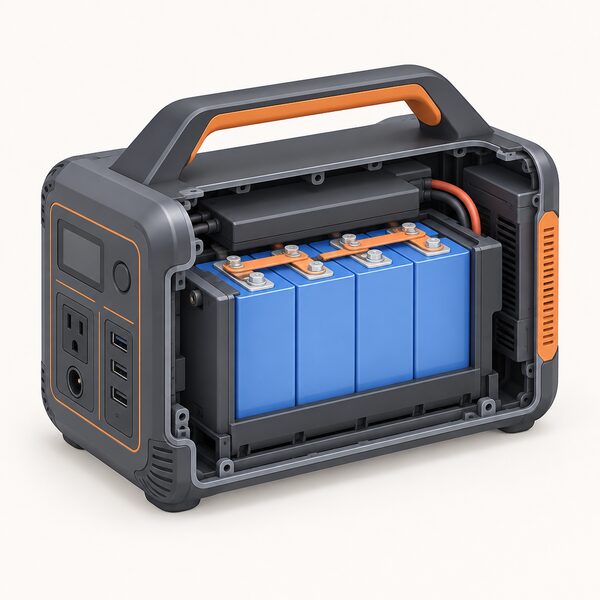
The Explorer 2000 Plus uses a LiFePO4 battery, and Jackery states the cells are rated at 4,000 cycles to 70% or more remaining capacity9. The same page states the battery retains over 70% of its capacity even after 10 years of daily charge-discharge cycles8. Elsewhere Jackery describes the LiFePO4 battery as guaranteeing a lifespan of 10 years even with daily usage limited to once per day7.
The chemistry is the reason for those figures. Jackery's general guidance on LiFePO4 describes a 10 to 12-year service life, 95% round-trip efficiency and over 6,000 charge cycles before significant degradation19. That is a broader claim about the chemistry than about this specific unit, and the two should not be conflated: the 4,000-cycle figure is the one tied to the Explorer 2000 Plus, while the 6,000-cycle figure is a general statement about the cell type.
The distinction between cycle life and calendar life matters for a backup unit. A station used once a week will not approach 4,000 cycles for decades, so calendar ageing and storage conditions become the limiting factors rather than cycle count. Jackery states the unit has an ultra-long standby mode that holds a 50% charge for up to 2 years7. That is a storage claim, and it assumes the unit is left at the right charge level rather than fully charged or fully flat.
For a household, the lifespan figures support the case for a unit kept for years rather than a single winter. They also set the warranty in context: the 5-year warranty covers a fraction of the stated 10-year design life, so the later years of service are the household's risk, not the maker's.
Ports, app control and EPS backup in a 20 ms switchover
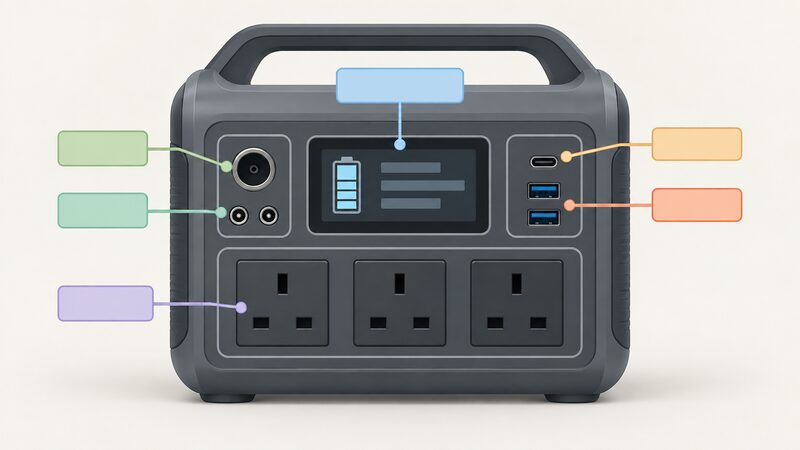
The station supports emergency power supply operation with a 20 ms switchover, described as fast enough for a refrigerator to keep running through brief interruptions2. The same 20 ms figure appears across the range, including the Explorer 2000 v2 and the Explorer 3000 v212. One listing describes the UPS function as certified to UL1778, a North American standard13.
The 20 ms figure is the maker's, and it is the number that determines whether a device notices the switch. A desktop computer with a switched-mode power supply will typically ride through a gap of that length; a fridge compressor will not stall. What the station does not do is back up a whole house. It backs up whatever is plugged into it, which means the household decides in advance which appliances matter.
App control runs through the Jackery app, and the silent charging mode is set there1. The app also provides the quiet-charging option that caps noise at 30 dB and extends a full charge to 4.5 hours2. That is the clearest dependence the unit creates: the app, the firmware and any remote features rely on a phone, a manufacturer's software and, for updates, an internet connection. Local operation at the unit continues without any of that, but the smart layer does not.
Price, warranty and buying from Jackery in the UK
The UK list price for the Explorer 2000 Plus is £1,999.004. The Explorer 2000 Pro carries the same £1,999.00 figure21. For comparison within the range, the Explorer 1000 Plus is listed at £2,199.00, and the Explorer 2000 v2 at £807.00 against a list price of £1,399.004. The refurbished Explorer 2000 Plus has appeared at 56% off, though it is currently sold out23.
The warranty is a 3+2 year structure. Jackery provides 3+2 years on the Explorer 2000 Plus, with a 5-year total for orders placed on the Jackery website, including a 2-year extension1. Orders from Amazon require registration on the official website to receive the extra 2 years9. The same structure applies to the Explorer 300 Plus, where Amazon orders are registered at the support site6. The Explorer 5000 Plus carries a 5-year warranty available exclusively when bought directly from Jackery.com24.
Returns run to 30 days2. The station weighs 61.5 lbs, which is 27.9 kg, and is described with pull rods and double wheels14. That weight is the practical constraint on where the unit can be used: it can be rolled on a flat floor but not carried up stairs easily.
For a household, the buying position is that the model is discontinued, the UK listing is sold out, and the price is a maker list figure rather than a street price. The warranty is real and runs with the product, but the supply of add-on battery packs and the arrival of a replacement model are the two variables a buyer cannot control. The wider context on how portable stations compare with fixed home batteries is set out in home battery vs portable power station for cuts, and the sizing question is covered in what size portable power station you need.
Sources24 cited
- Explorer 2000 Plus product page, Jackery UK, 2026-09-20
- Explorer 2000 Plus product page (US), Jackery, 2026-09-19
- Explorer 2000 Plus Refurbished, Jackery, 2026-09-19
- Explorer Plus series collection, Jackery UK, 2026-09-20
- Average electricity bill for a 3 bedroom house UK, Jackery UK, 2026-04-29
- Explorer 300 Plus product page, Jackery UK, 2026-09-20
- Solar Generator 2000 Pro, Jackery, 2026-09-19
- When is off peak electricity, Jackery UK, 2026-05-29
- Solar Generator 2000 Plus with 200W solar panel, Jackery UK, 2026-09-20
- Comparing Jackery's portable power stations to traditional home battery backup systems, Jackery UK
- Solar Generator 2000 Plus, Jackery UK, 2026-04-29
- Explorer 2000 v2 product page, Jackery UK, 2026-09-20
- Explorer 2000 v2 with accessories, Jackery UK, 2026-04-29
- Introducing the Jackery 2000 v2 with compact size, Jackery UK, 2026-04-29
- Are air source heat pumps expensive to run, Jackery UK, 2026-04-29
- Cornwall power outage guide, Jackery UK, 2026-04-29
- Power outage in York guide, Jackery UK, 2026-04-29
- Why is my electric bill so high, Jackery UK, 2026-07-02
- Why solar PV battery storage is essential for UK homeowners, Jackery UK, 2026-08-27
- Average monthly electric bill with solar panels UK, Jackery UK, 2026-06-02
- Explorer 2000 Pro product page, Jackery UK, 2026-09-20
- Jackery new arrivals, Jackery UK, 2026-09-20
- Portable power stations collection, Jackery, 2026-09-19
- Explorer 5000 Plus product page, Jackery, 2026-09-19
 Jackery portable power stations and solar generatorsWhich Jackery power station suits a weekend camping trip, and which one could keep a fridge and freezer running at home in a power cut?
 Jackery Portable Power Stations and Home BackupCan a Jackery power station really run your home in a power cut, and what does one cost?