
In this guide
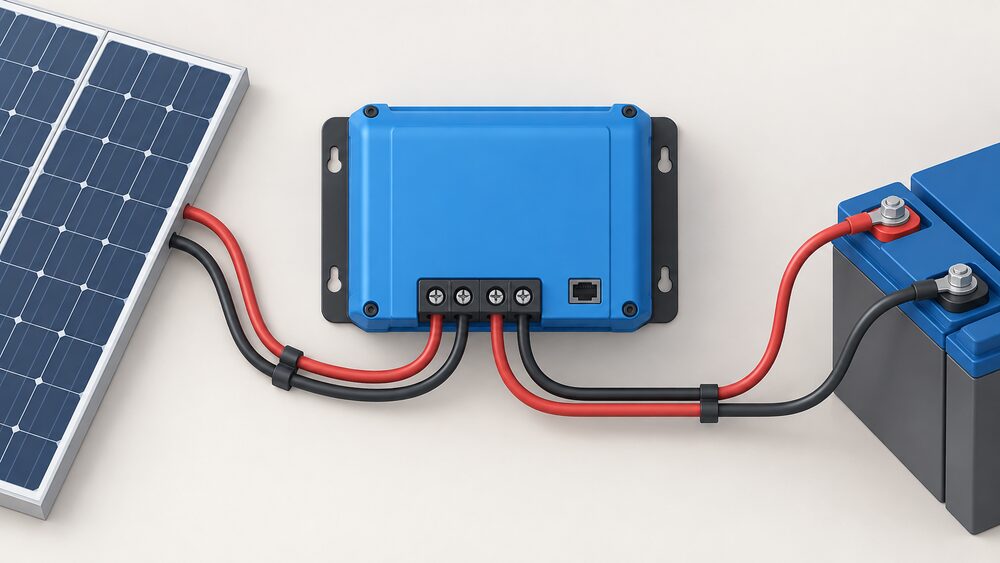
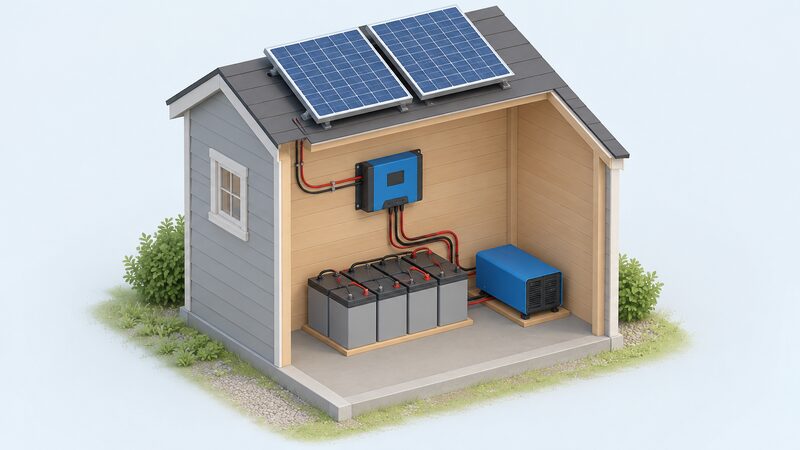
A Victron SmartSolar MPPT controller sits between a solar array and a battery bank, tracking the array's maximum power point and converting the surplus voltage down to a charging current the battery can accept. Victron states the range operates at 98% efficiency with natural cooling, and that its MPPT controllers improve energy harvest by up to 30% compared with PWM controllers and by up to 10% compared with slower MPPT controllers1. For a UK off-grid cabin, boat or self-build, that is the core of the system: panels, a controller, a battery, and an inverter to make 230V.
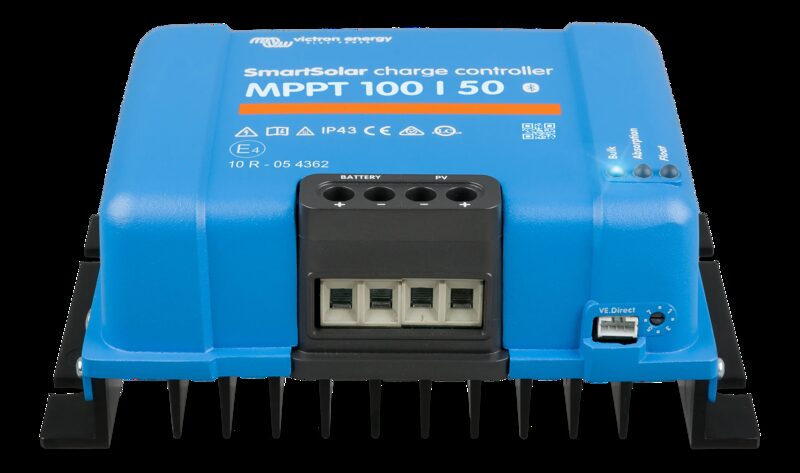
The range runs from the small SmartSolar MPPT 75/10, which accepts a PV input with a maximum open circuit voltage of 75V, up to the 150/70 to 250/100 VE.Can models with 150V or 250V maximum PV open circuit voltage and up to 100A output4. Every model in the family carries a five year warranty, and Victron states the standard five year term is upgradable to ten years for an additional 10% of the initial investment7.
What the kit buys a household is a measurable step away from a supplier: the array charges the battery directly, the controller manages the charge, and the system keeps running when the grid does not. What it does not remove is dependence on a battery manufacturer, on a GX device for remote monitoring, and on Victron's own app and portal for anything beyond local control.
What a Victron SmartSolar MPPT controller does
An MPPT controller's job is to hold the solar array at the voltage where it produces most power, then convert that down to whatever the battery needs at that moment. A PWM controller instead pulls the array towards battery voltage, which wastes the difference. Victron's own comparison puts the harvest gain from MPPT at up to 30% over PWM and up to 10% over slower MPPT designs3. The gain is largest when the array voltage is well above battery voltage, which is why a 60-cell or 72-cell panel on a 12V battery benefits most.
The SmartSolar range adds features beyond basic tracking. Advanced Maximum Power Point Detection handles partial shading conditions, so a controller can find a better operating point when part of the array is shaded3. Charging is temperature compensated: the controller carries an internal temperature sensor and adjusts absorption and float voltages accordingly, with the 150/35 and 150/45 datasheets quoting compensation of -16 mV, -32 mV or -64 mV per degree C depending on system voltage6. The charge algorithm is multi-stage adaptive3.
Protection is grouped by Victron under the SafetyShield+ name: temperature-compensated charging, over-temperature protection, and safeguards against PV short-circuits, reverse polarity and reverse current1. The published datasheets for the 100/30 and 100/50 list PV reverse polarity, output short circuit and over temperature3. These cover the common wiring mistakes and hot-day conditions, but they do not replace correct fusing, isolation and cable sizing on the DC side.
An optional SmartSolar Control Display plugs into the front of the controller for the 150/45 to 250/70 units, giving a retrofittable LCD readout without a phone6. The separate MPPT Control unit works with any Victron MPPT controller that has a VE.Direct port, letting a householder set up and see the status of the controller from a fixed panel11.
The range: from the 75/10 to the 250/100 VE.Can
The SmartSolar family is organised by two numbers: maximum PV open circuit voltage and maximum output current. The smallest models, the 75/10, 75/15, 100/15 and 100/20, accept a PV input with a maximum open circuit voltage of either 75V or 100V and work with 12V, 24V, 36V and 48V battery systems, with 36V available via software configuration4. The 100/30 and 100/50 sit above them, with 12/24V auto-select on the smaller unit and a multi-stage adaptive charge algorithm3.
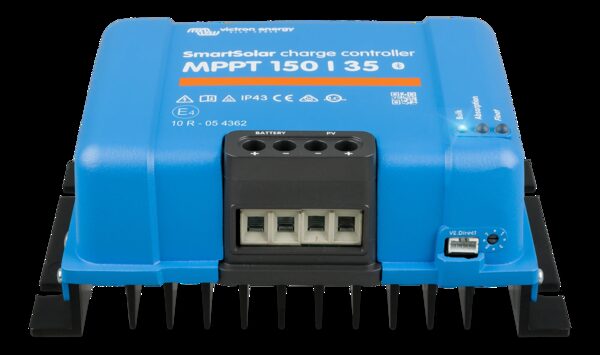
The 150 series covers the middle of the range. The 150/35 and 150/45 work with 12V, 24V, 36V and 48V battery systems and carry Bluetooth and VE.Direct connectivity4. The 150/45 has a nominal PV power rating of 650W at 12V, 1,300W at 24V, 1,950W at 36V and 2,600W at 48V7. The 150/60 to 250/60 range supports a PV input with a maximum open circuit voltage of 150V or 250V and a maximum output of up to 70A12.
At the top sit the 150/70 to 250/100 VE.Can models, with 150V maximum VOC on the 150 series and 250V on the 250 series, and connections available either as 35 mm² screw terminals or three sets of MC4 connectors6. These are the models that coordinate: all individual VE.Can SmartSolar chargers synchronise their charge stages, so a bank of controllers behaves as one charger rather than several competing ones6.
| Model group | Max PV open circuit voltage | Battery voltages | Notable feature |
|---|---|---|---|
| 75/10, 75/15, 100/15, 100/20 | 75V or 100V4 | 12V, 24V, 36V, 48V4 | Entry point, from £44.129 |
| 100/30, 100/50 | 100V3 | 12/24V auto-select3 | Multi-stage adaptive charging3 |
| 150/35, 150/45 | 150V4 | 12V, 24V, 36V, 48V4 | Bluetooth and VE.Direct4 |
| 150/60 to 250/60 | 150V or 250V12 | 12V, 24V, 48V, 36V by software12 | Up to 70A output12 |
| 150/70 to 250/100 VE.Can | 150V or 250V6 | 12V, 24V, 36V, 48V6 | Charge stage synchronisation across VE.Can units6 |
Efficiency: up to 98%, with better harvest in partial shading
Victron states 98% efficiency for the SmartSolar MPPT range, and repeats the figure across the product pages for the 75/10 group, the 100/30 and 100/50, the 150/35 and 150/45, and the 150/60 to 250/70 models1. The EasySolar MPPT 100/50 quotes a maximum efficiency of 98% as well10. The figure is a conversion efficiency for the controller itself, not a system efficiency: it says nothing about panel yield, cable losses, battery round-trip losses or inverter losses downstream.
The more useful claim for a UK household is the harvest comparison. Victron's datasheets state that its MPPT controllers improve energy harvest by up to 30% compared with PWM charge controllers and by up to 10% compared with slower MPPT controllers3. Those are maker figures and should be read as such, but the direction is uncontroversial: an MPPT controller that tracks quickly and accurately will out-harvest one that does not, particularly in the changeable, partly cloudy conditions common in the UK.
Partial shading is where the difference shows most. Advanced Maximum Power Point Detection is listed across the SmartSolar range, and the 100/30 and 100/50 datasheet names it explicitly for partial shading conditions3. A controller that can find a second, lower power peak when a chimney or a mast shades part of the array will recover output that a simpler tracker misses. That matters more on a boat or a cabin with an awkward array than on a clean south-facing roof.
Specifications: voltage, dimensions, IP rating and connections
The published specifications vary by model, so the table below names the exact unit for each figure. The 100/30 measures 130 mm high and 186 mm wide, with screw terminals for connection13. The 150/35 is 130 mm high and uses 16 mm² screw terminals4. The 150/60 to 250/60 range has a depth of 95 mm12. The 150/70 to 250/100 VE.Can models are available with 35 mm² screw terminals or three sets of MC4 connectors6.
Ingress protection is consistent across the range: IP43 for the electronic components and IP22 for the connection area3. That is protection against spraying water and against fingers reaching live parts, not against immersion. A controller mounted in a damp cabin locker or an unheated outbuilding will see condensation, and the IP22 rating on the terminal area is the weaker of the two figures.
| Specification | Figure | Model |
|---|---|---|
| Dimensions | 130 x 186 mm | SmartSolar MPPT 100/3013 |
| Height | 130 mm | SmartSolar MPPT 150/354 |
| Depth | 95 mm | 150/60 to 250/60 range12 |
| IP rating | IP43 (electronics), IP22 (connection area) | Across the range3 |
| Terminals | 16 mm² screw terminals | SmartSolar MPPT 150/354 |
| Terminals | 35 mm² screw or 3 sets of MC4 | 150/70 to 250/100 VE.Can6 |
| Programmable relay | 4A up to 35VDC, 1A up to 60VDC | 150/70 to 250/100 VE.Can6 |
The programmable relay on the larger VE.Can models is worth noting for anyone planning a generator start or a load shed: it switches 4A up to 35VDC or 1A up to 60VDC6. The commodity code for the range is 85044055, which matters only for import paperwork6.
Battery compatibility and system integration through GX devices
Victron describes the SmartSolar range as compatible with lithium, AGM, gel and flooded batteries, with automatic voltage selection1. The 100/30, 150/35, 150/45 and the VE.Can models are all listed as lithium compatible4. That covers the common lead-acid types and the lithium packs most off-grid builds now use, but "lithium" is not one charge profile: absorption voltage, float voltage and tail current differ between chemistries and between manufacturers, so the controller's profile has to be set to match the battery's own specification.
Integration is where Victron's ecosystem does most of its work. Managed batteries can be integrated through GX devices in minutes, and AC-PV inverters are supported directly after installing a software assistant on Victron's inverters, with strong collaboration with Fronius PV inverters9. The Ekrano GX communication centre supports managed lithium batteries, Victron connected products, solar irradiance and wind meters, auto start/stop generator control, marine multifunction displays, and resistive tank level and temperature inputs14.
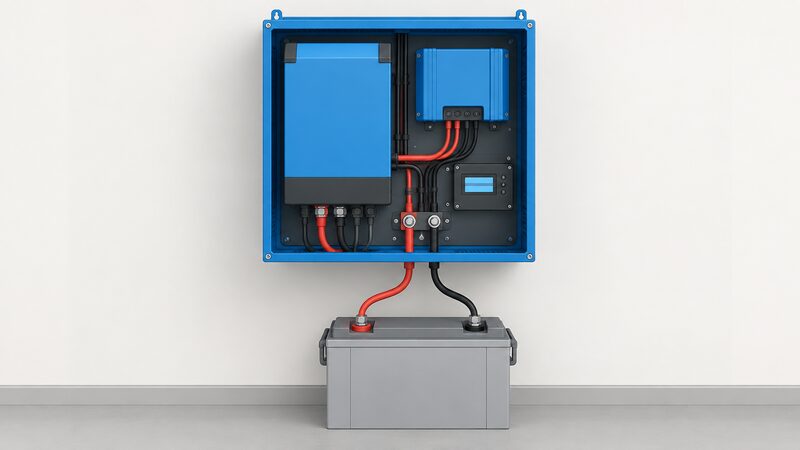
Multiple MPPTs can coordinate using Bluetooth or a GX communication centre connected to the VE.Can port1. The Solar and Wind Priority feature, which prioritises running loads from solar before drawing on the battery, requires an inverter/charger and a GX device to coordinate the system1. The EasySolar-II GX packages the whole thing: a MultiPlus-II inverter/charger, a SmartSolar MPPT -Tr charge controller and a GX device with a 2 x 16 character display in one enclosure, with the MPPT's DC output parallel wired to the MultiPlus-II's DC connection and the battery connected via two M8 studs15.
Warranty: 5 years, upgradable to 10

Every Victron product in the material reviewed here carries a five year warranty: the SmartSolar MPPT range, the EasySolar, the Phoenix Smart Inverters, the MPPT Control, the SmartSolar MPPT RS and the SmartShunt4. Victron states that its standard five year warranty is upgradable to ten years by an additional 10% of the initial investment9. That is a priced extension rather than a registration formality, and it is calculated on what the household paid, so the cost scales with the size of the system.
The five year term is longer than the two to five years typical of domestic gas boilers, and it applies across the range rather than only to premium models. It is a manufacturer's warranty, so it covers defects in the product, not installation faults, water ingress from a badly sealed enclosure, or damage from an incorrectly configured battery profile. For an off-grid system where a failed controller can mean no charging at all, the length of the term matters less than what happens during it: a replacement has to reach a remote cabin or a boat, and that logistics gap is not covered by any warranty term.
Victron Energy: a Dutch family firm with UK support
Victron Energy is a Dutch company, family run, with over 50 years of experience in energy storage and self-consumption systems9. The company describes itself as having over 45 years of experience building backup and off-grid systems in its off-grid market material9. The two figures appear in different documents and are not reconciled here; both are the company's own statements about its history.
For a UK buyer, the practical point is support. Victron offers full technical support in the UK22. That matters for a brand whose products are configured rather than simply installed: charge profiles, VE.Can synchronisation, GX device setup and VRM portal access all involve settings that a householder or a marine electrician has to get right, and a UK support route shortens the loop when something does not behave.
The company's product range extends well beyond charge controllers. The Phoenix Smart Inverters, the Sun Inverter, the EasySolar range, the SmartSolar MPPT RS and the SmartShunt all carry the same five year warranty17. The Sun Inverter reads out inverter and solar charger parameters over Bluetooth using the VictronConnect app, and carries a VE.Direct port for connection to a GX device or a GlobalLink 52024. The VE.Direct inverters are short circuit proof and protected against overheating, and carry a VE.Direct communication port25.
Buying in the UK and what the kit means for off-grid independence
UK pricing for the entry models is published: the SmartSolar MPPT 75/10, 75/15 and 100/20 start from £44.12, the SmartSolar Control Display is £23.94, the SmartSolar MPPT 100/50 is £137.92, and the 150/70 to 250/100 VE.Can models start from £309.966. Those are component prices, not installed system prices, and the VAT position is not stated in the figures. Above the entry models, prices are quoted by the distributor or installer for the specific configuration.
The wider UK context is that self-installed solar has moved from a niche to a mainstream option. Plug-in photovoltaic panels, also known as balcony solar, are now available to buy and self-install in the UK, and since the end of August 2026 plug-in solar kits have been available to buy online and on the high street26. Plug-in solar panels are now available to buy and use across Great Britain28. Freestanding and portable panels have been available in the UK for longer, but are only legal for off-grid use29. A UK government funding pilot is designed to put plug-in kits into low-income households, delivered through local authorities.
That distinction matters for a Victron buyer. A SmartSolar controller is an off-grid device: the SmartSolar MPPT 100/30, the 150/35, the 150/45, the wider SmartSolar range and the EasySolar-II GX are all listed as off grid4. The controllers do not export to the grid and are not grid-tied equipment. What they do is make a battery bank charge properly from a solar array, which is the foundation of a system that keeps running when the grid does not.
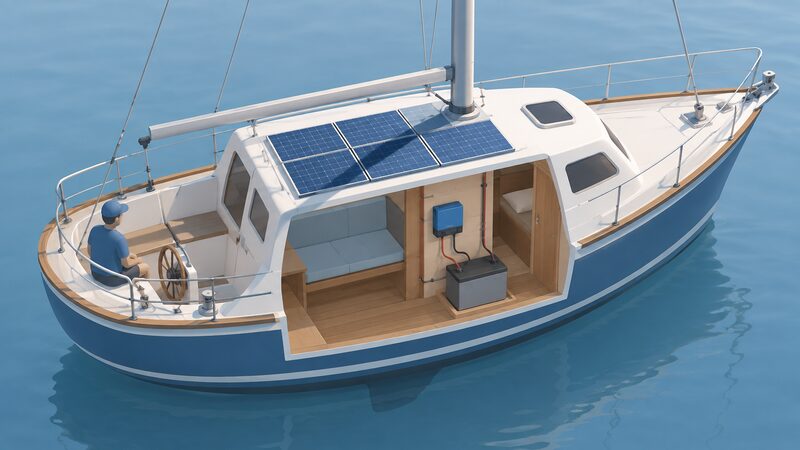
The dependence that remains is real and worth stating plainly. The system depends on a battery manufacturer for the storage, on a GX device for coordinated control and remote monitoring, on Victron's VRM portal and VictronConnect app for anything beyond local Bluetooth, and on a home broadband connection for remote access. It depends on the sun for input, which in a UK winter is limited. And it depends on the household understanding charge profiles well enough to set them correctly, because a lithium pack charged to the wrong absorption voltage will not last its rated life. For a cabin, a boat or a self-build where a grid connection is expensive or impossible, that trade is usually worth making. For a grid-connected house, the same controller is a component in a hybrid system rather than a route to independence on its own.
Sources29 cited
- SmartSolar MPPT 100/30 and 100/50, Victron Energy, 2026-09-19
- SmartSolar MPPT 75/10, 75/15, 100/15 and 100/20, Victron Energy, 2026-09-19
- Datasheet: SmartSolar charge controller MPPT 100/30 and 100/50, Victron Energy, 2026-09-17
- SmartSolar MPPT 150/35, Victron Energy, 2026-09-19
- SmartSolar MPPT 250/85 and 250/100, Victron Energy, 2026-09-19
- Datasheet: SmartSolar charge controller MPPT 150/70 up to 250/100 VE.Can, Victron Energy, 2026-09-17
- Datasheet: SmartSolar charge controller MPPT 150/35 and 150/45, Victron Energy, 2026-09-17
- Datasheet: Blue Solar Charge Controller MPPT 75/10, 75/15, 100/15, 100/20 48V, Victron Energy, 2026-09-17
- Off-grid market, Victron Energy, 2026
- Brochure: Self-Consumption and Energy Storage, Victron Energy, 2026-02
- Ekrano GX communication centre, Victron Energy, 2026-09-19
- Datasheet: EasySolar-II 48V 4k5 and 6k5 GX, Victron Energy, 2026-09-17
- Victron SmartSolar charge controllers MPPT 100/30 and 100/50, Wind and Sun, 2026-09-20
- Victron SmartSolar charge controllers MPPT 75/10, 75/15, 100/15 and 100/20, Wind and Sun, 2026-09-20
- Victron SmartSolar charge controller MPPT 150/35 and 150/45, Wind and Sun, 2026-09-20
- Victron SmartSolar charge controller MPPT 150/70 up to 250/100 VE.Can, Wind and Sun, 2026-09-20
- Victron SmartSolar charge controllers MPPT 150/45 up to 250/70, Wind and Sun, 2026-09-20
- Victron MPPT Control, Wind and Sun, 2026-09-20
- Victron SmartShunts, Wind and Sun, 2026-09-20
- Victron EasySolar-II GX, Wind and Sun, 2026-09-20
- Victron EasySolar inverter/charger/solar charge controller, Wind and Sun, 2026-09-20
- Victron Phoenix Smart Inverters, Wind and Sun, 2026-09-20
- Victron SmartSolar MPPT RS, Wind and Sun, 2026-09-20
- Victron charge controllers collection, Wind and Sun, 2026-09-20
- Victron storage economics, Spirit Energy, 2026
- SmartSolar MPPT 75/10, Victron Energy, 2026-09-19
- Sun Inverter, Victron Energy, 2026-09-19
- Datasheet: Inverter VE.Direct 250VA to 1600VA, Victron Energy, 2026-09-17
- EO Charging home charging FAQs, EO Charging, 2026-09-17
 Victron MultiPlus-II inverter-chargerThinking about a Victron MultiPlus-II for home backup?
 Victron Energy Systems for Off-Grid and Home Battery UseThinking about Victron for a home battery or off-grid setup?
 Victron EnergyCan you check your home battery and solar from your phone, and does it work if the internet goes down?