
In this answer
Short answer
Shade is the single most common reason a solar array underperforms its headline rating, and the effect is larger than most households expect. A roof that is more than 80% shaded can reduce output by as much as 50%1. Even if just one panel is in the shade, the whole system's performance may be hampered2. Panels generate from daylight, including wavelengths that pass through cloud, so a shaded array is not dead, but it is working well below its potential3.
The mechanism is electrical rather than optical. Panels wired in a string are only as efficient as the lowest performing panel, so one shaded module sets the ceiling for the group it sits in4. Bypass diodes inside the panel limit the damage by taking a shaded group of cells out of the circuit, but the string still loses that group's contribution while the shade lasts5. Panel-level power optimisers and microinverters change this by letting each panel work independently, which is why installers recommend them where shade is unavoidable6.
What follows is what shade does to output, why the string architecture matters, how mounting orientation changes the picture, and what optimisers can and cannot do. The practical question underneath is independence: a shaded array still cuts reliance on the grid, but it does so with a smaller and less predictable yield than an unshaded one7.
How shade affects a solar panel: the basic mechanism
Solar panels convert the sun's energy into electricity via the photovoltaic effect10. Anything that blocks light from reaching the cells reduces the current they can produce, and the reduction is not proportional to the size of the shadow in a simple way. Shading on solar panels usually comes from trees, chimneys and nearby buildings6. Any source of shade, mainly trees or other structures, will reduce the generation potential of a roof11.
Shade is not the only thing that suppresses output, and it is worth separating the causes. Generation drops can come from weather conditions, dirt building up, or a change in the environment such as shading from trees or new structures, and a faulty DC string can look similar12. That matters for diagnosis: a sudden fall in yield is not automatically a shading problem, and a slow seasonal fall usually is not one either.
Season and time of day change how hard shade bites. The sun sits lower in the sky during winter, so it may not hit the panels as directly as it does in the summer, which lengthens shadows from trees, chimneys and neighbouring roofs8. East-facing panels generate more electricity in the morning, while west-facing panels do better in the afternoon and early evening, so a tree to the east costs most before midday and one to the west costs most in the late afternoon6.
The practical consequence is that shade is a siting question before it is an equipment question. Official guidance is that panels should not be shaded for long periods of the day, as they will not function when overshadowed13. Where a roof is heavily shaded, solar panels may not be the most suitable option at all14. For a household weighing up a quote, that makes the shading survey, not the panel datasheet, the decisive document. The wider siting rules are set out in roof orientation, pitch and shading.
Why one shaded cell drags down a whole string
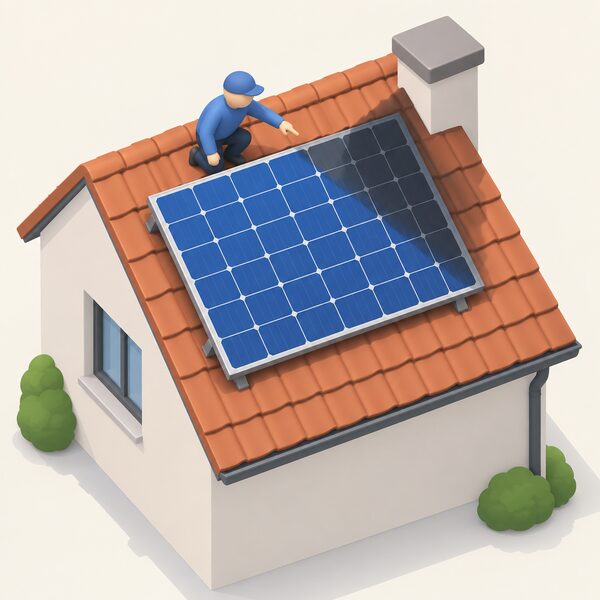
A conventional string inverter connects panels in series, and series wiring means the current through every panel is limited by the weakest one. The maker guidance is blunt: a single underperforming panel reduces the output of the entire string15. When one panel is shaded or not functioning correctly, it reduces the output of the entire array16. Panels in a string system are only as efficient as the lowest performing panel4.
Inside the panel, the same logic runs at cell level. In a traditional panel, when one cell is shaded or faulty, the entire row or string of cells stops producing power, knocking out a third of the panel5. Bypass diodes are the mitigation: they route current around the affected group so the rest of the module keeps working, but the bypassed third contributes nothing while the shade is present. In extreme scenarios, when a single cell in a string is shaded, entire modules can lose more than half their power17.
This is why the age of a system matters to how it behaves. Older systems were built so that if just one cell was broken or shaded or facing away from the sun, the entire system would have reduced capacity18. Modern module designs partition the cells into more independent zones, which limits how far a single shadow spreads, but the string-level constraint remains unless panel-level electronics are fitted.
"In a traditional panel, when one cell is shaded or faulty, the entire row of string of cells (Row 1 below) will stop producing power, knocking out a third of the panel"
The design of the module itself is a factor, but not a simple one. Shingled cell layouts are presented by their maker as a design-dependent advantage, not a universal rule, with the outcome depending on module partitioning, string configuration and shading pattern19. That is a fair description of the whole subject: the loss depends on where the shadow falls, how the module is divided internally, and how the panels are wired together.
Portrait orientation and the short-edge shutdown problem
Mounting orientation decides which edge of the panel a shadow crosses first, and that changes the electrical outcome. In portrait orientation, shade on the bottom short edge is the worst case: it quickly affects all three electrical zones, completely shutting down the panel20. A shadow creeping up from the bottom edge of a portrait-mounted module therefore does disproportionate damage relative to its area.
Some module designs address this directly. Maxeon states that its Performance panels re-route energy flow through the top two thirds of the panel when shade falls on the short edge in portrait20. That is a maker claim about that maker's own product, and it illustrates the principle rather than settling the general case. For a conventional panel, the same shadow produces the shutdown described above.
Landscape mounting puts the long edge at the bottom, so a shadow crossing that edge interacts with the bypass zones differently. The illustrative figure given for a long edge shaded in landscape is that a panel quickly becomes a 198W panel20. Mounting hardware has to support whichever orientation is chosen: at least one façade mounting system is specified for both portrait and landscape module orientation21.
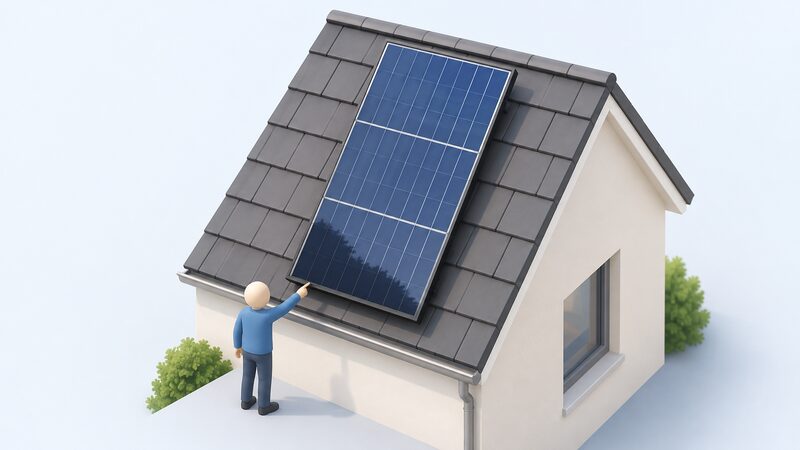
Orientation also interacts with the roof's own direction. The standard modelling assumption for a UK dwelling is a south-facing roof at 30 degrees pitch with modest overshading9. Where a roof cannot meet that, the shading pattern and the mounting orientation become the variables an installer can actually work with, alongside the choice of panel-level electronics.
Panel-level power optimisers: how they limit shade losses
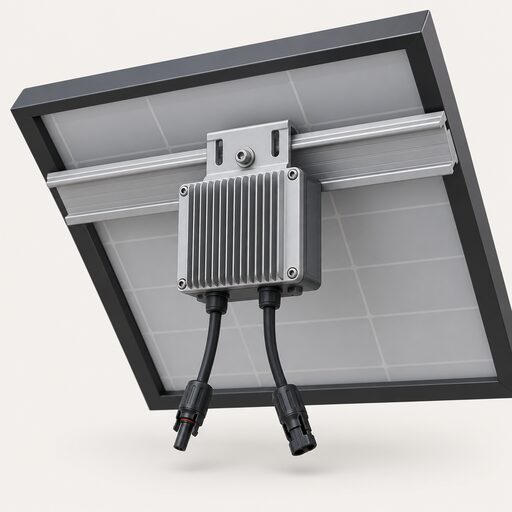
Power optimisers are fitted one per panel, or one per pair, and they decouple each module from the string's weakest link. SolarEdge states that its optimisers maximise the energy production of each solar panel and mitigate mismatch loss, from manufacturing tolerance to partial shading and aging, while ensuring high levels of system safety and visibility22. Its product page adds that they maximise the energy output from each PV panel, even if others are shaded or facing various orientations23.
The limit is important and is often overstated in sales conversations. Optimisers reduce the losses of the overall system, but individual panel losses will still affect performance11. A fully shaded panel produces nothing for the optimiser to work with; what the device does is stop that panel dragging down its neighbours. Independent guidance reflects the same position: if shading is unavoidable, an installer might recommend microinverters or power optimisers, which let each panel work independently, alongside trimming trees causing partial shade6.
| Approach | Effect on a shaded panel | Effect on the rest of the array |
|---|---|---|
| String inverter alone | Shaded group bypassed, module loses a third or more5 | Whole string limited by the weakest panel15 |
| Power optimiser per panel | Panel still loses output while shaded11 | Other panels continue near their own peak23 |
| Microinverter per panel | Panel still loses output while shaded11 | Each panel works independently6 |
Monitoring is the other half of the case for panel-level electronics. SolarEdge describes its optimisers as delivering real-time visibility alongside the energy and safety benefits23. That visibility is what turns a vague suspicion of shading into a specific finding about one module, which is the difference between trimming a tree and replacing an array. The trade-offs between the two panel-level approaches are compared in microinverters vs string inverters and power optimisers.
Which roofs and shade patterns suit optimiser systems
The threshold most often quoted is simple: a roof with 20% shading or less is best1. An unshaded, south-facing roof is ideal for maximum performance24. A mainly south-facing roof gives the best power output, with southwest or southeast-facing roofs also good, and a pitch of around 30 degrees is best25. Where a roof meets those conditions, panel-level electronics are usually an unnecessary cost; where it does not, they are the main lever available.
Shade patterns differ in kind, and the kind matters more than the percentage. A single chimney casting a moving shadow across one or two panels for an hour is a different problem from a neighbouring building shading the whole array every afternoon. A tree to the east costs morning generation; a tree to the west costs the afternoon and early evening, when west-facing panels do better6. Winter lengthens all of these shadows because the sun sits lower8.
Flat roofs have their own version of the problem. Solar panels can be installed on both pitched and flat roofs, and on a flat roof the panels will need to be tilted and spaced to avoid shading20. Spacing rows far enough apart that one does not shade the next is a design decision made at survey stage, and it costs roof area. On pitched roofs, official planning guidance in some boroughs asks that panels be spaced evenly on the roof slope and not in an irregular pattern, which is an aesthetic requirement rather than a performance one26.
For a household, the useful sequence is: establish how much of the roof is shaded and when, decide whether the remaining generation justifies the array, and only then decide whether panel-level electronics earn their place. The general suitability questions are covered in which homes suit solar panels.
What shade means for your household's energy independence
A shaded array still does the core job. Photovoltaic panels could power your home, reduce your bills and may earn you money14. Solar panels generate clean energy for your home, and this can cut down on your energy bills27. Home solar panels can reduce reliance on the grid, and your Energy Performance Certificate can be improved28. Self-consumed solar power has an effective locked-in cost of 0p per kWh for the next 25 years, which is the figure that makes the case regardless of how many hours of shade a roof sees29.
What shade changes is the size and predictability of that contribution. A roof more than 80% shaded can lose as much as 50% of its output1. Those are not reasons to abandon the idea, but they are reasons to size expectations honestly. The dependence that remains is on the grid for everything the array cannot cover, and on the weather for how much it covers on any given day: a cloudy day yields roughly 10% to 25% of a sunny day, and winter runs 25% to 50% below summer8.
Shade also has a maintenance dimension that affects long-run performance. Checking panels after rough or stormy weather, watching out for animals nesting near the panels, and scheduling annual inspections are the routine tasks that catch new shading before it becomes a habit28. A tree grows, a neighbour extends, a chimney gains a cowl: the shading survey done at installation has a shelf life. Expected degradation can be found on the panel datasheet, searchable by make and model on the MCS certificate, which gives a baseline against which an unexpected fall in output can be judged12.
The independence picture is therefore conditional rather than binary. An unshaded south-facing roof delivers the most self-sufficiency per panel; a shaded roof delivers less, and panel-level electronics recover part of the difference rather than all of it. The wider context, including what independence means across generation, storage and export, is set out in solar panels and household energy independence.
Sources29 cited
- Buying advice for solar panels, Which?, 2026-08-12
- Make the most of your solar panels, Which?, 2026-08-12
- Solar power facts, Energy Saving Trust, 2026-08-13
- What type of solar panels should I install?, Good Energy, 2026-09-07
- Don't put solar in the shade, Wind & Sun, 2024-06-11
- Solar panel installation, Energy Saving Trust, 2026-09-07
- How do solar panels work?, Smart Energy GB, 2026-03-16
- Do solar panels work in winter?, Uswitch, 2026-09-15
- SAP 10.2 specification, BRE Group, 2024-02-12
- Solar panel installation, maintenance and repair, NICEIC, 2026-09-17
- What makes a good solar PV roof?, Renewables First, 2026-04-08
- Solar panel problems and how to solve them, Which?, 2026-03-26
- Generating your own energy: solar electricity, Welsh Government, 2018-09
- Solar photovoltaic (PV) panels, London Borough of Bromley, 2026-09-17
- Microinverter complete guide, Sungrow, 2025-04-23
- Solar inverter, EcoFlow, 2025-06-16
- Back-contact technology: how LONGi's HPBC 2.0 improves performance in partial shade, LONGi, 2025-10-06
- What is the best location for solar panels?, Marley, 2026-09-17
- Advantages of shingled solar panels, Alternergy, 2026-04-15
- Shade happens, Maxeon, 2026-09-17
- Façade mounting system, Sunfixings, 2026-09-17
- Residential products, SolarEdge, 2026-09-17
- Power optimizers, SolarEdge, 2026-09-17
- Solar panels, Energy Saving Trust, 2026-08-27
- Solar panel myths: five common concerns debunked, Which?, 2026-06-09
- Solar panels and permitted development, London Borough of Richmond upon Thames, 2026-07-06
- What is global warming and what can I do about it?, Smart Energy GB, 2026-03-16
- Solar panels, Uswitch, 2026-09-16
- Solar panels, East Herts Council, 2026-09-17
 Power OptimisersIf one panel is shaded, does it drag the whole roof down?
 Solar and Energy IndependenceHow far domestic solar cuts dependence on suppliers and the grid, what self-consumption really looks like across the year, what a battery, diverter or EV adds, and the grid-outage limit of ordinary inverters.
 Islanding and Anti-IslandingWhy do solar panels switch off in a power cut, and can you keep the lights on anyway?
 Savings and PaybackExplains how bill savings from solar are made up of avoided import and export income, and what drives the payback period.
 Roof Orientation and ShadingWhich way should your roof face for solar panels, and does it really matter if it is not south?
 Energy Bills and IndependenceSolar panels can cut the part of your bill that goes up with every unit you use, but you still pay a daily standing charge just for being connected to the grid.