
In this answer
Short answer
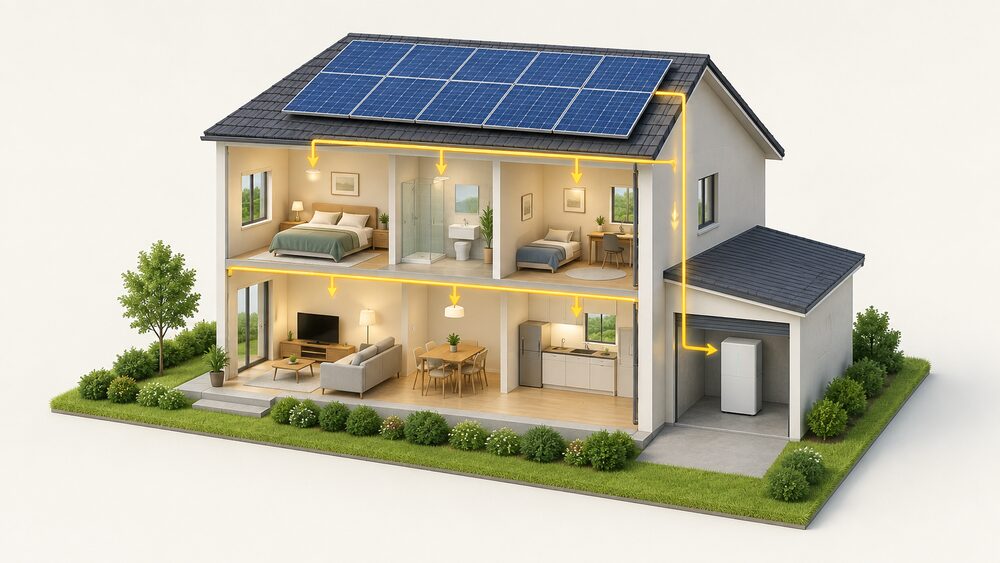
A home with solar panels and no battery typically uses only 30 to 40 per cent of the electricity it generates, and exports the rest1. Adding a battery lifts that share to 70 to 80 per cent, and a correctly sized battery paired with a time-of-use tariff can push it past 90 per cent in modelled configurations2. That jump, from roughly a third of generation to three quarters or more, is the single largest change a household can make to how much of its own power it actually consumes.
The figure matters because self-consumption is the practical measure of energy independence. Every kilowatt hour a home uses directly is a kilowatt hour it does not buy, and every kilowatt hour exported is sold at whatever rate the export tariff offers. Self-consumption is defined as the amount of solar electricity generated by a domestic system that is consumed within the property and not exported to the distribution network4. It can be quoted in kWh or as a percentage of total PV generation, and standards require both to be communicated4.
The range across sources is wide because the answer depends on three things: how much the home uses during daylight, how much the array generates, and how much usable battery capacity sits between them. A home that is empty all day without a battery can sit as low as 10 per cent self-consumption in the worked tables, while a home that is occupied all day reaches 35 per cent on the same generation5. This page sets out what the figures are, what drives them, and where the limits lie.
Self-consumption without a battery: typically 30 to 40%
The baseline is consistent across independent and maker sources. Independent guidance puts a system without a battery at 30 to 50 per cent of generation used on site1. Maker guidance converges on a narrower band: 30 to 40 per cent4, with one source putting it at 20 to 30 per cent9. The variation is not disagreement about the physics but about the household. A home with someone in during the day, running appliances as the sun shines, will sit at the top of the range. A home empty from morning to evening will sit at the bottom.
The MCS self-consumption tables show how wide that spread becomes at the extremes. For a home out during the day with annual consumption of 1,500 to 1,999 kWh and generation of 5,700 to 5,999 kWh, self-consumption runs from 10 per cent up to a ceiling of 25 per cent across the battery sizes modelled5. For a home in all day with consumption of 5,000 to 5,499 kWh and generation of 4,800 to 5,099 kWh, the same table runs from 35 per cent to 78 per cent5. The array size relative to the load is doing as much work as the occupancy pattern.
The hard ceiling is worth stating. Self-consumption cannot exceed 95 per cent of total annual generation under the standard4. Even a perfectly matched system with unlimited storage cannot consume everything, because generation in high summer exceeds any realistic household demand and some export is unavoidable.
What this means for independence is straightforward: without storage, a household remains dependent on the grid for the majority of its electricity, and on the export tariff for the value of what it gives away. The grid is not just a backup in that arrangement; it is the destination for most of the generation.
What a battery adds: self-consumption rises to 70 to 80%
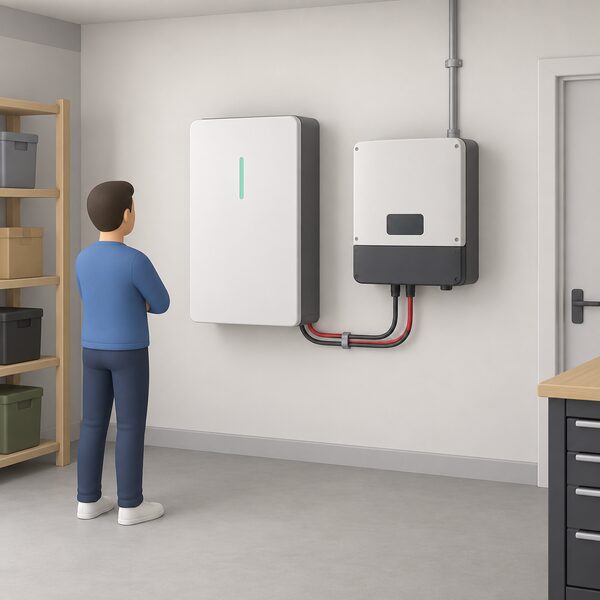
Official guidance is the strongest single figure here. Great British Energy states that adding a battery to a solar installation increases self-consumption from 30 to 40 per cent to 70 to 80 per cent7. Independent guidance puts the same jump at 80 per cent or more1. Maker sources cluster around the same band: 70 to 80 per cent with a properly sized system4, 60 to 80 per cent8, 60 to 75 per cent9, and 70 to 80 per cent with up to 90 per cent where system sizing is strategic10.
The mechanism is simple. A battery moves generation from the middle of the day, when the home may not need it, to the evening, when it does. That single shift captures the largest block of otherwise exported electricity. The size of the gain depends on how much of the evening load the battery can cover, which is why the range is 60 to 80 per cent rather than a single number.
There is a separate measure that is often confused with self-consumption. Self-sufficiency is the share of a household's total demand met from its own generation, and it is lower than self-consumption because it is measured against consumption rather than generation. Maker guidance puts homeowners adding battery storage to solar PV at 70 to 80 per cent of annual electricity demand met on site11. That is a different denominator and should not be read as the same figure.
"Great British Energy says adding a battery to a solar installation increases self-consumption from 30 to 40% to 70 to 80%"
The independence gain is real but partial. A battery shifts when grid electricity is drawn, and cuts how much is drawn, but it does not remove the connection. Most homes with a battery still import in winter, still rely on the grid for the evening peak in the darkest weeks, and still depend on a supplier for whatever they cannot generate. The self-sufficiency ratio is the measure that captures that remaining dependence, and it is worth reading alongside the self-consumption figure.
How battery size affects the result: from 60% to 90%
Capacity is the main lever a household controls. Maker modelling of a 4 kWp array shows the progression clearly: 30 per cent self-consumption with no battery, 75 per cent with a 5 kWh battery on a flat tariff, 80 to 90 per cent with the same battery on a time-of-use tariff, and 90 per cent or more with a 10 kWh battery on time-of-use3. The tariff matters as much as the capacity, because cheap overnight charging lets the battery serve load that solar alone could never cover.
| Configuration | Self-consumption |
|---|---|
| 4 kWp solar, no battery | 30%3 |
| 4 kWp solar + 5 kWh battery, flat tariff | 75%3 |
| 4 kWp solar + 5 kWh battery, time-of-use | 80 to 90%3 |
| 4 kWp solar + 10 kWh battery, time-of-use | 90%+3 |
The general range for a correctly sized battery is 70 to 90 per cent12, with one source putting a home battery at 60 to 80 per cent and over 90 per cent in smart, optimised setups14. A battery with a solar array is reported to lift self-consumption from 30 per cent to between 70 and 80 per cent, potentially over 90 per cent with advanced smart-charging schedules15. Independent data from Uswitch puts the self-consumption rate at 70 per cent with a 10 kWh battery16.
Bigger is not automatically better. Independent guidance warns that adding a battery to a solar panel system can increase bill savings but often not enough to recover the cost of the battery within its expected lifetime, particularly where households already have access to a good export tariff17. A battery that is oversized for the array and the load sits part-full for much of the year, and the household has paid for capacity it rarely uses. The relationship between capacity and self-consumption is a curve that flattens, not a straight line.
Worked example: a 4kW solar system with a 5 to 6 kWh battery
A 4 kWp array with a 5 to 6 kWh battery is the most common configuration discussed in UK guidance, and the figures for it are consistent enough to be useful. Independent guidance gives a household with solar and a 6 kWh battery a self-consumption rate of 70 per cent18. Maker guidance for a 4 kW solar system with a 5 to 6 kWh battery puts the share of solar energy used in the home at around 80 per cent19. A 4 kWp array with a 5 kWh battery is modelled at 60 to 70 per cent in one installer's East Midlands installations20.
The recommended match for a standard 4 kWp system is a 5 kWh to 8 kWh usable battery, rising to 10 kWh if the household plans to charge extensively on overnight grid tariffs21. That is a sizing rule of thumb, not a guarantee: the usable capacity is what matters, and a battery quoted at 5 kWh may deliver less than that once depth of discharge is accounted for.
The spread between 60 and 80 per cent for the same nominal configuration comes down to how the battery is operated. A flat tariff gives no reason to charge from the grid, so the battery only ever stores solar surplus. A time-of-use tariff gives a reason to fill the battery overnight at a cheap rate, which means it can serve morning load as well as evening load, and self-consumption rises accordingly. The same hardware produces different results under different tariffs.
For a household weighing independence, the 4 kWp plus 5 to 6 kWh combination is the point at which self-consumption moves from a minority of generation to a clear majority. It does not make the home independent. It makes the home's own generation the primary supply for most of the year, with the grid as the balance. The sizing a self-sufficient home system page covers what a larger system would need to go further.
Water batteries and alternative storage: 60 to 70% self-consumption
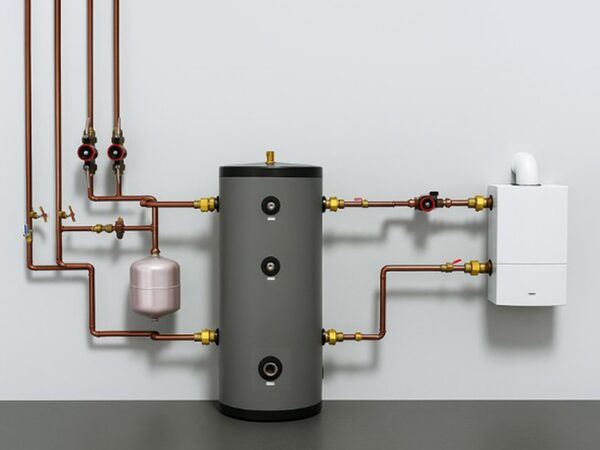
A water battery stores heat rather than electricity, and it is a genuinely different proposition. Maker guidance describes the distinction plainly: a water battery stores heat, a home battery stores electricity, and both increase self-consumption, but a water battery does so thermally, often cheaper per kWh6. A well-configured water battery can increase the share of self-consumption of solar energy from around 30 to 40 per cent to 60 to 70 per cent6.
That is below the 70 to 90 per cent claimed for a correctly sized electrical battery, and the reason is physical. Independent guidance notes that lithium-ion batteries can have roughly double the energy density of water storage, so could be effective in space-constrained settings22. A thermal store also only displaces demand for heat, not for electricity, so it cannot serve lighting, appliances or an electric vehicle.
The related route is a solar diverter or a heat pump with PV. Maker product guidance states that using surplus solar power for hot water production or heating allows a degree of self-consumption above 60 per cent23. Independent guidance notes that a solar battery can increase savings further by storing the sun's energy to power a heat pump later in the day24. Solar water heating itself will not cover 100 per cent of hot water needs and is best used alongside a boiler or immersion heater to make up the difference25.
The choice between thermal and electrical storage is a choice about what the household wants to displace. A water battery or diverter is cheaper per kWh stored and works well where hot water demand is high and consistent. An electrical battery is more flexible and reaches higher self-consumption, but costs more for the same capacity. The home battery vs hot water tank comparison sets the two side by side.
How self-consumption is measured, and what happens to the surplus
Self-consumption is the percentage of the solar energy generated that is used directly by the home rather than exported to the grid26. The formal definition is the amount of solar electricity generated by a domestic solar PV system which is subsequently consumed within the property and not exported to the distribution network4. The standard requires it to be communicated in both the estimated annual kWh and the percentage of solar PV electricity consumed4.
That dual reporting matters because a percentage alone hides the scale. A home with a small array and a high self-consumption percentage may still be importing most of its electricity. A home with a large array and a lower percentage may be meeting more of its own demand in absolute terms. The self-consumption page works through the distinction.
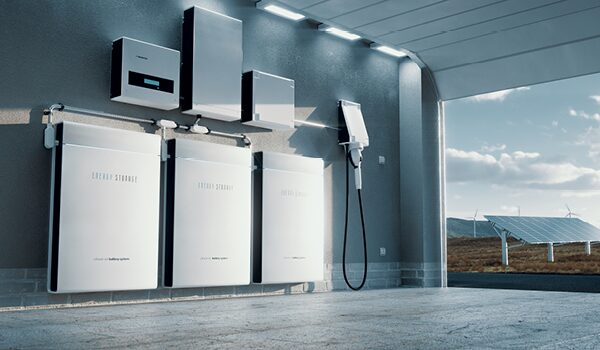
What is not used is exported. Without a battery, a household can only use solar electricity as it is being generated27. With a home battery, surplus energy is captured and held for when it is needed, including overnight electric vehicle charging, whereas without one the surplus is exported to the grid, often at a relatively low rate28. Around 20 per cent of new solar installations have battery storage, although some analysts believe this figure to be higher7.
The independence a battery delivers is therefore measured in reduced imports, not in their elimination. The household still depends on a supplier, on the grid's availability, and often on a manufacturer's app or cloud service to manage the system. The local control versus the manufacturer's cloud page covers what that dependence means in practice, and the household energy independence guide sets the whole picture out.
Sources28 cited
- Solar panels guide, Uswitch, 2026
- Battery storage for solar: residential economics, Spirit Energy, 2026
- Why solar PV battery storage is essential for UK homeowners, Jackery UK, 2026
- MCS 032: Solar PV self-consumption standard, MCS Certified, 2025
- MGD 003: Solar PV self-consumption, MCS Certified, 2022
- Water battery: how to store heat smartly, Homey, 2026
- POST note on solar and battery storage, UK Parliament, 2026
- Are plug-in solar panels worth it?, Spirit Energy, 2026
- Solar panels: are they worth it?, EcoFlow UK, 2026
- Home battery storage and energy independence, Jackery UK, 2026
- Solar energy pros and cons, Spirit Energy, 2026
- Why solar PV battery storage is essential, Jackery UK, 2026
- Why are UK homeowners detaching their rooftop solar?, Jackery UK, 2026
- Solar energy storage, Jackery UK, 2026
- Best home battery storage UK, Jackery UK, 2026
- Britain's homes with solar panels reap £40 million during the heatwave, Uswitch, 2026
- Supporting households with low carbon technology combinations, Energy Saving Trust, 2026
- Battery storage advice, Centre for Sustainable Energy, 2025
- How a 4kW solar system works, EcoFlow UK, 2025
- Solar power for your home, Jackery UK, 2026
- What size battery for solar panels, Jackery UK, 2026
- The suitability of clean heating options for challenging dwelling types, ClimateXChange, 2024
- Heating with PV, Fronius, 2026
- Is now a good time to get a heat pump?, Energy Saving Trust, 2025
- Boilers advice, Energy Saving Trust, 2026
- Smart appliances and load shifting, Homey, 2026
- Solar panels: how much of your electricity can they produce?, Which?, 2024
- EV chargers for solar panel charging, E.ON Next, 2026
 Self-ConsumptionHow much of the electricity from your own solar panels do you actually use, and how much goes to the grid?
 MGD 003 Self-ConsumptionBuying a battery with solar panels means asking how much of your own solar you will actually use instead of sending it to the grid.
 Sizing a Self-Sufficient HomeHow many solar panels and how much battery storage does a home need to stop relying on the grid?
 Round-Trip EfficiencyHow much of the electricity you put into a home battery do you actually get back?
 Solar and Energy IndependenceHow far domestic solar cuts dependence on suppliers and the grid, what self-consumption really looks like across the year, what a battery, diverter or EV adds, and the grid-outage limit of ordinary inverters.
 Charging an EV from Solar PanelsCharging your car from solar panels means using the power your roof makes instead of sending it to the grid.