
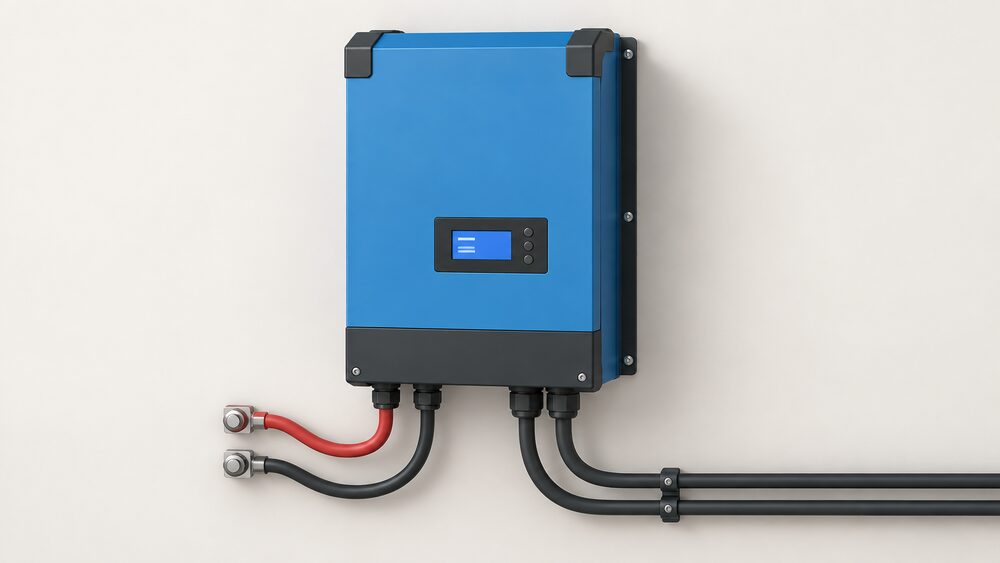
In this comparison
The MultiPlus-II is not a replacement for the MultiPlus so much as an extension of it. Victron describes it as "a multifunctional inverter/charger with all the features of the MultiPlus, plus an external current sensor option"1. That single addition is what turns the unit from a battery inverter into the metering point of a whole-house energy system, because the sensor lets the device see the whole property's import and export rather than only its own output.
The practical differences for a UK household are the model spread, the certification and the price. The MultiPlus-II range runs across eight models, from 3000 VA to 15000 VA, with a 32 A to 100 A transfer switch depending on model2. The 48/3000 to 48/10000 models carry G98 and G99 certification for the United Kingdom3. UK distributor listings show 8 models available from £485.60, and 3 MultiPlus-II GX models from £552.764.
Both ranges share the same core behaviour: PowerControl and PowerAssist, two AC outputs, parallel and three-phase capability, and a 5 year warranty. What separates them is the sensor, the GX variants and the larger frame sizes. This page sets out what each range is, what changed, the models, how batteries and solar connect, who makes the equipment, and what buying one in the UK involves.
MultiPlus and MultiPlus-II: what the two ranges are
Both are inverter-chargers, meaning one box that converts battery DC to mains AC and, in the other direction, charges the battery from mains or a generator. Victron calls the MultiPlus-II "a multifunctional inverter/charger"7, and the same phrase appears across the 120 V and 230 V datasheets8. The MultiPlus-II 230 V units accept an AC input range of 187 to 265 VAC, which is wide enough to ride through most UK supply variation without dropping to battery5.
The MultiPlus family is the older and broader line. UK listings show 12 models available in the 500 VA to 1600 VA sizes and 7 models in the 3000 VA to 5000 VA sizes9. Those smaller units are the ones that appear in vehicle, marine and small backup roles, and the MultiPlus-II 48/4k5/55-32 230V is listed as a battery inverter/charger10. The MultiPlus 48/20k/250-100 is the largest of the line and, like the MultiPlus-II, is compatible with both solar charge controllers and grid-tie inverters11.
The MultiPlus-II sits above that in power and below the Quattro range, which is the two-input model for installations with both a generator and a grid supply. The Quattro II carries the same 5 year warranty as the rest of the family12. For a household choosing between them, the deciding facts are usually the number of AC inputs needed, the size of the transfer switch, and whether the external current sensor matters for the way the system is to be metered.
What the MultiPlus-II does for independence is straightforward: it lets a battery supply the house directly, and it lets the house keep running when the grid does not. What it does not do is remove the battery, the installer or the configuration work. The unit is a component, not a complete system.
What changed between MultiPlus and MultiPlus-II
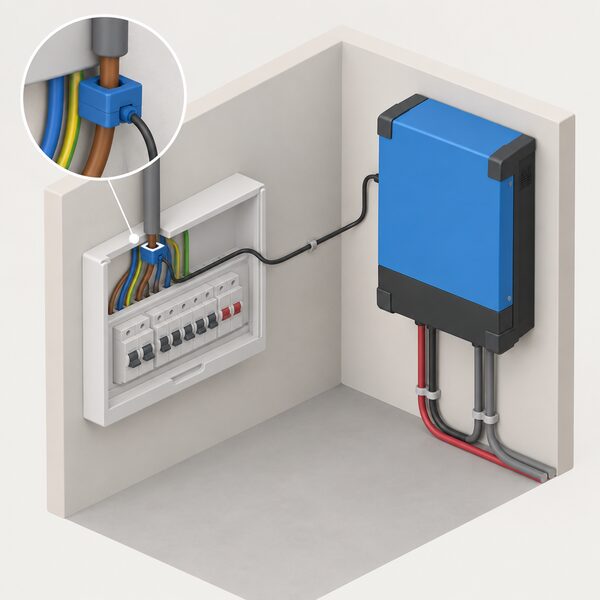
The headline change is the external current sensor option. With it, the inverter can measure the property's total load and generation, which is what makes self-consumption control and export limiting possible without a separate meter. Victron also states the MultiPlus-II "extends battery life", a claim tied to the way the unit manages charge and discharge rather than to any change in cell chemistry1.
The second change is the transfer switch rating. On the MultiPlus-II 230 V range it runs from 32 A on the 48/4k5/55-32 up to 100 A on the 48/10k/150-1005. A larger transfer switch means more of the house can sit behind the inverter without a separate contactor, which matters in a property with an electric shower or a large cooker circuit.
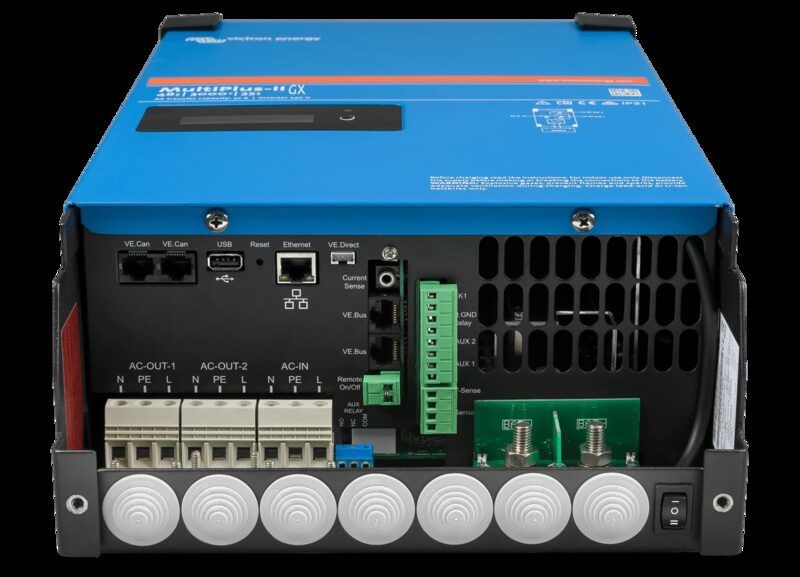
The third is the GX variants. The MultiPlus-II GX integrates a MultiPlus-II inverter/charger and a GX device with a 2 x 16 character display in one enclosure13. That removes a separate box and its wiring, and it is the version to consider where managed battery communication is needed from the outset.
The fourth is certification. The MultiPlus-II carries G98 and G99 for the United Kingdom on the 48/3000 to 48/10000 models only3. The larger 8 kVA, 10 kVA and 15 kVA units hold separate approvals, including a G99 NI certificate for three-phase configuration in the UK and Northern Ireland14, and an EN 50549 certificate covering the GX models15. The 4k5 and 6k5 GX units hold IEC 60335 certification16, and the 48 V 8 kVA, 10 kVA and 15 kVA units hold IEC 6247717.
MultiPlus-II: 8 models across the range
The range spans 3000, 4k, 4k5, 5000, 6k5, 8000, 10000 and 15000 VA1. Every model shares PowerControl and PowerAssist, an isolated inverter topology, M8 battery bolts, a pollution degree of 2, and a DC input range of 38 to 66 V on the 230 V units6. The 48/6k5/100-50 and 48/10k/150-100 differ in DC input range, at 38 to 60 V and 40 to 66 V respectively5.
| Feature | MultiPlus-II 230 V range |
|---|---|
| Models | 3000, 4k, 4k5, 5000, 6k5, 8000, 10000, 15000 VA1 |
| Transfer switch | 32 A to 100 A by model2 |
| AC input range | 187 to 265 VAC5 |
| DC input range | 38 to 66 V6 |
| AC outputs | Two1 |
| Parallel capability | Up to 6 units5 |
| Frequency | 50/60 Hz18 |
| Battery connection | M8 bolts6 |
Parallel operation is the main route to more power without moving to a larger single unit. Up to 6 Multis can operate in parallel5, and the MultiPlus-II supports parallel and three-phase configurations1. There is a limit worth knowing: the 8k, 10k and 15k models can only be connected in parallel if an external AC transfer switch is used2. The smaller models parallel directly.
The GX variants add a third option. The MultiPlus-II GX is capable of parallel operation for increased power output or battery charge rates, and can be configured for three-phase supply13. Its storage mode voltage is 52,8 V13. For a household planning a three-phase supply or a managed battery, the GX version removes a separate GX device from the parts list.
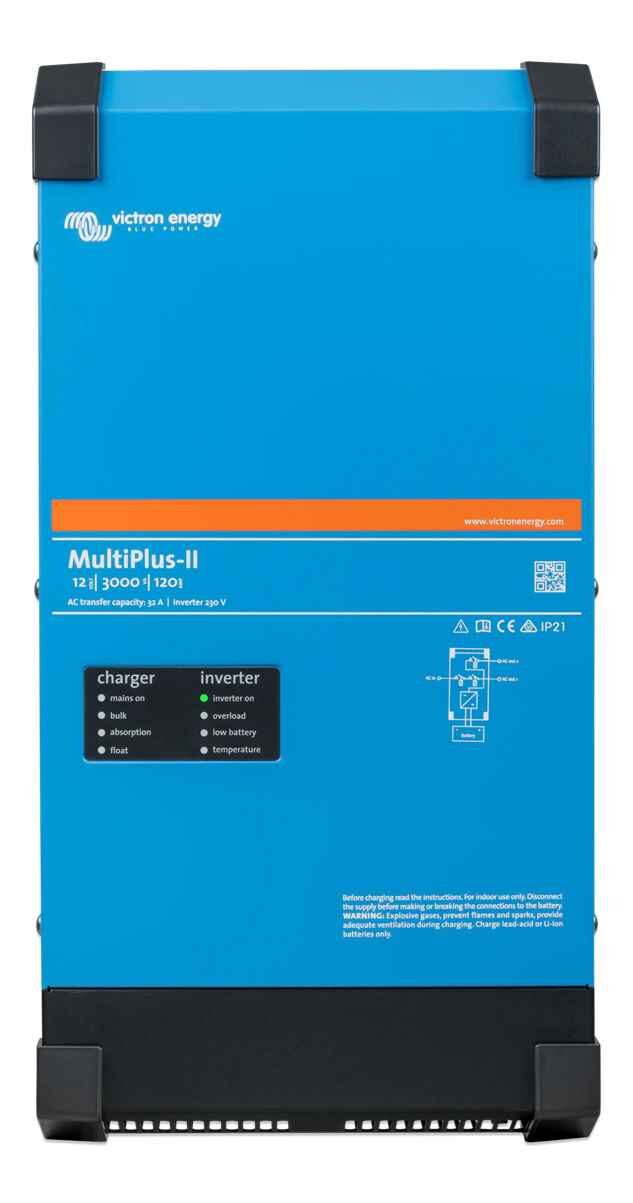
Battery and solar integration: GX devices and AC-PV support
The MultiPlus-II is compatible with both solar charge controllers and grid-tie inverters7. That covers the two ways solar reaches a battery system: DC-coupled through an MPPT charge controller, and AC-coupled through a grid-tie inverter on the AC side. AC-PV inverters are supported directly after installing a software assistant on the inverter, and Victron reports strong collaboration with Fronius PV inverters6.
GX devices are the integration point. They list compatibility with CAN-bus BMS batteries from many brands, and with Fronius, SMA, ABB/FIMER and SolarEdge PV inverters, with details in the linked documentation19. Victron states managed batteries can be integrated through its GX devices in minutes6. The MultiPlus-II GX range carries a BMS-Can interface, USB port, Ethernet port and VE.Direct port, and the BMS-Can interface is the one used to connect a compatible CAN-bus managed battery2.
Where a single enclosure is wanted, the EasySolar-II GX combines an MPPT solar charge controller, inverter/charger and control hub with display in one unit20. It integrates a MultiPlus-II inverter/charger, a SmartSolar MPPT-Tr solar charge controller and a GX device with a 2 x 16 character display21. The DC output of the SmartSolar MPPT is parallel wired with the DC connection of the MultiPlus-II, and the on/off mechanism of the MultiPlus-II also controls the SmartSolar MPPT20. Battery connection is via two M8 studs and PV connection via two M6 studs20.
The VE.Bus BMS V2 adds the ability to disable VE.Direct and VE.Can solar chargers via a GX device, and allows control of the VE.Bus inverter/charger from multiple devices such as the Digital Multi Control, the VE.Bus Smart dongle or a GX device22. The VE.Bus Smart Dongle itself works with Multis, MultiPlusses, MultiPlus-II, Quattros and Phoenix inverters that have a VE.Bus port23.
Victron Energy: a Dutch family-run maker with over 50 years' experience
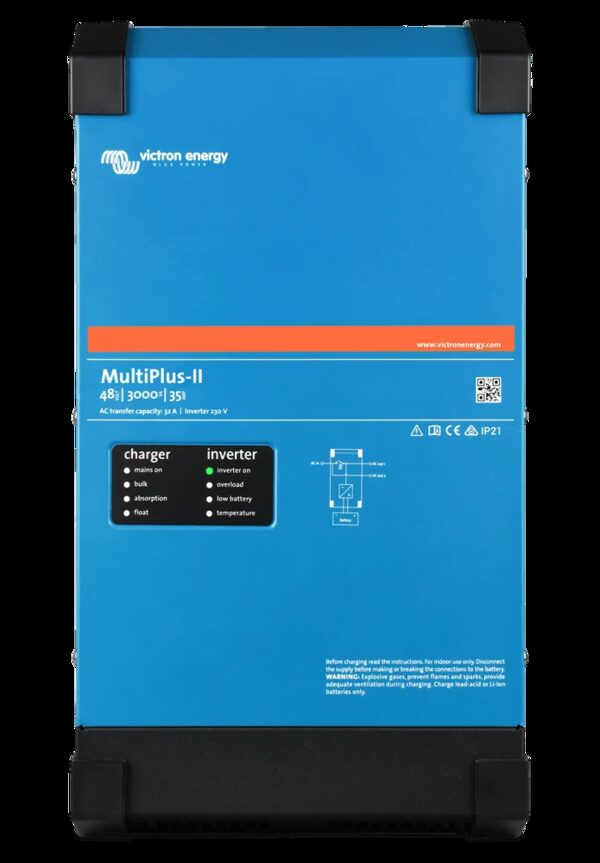
Victron Energy is a Dutch company, based in the Netherlands with representatives all over the world24. It describes itself as a family run business with over 50 years of experience6, and elsewhere as having over 45 years of experience25. The two figures appear in different maker documents and are not reconciled; both are the maker's own statements. The company was founded in 197526.
The manufacturer named on the declarations is Victron Energy B.V.16, and the same entity appears as manufacturer on a UK PSTI statement of compliance27. The company began in the marine industry and now supplies marine, automotive, telecom, home and industrial applications both on and off grid24. It has been supplying off-grid and on-grid battery storage systems for automotive, marine and industrial use for over 50 years28.
For a household, the maker's longevity matters for one reason: spares, firmware and documentation. Victron publishes its own datasheets, certificates and a public wiki, and the MultiPlus-II is described as the key component in a Victron Energy Storage System1. That is a maker claim about its own product, but it is consistent with the way the range is documented and supported.
The dependence that remains is on the maker's continued support and on the distributor network. Victron offers full technical support in the UK28, but the route to it normally runs through the seller or installer. A household buying into the platform is buying into a Dutch manufacturer's firmware and app ecosystem as well as a box on the wall.
Buying and owning one in the UK
UK stock is held by specialist distributors. One lists 8 MultiPlus-II models available from £485.60, and 3 MultiPlus-II GX models from £552.764. The same distributor lists the MultiPlus-II GX from £552.76 and the MultiPlus-II from £485.60 on separate pages29. A Victron current transformer for the MultiPlus-II is listed from £20.1712. These are distributor prices and the VAT position varies between listings, so the figure to compare is the one on the page being ordered from.
Prices for individual models are not consistently published. Distributor listings for the same model have shown different figures on different dates, and those conflicts are unresolved, so no single model price should be treated as settled. Where a model price is not published, it is installer-quoted.
| Item | UK listing |
|---|---|
| MultiPlus-II | 8 models available, from £485.604 |
| MultiPlus-II GX | 3 models available, from £552.764 |
| Current transformer | from £20.1712 |
| Warranty | 5 years standard30 |
The warranty is 5 years as standard across the family, including the MultiPlus 3000 VA to 5000 VA and the Quattro II10. Victron states the standard 5 year warranty is upgradable to 10 years by an additional 10% of the initial investment25. That is a maker term and the calculation is on the initial investment, so the cost scales with the equipment bought.
Country of manufacture for the MultiPlus-II is listed as India18. The units carry G98 and G99 certification for the United Kingdom on the 48/3000 to 48/10000 models only3, and the MultiPlus-II has built in anti-islanding functionality31. The MultiPlus-II GX carries G98 and G99 certification for use in the UK on 48 V models only13.
For a household, the independence this buys is real but partial. A MultiPlus-II with a battery can run essential circuits through a cut and can shift solar generation to evening use. It does not remove the grid, the distributor, the installer or the maker's firmware from the picture. For the wider context of what backup equipment does and does not cover, see backup power for UK homes and inverters and inverter-chargers.
Sources31 cited
- MultiPlus-II inverter-charger range, Victron Energy, 2026-09-17
- Self-consumption and energy storage brochure, Victron Energy, 2026-02
- Victron ESS package collection, Wind and Sun, 2026-09-20
- Victron inverters collection, Wind and Sun, 2026-09-20
- MultiPlus-II inverter-charger datasheet, 4k to 10k, Victron Energy, 2026-09-17
- MultiPlus-II inverter-charger datasheet, Victron Energy, 2026-09-17
- MultiPlus-II inverter-charger datasheet, 230 V, Victron Energy, 2026-09-17
- MultiPlus-II 120 V datasheet, Victron Energy, 2026-09-17
- Off-grid battery inverter chargers, Wind and Sun, 2026-09-20
- Victron MultiPlus inverter-charger 2000VA, Wind and Sun, 2026-09-20
- MultiPlus 48V 20k datasheet, Victron Energy, 2026-09-17
- Victron MultiPlus-II, Wind and Sun, 2026-09-20
- MultiPlus-II GX 4k5 and 6k5 datasheet, Victron Energy, 2026-09-17
- G99 NI certificate, MultiPlus-II three-phase, Victron Energy
- Victron MultiPlus 3000VA to 5000VA, Wind and Sun, 2026-09-20
- IEC 60335 certificate, MultiPlus-II GX 4k5 and 6k5, Victron Energy, 2025-11-12
- IEC 62477 certificate, MultiPlus-II 48V 8kVA to 15kVA, Victron Energy
- MultiPlus-II 8k, 10k and 15k datasheet, Victron Energy, 2026-09-17
- Venus OS documentation, Victron Energy, 2025-10-15
- Victron EasySolar-II GX, Wind and Sun, 2026-09-20
- EasySolar-II 48V 4k5 and 6k5 GX datasheet, Victron Energy, 2026-09-17
- Victron VE.Bus BMS V2, Wind and Sun, 2026-09-20
- Victron VE.Bus Smart Dongle, Wind and Sun, 2026-09-20
- Victron Energy distributor page, Wind and Sun, 2026-09-20
- Off-grid market page, Victron Energy, 2026
- Victron and Dyness compatibility, Dyness, 2024-09-19
- UK PSTI statement of compliance, smallBMS NG, Victron Energy, 2025-04-11
- Victron storage economics, Spirit Energy, 2026
- Victron MultiPlus-II GX, Wind and Sun, 2026-09-20
- Victron Quattro II, Wind and Sun, 2026-09-20
- On-grid battery storage inverters, Wind and Sun, 2026-09-20
 SMETS1 and SMETS2 MetersIs your smart meter an old first generation model or a newer one, and does it matter?
 The Full Boilers and Heating GuideWhich boiler suits your home, and when is it worth swapping the old one?
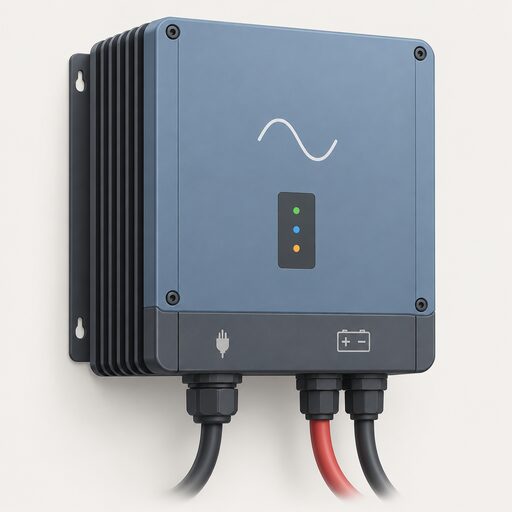 Inverters and Inverter-ChargersIf the power goes off, what actually keeps your fridge and boiler running?
 Controls, Thermostats and TRVsWhich heating controls actually cut your bills, and what does each one do?
 Boiler SizingWhat size boiler does your home actually need, and does the number of bedrooms or radiators decide it?
 Double GlazingMisted up panes, noisy streets, rooms that never feel warm: is new double glazing worth the money, and how much could it cut your bills?