
In this answer
Short answer
The short answer is that it depends on the supplier, not on the car. Some EV tariffs are written for battery electric vehicles and exclude plug-in hybrids; others accept them, and a third group sidesteps the question entirely by crediting charging rather than replacing the household tariff. The eligibility test that recurs across the market is a smart meter and an EV charger, not the size of the battery1.
That matters because a plug-in hybrid is a different proposition from a full EV. Most PHEVs carry batteries of roughly 8kWh to 15kWh, far smaller than a full electric car, so the cheap overnight window fills the battery quickly and the rest of the night's cheap electricity goes to the house or nowhere2. A PHEV also charges slowly: it can use slow and fast public charging points, but most are unable to use the growing network of rapid and ultra-rapid chargers3.
So the question is really two questions. Does the tariff accept the vehicle, and does the household's pattern of electricity use make the cheap window worth having? The first is a matter of contract terms. The second is arithmetic the household can do from its own half-hourly data.
What an EV tariff is, and why it is aimed at plug-in cars
An EV tariff is a time-of-use product built around the fact that a car sits parked for long stretches. They are typically two-rate tariffs, where it is cheaper to use energy at night, so electric vehicles can be charged more cheaply overnight4. The Energy Saving Trust describes the same shape: cheaper overnight electricity on a two-rate tariff, so the cheap power can also be used for other appliances7.
The design intent is load shifting. Home EV drivers get the benefit of accessing lower tariffs at times when demand for electricity is lower, which is useful to the grid as well as the bill6. The tariffs are described as designed to support the charging of electric vehicles, and the intended users are EV drivers8.
Two structures exist. A two-rate tariff gives a cheap window across the whole house, usually overnight. An add-on gives a discount tied to charging alone. The Energy Ombudsman sets out the add-on model plainly: consumers keep their existing household tariff but receive separate EV charging discounts, credits or other benefits1. The distinction matters for a PHEV owner, because a small battery draws little power and an add-on may capture more of the benefit than a whole-house two-rate tariff whose cheap hours go largely unused.
There is a third consideration: an EV tariff usually applies the lower rate only to EV charging, not to the rest of the home's electricity use, which is the opposite of the traditional two-rate model2. Which structure suits a household depends on whether the cheap hours can be filled by something other than the car.
Which tariffs accept a PHEV: the eligibility rules
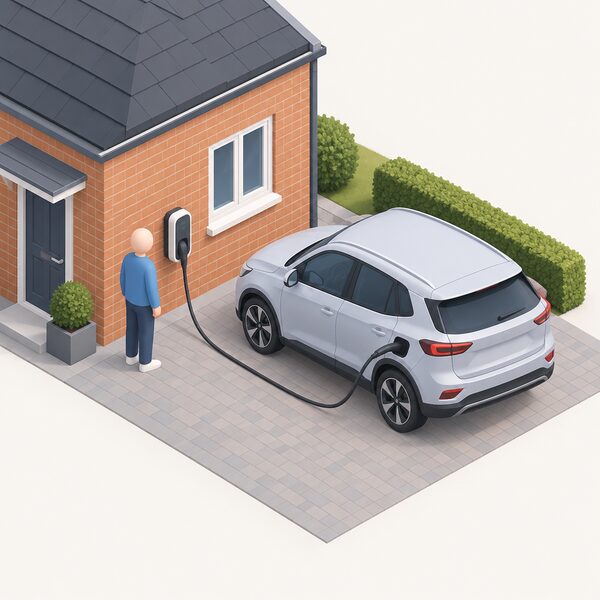
Eligibility is set supplier by supplier, and the published conditions are mostly about equipment and payment rather than the car. Most electric vehicle tariffs require a smart meter, as well as an EV charger1. Some tariffs are only available if certain equipment is installed, such as an EV charger or solar panels8. The Energy Saving Trust frames the same point from the household side: an EV, heat pump or home battery makes smart tariffs much more valuable9.
Payment conditions are common and easy to miss. The bill must be collected by monthly direct debit, and EV tariffs are not available for those on prepayment meters5. The vehicle requirement in the same guidance is stated as owning or leasing an EV5.
Where a plug-in hybrid sits inside those rules varies. The government's own grant scheme for domestic charge points accepts some plug-in hybrid electric vehicles, with the eligible models listed by OZEV, which shows that PHEVs are not excluded from EV infrastructure support as a category10. The same logic does not automatically carry into supply tariffs, which are commercial products with their own terms.
The wider policy direction keeps plug-in hybrids in the picture for longer than battery cars alone. The government will permit the sale of Hybrid Electric Vehicles and Plug in Hybrid Electric Vehicles alongside zero emission vehicles across the 2030 to 2035 period11. That means the PHEV population, and the question of which tariff suits it, will persist through the 2030s.
Used-market demand has moved the other way recently: plug-in hybrid transactions fell by 8.9% to 20,021 units in the first quarter of 202612. The installed base is still substantial, and every one of those cars raises the same tariff question.
When a PHEV owner is better off on a standard tariff
The case for a dedicated EV tariff rests on how much electricity the car actually draws, and a plug-in hybrid draws less than a full EV by design. Most PHEVs have smaller batteries than full EVs, usually between 8kWh and 15kWh2. A cheap window of several hours will fill that pack well before the window closes, so the household is buying cheap electricity it may not use unless something else can absorb it.
Driving behaviour decides the rest. PHEVs typically offer at least two driving modes, including a zero-emission mode that forces the vehicle to run on electricity where charge allows3. A household that plugs in nightly and covers most local journeys electrically will use the cheap window consistently. A household that rarely plugs in will not, and the standing charge and any premium on daytime rates then work against it.
Cost estimates for plug-in hybrids often assume mixed running. The journey cost calculator used by Zapmap estimates fuel cost on the assumption that the vehicle is driven for half the distance in electric-only mode and half using a conventional fuel13. That is an assumption about typical use, not a prediction for any one household, and it illustrates why the value of an EV tariff varies so widely across PHEV owners.
"The fuel cost is estimated using the assumption that the vehicle is driven for half the distance in electric-only mode and half using a conventional fuel."
A standard tariff with no time-of-use structure is simpler and carries no exit risk. Where a household's electricity use is dominated by daytime cooking, heating and appliances, and the car is charged irregularly, the cheap window has little to work on. The Energy Saving Trust's guidance on renewable technology tariffs makes the general point that a cheap overnight period exists for charging an electric vehicle, which is a benefit only if charging happens in it14.
How to check a tariff's terms before switching
The terms that decide whether a PHEV works on a given tariff are in the contract, not the marketing. Before changing, make sure you understand any exit fees, fixed-term conditions or other charges that might apply15. The same caution appears in switching guidance: be aware of any exit fees you may have to pay when switching16.
The comparison itself needs a short list of facts to hand: the name of the current supplier and current tariff, spend on electricity and gas in the past year, current and preferred payment method, and postcode17. The factors worth weighing between deals are unit rates and standing charges, whether prices are fixed or can change, the length of any fixed-term contract, payment methods available, customer service and support, and additional benefits or incentives18.
For time-of-use products specifically, the contract terms to check are early termination fees, contract duration, and penalties for switching tariffs or suppliers8. A fixed-rate deal is generally worth considering where it is no more than 40% more expensive than the current price cap, which is a threshold rather than a recommendation19.
Switching itself is undramatic. Switching to any energy tariff is simple, will not cause power outages and typically takes just a few days20. As more suppliers make their EV tariffs available for comparison, the easier it becomes to find the one that matches a household's needs20.
Northern Ireland: a different market

Domestic electricity in Northern Ireland is not sold under the same arrangements as in Great Britain. Energy prices were not capped in Northern Ireland and energy suppliers have the flexibility to set their tariffs independently to reflect their costs of operating6. That means the EV tariff landscape there is set by suppliers without the price cap framework that shapes the rest of the UK market.
Home charging is still the cheap option. Official guidance states that in Northern Ireland, home charging is the least expensive way to charge an electric vehicle because lower home electricity tariffs can be used21. Qualifying supplies of electricity in Northern Ireland remain liable to VAT at the reduced rate of 5%22.
Support has taken a different form. All households in Northern Ireland received a one-off £600 payment to help with energy bills in winter 2022/23, made up of the £400 Energy Bills Support Scheme plus the £200 Alternative Fuel Payment23. The Energy Price Guarantee discount for Northern Ireland in the fourth quarter of 2022 was reported as up to 19.9 p/kWh for electricity and 4.8 p/kWh for gas, and separately as up to 13.6 p/kWh for electricity and 3.9 p/kWh for gas; the two figures are both in circulation and do not agree23.
Public charging density is lower than in Great Britain. Northern Ireland had 60.0 total EV chargers per 100,000 population as of 1 July 202624. For a plug-in hybrid, which can use slow and fast public points but generally not rapid ones, that density is a practical consideration alongside any tariff decision3.
Where a PHEV on an EV tariff falls short
The limits are worth stating as firmly as the benefits. A plug-in hybrid's battery is small, so the cheap window is underused unless the household has other flexible load such as a heat pump, a home battery or appliances that can be timed. The tariff structure itself may apply the cheap rate only to charging, leaving the rest of the house on standard rates2.
Dependence remains in several directions. The household still relies on the grid and on a supplier, and the cheap window exists because the supplier chooses to offer it, not because the household controls it. A smart meter is a prerequisite, which ties the tariff to a device the supplier can read remotely1. Some tariffs are tied to particular equipment, which ties the household to a charger or solar installation as well8.
For a PHEV owner, the honest position is that an EV tariff can work well where the car is charged most nights and the cheap hours are filled, and can be a poor fit where the car is mostly run on petrol and the household's electricity use is concentrated in the day. The eligibility rules are the first filter; the household's own half-hourly consumption pattern is the second.
Sources24 cited
- EV tariffs and home charging: what consumers need to know, Energy Ombudsman, 2026-09-11
- Does a hybrid car need an EV tariff?, Uswitch, 2025-07-02
- EV basics, Zapmap, 2024-05-14
- Understanding energy flexibility, Smart Energy GB, 2026-08-17
- Electric cars and energy bills, Uswitch, 2026-04-27
- Energy Price Guarantee up until 30 June 2023, GOV.UK, 2026-09-17
- Time of use tariffs explained, Which?, 2026-04-23
- Time of use tariffs: all you need to know, Energy Saving Trust, 2026-05-20
- Should I switch to a time of use tariff?, Energy Saving Trust, 2026-01-23
- Domestic charge point funding, Energy Saving Trust, 2026-08-27
- Phasing out sales of new petrol and diesel cars from 2030, GOV.UK, 2025-04-07
- EVs charge up used car market with record sales, SMMT, 2026-05-12
- Journey cost calculator: calculator details, Zapmap, 2026
- Tariffs for renewable technology, Energy Saving Trust, 2026-08-12
- How to check your energy tariff and switch if you find a better deal, British Gas Energy Trust, 2026-08-11
- The average gas and electric bills in the UK, Energy Helpline, 2026-09-20
- Getting the best energy deal, Age UK, 2026-09-10
- Energy savings tips, British Gas Energy Trust, 2026-02-27
- Agile Streets: future flexible charging report, Energy Saving Trust, 2025-10-03
- EV energy tariffs, Uswitch, 2025-09-17
- Electric vehicles, nidirect, 2026-09-17
- VAT on fuel and power (Notice 701/19), GOV.UK, 2026-10-01
- Energy bills support, British Gas Energy Trust, 2026-08-28
- Public electric vehicle charging infrastructure statistics, 1 July 2026, GOV.UK, 2026-07-01
 EV Tariffs and Home ChargingHow EV-specific import tariffs and charging bolt-ons work, including supplier-controlled charging where the energy company decides when the car draws power, which charge points each scheme supports, and what a household needs in place.
 Electric Vehicle TariffsCharging an electric car at home can cost far less overnight, but only on special electricity plans.
 Charging by Home TypeHow the practical and legal position for home EV charging changes by property type: flats and leasehold consent, terraced homes without frontage, shared car parks and metering, rural properties with long cable runs, and listed or conservation area homes.
 EV Charging Bolt-OnsCan you get cheap electricity for your car without changing the tariff for the rest of your home?
 Home Charger InstallationWho can fit a home EV charger, and does it need building regulations approval?
 Batteries and Smart TariffsA home battery can earn its keep if your electricity prices change through the day.