
In this answer
Short answer
A home EV chargepoint is fixed wiring, not an appliance, and the electrical industry's position is that it should be installed by a registered electrician with experience of this type of work1. The charger must be wired in line with the current edition of BS 7671, the national standard for electrical installations, and building regulations approval is always required when one is fitted2. So the honest answer to whether a householder can install one themselves is that the physical fitting is a job for a qualified person, and the parts of the job a householder can genuinely own are the decisions: where the charger goes, which parking and planning route applies, and which grant the property qualifies for.
That does not make the question pointless. Some makers sell chargers on the basis that the buyer arranges their own installation, and the choice of who does the work sits with the household. What does not move is the standard the circuit has to meet, the notification to building control, and the network operator's interest in a new load on the supply.
Can you install an EV charger yourself? What makers and installers say
The published guidance is consistent across the bodies that write the rules and the companies that sell the hardware. The Planning Portal recommends using a reputable company and ensuring the installer has the relevant qualifications3. NICEIC, the certification body, states that EV chargers should be installed by a registered electrician with experience in this type of installation1. On the maker side, Fuse Energy puts it flatly: professional installation by a qualified electrician is mandatory for home EV chargers7. Power NI says the work must be carried out by a qualified electrician, ideally someone experienced with EV charging systems8.
The reason is not commercial protectionism. A chargepoint draws a sustained load, often for hours overnight, and it sits on a circuit that has to be designed, protected and tested. Guidance for installers sets out two requirements that a householder cannot self-certify: competence in the IET Code of Practice for Electric Vehicle Charging, and registration with a competent person scheme for Part P self-certification9. That second point is the practical hinge. Electricians registered on a Competent Person Scheme such as NICEIC's are deemed competent to self-certify their own work, which saves householders time and money by removing the need to notify and pay for a separate building control visit2.
For a household, this is the first place where energy independence meets a hard limit. The charger is yours, on your wall, on your supply, but the legal route to energising it runs through a registered person. What you gain is control of when and how the car charges; what remains is a dependency on a qualified trade and on the certification system that backs their work.
Why a qualified electrician is the usual requirement
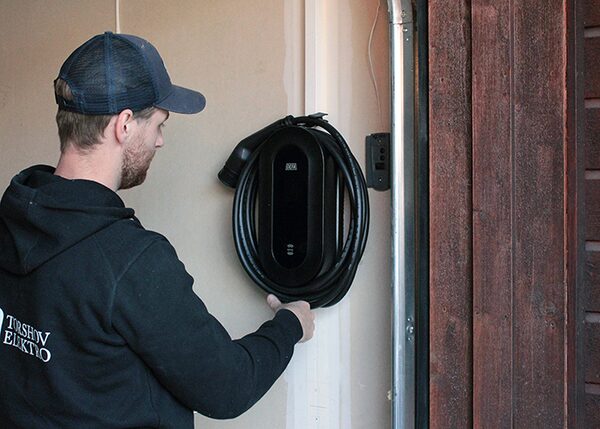
The requirement has three layers, and they are worth separating because they explain why self-installation is not simply discouraged but structurally difficult.
The first is the wiring standard. Your EV charger must be installed in line with the current edition of BS 76712. That standard governs cable sizing, protective devices, earthing and the specific requirements for EV supply that sit in Section 722 of the wiring regulations9.
The second is building regulations. Any work on a home's fixed wiring must comply with UK building regulations, and Part P applies to domestic electrical work10. Building regulations approval is always required when installing an EV home charger, and a competent and reputable installer should be used, with specific processes for notifying the local building control authority3. A registered competent person handles that notification as part of the job.
The third is the supply itself. Before anything is ordered, the network operator's advice is to speak to an electrician or installer first to check whether the home's wiring can support an EV charger11. That check is not a formality. Where a home shares a looped electricity cable with a neighbour, the household needs its own dedicated cable installed before a charger can go ahead12. In that situation the job stops being a wallbox fitting and becomes a connection project.
"EV chargers should be installed by a registered electrician with experience in this type of installation"
Self-installation: where makers allow it and what it takes
There is a real distinction between a maker permitting self-installation and a maker permitting unqualified wiring. Andersen EV lists three routes: independent installation, where the buyer purchases the charger, takes delivery and arranges installation; installation by Andersen EV; and installation through an approved partner13. That first option is the closest thing in the UK market to a self-installation path, and it still ends with a qualified electrician on site.
What the process looks like when a maker's approved installer runs it is set out by Fuse Energy: an approved installer conducts a site survey to determine the best location for the charger, assess the electrical supply, and confirm eligibility for any grants14. A householder arranging their own installation is effectively taking on the coordination of that survey, not the electrical work.
Cost, when it is quoted, depends on the charging station model, the charging speed, and the electrician's fees to install it2. Prices for the hardware and the fitting are installer-quoted, and no published figure covers a specific property.
Off-road parking and other site requirements
Parking determines almost everything else: the planning route, the grant route, and whether a charger is practical at all.
Where a home has its own private off-street parking space, the grant schemes for renters and flat owners are open on that point15. The same condition appears in the scheme rules: you must have private off-street parking16. The planning rules for installing charge points depend on whether the dwelling has off-street parking or on-street parking, so the two cases are treated separately from the start17.
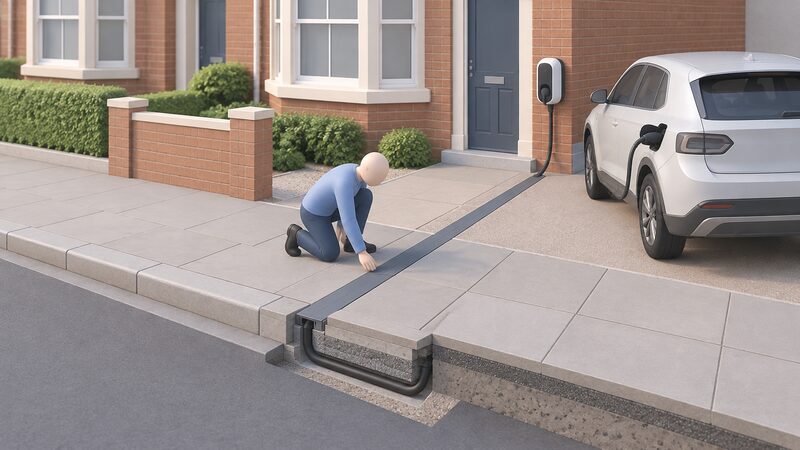
For on-street parking, the charger still has to sit within an acceptable distance of the home18. Where a cable has to cross a pavement, permission from the Highways Authority is required, and separate planning permission may be needed for the pavement crossing solution19. Planning permission is required to install any cross-pavement solution and its associated private EV chargepoint unless a local development order is in place20.
| Site situation | Planning position | Grant position |
|---|---|---|
| Off-street parking at the home | Likely permitted development, no application4 | Renter and flat owner grant requires private off-street parking15 |
| On-street parking only | Permission usually required21 | On-street parking grant requires an OZEV approved installer5 |
| Cross-pavement channel | Highways Authority permission, plus planning permission unless a local development order applies19 | Grant requires a non-temporary cross-pavement solution22 |
| Looped supply shared with a neighbour | Dedicated cable needed before the charger can proceed12 | Not applicable |
Planning permission: when it is and isn't needed
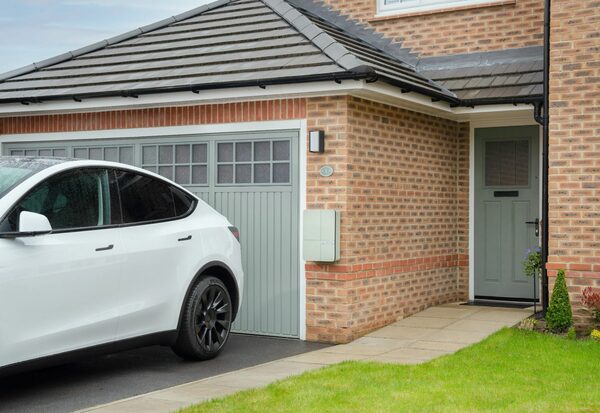
For most homes with a driveway, the answer is that no planning application is needed. The installation of a domestic electric vehicle charger can be achieved using permitted development rights, provided certain limits are met19. The Planning Portal's position is that if a home has off-street parking it is likely the installation of a domestic electric vehicle charger will fall under permitted development rights23. Planning permission is not generally required for installing or replacing electrical circuits24.
The exceptions matter, and they are listed plainly. Planning permission is usually required for on-street parking, conservation areas, listed buildings, areas where the installation is restricted, and more than one upstand per parking space21. Article 4 directions, which remove permitted development rights in a defined area, are among the restrictions that change the answer21.
Building regulations are a separate matter and are not waived by permitted development. Building regulations approval is always required when installing an EV home charger3. That is the point householders most often miss: no planning application does not mean no approval.
Grants and eligibility for the installation
Grant funding exists, but every route carries an installer condition, which is where the self-installation question and the grant question meet.
The Electric Vehicle Chargepoint Grant helps towards the cost of installing an electric vehicle chargepoint socket at a property, and it is aimed at renters and flat owners25. The grant for households with on-street parking requires an OZEV approved installer to complete the installation5, and its eligibility rules require that the chargepoint has not already been installed, that the applicant owns or rents the home they live in, that a non-temporary cross-pavement charging solution is installed alongside the chargepoint, that the household does not have private and exclusive access to off-street parking, that there is adequate on-street parking, that permission has been obtained from the local highways authority, and that the applicant owns or is responsible for an eligible vehicle22.
For landlords, the residential landlord grant requires each parking space to be off-street, private and clearly defined, accessible to the tenant, and owned by the landlord or held under a legal right6. Landlords cannot apply if they live in the property, if the property is not a residential property, if a chargepoint was already installed before OZEV confirmed eligibility, if the property is only used for holiday accommodation, if there is no company or VAT registration number, or if the installation is being made because of a mandatory requirement6. An OZEV-authorised installer and an eligible residential chargepoint must be used6.
In Scotland, Home Energy Scotland offers a grant towards the cost of purchasing and installing a home charge point26, and it also offers grants to help cover the cost of purchasing and installing a charge point27. In Northern Ireland, the chargepoint and infrastructure grants are administered separately28. The Energy Saving Trust notes that the UK Government grant offers up to £350 per socket for residential landlords, people living in flats and people who rent29. Independent reporting describes the groups that often face difficulties installing chargers, such as renters, flat owners, homeowners without driveways, and small businesses30.
Do you need Wi-Fi, and what about solar?
A chargepoint delivers power without any network connection, but the features that make it useful to a household usually depend on one. An EV energy tariff is of little value without a home charger that can be scheduled, because there is no point having an EV tariff if the car cannot actually be charged at home31. That is a dependency worth naming: the smart layer of a charger often runs through the maker's app or cloud service, not through the household's own equipment.
Solar pairing raises the same point in a sharper form. Guidance is that EV chargers should be installed by a qualified electrician with relevant experience, and that compatibility between the charger, the solar system and any battery storage should be considered from the outset32. The sequencing of solar, battery and charger is a design decision made before installation, not something added afterwards. Where a solar and battery system is installed by a supplier, the installation is carried out by that supplier's own team33.
For a household, this is where independence is partial. A charger on your own wall, fed by your own solar, reduces what you buy from a supplier. It does not remove the grid connection, the network operator's interest in the load, or the maker's platform that schedules the charge.
Sources33 cited
- EV charger regulations in England: what's changed, NICEIC, 2026-08-19
- Electric vehicle charger installation and maintenance, NICEIC, 2025-08
- Building regulations for electric vehicle charging, Planning Portal, 2026
- Permitted development for electric vehicle charging, Planning Portal, 2026
- Electric vehicle chargepoint installers, GOV.UK, 2026-09-17
- Electric vehicle chargepoint and infrastructure grants for landlords, Find a Grant, 2026-09-18
- EV charger installation in Carlisle, Fuse Energy, 2026-08-31
- How to charge your electric car at home, Power NI, 2025-08-05
- Section 722 EV charging: complete guide, elec-mate, 2026-07-02
- How much does EV charger installation cost in the UK: 2025 price guide, waEV-charge, 2025-08-12
- Existing electricity supplies, SSEN, 2026-09-19
- EVs and heat pumps, NIE Networks, 2026-09-19
- What type of EV charger is best for me, Andersen EV, 2023-07-17
- EV charger installation in Croydon, Fuse Energy, 2026-08-13
- Electric vehicle chargepoint grant for householders: eligibility, GOV.UK, 2026-09-17
- Electric vehicle chargepoint grants, GOV.UK, 2025-04-08
- Do I need planning permission, Cornwall Council, 2026-09-09
- What's involved in EV charger installation, Good Energy, 2026-01-22
- Electric vehicle chargers, Planning Portal, 2026
- Solar carparks and EV charging: call for evidence, Department for Energy Security and Net Zero, 2025-05
- Planning permission for electric vehicle charging, Planning Portal, 2026
- Electric vehicle chargepoint grant for households with on-street parking, Find a Grant, 2026-09-18
- Smart search: electric vehicle charging, Planning Portal, 2026
- Planning permission for electrics, Planning Portal, 2026-09-17
- Electric vehicle chargepoint grant for householders, GOV.UK, 2026-09-17
- Charging home grant, Home Energy Scotland, 2026-09-18
- Electric cars, Home Energy Scotland, 2026-09-20
- Electric vehicle chargepoint and infrastructure grants, Department for Infrastructure Northern Ireland, 2026-09-18
- Charging electric vehicles, Energy Saving Trust, 2026-04-23
- Electric car charger grants rise to £500, Carwow, 2026-02-25
- EV energy tariffs, Uswitch, 2025-09-17
- Can solar panels charge electric cars, The CPA, 2026-04-15
- Smart Export Guarantee, Solar Energy UK, 2026-05-12
 Home Charger InstallationWho can fit a home EV charger, and does it need building regulations approval?
 Electrical RequirementsWill your home need a bigger electricity supply before a charge point can go in?
 Telling the Network OperatorWho tells the network operator you are having a home EV charger fitted, and when?
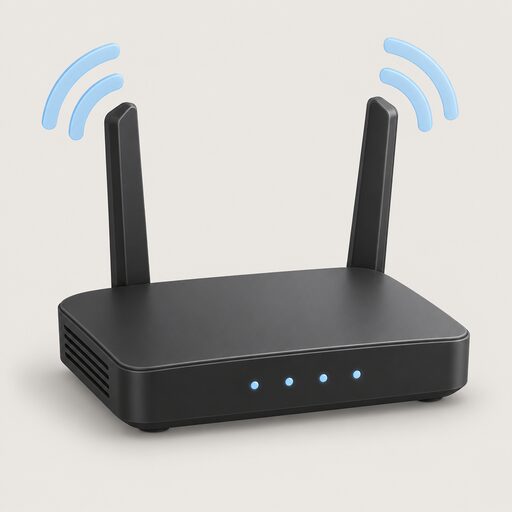 Charger Apps and ConnectivityHow a home charge point connects: Wi-Fi, Ethernet, 4G and Bluetooth, what the app controls, what happens when the network drops, and how much of the charger depends on the maker's cloud.
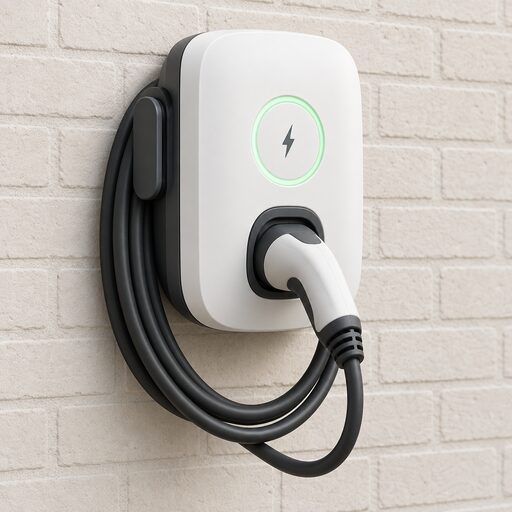 Home EV Charger ManufacturersWhich home EV charger brands are worth considering, and how do you choose between them?
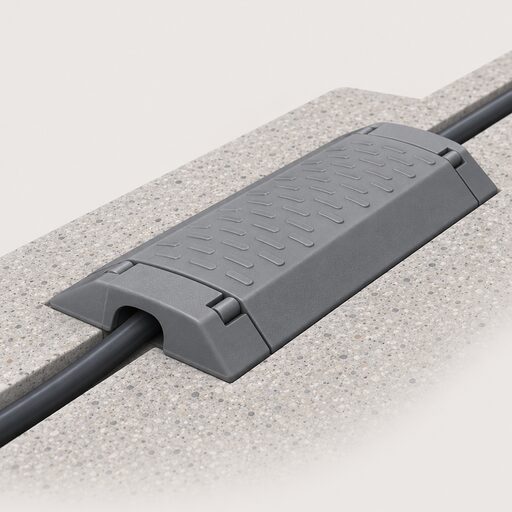 Charging Without a DrivewayParking on the street makes charging an electric car at home tricky.