In this guide
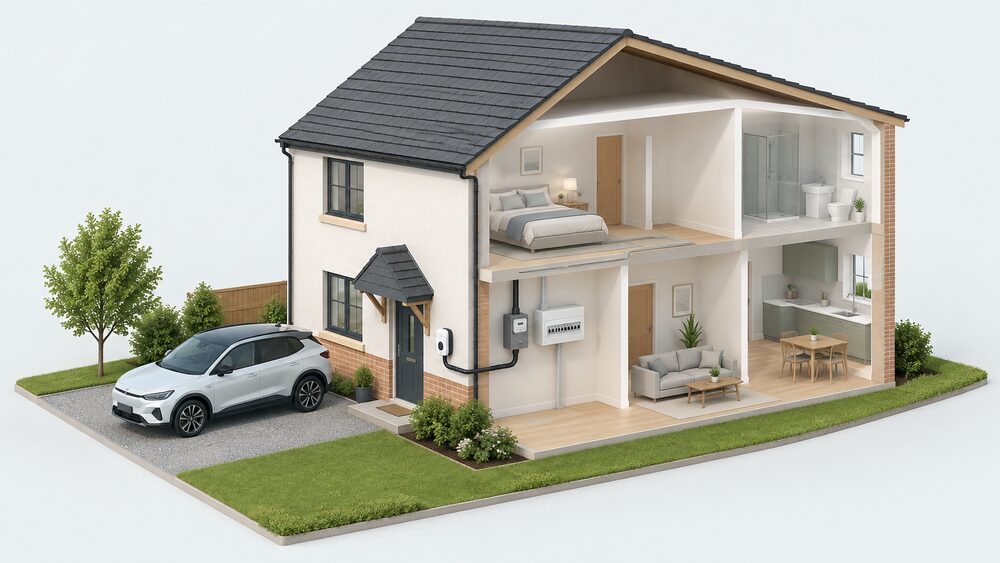
A home electric vehicle charge point is not an appliance that plugs in. It is a new final circuit, and BS 7671 Section 722 sets the requirements for electric vehicle charging installations: each charging point should be supplied by its own dedicated final circuit, and that circuit must be designed as a continuously rated load rather than an intermittent one1. Every EV charging installation must comply with BS 7671, the wiring regulations governing electrical work in the UK2. On the protection side, most local authorities specify a dedicated EV charger with protective earth neutral (PEN) fault protection3, and where the charger has built-in DC fault current detection to 6mA, a Type A 30mA RCD is sufficient1.
The other half of the question is capacity. The charger has to fit inside the house's existing supply. One network operator sets the dividing line at 60 amps: if the total demand of the property is 60 amps or less and there are no safety concerns, the installer does not need to apply in advance, and where the addition is within the existing rating of the supply equipment the network operator can be notified retrospectively within 28 days4. Above that, a load check is required and the installer must wait for permission before installing4. Where a fuse upgrade is needed, that upgrade is typically to 80 to 100 amps, which often cannot be done on a looped supply without overloading the shared cable6.
Finally, the paperwork. Building regulations approval is always required when installing an EV home charger, because the work is deemed notifiable work as it involves creating a new circuit7. An Electrical Installation Certificate must be issued for the circuit itself1.
What a home charge point needs from the supply
Three things have to line up: a circuit of its own, protection appropriate to EV charging, and enough headroom in the service fuse and the network cable feeding the house.
The circuit requirement is the simplest to state and the one most often ignored. Section 722 requires each EV charging point to be supplied by its own dedicated final circuit, sized for a continuously rated load1. That matters because a car draws close to its maximum for hours at a time, unlike a kettle or an oven, so diversity assumptions that work elsewhere in a domestic installation do not apply here.
Earthing is the second element. The IET Code of Practice places on the installer a duty to assess the adequacy of the earthing before installing the charging equipment, as well as the adequacy of supply capacity for the new EV load plus any existing load, and to notify the network operator once the installation is complete9. In practice this is why PEN fault protection has become the default: most local authorities specify a dedicated EV charger with protective earth neutral fault protection3. Where that protection is built into the unit, a separate earth rod is avoided.
Protection against residual current is the third. Where the charge point includes DC fault current detection to 6mA, a Type A 30mA RCD is sufficient for the circuit1. The detail of that pairing is covered on EV charger RCD protection, and surge protection is treated separately.
Domestic units are also subject to a functional requirement beyond the wiring: the Electric Vehicles (Smart Charge Points) Regulations 2021 require domestic EV chargers to be smart, meaning capable of responding to signals to shift charging to off-peak periods1. That duty sits with the equipment, not the circuit, and is set out under the smart charge point regulations.
A 13A plug is not a charging installation

A UK three-pin connector can be used to charge some EVs in an emergency but is far from ideal, lacking the safety and speed of a dedicated charging point10. Zapmap puts the same point in terms of current: slow charging at home can be carried out using a standard 3-pin socket, but because of the higher current demands a dedicated unit is strongly recommended for regular charging11. Energy Networks Association guidance recommends a dedicated EV charge point over a standard household socket (13A) to achieve faster charging speeds12.
Electrical Safety First sets the conditions most directly for slow EV charging:
"Not to be used with an extension lead Dedicated circuit required and ideally an EV rated socket-outlet"
A dedicated circuit is therefore required even for the three-pin route, so the supposed advantage of avoiding an installation largely disappears. EV marked socket-outlets used for charging electric vehicles are subject to additional testing requirements under BS 1363-214, which is the standards system acknowledging that an ordinary socket was not designed for this duty.
Speed compounds the argument. Chargers in the 3kW and 7kW band are suited to overnight charging and will generally take between six and 12 hours to recharge a car from 20 to 80% or above15. A slower three-pin connection stretches that further, which is one reason nationally 49% of EV chargers were rated standard, defined as 3kW to less than 8kW, as at 1 July 202616. The fuller answer is at can I charge an EV from a 3-pin socket.
The standard behind the work: BS 7671 and Section 722
BS 7671, also known as the IET Wiring Regulations, is the UK's national standard for the design, erection and verification of electrical installations8. A charge point must be installed in line with the current edition17, and all EV charging installations must continue to comply with its requirements2. The current edition is BS 7671:2018+A4:2026, published on 15 April 2026 and superseding BS 7671:2018+A2:2022+A3:20248.
Within that standard, Section 722 sets the requirements for electric vehicle charging installations specifically1. It is where the dedicated final circuit, the continuous load design basis and the RCD arrangements for EV charging sit. Installers are expected to hold competence in the IET Code of Practice for Electric Vehicle Charging to carry out this work1.
BS 7671 is not the only document in play. Grant-funded chargepoint installations must be carried out in accordance with BS EN 61851, the IET wiring regulations BS 7671, the IET Code of Practice for Electric Vehicle Charging Equipment Installations, and the Electricity Safety, Quality and Continuity Regulations18. Equipment certification is a separate track again: BSI tests EV chargers against various electrical safety criteria so that products meet legislative, market access, specifier and compliance requirements19. Product approval and installation compliance are distinct, and both are discussed under EV charge point safety, standards and certification.
One point deserves emphasis because it is easy to mistake. Compliance with BS 7671 does not by itself discharge the building regulations duty, and notifying building control does not by itself satisfy BS 7671. They are parallel obligations.
Part P: what is notifiable and who can sign it off

Part P of the Building Regulations applies to electrical installations in or attached to a dwelling operating at voltages not exceeding 1000 V a.c., where dwelling includes houses, maisonettes and flats20. It applies to all electrical work in dwellings, whether carried out by professionals or DIYers20. Most fixed electrical installation work in homes must, by law, meet Part P and have certification to that effect21. All new electrical work in a dwelling must be designed and installed to account for it22.
Notifiable work includes new installations, house re-wires, the installation of new circuits, and additions to existing circuits in special locations such as a room containing a bathtub or shower20. In Wales, notifiable works are explained in Approved Document P Section 0 and include new circuits back to the consumer unit and additions or alterations to existing circuits in kitchens, bathrooms and outdoors23. A charge point falls squarely in scope: the work is deemed notifiable work as it involves creating a new circuit7.
Two compliance routes exist. Either the electrical work is reported to the local authority building control body, or it is carried out by a registered electrician who is a member of a government-approved scheme24. Where the work is not done by a person registered with the competent person scheme, the relevant building control authority must be notified25, and the building control body or registered third-party certifier must be notified before work starts26. NICEIC states that this notification must be given 48 hours in advance of the work starting where the electrician is not on a competent person scheme17.
A Building Regulation Certificate of Compliance under Part P is required for any notifiable electrical job, including changes to a consumer unit, a full rewire, the installation of new circuits, and any addition or alteration to an existing circuit in a special location27. Installing or replacing a consumer unit is itself notifiable in England and Wales28, which matters where a charge point circuit prompts a board change.
The government estimated that around 30 per cent of electrical accidents could be prevented through regulation, and expected bringing electrical work in dwellings under building regulations control to reduce deaths, injuries and fires caused by faults in electrical installations20. Further detail sits on building regulations approval for an EV charger.
Part P covers England and Wales, not Scotland
The territorial split is clean on electrical work. Electricians working in England and Wales must comply with Part P24, whereas in Scotland electrical work falls under the Building Standards system instead31. BS 7671 itself is the UK-wide national standard, so the technical requirements for the circuit do not change at the border; what changes is the building control machinery and the certificate that evidences compliance.
| Nation | Building control route for a charge point circuit |
|---|---|
| England | Part P of the Building Regulations; notifiable work, competent person or building control20 |
| Wales | Part P; notifiable works listed in Approved Document P Section 0 include new circuits back to the consumer unit23 |
| Scotland | Building Standards system rather than Part P31 |
| Northern Ireland | Network operator duties apply through NIE Networks, including load details and IET Code of Practice assessments32 |
Grant eligibility, by contrast, is UK-wide: the residential landlord chargepoint grant requires only that the property is located in England, Wales, Scotland or Northern Ireland34.
Load checks, service fuses and looped supplies
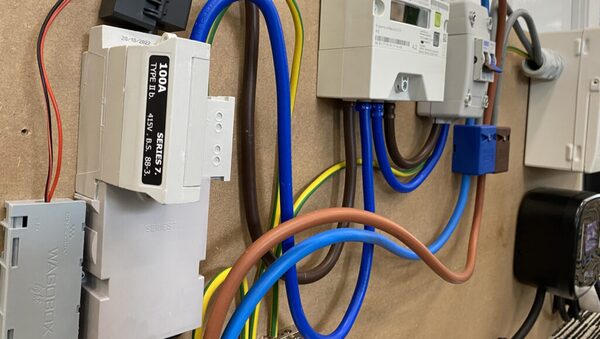
EV chargers and other low-carbon technologies can push a home's electricity demand above the available supply, which may require an upgrade35. That is why the IET Code of Practice requires the installer to assess the adequacy of the supply capacity for the new EV load plus any existing load before installing the charging equipment33.
The operational threshold is set by the network operator. SSEN applies connect and notify where the total demand of the property is 60 amps or less with no safety concerns; where total demand exceeds 60 amps or the installation does not otherwise qualify, a load check is required and the installer must apply and wait for permission before installing the charger4. The Energy Networks Association describes the same principle: where the proposed addition is assessed as within the existing rating of the supply equipment and maximum demand is 60A or less, it can be installed and the network operator notified retrospectively within 28 days5. The IET adds a parallel notification trigger: the ENA must be notified by email within one month of installation where the maximum demand of the whole customer connection is less than 13.8 kVA14.
If the load check shows the supply requires an upgrade, that upgrade must be completed before the EV charger is installed4. Installing a home EV charger typically requires a fuse upgrade to 80 to 100 amps, which often cannot be done on a looped supply without overloading the shared cable6. A looped service, where two properties share one service cable, is therefore one of the more common reasons a straightforward installation turns into a network job.
Practice differs slightly by operator. Electricity North West asks that the installer contact them before a charge point is installed37. NIE Networks requires the electrician to complete the load details section of a supply application, including the make and model of EV chargers, PV panels and heat pumps32. Every time an installer or customer installs an EV charge point at an existing property, the network operator must be informed5. The process is set out at telling the network operator about a home EV charger, and where headroom is the binding constraint, load management and load balancing is the usual alternative to a fuse upgrade.
Households planning more than one charger should also account for physical space: two EV chargers typically need around 1 to 2 square metres of wall depending on the models and installation method38. Three-phase installations are a further step: 22kW chargers are the most expensive and require a three-phase connection39.
New builds: a 7kW socket per parking space
New-build requirements are set separately from the retrofit rules and raise the electrical baseline. In England, Approved Document S provides technical guidance on installation and charge point requirements for electric vehicles under Part S of the Building Regulations40. Requirement S2 provides that where dwellings result from a material change of use, at least one associated parking space for the use of each such dwelling must have access to an electric vehicle charge point, and Requirement S3 applies the same principle to residential buildings undergoing major renovation with more than 10 spaces41. Planning Portal guidance frames the policy direction as requiring all new-build homes to have EV charge points installed7, and the Future Homes Standard is described as meaning every new home needs at least one place to charge an electric car42.
Scottish policy proposals set the output explicitly: all dwellings with a parking space to have at least one EV charge point socket with a minimum 7kW output power rating, and for residential buildings undergoing major renovation, sockets with the same minimum rating in as many residential car parking spaces as post-renovation electrical capacity allows, with a cost cap of 7% of the total major renovation cost43. For non-residential buildings with more than 10 parking spaces, 1 in every 10 spaces is to provide a 7kW socket and 1 in every 2 spaces is to have ducting installed; for existing non-residential buildings with more than 20 spaces the equivalent duty applied by 1 January 202543. On accessibility, the preferred option provides that where a car park has fewer than 4 accessible parking spaces, at least one of those spaces should have access to an EV charge point socket44. Grant-funded chargepoints must also meet the needs of EV owners with disabilities or mobility issues18.
These rules matter to a householder buying a new home because the supply design, ducting and consumer unit capacity are settled by the developer. The nation-by-nation position is set out on EV charge point requirements for new build homes.
What the grant schemes require of the installation
Where public money is involved, the standards tighten into scheme conditions. The Electric Vehicle Chargepoint Grant for households with on-street parking requires an OZEV approved installer to complete the installation45, and the residential landlord grant requires an OZEV-authorised installer and an eligible residential chargepoint34. Chargepoints must be installed on a residential property18. Under the closed Electric Vehicle Homecharge Scheme, the wall charging unit had to be installed by a supplier approved by the Office for Zero Emission Vehicles, who claimed the grant on the householder's behalf39.
Installation must follow BS EN 61851, BS 7671, the IET Code of Practice for Electric Vehicle Charging Equipment Installations and the Electricity Safety, Quality and Continuity Regulations18. Where a cross-pavement solution is involved, the householder was required to install a dedicated EV charger and provide an electrical safety certificate to verify this3. Scheme detail sits on the chargepoint grant for renters and flat owners and the cross-pavement charging grant.
Certification and competence after the work
Two documents come out of a compliant installation. An Electrical Installation Certificate must be issued for the circuit1. A compliance certificate proves the work complies with building regulations7, and the Department for Communities and Local Government made the issue of compliance certificates for most electrical work a legal requirement under Part P29.
On competence, the guidance is unanimous in direction if varied in wording. A charge point should always be fitted by a qualified and certified electrician46; it should be installed by a registered electrician with experience in this type of installation2; householders are advised to use an electrician registered with a recognised certification body17; Planning Portal guidance recommends using a reputable company and ensuring the installer has the relevant qualifications7; and the ENA suggests looking for installers holding certifications from government-approved registering bodies12. Where solar or battery storage is present, compatibility between the charger, solar system and any battery storage should be considered from the outset47. A broken charger should not be repaired by the householder: that is work for a professional electrician with the relevant qualifications and certifications17. The self-install question is handled at can I install an EV home charger myself.
Permissions run alongside certification. Installing a home charger is classified as development, so it is up to the householder to ensure the correct permissions are in place48. Permission is usually required for on-street parking, conservation areas, listed buildings, areas restricted by article 4 directions, and more than one upstand per parking space48. See planning permission for a home EV charge point.
What compliance buys a household in independence
The gain is real but bounded. A dedicated, compliant circuit is what makes overnight charging at 7kW possible, and overnight charging on a domestic supply is the mechanism by which household transport energy shifts from the forecourt to the meter. It is also the precondition for the smart functionality the 2021 regulations require, meaning the charger can respond to signals to shift charging to off-peak periods1, and for pairing with generation, given the compatibility considerations between charger, solar and storage47. Where bidirectional use is contemplated, both the EV and the charger need to be bidirectional charging compatible49, which is not a property of the circuit alone.
The dependencies that remain should be stated as plainly. The supply belongs to the distribution network operator, and the 60A threshold, the load check and the fuse upgrade are its decisions, not the householder's4. A looped service can block the upgrade outright without work on the shared cable6. Building control, whether through Part P in England and Wales or Building Standards in Scotland, holds a veto backed by criminal liability20. The equipment carries its own dependencies on firmware, apps and the manufacturer's continued existence, covered under EV charger apps and connectivity and warranties and aftercare.
What a compliant installation does deliver is a circuit that is documented, certified and known to the network. That is the difference between a household that can add solar, storage or a second charger later and one that discovers at the point of need that its supply was never assessed. The wider picture is drawn on EV charging and household energy independence and across the EV charging guide.
Sources49 cited
- Section 722: EV charging complete guide, Elec-Mate, 2026-07-02
- EV charger regulations in England: what's changed, NICEIC, 2026-08-19
- Cross-pavement charging solutions, Energy Saving Trust, 2025-07-18
- EV connections, SSEN, 2026-09-19
- Frequently asked questions about connecting to the networks, Energy Networks Association, 2026-09-17
- Looped services, NIE Networks, 2026-09-19
- EV charging and building regulations, Planning Portal, 2026-09-17
- BS 7671 Requirements for Electrical Installations, BSI, 2026-04-15
- Frequently asked questions about connecting to the networks, Energy Networks Association, 2026-09-17
- EV glossary, Uswitch, 2024-11-26
- EV buying guide, Zapmap, 2024-12-06
- Low carbon technologies strategy, Energy Networks Association, 2026-09-17
- Ratings of electrical appliances, Electrical Safety First, 2026-09-19
- Electric vehicle charging installations FAQs, IET, 2026-09-17
- How long does it take to charge an electric car, Zapmap, 2026-04-15
- Public electric vehicle charging infrastructure statistics, 1 July 2026, GOV.UK, 2026-07-01
- Electric vehicle charger installation and maintenance, NICEIC, 2025-08
- Electric vehicle chargepoint and infrastructure specifications, GOV.UK, 2023-10-10
- EV charging Kitemark certification, BSI, 2026-09-17
- Part P frequently asked questions, IET, 2026-09-17
- Electrical Part P registration, OFTEC, 2026-09-17
- Building regulations and electrical works, London Borough of Richmond upon Thames, 2026-06-02
- Quick guide to the building regulations, Welsh Government, 2021-12
- Part P of the Building Regulations, Electrical Safety First, 2026-09-17
- Electric vehicle chargers, Planning Portal, 2026
- Electrics: building regulations general information, Planning Portal, 2026
- Householders and landlords help hub, NICEIC, 2026-09-17
- Consumer units and fuse boxes, NICEIC, 2025-09
- House buyer beware: illegal electrics in hundreds of homes, Electrical Safety First, 2026-09-19
- Wiring a shed: a guide for homeowners, NICEIC, 2026-09-17
- Building regulations, Electrical Safety First, 2026-09-17
- What you need to start your application, NIE Networks, 2026-09-19
- EVs and heat pumps FAQs, NIE Networks, 2026-09-19
- Electric vehicle chargepoint and infrastructure grants for landlords, Find a Grant, 2026-09-18
- If your electricity supply can't cope with the new equipment, NIE Networks, 2026-09-19
- Electric vehicles connections, Electricity North West, 2026-09-19
- Electric vehicles for home: charging, Electricity North West, 2026-09-19
- Best EV tariffs for multi-car families, Uswitch, 2025-07-02
- Electric car charging at home, Which?, 2026-02-25
- Approved Document S: infrastructure for charging electric vehicles, Planning Portal, 2021-12
- Approved Document S, GOV.UK, 2021
- Future Homes Standard for your home's future, Low Carbon Hub, 2026-09-01
- EV charge points for new buildings: policy proposals, Transport Scotland, 2026-09-20
- Scottish building regulations: proposed changes to energy standards, Scottish Government, 2021-07-23
- Electric Vehicle Chargepoint Grant for households with on-street parking, Find a Grant, 2026-09-17
- EV charging, Uswitch, 2026-09-19
- Can solar panels charge electric cars, The CPA, 2026-04-15
- EV charging: planning permission, Planning Portal, 2026
- Battery storage, Centre for Sustainable Energy, 2025-10
 Home Charger InstallationWho can fit a home EV charger, and does it need building regulations approval?
 Planning Permission for ChargersDo you need planning permission for a home EV charger, and does it change if you live in a listed building, a conservation area or a flat?
 Telling the Network OperatorWho tells the network operator you are having a home EV charger fitted, and when?
 New Build Charger RequirementsExplains the requirement for charge points and cable routes in new and materially altered homes, set by Part S in England and equivalent rules elsewhere in the UK.
 Home EV Charger CostA home charge point usually costs between seven hundred and fifteen hundred pounds fitted, with most people paying around a thousand.
 The Full EV Charging GuideCharging an electric car at home usually means a wallbox, but do you need one, and what will it cost to fit and run?