In this guide
A home charge point is now a networked computer with a mains cable attached, and the rules treat it that way. In Great Britain, the Electric Vehicles (Smart Charge Points) Regulations 2021 came into force on 30 June 2022 and apply to private charge points sold in Great Britain after that date1. They require smart functionality, minimum security, encrypted communications and secure software updates, and they place the duties on the seller rather than the householder1.
The security requirements sit in Schedule 1 to the regulations and are mostly based on the existing cyber security standard ETSI EN 303 6452. Charge points sold before 30 December 2022 are not required to comply with those Schedule 1 security requirements, so an older unit sits outside the security regime even though the general smart charging duties applied from June 20221.
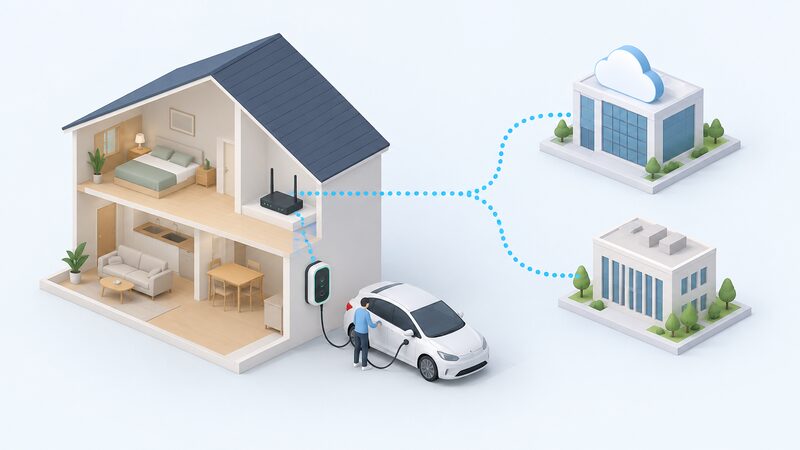
For a household, the practical effect is that a compliant charger keeps working when the internet drops, reports its energy use to within 10%, and can be told remotely to delay or shift a charge2. What it does not do is remove dependence: the charger still needs the grid, still needs a supplier or an aggregator to send the signals, and still depends on the maker's servers and app for remote control.
What cybersecurity rules apply to home EV chargers in Great Britain
Two regimes overlap. The first is electrical. All EV charging installations must continue to comply with BS 7671, the Wiring Regulations governing electrical installations, and in England and Wales an installation must be notified to local authority building control because it involves creating a new circuit3. Mode 3 equipment, the type used for home charging, must also conform to the Electrical Equipment (Safety) Regulations 2016 and the Electromagnetic Compatibility Regulations 2016 as amended4.
The second regime is digital. The Electric Vehicles (Smart Charge Points) Regulations 2021 cover charge points sold in Great Britain only, so Northern Ireland sits outside them2. They apply to the sale of private charge points sold in Great Britain after 30 June 2022, and they require all new domestic and business charge points to include smart functionality to support off-peak, lower-cost charging2. The regulations are a legal requirement rather than optional guidance: domestic EV chargers must be capable of responding to signals to shift charging to off-peak periods5.
The Building Regulations 2010 also carry a minimum standard for an electric vehicle charge point under regulation 44J, which is the hook for the new build requirements in Approved Document S6. Those requirements are about provision and cable routes rather than cybersecurity, but they matter here because they determine which chargers exist in which buildings and therefore which units fall under the smart charge point rules.
The dividing line for a householder is simple. If the charger was sold in Great Britain after 30 June 2022, the smart functionality duties apply. If it was sold before 30 December 2022, the security duties in Schedule 1 do not1. Everything else, including the electrical standards, applies regardless of when it was bought.
| Regime | What it covers | Applies from | Territorial extent |
|---|---|---|---|
| BS 7671 and building control notification | Electrical installation, new circuit | Always | England and Wales for notification3 |
| Electrical Equipment (Safety) Regulations 2016 | Mode 3 charging equipment | Always | Great Britain4 |
| Smart Charge Points Regulations 2021, smart functionality | Off-peak shifting, randomised delay | 30 June 20221 | Great Britain only2 |
| Smart Charge Points Regulations 2021, Schedule 1 security | Encryption, secure updates | 30 December 20221 | Great Britain only2 |
The Electric Vehicles (Smart Charge Points) Regulations: what they require
The regulations do three things at once: they mandate smart functionality, they mandate a minimum security baseline, and they set rules about how the device behaves on the network. Those selling a charge point must ensure it meets the security requirements set out in Schedule 1, which are mostly based on ETSI EN 303 6452. The NICEIC summarises the same duty as a requirement that charge points meet minimum security requirements in addition to the smart functionality rules3.
The smart functionality duty is the one most householders notice, because it changes when the car charges. The security duty is the one they rarely see, because it operates in the background: encryption, authentication, update integrity and tamper resistance. The regulations also include a safety override. Regulation 8 requires that a relevant charge point must not follow certain user inputs where this would create a safety risk1. In other words, a remote or app command cannot be allowed to override a safety condition.
There is a separate consumer connectable product security regime that applies to a range of smart products, and charge points for electric vehicles are not covered by it7. That exclusion matters: it means the EV-specific regulations are the operative security rules for chargers, rather than the general consumer product regime.
Security requirements: passwords, encryption, tamper protection and security logs
The Schedule 1 requirements are technical, and the legislation states them directly. Communications sent from the charge point must be encrypted1. The charge point must incorporate software which is able to be securely updated, using adequate cryptographic measures with verification of authenticity and integrity1. Those two duties cover the two most common failure modes in connected devices: interception of traffic, and malicious or corrupted firmware.
The BSI Kitemark for Smart EV Chargers tests against a comparable list. Its cybersecurity tests cover security scans, data protection, secure software updates and network security testing, and it verifies that personal data is encrypted and safe from unauthorised access8. The Kitemark scheme is built on the UK Smart Charge Regulations, ETSI EN 303 645 and IEC 61851-18.
Tamper protection and security logging are part of the same family of controls. The regulations' safety override in regulation 8 is a form of tamper resistance in the physical sense: the device must refuse inputs that would create a safety risk1. On the digital side, the requirement that inaccuracies in reported data must not be systematic is a control against a device quietly misreporting what it has done2.
"A relevant charge point must incorporate software which is able to be securely updated."
For a household, these requirements are the difference between a charger that can be patched and one that cannot. A unit that cannot receive verified updates keeps whatever vulnerabilities it shipped with for its whole service life.
Smart functionality: off-peak defaults, randomised delays and offline charging
Smart functionality is not a marketing label. It is a defined behaviour set. A charge point must be configured to operate a default randomised delay of up to 600 seconds, which is 10 minutes, at each charging instance2. The same guidance requires the charger to be capable of remotely increasing that randomised delay up to 1800 seconds, or 30 minutes, in the event this is required in future regulation2. The two figures serve different purposes: the 10 minute default is what happens now, and the 30 minute capability is headroom for later rules.
The reason for the delay is grid management. If every charger on a street started drawing power the moment its owner plugged in, the local network would see a spike. Randomising the start spreads that demand. Some smart chargers go further and automatically power EVs during off-peak hours when electricity costs are lower9.
Offline behaviour is the third pillar. A charge point must be configured such that when it loses communications network connectivity it is still able to charge2. That is a deliberate design requirement, and it means a broadband outage does not strand the car.
Maker implementations vary. Growatt's smart charger, for example, lists PV Linkage mode, Fast mode and Off-Peak Mode as its working modes, alongside protection features including overload, over and under voltage, lightning, over temperature, earth leakage, short circuit, fault current and 6mA DC RCD protection9. Those modes are the maker's own description of its product, not a regulatory requirement, but they show how the mandated off-peak behaviour is presented to owners.
What data your charger collects and who can see it
A smart charge point is a metering device as well as a charging device. It must have the capability to measure or calculate every one second the electrical power it has imported or exported, in watts or kilowatts, and must be capable of providing that information via a communications network2. That is a high-resolution record of when a household draws power and how much.
The accuracy rule is explicit: all information referenced in that sub-section must be accurate to within 10%, and any inaccuracies must not be systematic2. The BSI Kitemark scheme tests energy metering accuracy for billing purposes as part of its smart charging tests, alongside demand management, compatibility and user interface8.
The data does not stay on the device. Charging data feeds into mapping and planning work: one collaborative project gathered information from a range of data sources, including local authorities10. For smart metering more broadly, energy suppliers get accurate and reliable readings automatically over the DCC network, enabling billing only for energy used11. A charger's own metering is separate from the smart meter, but the two sit in the same household data picture.
Who can see charger data depends on the arrangement. The maker's app sees it, any aggregator or flexibility service the household signs up to sees it, and the supplier may see it if the tariff depends on charging behaviour. The regulations require encryption of communications from the charge point, which protects the traffic in transit1, but encryption in transit does not determine who is entitled to the data at the other end.
| Data item | Requirement | Source |
|---|---|---|
| Imported or exported power | Measured or calculated every one second, in watts or kilowatts | 2 |
| Accuracy | Within 10%, and not systematically inaccurate | 2 |
| Provision | Capable of being provided via a communications network | 2 |
| Communications | Encrypted | 1 |
| Metering for billing | Tested under the BSI Kitemark scheme | 8 |
Remote control: how chargers are managed and the role of OCPP
Remote control is the point of a smart charger. The regulations assume a device that can receive signals and act on them, which is why the randomised delay must be remotely extendable to 1800 seconds if future rules require it2. The protocol that carries most of this traffic is OCPP, the Open Charge Point Protocol. Growatt's smart charger, for instance, is described as working with OCPP protocol9.
OCPP is an open application protocol between a charge point and a central management system. Its significance for a household is that it separates the hardware from the back office: a charger speaking OCPP can be managed by a different platform from the one that made it, which is what allows aggregators, suppliers and flexibility services to send commands without the maker being the only route. It is also what allows a charger to be enrolled in a demand response scheme.
The commands that travel this way are start, stop, schedule and rate limits. The safety override in regulation 8 caps them: a relevant charge point must not follow certain user inputs where this would create a safety risk1. So remote control is real but bounded, and the boundary is safety rather than convenience.
There is a documented case of remote restriction in practice. For the Easee One EV Charger Backplate, where a mislabelled unit is confirmed to be incorrectly wired and without external PEN protection, charging is temporarily paused until remediation is completed12. That is a safety-driven remote action rather than a cyber one, but it shows that a connected charger can be stopped by a party other than its owner.
BSI Kitemark certification: what it covers and why it matters
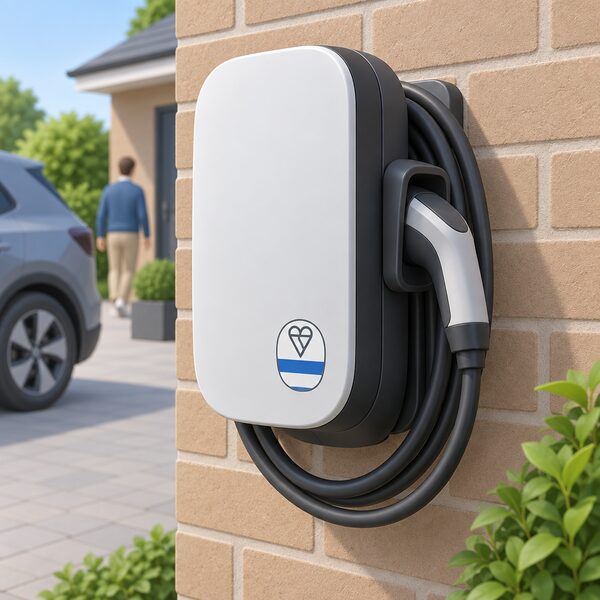
The BSI Kitemark for EV chargers covers two assessment areas: electrical safety and digital smart security13. The electrical safety element can be assessed independently or combined with the digital security assessment criteria13. Testing and certification is offered for charge points both for home and commercial use13.
The digital security certification exists to demonstrate compliance with named instruments. BSI states that its Kitemark Certification for Digital Security of EV Chargers ensures compliance with regulations such as UK Smart Charge Regulation and ETSI EN 303 64513. The scheme supports legislative, market access, specifier and compliance requirements, and tests EV chargers against various electrical safety criteria13.
The Kitemark for Smart EV Chargers is built on UK Smart Charge Regulations, ETSI EN 303 645 and IEC 61851-18. Its cybersecurity tests cover security scans, data protection, secure software updates and network security testing, and its smart charging tests cover demand management, compatibility, user interface and energy metering accuracy for billing purposes8.
For a household, certification is evidence rather than a guarantee. It shows that an independent body has assessed the unit against the same standards the regulations reference, which is useful where a buyer wants to check a claim that a charger is compliant. It does not replace the regulations, and it does not make the charger independent of the maker's cloud.
Which chargers are exempt from the rules
The exemptions fall into two groups: territorial and building-related. The smart charge point regulations cover charge points sold in Great Britain only, so Northern Ireland is outside them2. Charge points for electric vehicles are also excluded from the separate consumer connectable product security regime7.
On the building side, Approved Document S exempts a building with only covered parking spaces from installing charge points, though cable routes must still be provided; charge points installed voluntarily in that situation fall outside section 6 guidance but must still meet other relevant standards including electrical safety14. The underlying legislation is consistent: where all parking spaces are within a covered car park, the requirement to install an electric vehicle charge point does not apply, and cable routes must still be provided for a minimum of one in five parking spaces15.
Planning exemptions are a different matter and are often confused with regulatory exemptions. Home EV chargers, public charging points and business installations fall under permitted development rights in England, with exceptions including listed buildings, conservation areas and world heritage sites3. Usually no planning permission is needed because the installation falls within permitted development rights, with exceptions for listed buildings, conservation areas or cross-pavement solutions16.
What happens if a charger breaches the regulations
Regulation 15 provides for the Secretary of State to enforce the Electric Vehicles (Smart Charge Points) Regulations 2021, and the regulations define enforcement authority as the Secretary of State1. Enforcement therefore sits with central government, not with a local authority or an energy regulator. The regulations set the enforcement route rather than a single published penalty figure.
Adjacent energy obligations show the shape of enforcement in this area. The government has stated that failure to comply with smart meter repair rules could result in the energy regulator putting companies on notice or enforcing fines17. That is a different regime, but it indicates that non-compliance in connected energy devices is treated as an enforcement matter rather than a technicality.
Installation breaches carry their own consequences. Without the correct permissions, enforcement action may be taken against the householder18. In a designated area such as a conservation area, there are increased chances that if an application is accepted there will be conditions attached, affecting the size, appearance and placement of the charger18. Trailing a cable across the pavement without permission is an offence, as it breaches the Highways Act 1980 Section 162 and Section 17819.
Product safety failures are handled separately again. A safety report on the ROMADA New Energy EV Charger and Cable found that improvements were required to the product documentation, markings and instructions20. That is the documentation side of compliance, and it is the part a buyer can check before installation.
What documents must come with a charger when I buy it
The regulations place the security duties on those selling charge points, and the requirements themselves are set out in Schedule 12. Beyond the product itself, an installed charger should be supported by paperwork. A compliance certificate serves the purpose of proving the work complies with building regulations21. Installation must be in line with the current edition of BS 7671, the national standard for electrical installations16.
The grant-funded route adds its own documentation requirements. Chargepoint installations under the electric vehicle chargepoint grant for renters and flat owners must be carried out as per BS EN 61851, the IET wiring regulations BS 7671, the IET Code of Practice for Electric Vehicle Charging Equipment Installations, and the Electricity Safety, Quality and Continuity Regulations22. Those are installation standards rather than product documents, but they are the standards an installer is expected to work to.
Documentation quality is a known weak point. The ROMADA safety report required improvements to product documentation, markings and instructions20. For a household, the practical checklist is the compliance certificate, the installer's notification to building control in England and Wales, and the maker's own security and update documentation.
Do the rules still apply if I switch energy supplier?
Yes. The obligations attach to the charge point and the seller, not to the energy supply contract, so changing supplier does not change them. Ofgem states that a household does not need to do anything if its current supplier goes out of business: it is moved automatically to a new supplier and supply is not interrupted23. The charger's smart functionality and security requirements are unaffected by that change.
Where supplier arrangements do interact with charging is through tariffs and flexibility services. A charger enrolled in a smart tariff or an aggregator's scheme depends on the supplier or platform to send the signals, and that dependency ends when the arrangement ends. The charger itself remains compliant either way.
Where the independence stops
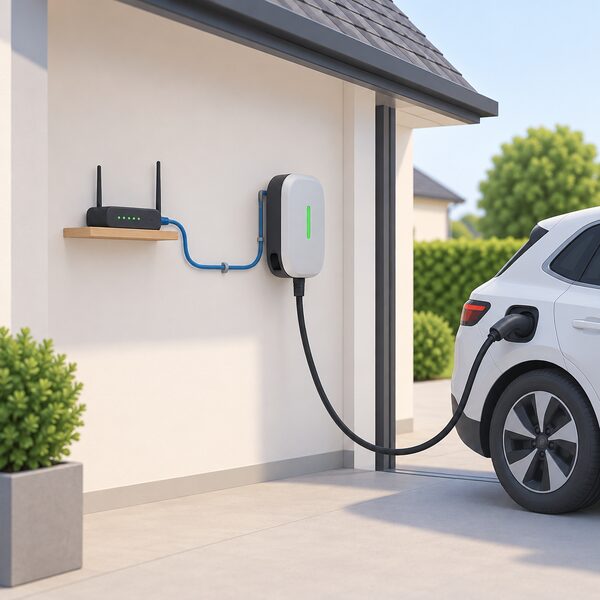
A compliant charger gives a household control over when it draws power, and it gives the grid a way to ask for that timing to shift. That is genuine value: off-peak charging, randomised starts and remote scheduling all reduce cost and load. The security requirements mean the device can be patched, its traffic encrypted and its reported data trusted to within 10%1.
The dependence that remains is structural. The charger needs the grid, and it needs a supplier or platform to send the signals that make smart charging worthwhile. Remote control runs through the maker's servers and the household's network link, and while the charger must still charge when that link fails2, the smart behaviour stops with it. Certification such as the BSI Kitemark is evidence of assessment against the standards, not a transfer of control to the owner13.
For a household weighing energy independence, the honest position is that a smart charger is a managed device on someone else's protocol. It reduces cost and carbon, and it can be stopped or delayed by parties other than the driver, within the safety limits the regulations set1.
Sources23 cited
- The Electric Vehicles (Smart Charge Points) Regulations 2021, legislation.gov.uk, 2021-12-15
- Guide to the Electric Vehicles (Smart Charge Points) Regulations 2021, GOV.UK, 2026-09-18
- EV charger regulations in England: what's changed, NICEIC, 2026-08-19
- RCDs for electric vehicle supply equipment (EVSE), IET, 2024-05
- Section 722 EV charging complete guide, Elec-Mate, 2026-07-02
- The Building Regulations 2010, legislation.gov.uk, 2026-09-17
- Regulations: consumer connectable product security, GOV.UK, 2024-01-08
- What makes BSI Kitemark certified EV chargers a smarter choice, BSI, 2026-09-17
- Smart EV Charger Solution, Growatt, 2026-09-17
- Electric vehicle charge points for new buildings: consultation response, Transport Scotland, 2026-09-20
- How accurate are smart meters?, Smart DCC, 2026
- Product safety report: Easee One EV Charger Backplate, GOV.UK, 2026-05-06
- Powering trust in electric vehicle charging with BSI Kitemark certification, BSI, 2026-09-17
- Approved Document S: infrastructure for charging electric vehicles, frequently asked questions, GOV.UK, 2023-04-17
- Approved Document S, GOV.UK, 2021
- Electric vehicle charger installation and maintenance, NICEIC, 2025-08
- Tough new rules force suppliers to fix faulty smart meters, GOV.UK, 2026-03-10
- Planning permission for electric vehicle charging, Planning Portal, 2026
- Electric vehicle chargers, Planning Portal, 2026
- Product safety report: ROMADA New Energy EV Charger and Cable, GOV.UK, 2026-09-11
- Building regulations for electric vehicle charging, Planning Portal, 2026-09-17
- Electric vehicle chargepoint and infrastructure specifications, GOV.UK, 2023-10-10
- Switch your home energy supplier, Ofgem, 2026
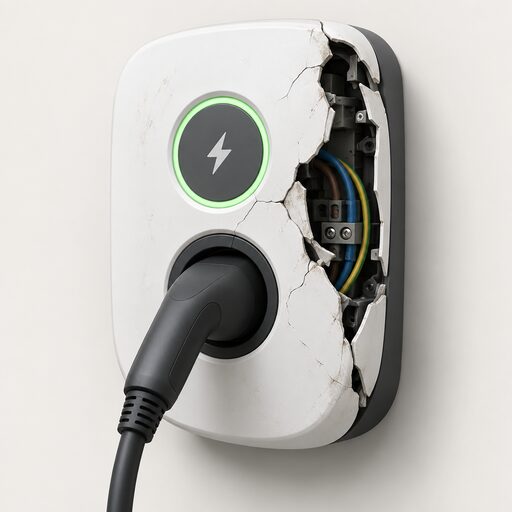 EV Charger Safety and StandardsHow do you know a home charge point is safe to use?
 Charging With a Home BatteryHow a home battery and an EV charger share one supply, whether a battery can usefully charge a car, and how combined systems are controlled so the battery is not discharged into the vehicle at a loss.
 Home Charger InstallationWho can fit a home EV charger, and does it need building regulations approval?
 Telling the Network OperatorWho tells the network operator you are having a home EV charger fitted, and when?
 Charger Apps and ConnectivityHow a home charge point connects: Wi-Fi, Ethernet, 4G and Bluetooth, what the app controls, what happens when the network drops, and how much of the charger depends on the maker's cloud.
 EV Charger WarrantiesCovers typical warranty lengths on UK home charge points, what parts and labour are included, registration conditions and extended warranty options.