In this guide
Vehicle-to-grid charging lets an electric car do something a petrol car never could: give electricity back. Energy Saving Trust states that vehicle-to-grid technology "allows an electric vehicle (EV) charger to not only charge a vehicle, but also take energy from the vehicle"1. The Climate Change Committee's framing is broader still: V2X "allows for electric vehicles to operate bidirectionally, charging from the electricity grid but also discharging to the grid, building or home as needed"2.
The money is real but modest at household scale. Average UK revenue generation from V2G is estimated at £150 to £200 per year, while the largest domestic trial found customers could earn up to £725 a year where chargers provided grid services3. The gap between those two figures is the whole story of this page: what a car earns depends on the tariff, the grid services stacked on top, and whether the household has solar.
The equipment is the barrier. A V2G chargepoint needs a bidirectional unit and a car that supports it, and V2G remains not widely available, with eligibility resting on a compatible car, charger and smart meter5. The premium over a smart charger has been around £3,7004. This page sets out what the technology does, what the trials found, what it costs, and what it means for a household's energy independence.
What V2G, V2H, V2B and V2L each do
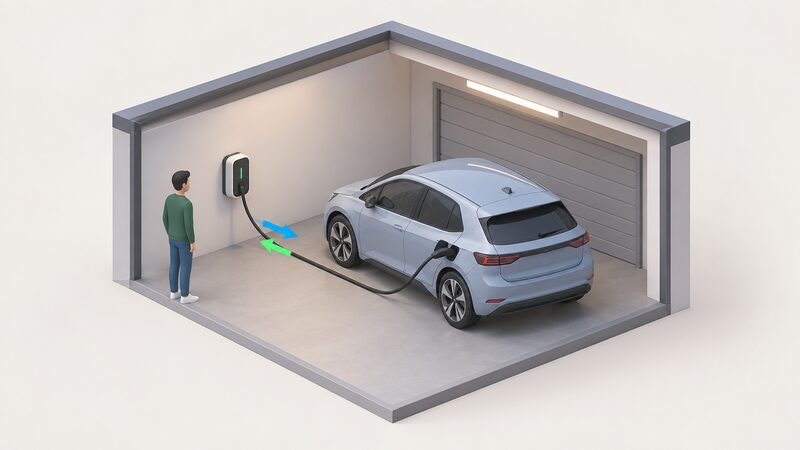
The terms are often used interchangeably, and they are not the same thing. The distinction is where the electricity goes once it leaves the car battery.
- Vehicle-to-grid (V2G) exports electricity from the car back to the grid. It is the version that earns money through grid services and demand shifting, and it is the one that needs a bidirectional chargepoint and a compatible vehicle6.
- Vehicle-to-home (V2H) discharges to the building instead, powering the home rather than the network. The same bidirectional hardware is used, but the destination is the house2.
- Vehicle-to-business (V2B) does the same for a commercial premises.
- Vehicle-to-load (V2L) is the simplest form: a socket on the car that runs an appliance directly, with no chargepoint involved at all.
V2X is the umbrella term covering all of them2. The practical consequence for a household is that V2H is the version that speaks to energy independence, because it can carry a home through a power cut or a peak-price period without exporting anything. V2G is the version that speaks to income, because it sells the stored energy into a market. A single car and charger can do both, but only where the vehicle, the chargepoint and the tariff all support the mode in question.
The equipment a household needs
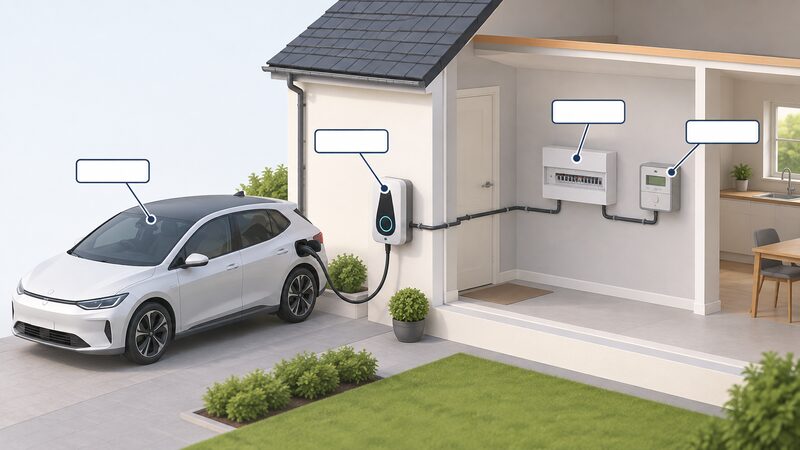
Three things have to line up before a car can send power anywhere: a bidirectional chargepoint, a car that supports bidirectional charging, and a smart meter so the flows can be measured and settled5. Remove any one and the system reverts to ordinary one-way charging.
The charger side is the narrowest part of the market. Four charger models were available in the UK through different suppliers as of January 2021, with new suppliers entering regularly6. That is a small field against the wider home charger market, and it explains why V2G is described as not widely available rather than merely expensive.
The car side is similarly restricted. Common V2G-ready vehicles include the Nissan Leaf and VW ID Buzz6. Most electric cars on UK roads cannot do it at all, even where the charger can. The Society of Motor Manufacturers and Traders counted more than a hundred EV models available to British buyers, so the compatible subset is a small fraction of the choice on the forecourt9.
Installation is not a like-for-like swap for a standard charger. A bidirectional unit has to be registered as an energy device in the home, and the guidance for device owners and installation contractors sets out what that involves5. Welsh national standards for electric vehicle infrastructure apply to chargepoint installations in Wales, and the Scottish Government has consulted on charge point provision for new buildings, so the rules a household meets depend on where in the UK it sits10.
What the trials found
The UK has run the largest domestic V2G trial in the world, and its results are the best evidence a household has. Project Sciurus ran from 2018 to 2021 with OVO Energy, Cenex, Nissan and Indra, and installed 330 V2G devices across the UK7. It found customers could recover the majority of their household energy costs, and in the best cases earn up to £725 a year where chargers provided grid services such as Firm Frequency Response or Dynamic Containment4.
The V2G Britain project, funded by the Office for Low Emission Vehicles and BEIS with Innovate UK, produced a different and more sober number. Cenex modelling put V2G at around £410 a year against unmanaged charging13. The two figures are not in conflict so much as measuring different things: £725 is the top of a range where grid services are stacked, while £410 is a modelled comparison against doing nothing clever at all.
Project Sciurus ran between 2018 and 2021, starting in April 2018 with OVO Energy, Cenex, Nissan and Indra, and became a three-year innovation project1. The target number of units was reduced to between 300 and 400, and 325 V2G units were installed in real homes across the UK1. Analysis of twelve months of data, between January 2020 and December 2020, recorded more than 750MWh of energy offset through V2G, and the trial found that drivers could save up to £725 on their electricity bills1.
The trials also tested the fear that bidirectional cycling wears a battery out. EV-elocity found V2G could extend the life of an EV battery by about 10%, around one extra year of use, and capacity fade can be reduced by 9.1% over a year through battery management7. Concerns that frequent charging and discharging could shorten battery life exist, but the impact should be relatively minimal within recommended guidelines7. That is a finding about managed cycling under trial conditions, not a guarantee for every car and charger combination.
| Trial or project | What it tested | Headline finding |
|---|---|---|
| Project Sciurus (2018 to 2021) | Largest domestic V2G trial, 330 devices | Customers could recover the majority of household energy costs; up to £725 a year with grid services7 |
| V2G Britain | Commercial viability and modelling | Around £410 a year against unmanaged charging13 |
| EV-elocity | Battery degradation under V2G | About 10% battery life extension, around one extra year7 |
Earnings: £150 to £725 a year, and what drives the range
The spread in reported earnings is wide enough that a single figure misleads. Average UK revenue generation from V2G is estimated at £150 to £200 per year3. At the top end, Project Sciurus found up to £725 a year where chargers provided grid services4. Cenex modelling sits between them at around £410 a year against unmanaged charging13.
Three things move a household along that range. The first is the tariff: a V2G charger costing around £1,000 would mean the payback period could comfortably be below five years on tariff optimisation alone8. The second is whether the charger is enrolled in grid services, which is what separates the £150 to £200 average from the £725 top end4. The third is solar. Cenex modelling found £278 net annual revenue per battery electric vehicle for customers with solar and high plug-in rates in a constrained area3.
The solar combination is where the strongest modelled returns appear. Storing generation from a 4 kWp domestic solar PV system in an EV battery over a weekend with six hours of sun per day cuts over 600 kgCO2e a year3. For a household already generating its own electricity, the car becomes a store for it rather than a load on the grid.
The premium, and when it pays back
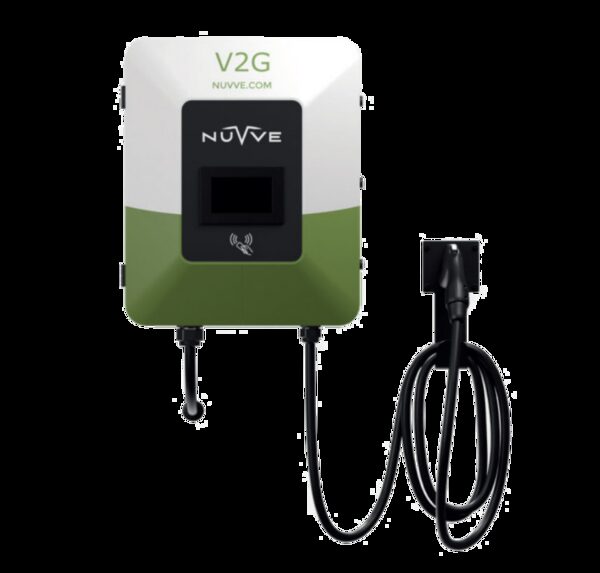
The cost gap between a bidirectional charger and an ordinary smart one has been the single biggest obstacle. By the end of Project Sciurus the V2G hardware and installation cost was around £3,700 higher than a smart chargepoint, and an earlier estimate put the premium at around £4,0004. Analysis from V2G trials concluded the premium would need to be less than £2,000 for the technology to be acceptable to the mass market8.
Set that against the earnings. At a £3,700 premium and £150 to £200 a year, the arithmetic does not close quickly. At the modelled £410 a year it closes faster but still over years. The picture changes if the premium falls: Cenex predicts V2G charger cost falling to £1,000 by 2030, and at that price the payback period could comfortably be below five years on tariff optimisation alone8.
Commercial readiness and mass rollout in the UK is expected between 2030 and 20358. That is the timeline a household is buying into if it adopts early: a technology whose economics are expected to improve substantially, on hardware that will be superseded.
| Item | Figure | Date or period |
|---|---|---|
| V2G premium over a smart chargepoint | Around £3,700 | End of Project Sciurus, 20214 |
| Earlier premium estimate | Around £4,000 | Earlier estimate4 |
| Premium needed for mass market acceptance | Less than £2,000 | Trial analysis8 |
| Predicted V2G charger cost | £1,000 | By 20308 |
| Expected mass rollout | 2030 to 2035 | Prediction8 |
Where the standards stand
Bidirectional charging sits inside a standards framework that is still filling in. The relevant international publication for the technology is IEC 61851, the electric vehicle conductive charging system standard14. On the safety side, the Institution of Engineering and Technology has published guidance on RCDs for electric vehicle supply equipment, which matters because a bidirectional unit has to protect against faults in both directions of flow15.
Testing and certification are handled separately. BSI became the first UKAS-accredited lab for electric vehicle charger testing, and its Kitemark scheme covers charger certification16. For a household, the practical point is that a bidirectional charger should carry the same certification evidence as any other chargepoint, and that the safety case is not automatically covered by the car's own approvals.
The regulatory picture also differs by nation. Welsh national standards for electric vehicle infrastructure set requirements for chargepoint installations in Wales10. The Scottish Government has consulted on electric vehicle charge points for new buildings and on changes to building regulations energy standards11. A household in England, Scotland, Wales or Northern Ireland should expect the installation rules, and any grant conditions attached to them, to differ.

What V2G does for energy independence, and what it does not
The independence case is straightforward and worth stating precisely. A car with bidirectional charging is a battery the household already owns, and V2H can discharge it to the building rather than the grid2. That is stored energy under the household's control, which is more than a grid-only home has. Paired with solar, it stores generation the household made itself: a 4 kWp system's weekend output held in the car battery cuts over 600 kgCO2e a year3.
The dependence that remains is substantial. V2G earnings come from grid services, so the income depends on the network, the aggregator and the market rules, not on the household4. The hardware depends on a manufacturer's continued support and on a compatible car, and the compatible car list is short6. The system depends on a smart meter and on device registration5. And the whole proposition depends on a premium that has been around £3,700 and is predicted to fall to £1,000 by 2030, which means early adopters carry a cost the later market will not4.
For a household weighing it up, the honest summary is that V2G is a real technology with real trial evidence behind it, a narrow equipment market, a wide and uncertain earnings range, and a payback that depends on a price fall that has not happened yet. It adds a degree of energy independence, mostly in the V2H direction, and it leaves the household dependent on the grid, a supplier, an aggregator and a car maker to realise the rest.
Sources17 cited
- Vehicle-to-grid best practice guide, Energy Saving Trust
- Well-adapted energy system monitoring framework, Climate Change Committee
- More than money: finding the true power of V2G, Cenex
- World's largest domestic vehicle-to-grid trial reveals customers could recover the majority of their household energy costs, Cenex
- Register energy devices in homes or small businesses: guidance for device owners and installation contractors, GOV.UK
- Vehicle-to-grid charging guide, Uswitch
- Project Sciurus trial insights report, Cenex
- Commercial viability of V2G, Cenex
- Brits enjoy best ever EV choice with more than a hundred models now available, SMMT
- Electric vehicle infrastructure national standards, Welsh Government
- Electric vehicle charge points for new buildings: consultation response, Transport Scotland
- Scottish building regulations: proposed changes to energy standards, Scottish Government
- V2GB: vehicle-to-grid Britain, Cenex
- IEC 61851 electric vehicle conductive charging system, IEC
- RCDs for electric vehicle supply equipment (EVSE), IET
- BSI becomes the first UKAS-accredited lab for electric vehicle charger testing, BSI
- WAI EVCUK216WC Type 2 female to UK plug electric vehicle charging cable recall, Electrical Safety First
 Bidirectional Chargers and CostsA bidirectional charger lets your electric car send power back to your home or the grid, not just take it in.
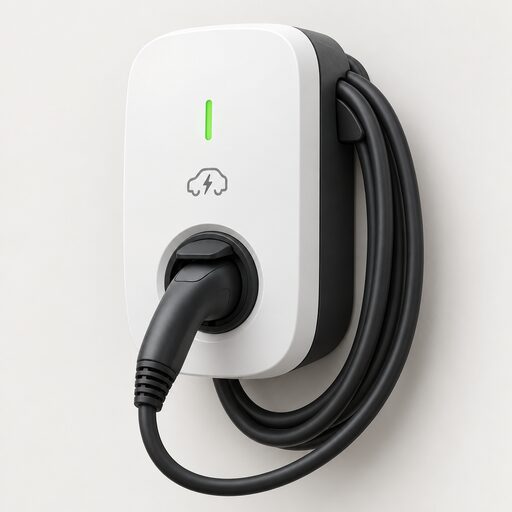 Bidirectional Charging ExplainedCan your electric car actually earn you money by sending power back to the grid?
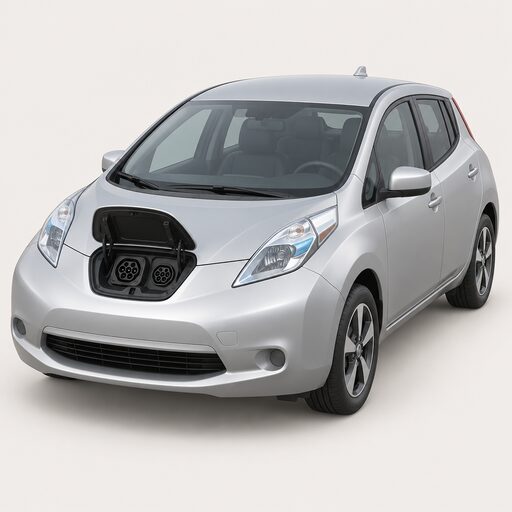 Cars That Support BidirectionalWhich electric cars in the UK can actually send power back to your home or the grid, and which ones only promise it for later?
 Charging and Energy IndependenceCharging an electric car at home can cut your fuel costs, but how much does it really free you from the grid?
 V2G Earnings and TariffsExplains how households are paid under vehicle-to-grid arrangements, whether through export payments, a flat monthly credit or a time-of-use tariff.
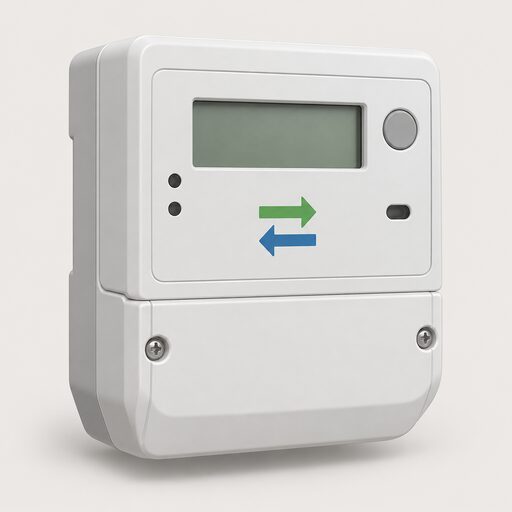 Grid Connection Rules for V2GCan your charger send power back to the grid?