
In this comparison
Bidirectional charging lets an electric vehicle either draw power from the grid or supply power back out, and the two uses that matter to a household are vehicle-to-grid (V2G) and vehicle-to-home (V2H). V2G sends energy to the electricity network; V2H keeps it inside the property. Both rest on the same hardware idea: a charger that can reverse the flow, a car whose battery will accept it, and a smart meter to record what moves1.
The distinction is not academic. Only CHAdeMO currently has a valid protocol for V2G charging that feeds electricity into the public grid, so a car with a CCS inlet cannot yet export to the network even though bidirectional charging itself is legal in the UK and encouraged by government1. V2H sidesteps that limit because the energy never reaches the grid, but it is generally implemented in Europe through a DC bidirectional charger rather than as a universal vehicle feature, and it is restricted to certain EV models and compatible chargers2.
In practice, V2G remains not widely available, with eligibility requirements such as a compatible car, charger and smart meter2. Trials have produced the household numbers: an incremental value of V2G above smart charging of £220 per year, and an annual depreciation saving of £2304. System-level value is far larger, at a net saving of between £40M and £90M a year across Great Britain by 20306.
Bidirectional charging: what V2G and V2H both rest on
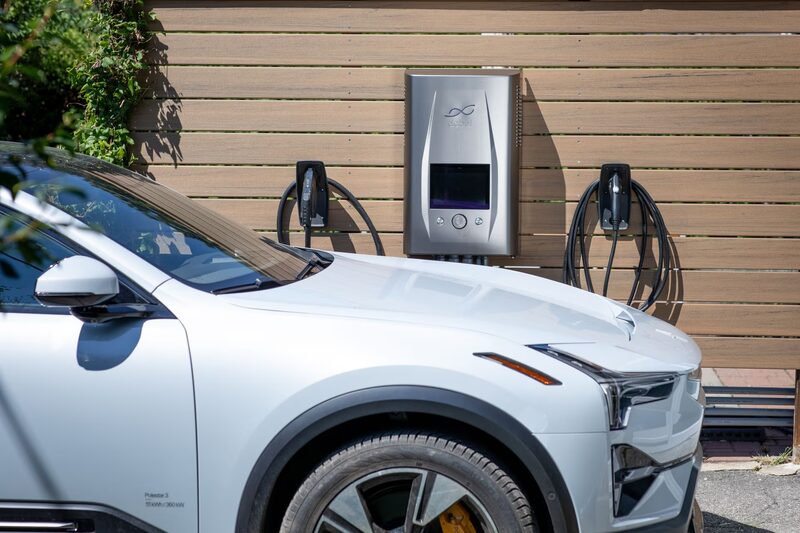
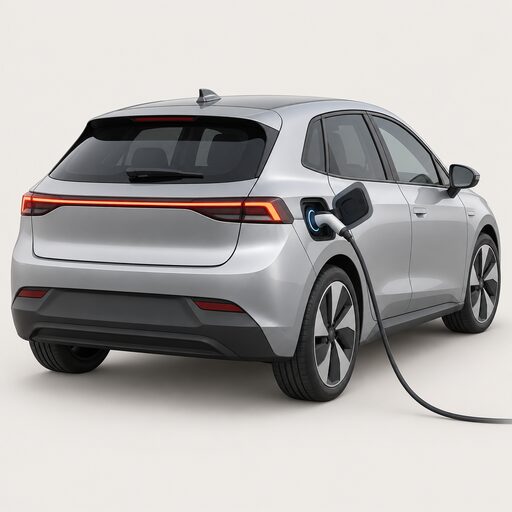
The shared foundation is a charger that can move energy in both directions. V2G chargepoints provide bi-directional flows of energy and data between a plug-in electric vehicle and the grid, enabling EV batteries to charge, store and discharge electricity when prompted7. Smart V2G chargers such as the Wallbox Quasar 1 and Indra V2G units enable that bidirectional energy flow, allowing the EV to both charge and discharge to the grid2.
V2X is the umbrella term covering all of it. It allows electric vehicles to operate bidirectionally, charging from the electricity grid but also discharging to the grid, building or home as needed8. V2G is the grid-facing branch; V2H is the building-facing branch. The Energy Saving Trust describes a vehicle-to-grid system as one that could potentially offer a two-way movement of energy, with energy stored in the car battery used in the home or sold back to the grid at times of peak demand9.
Three things have to line up before either works. The car must support the technology, the charger must be bidirectional, and a smart meter must be present to record the flows2. On the vehicle side, EVs with battery sizes of 40 kWh or above captured more revenue through V2G tariff optimisation than smaller ones, which is the clearest signal that battery size, not just capability, shapes what a household gets back4.
V2G vs V2H: where the energy goes
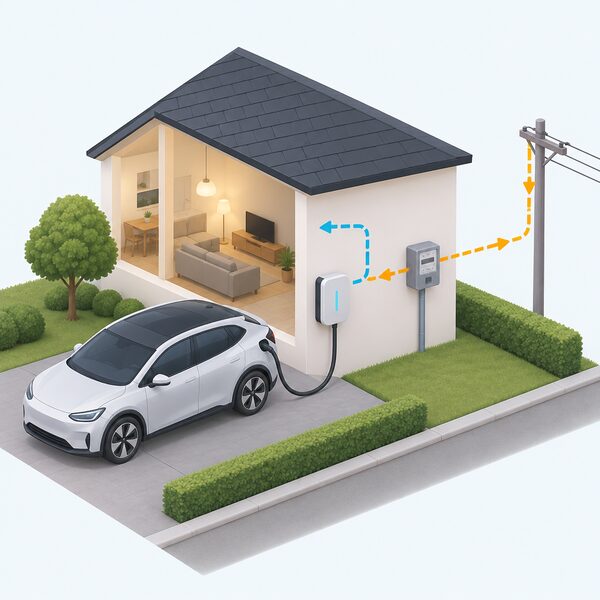
The difference is the destination. V2H utilises the energy to power a home rather than delivering it back to the grid3. V2G enables energy stored in EVs to be fed back into the electricity network, and in doing so helps reduce peak demand on the network10. V2G charging allows energy stored in the vehicle's battery to be exported to the grid during periods of high demand11.
That single difference drives everything else. A V2G export is a transaction with the network, so it depends on a protocol the network accepts, a supplier or aggregator to trade it, and a meter to measure it. A V2H discharge is a transaction with the house, so it depends on a charger that can island the property safely and a vehicle that will allow DC discharge into a fixed system.
In Europe, V2H is generally implemented via DC bidirectional charging using a compatible bidirectional charger, rather than as a universal feature of the car12. That is why the equipment list is short and specific. Some products are described by their makers as V2X-ready only, meaning they are not yet capable of V2H at all12.
| V2G | V2H | |
|---|---|---|
| Energy destination | The electricity network10 | The home3 |
| Main benefit | Export at peak demand, network support11 | Backup power, off-grid support2 |
| Protocol position | Only CHAdeMO has a valid protocol for grid export1 | Implemented via DC bidirectional charging in Europe12 |
| Availability | Not widely available; trials and partnerships2 | Limited to certain EV models and compatible chargers2 |
What each can do for your home: backup power and running costs
V2H is the branch with a direct household function. It can provide backup power from your EV to your home during power outages and support off-grid setups, though it is limited to certain EV models and compatible chargers2. When the public power grid goes down, a V2H system automatically disconnects the home from the grid, creating an electrical island so the home runs on EV battery power and prevents feedback into the grid12. That automatic disconnection is the safety mechanism that makes the arrangement permissible at all.
The Climate Change Committee places V2X in a wider resilience picture. At household level, further innovation in home battery technology, V2X and solar can provide households with additional backup options during power outages, alongside generators which are widely used already8. V2X is therefore one option among several, not a replacement for a generator or a home battery.
On running costs, the household figures come from trial data rather than from published tariffs. Project Sciurus, described as the world's largest domestic V2G trial, found an incremental value of V2G above smart charging of £220 per year, with an increase in value of 20% for the larger battery capacities4. A separate analysis puts the annual depreciation saving at £2305. The two figures measure different things and should not be added together as though they were one income.
What it means for the grid, and why that matters to you
V2G is a technology that allows electric vehicles to not only draw power from the grid to charge their batteries but also to send electricity back to the grid when needed, generating cash for the EV owner3. The network benefit is the reduction of peak demand, which is the expensive part of running a distribution system10.
The scale of that benefit is where the system-level numbers come from. V2G operation could generate a net saving of between £40M and £90M a year across Great Britain, depending on limits to V2G energy throughput6. V2G could defer network upgrades of £5bn, or £180 per household5. Those are savings to the system, not payments to a driver, and the distinction matters when judging what a household actually receives.
The value split is uneven. When grid services are included, smart charging captures 40% of the total value of V2G for low plug-in scenarios, or merely 10% for high plug-in cases6. In other words, as more cars plug in, the marginal advantage of full bidirectional export narrows. One modelled run put total grid services income for a combined archetype at £59, against £106 in the base case, and the two figures are not reconciled in the documents6.
For a household, the grid connection is also the point of remaining dependence. A V2G car is only as useful as the network it exports to and the supplier or aggregator that trades on its behalf. V2H removes the supplier from the discharge path but leaves the home dependent on the charger manufacturer and the car maker for compatibility.
UK legality and the CHAdeMO protocol limit
Bidirectional charging is allowed in the UK, and the government is keen to encourage it1. The constraint is not permission but protocol. Only CHAdeMO currently has a valid protocol for V2G charging in order to feed electricity into the public grid1. CHAdeMO is currently the only protocol that supports V2G13.
That limit has a market shape. In the UK, CHAdeMO is limited to a few EV brands, mostly Japanese or Korean in origin14. Older models such as the Nissan Leaf still use CHAdeMO for rapid charging, but CCS has largely replaced it15. Adapters between CCS and CHAdeMO do not exist, so a car with a CCS inlet cannot be converted to the CHAdeMO route15.
"Only for this connection is there currently a valid protocol for V2G charging in order to feed electricity into the public grid."
The rules differ across the UK where building and connection regulations are concerned. Regulation 27 of the Building Regulations applies to Wales only, with a separate version created for England only16. The Building Regulations (Amendment) (Wales) (No.2) Regulations 2022 apply only to buildings and building work in Wales17. The Green Homes Grant Local Authority Delivery and Home Upgrade Grant statistics release covers England only18, and the territorial scope of the solar carparks and EV charging call for evidence covers England only19.
Availability: trials, pilots and what households can actually get
V2G is still not widely available, with eligibility requirements such as having a compatible car, charger and smart meter2. Bidirectional charging more broadly is currently being trialled in some places but is not widely available20. Common V2G-ready vehicles include the Nissan Leaf and the VW ID Buzz2.
The trial record is substantial. Project Sciurus was the world's largest domestic V2G trial, and after completing it the majority of participants said their views had changed7. Of the survey respondents, 131 were able to be matched with chargepoint data collected during the trial4. The V2GB feasibility study is part of the Vehicle-to-Grid competition6. E-Flex found that V2G chargers could reduce costs for commercial fleet operators on dual electricity tariffs21.
Trials are not open-ended. They often require specific EV models and compatible chargers and may involve a selection process, with application handled through online registration, eligibility verification and coordination with installers and energy suppliers2. Several suppliers, including Octopus Energy, offer V2G schemes in the UK as part of trials and partnerships with companies including UK Power Network, Nissan and Indra Renewable Technologies2.
Public infrastructure is a separate question from home charging. Council charge points in one Welsh authority offer CHADeMo at 50kW, CCS at 50kW and Type 2 at 22kW22. That mix reflects the wider fleet rather than the bidirectional niche.
Equipment: connectors, chargers and vehicle compatibility
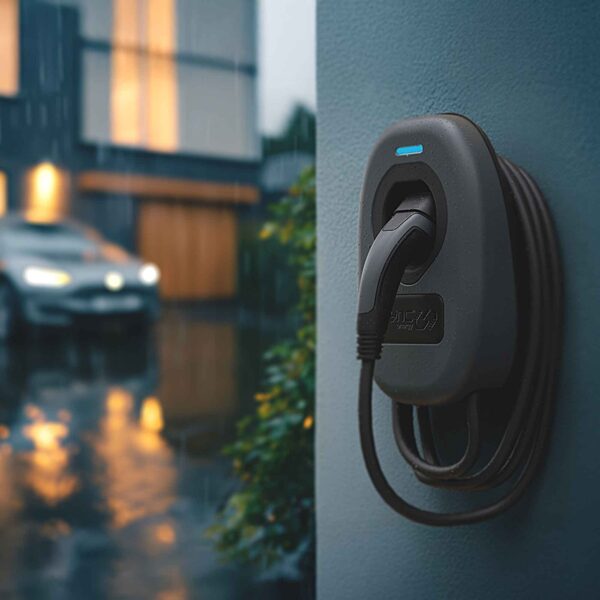
The equipment list splits by whether the charger handles DC or AC. DC V2H products are described as V2H capable, supporting vehicle-to-home charging with compatible vehicles and systems, with compatibility restricted to specific combinations and some products having limited commercial availability. Named examples include the BMW Wallbox Professional, Ambibox ambiCHARGE, Wallbox Quasar 2, E3/DC and EVTEC crema&charge12.
AC V2H products are described as V2H-ready, usable only when local regulatory frameworks are complete and cars supporting bidirectional AC charging exist. Named examples include the Vestel EVC04, Zaptec Go 2 and Enphase IQ EV Charger12. Products such as the go-e Charger PRO CABLE and CORE are therefore only V2X-ready12.
On the connection side, it is likely that V2G will exceed 16 A per phase, and therefore G98 is not applicable and G99 should be used23. Chargers must be type tested to EREC G98 specifications to be eligible for connect and notify24. The current curtailment guidance for EV and heat pump connections refers to import only, meaning the EV or heat pump acting as a demand only, and is not applicable to V2G or grid export limitation25.
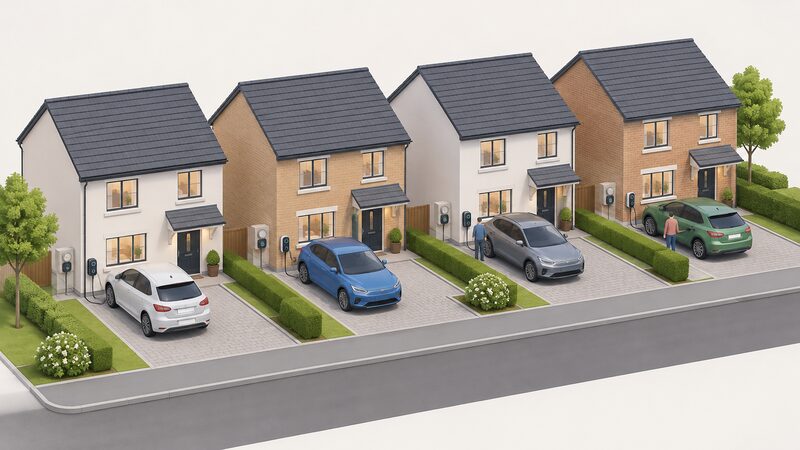
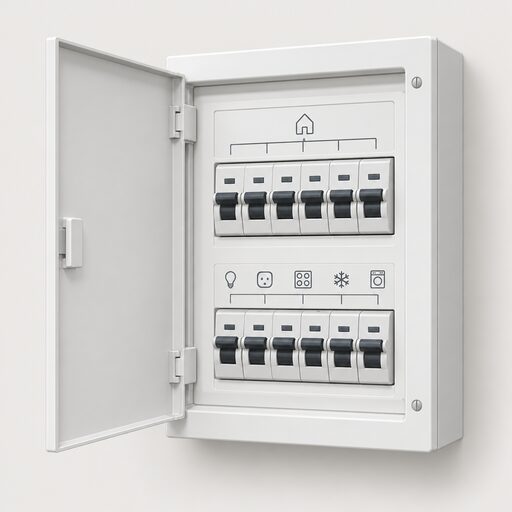
Vehicle-to-grid technology allows an EV charger to not only charge a vehicle but also take energy from the vehicle26. For connector compatibility, an electrician will confirm what type of connector is compatible with the vehicle27. To use V2G, a household needs a smart meter, a compatible V2G charger and a car that supports the technology2.
| Product | Maker's stated status | Notes |
|---|---|---|
| BMW Wallbox Professional | V2H capable | DC; compatibility restricted to specific combinations12 |
| Ambibox ambiCHARGE | V2H capable | DC; limited commercial availability12 |
| Wallbox Quasar 2 | V2H capable | DC; compatibility restricted12 |
| E3/DC | V2H capable | DC12 |
| EVTEC crema&charge | V2H capable | DC12 |
| Vestel EVC04 | V2H-ready | AC; needs complete regulatory frameworks and AC-capable cars12 |
| Zaptec Go 2 | V2H-ready | AC; same conditions12 |
| Enphase IQ EV Charger | V2H-ready | AC; same conditions12 |
| go-e Charger PRO CABLE and CORE | V2X-ready only | Not V2H capable12 |
Battery health and other practical concerns
The battery question has two answers depending on direction. Most experts agree that slow charging and discharging for V2H has only a minor impact on battery health12. For V2G, there are concerns that frequent charging and discharging could shorten EV battery life, though the impact should be relatively minimal within recommended guidelines2. One analysis suggests V2G could extend useable battery life by 10%5.
Regulation is moving towards transparency on battery condition. The Global Technical Regulation on EV batteries requires that EVs have easily accessible, accurate and comparable information on the battery's state of health28. That matters for a household weighing whether to let a car cycle more often, because it makes the state of health visible rather than inferred.
The remaining dependence is worth stating plainly. A V2H setup depends on the charger maker for firmware and compatibility, and on the car maker for the vehicle's willingness to discharge. A V2G setup adds a supplier or aggregator and a network connection to that chain. Where a company in that chain fails, the hardware can be orphaned, which is why the equipment list above names specific products and their stated status rather than treating bidirectional capability as a general property of electric cars.
Sources28 cited
- What is bidirectional charging?, Carwow, 2025-05-30
- Vehicle-to-grid charging guide, Uswitch, 2025-07-02
- LCT strategy, Energy Networks Association, 2026-09-17
- Project Sciurus trial insights report, Cenex, 2021-05
- More than money: finding the true power of V2G, Cenex, 2026-09-17
- V2GB: Vehicle to Grid Britain, Cenex, 2026-09-17
- Changing perceptions: the importance of V2G, Cenex, 2021-06-29
- Well-adapted energy system, Climate Change Committee, 2026-09-19
- Smart homes, lower carbon footprint, Energy Saving Trust, 2026-01-21
- Storage, Electricity North West, 2026-09-19
- Five electric vehicle innovations to watch, Energy Saving Trust, 2026-09-20
- Vehicle-to-home, go-e, 2026-07-15
- Commercial viability of V2G, Cenex, 2021-01
- BEAMA guide to electric vehicle infrastructure, BEAMA, 2024-09
- Electric car charging guide, Carwow, 2025-07-16
- Building Regulations 2010, Part 6, legislation.gov.uk, 2026-09-17
- Building Regulations (Amendment) (Wales) (No.2) Regulations 2022, Welsh Government, 2022-09-29
- Green Homes Grant LAD and HUG release, April 2024, GOV.UK, 2024-04-25
- Solar carparks and EV charging call for evidence, GOV.UK, 2025-05
- Battery storage, Energy Saving Trust, 2026-08-19
- 4 pioneering V2G projects, Cenex, 2023-03-22
- Electric vehicle charging, Isle of Anglesey County Council, 2026-09-20
- G98 single premises, Energy Networks Association, 2026-09-17
- Electric vehicles, Electricity North West, 2026-09-19
- Frequently asked questions about connecting to the networks, Energy Networks Association, 2026-09-17
- Vehicle-to-grid best practice guide, Energy Saving Trust, 2026-05-05
- Electric vehicle charger installation and maintenance, NICEIC, 2025-08
- Phasing out sales of new petrol and diesel cars from 2030, GOV.UK, 2025-04-07
 V2G and V2H ChargingCan your electric car earn money by sending power back to your home or the grid?
 Vehicle-to-Home and LoadCan an electric car really power your house, and which cars can do it?
 Charging and Energy IndependenceCharging an electric car at home can cut your fuel costs, but how much does it really free you from the grid?
 Bidirectional Charging ExplainedCan your electric car actually earn you money by sending power back to the grid?
 Bidirectional Chargers and CostsA bidirectional charger lets your electric car send power back to your home or the grid, not just take it in.
 V2G Battery DegradationDoes letting your electric car send power back to the grid wear the battery out faster?