
In this answer
Short answer
Vehicle-to-grid (V2G) export payments are not a single national rate. Guidance for UK drivers puts the figure at 5p to 15p per kWh exported, depending on the supplier and on demand at the time1. That is the number to hold on to: everything else in V2G earnings is a function of how many kilowatt hours a car can put back, and when.
The annual picture is wider than the per-unit rate suggests. Cenex modelling of the Sciurus trial data put V2G at around £410 per year compared with unmanaged charging2, and a later calculation from the world's largest domestic V2G trial gave £340 per year against one-way smart charging3. Against that, a Cenex estimate of average UK revenue generation from V2G is only £150 to £200 per year4. The gap between those figures is not a contradiction in the technology; it is a difference in assumptions about how often the car is plugged in, whether the household has solar, and whether the local network is constrained.
For a household, V2G is best understood as a flexibility product rather than a fuel substitute. It pays for the timing of energy, not for the energy itself, and it depends on a supplier, a network operator and a charger manufacturer all being in place. The sections below set out what the evidence supports, and where it runs out.
What V2G export pays: 5p to 15p per kWh
The export rate is the foundation of every earnings estimate. UK guidance for drivers states that a V2G owner could earn between 5p and 15p per kWh, depending on the supplier and the demand, and notes that this is not an amount set in regulation1. The variability is the point: V2G is paid for responding to network conditions, so the rate moves with them.
Two comparison figures help place that range. The Smart Export Guarantee, the framework that obliges large suppliers to buy small-scale exports, was reported in June 2026 as paying solar households around 12p per kWh6. An Ofgem case study from 2021 recorded V2G owners being paid 30p per kWh for energy sold back from their vehicle7. Those are different schemes at different dates, and the 30p figure is five years old, but together they show that V2G export rates sit in the same territory as solar export rates rather than far above them.
The floor is set by the basic buy-back price for electricity sold to the grid, which the Building Research Establishment lists at 5.81p per kWh from 1 January 20268. That is the price a household can expect when there is no flexibility premium attached. The ceiling depends on what the network will pay at a moment of constraint.
For a household's energy independence, the export rate matters less than the volume. A car with a large usable battery can cycle more kilowatt hours than a domestic solar array can generate, which is why V2G is treated as a network-scale resource. National Grid ESO estimated that if 50% of 2030 EVs were V2G enabled, they could provide around 16GW of daily flexible capacity to the grid9. That is the aggregate case; the household case is smaller and more conditional.
What the earnings depend on: supplier and demand
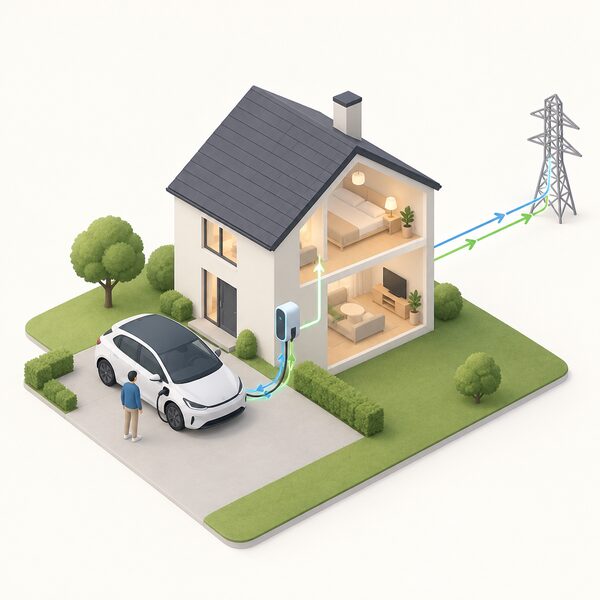
Three things determine what a V2G household actually receives: the supplier's export arrangement, the state of local demand, and how often the car is connected.
On the supplier side, EDF's Export Variable and British Gas's Export and Earn Flex are named as export arrangements available to households10. The Smart Export Guarantee is the mechanism that requires large suppliers to pay for small-scale exports, and it is the reason export payments exist at all for domestic generators10. The Feed-in Tariff, now closed to new applicants, paid in two parts: a generation tariff based on total output and a smaller export tariff loosely based on what was exported10. V2G sits outside that legacy structure, but the two-part logic is a useful reminder that export income is the smaller half of most domestic energy arrangements.
On the demand side, the value comes from what the network avoids. Cenex identified a short list of revenue streams available to V2G: low and high voltage distribution use-of-system charge avoidance, distribution transformer utilisation, imbalance management, firm frequency response in both dynamic and static forms, Short Term Operating Reserve, and energy price arbitrage5. Each of those is a payment for a different service, and a household sees only the aggregate through its supplier.
The plug-in rate is the third variable, and it is the one the household controls. Cenex modelling found that smart charging captures 40% of the total value of V2G in low plug-in scenarios, or merely 10% in high plug-in cases once grid services are included5. Both are reported here because the conflict is unresolved. What is consistent is the direction: the more often the car is available, the more of the value goes to V2G rather than to smart charging alone.
"V2G is a technology that allows electric vehicles to not only draw power from the grid to charge their batteries but also to send electricity back to the grid when needed generating cash for the EV owner"
Annual benefit per vehicle: £700 to £1,250
The headline annual benefit figure for a household comes from combining V2G revenue with the running-cost advantages of driving electric. The Energy Saving Trust puts average EV fuel savings at up to £750 a year12, and Home Energy Scotland gives an average of £760 annually, alongside vehicle excise duty of £180 a year for an average car13. Adding a V2G revenue stream of £150 to £200 per year4 to a fuel saving of £750 to £760 gives a total annual benefit in the region of £900 to £960 before depreciation effects.
The upper end of the £700 to £1,250 range comes from stacking more of the identified value streams. Cenex modelling of a high plug-in rate scenario with solar in a constrained area produced £278 net annual revenue per battery electric vehicle in a stacked case5. A separate Cenex figure for a 7kW V2G charger at a high plug-in rate gives annual revenues of around £436 above smart charging5. Add the £230 annual depreciation saving Cenex attributes to reduced battery wear4 and the fuel saving, and the total moves towards the top of the range.
The lower end reflects a household with a single car, average mileage, no solar and a standard export tariff. At £150 to £200 per year of V2G revenue4, the flexibility income alone will not justify the hardware. The case rests on the fuel saving, which applies whether or not the car is bidirectional.
| Component | Figure | Basis |
|---|---|---|
| V2G revenue, average UK | £150 to £200 a year | Cenex estimate4 |
| V2G revenue, 7kW high plug-in | around £436 a year above smart charging | Cenex modelling5 |
| V2G against unmanaged charging | around £410 a year | Cenex, Sciurus trial data2 |
| V2G against one-way smart charging | £340 a year | Cenex trial calculation3 |
| Fuel saving, average EV driver | £750 to £760 a year | Energy Saving Trust, Home Energy Scotland12 |
| Depreciation saving | £230 a year | Cenex4 |
How V2G earnings compare with what you pay to charge
The comparison that matters to a household is between what V2G pays for exported units and what the same units cost to put in. The export rate of 5p to 15p per kWh1 sits below most domestic import prices, which is why V2G only makes sense when the car is charged cheaply and discharged when the network is paying well.
The evidence on net benefit is genuinely mixed. Cenex modelling found that in a combined archetype, V2G produced £59 in total grid services income when firm frequency response prices were halved, against £106 in the base case5. The same modelling found that smart charging alone captures 40% of the revenue V2G can5. A separate Cenex study put V2G at around £410 per year compared with unmanaged charging2, and the world's largest domestic V2G trial calculated savings of £340 per year against £120 for one-way smart charging3.
The pattern across those figures is that V2G adds a few hundred pounds a year over smart charging, not a transformation of the household's energy position. The trial evidence supports the claim that customers could recover the majority of their household energy costs, but that outcome depends on high plug-in rates and favourable local network conditions3.
Does V2G wear out my EV battery faster?
The concern that bidirectional charging shortens battery life is not supported by the evidence. Cenex states that managed V2G cycling could extend useable battery life by 10%, because the battery spends less time sitting at a high state of charge4. That is a modelled outcome, not a warranty term, and it should be read as such.
The mechanism is straightforward. A battery held at 100% for long periods degrades faster than one that cycles in the middle of its range. The Energy Saving Trust's guidance on EV myths is the general reference point for battery and running-cost questions12.
What is missing is a manufacturer warranty statement covering V2G cycling. Battery warranties are set by the vehicle maker, and the terms vary. A household considering V2G should treat the battery warranty as the binding document, not the modelled 10% extension.
Do I need a special charger for vehicle-to-grid?
Yes. V2G requires a bidirectional charger, which is a different class of equipment from a standard one-way home unit. The Energy Saving Trust's best practice guide defines V2G as technology that allows an EV charger to not only charge a vehicle but also take energy from it14. The Energy Networks Association describes the same function from the network side: V2G allows EVs to draw power from the grid and to send electricity back when needed11.
The hardware has a short UK history. Cenex led the installation of the UK's first domestic vehicle-to-grid unit in Loughborough in 2017, a system that powered a home through the owner's electric vehicle15. The same installation was reported as being able to power a house with energy flowing both to and from the vehicle16. An earlier Cenex project described the unit's function as providing both charging for the vehicle and enabling it to act as a battery store, either directly to a building or to the National Grid through a virtual power plant17.
Cost is the main barrier. Cenex predicts the cost of a V2G charger will fall to £1,000 by 20304. Until then, prices are installer-quoted and depend on the vehicle, the charger and the electrical work required. Exports are triggered by a control unit that communicates with the grid18, so the charger is only part of the system: the supplier and the network operator are the other two.
Which suppliers pay for V2G exports?
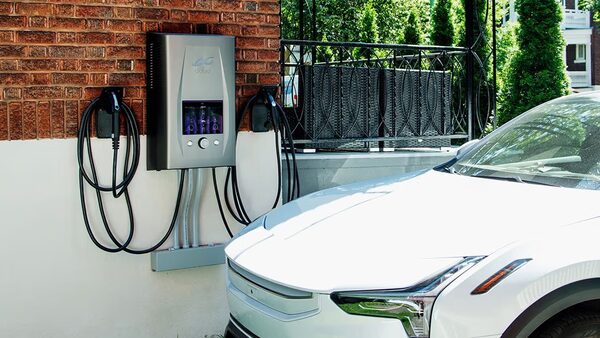
There is no definitive published list of suppliers paying for V2G exports. EDF's Export Variable and British Gas's Export and Earn Flex are named as export arrangements10, and the Smart Export Guarantee is the framework that obliges large suppliers to buy small-scale exports10. Whether a given supplier accepts V2G exports depends on the tariff and on the charger being approved for that supplier's scheme.
The wider market is moving. Toyota plans to expand its energy collaborations to additional countries and introduce more advanced solutions including V2G integration19. UK Power Networks has developed a fast-track approach to V2G technology18. The Vehicle to Grid Britain consortium, which ran the largest domestic trial, included Nissan, Energy Systems Catapult, Cenex, Moixa, Western Power Distribution, National Grid ESO and Element Energy20.
For a household, the practical position is that V2G export income depends on a supplier arrangement that is not yet universal. The Smart Export Guarantee provides the legal backstop for small-scale exports, but V2G-specific tariffs are a commercial product rather than a right.
How many hours a day can I export to the grid?
There is no fixed daily export window in the evidence. Exports are triggered by a control unit that communicates with the grid18, so the hours available depend on when the network or supplier calls for power and on the car being plugged in at that moment. A household that needs the car during the day will export less than one that leaves it on the drive.
The scale of the resource explains why networks are interested. National Grid ESO estimated that V2G could offset as much as 85% of residual EV peak demand by 2050, after smart charging has shifted the majority of EV demand outside peak hours9. Total V2G capacity in Great Britain is projected at 8GW by 205021. Those are system-level figures, but they describe the same behaviour a household performs: discharging when demand is high.
The Feed-in Tariff scheme's final year gives a sense of what domestic export volumes look like in aggregate. In the 2014 scheme year, just over 1.3 TWh was exported to the grid, with associated export payments of around £78.4 million22. That is solar export, not V2G, but it shows the order of magnitude of domestic export activity.
What owning a V2G setup means for household energy independence
V2G changes the direction of energy flow in a home, but it does not remove dependence. The Climate Change Committee defines V2X as allowing electric vehicles to operate bidirectionally, charging from the grid but also discharging to the grid, a building or a home as needed23. That is a flexibility capability, not self-sufficiency.
What it does for independence is narrow and real. A V2G household can sell energy back when the network is short, which reduces the net cost of the energy it buys. It can, in the right configuration, power the home from the car16. It cannot disconnect from the grid, because the export payments depend on the grid being there to buy. It cannot bypass the supplier, because the supplier sets the export rate. And it cannot operate without the charger manufacturer's cloud and control systems, because exports are triggered by a control unit that communicates with the grid18.
The dependence on a single vehicle is the other limit. A household with one car that is also its main transport has less flexibility than the trial archetypes assume. The Cenex modelling that produces the higher revenue figures assumes high plug-in rates and, in some cases, solar and a constrained local network5. Those conditions are not universal.
The network benefit is real and quantified. Cenex estimates that V2G could defer network upgrades worth £5bn, or £180 per household4, and that it could save an additional £40 to £90 million annually in Great Britain by 203020. Those savings accrue to the system, and only part of them reaches the household through export payments.
Sources23 cited
- Vehicle to grid charging guide, Uswitch, 2025-07-02
- Commercial viability of V2G, Cenex, 2021-01
- World's largest domestic vehicle-to-grid trial, Cenex, 2021-06-03
- More than money: finding the true power of V2G, Cenex, 2026-09-17
- V2GB: Vehicle to Grid Britain, Cenex, 2026-09-17
- Britain's homes with solar panels reap £40 million during the heatwave, Uswitch, 2026-06-28
- Case study: UK electric vehicle to grid charging, Ofgem, 2021-07-06
- SAP 10 fuel prices from 01/01/2026, BRE Group, 2026-01-01
- Batteries, wheels and smart charging, NESO, 2026-09-17
- Smart Export Guarantee, Solar Energy UK, 2026-05-12
- LCT strategy, Energy Networks Association, 2026-09-17
- Electric vehicles: debunking myths, Energy Saving Trust, 2026-09-17
- Electric cars, Home Energy Scotland, 2026-09-17
- Vehicle-to-grid best practice guide, Energy Saving Trust, 2026-05-05
- Cenex leading installation of UK's first domestic vehicle-to-grid unit, Cenex, 2017-03-09
- V2G domestic installation, BBC Radio Leicester, Cenex, 2017-03-09
- Cenex launches Ebbs and Flows energy systems project, Cenex, 2018-05-14
- UK first approach to fast-track vehicle-to-grid technology, UK Power Networks, 2026-09-17
- Toyota to expand EV charging ecosystem across the UK, SMMT, 2026-09-17
- V2G Britain case study, Cenex, 2022-11-11
- NESO document 263861, NESO, 2026-09-17
- Feed-in Tariff annual report, scheme year 14, Ofgem, 2024-12
- Well-adapted energy system, Climate Change Committee, 2026-09-19
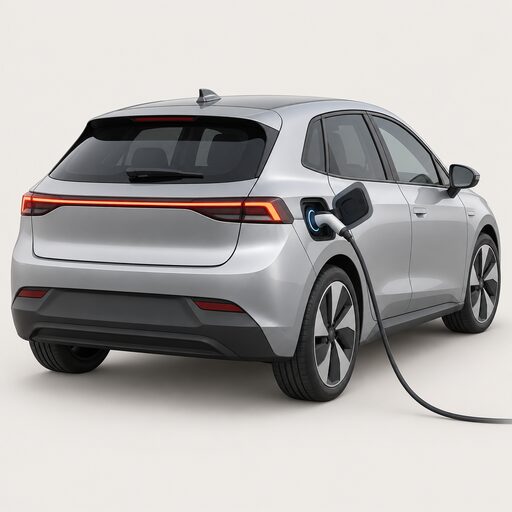 V2G and V2H ChargingCan your electric car earn money by sending power back to your home or the grid?
 Cost to Charge an EV at HomeHow home charging cost is worked out from battery size, efficiency, the unit rate paid and the tariff behind it, with full-charge costs of about £8 to £17, cost per mile, annual running costs and what changes for EV owners from April 2028.
 V2G Earnings and TariffsExplains how households are paid under vehicle-to-grid arrangements, whether through export payments, a flat monthly credit or a time-of-use tariff.
 EV Charging Bolt-OnsCan you get cheap electricity for your car without changing the tariff for the rest of your home?
 Exporting From a Home BatteryCan you actually get paid for electricity your home battery sends to the grid?
 Bidirectional Charging ExplainedCan your electric car actually earn you money by sending power back to the grid?