
In this answer
Short answer
Powerloop was a British domestic vehicle-to-grid project, delivered by a consortium of partners led by Octopus Energy and Octopus Electric Vehicles, and developed to test the feasibility of domestic V2G1. It is the scheme most often searched for by households who have heard that an energy supplier will pay them for the electricity in their car, and the first thing to say is that it is closed. Powerloop is described in the past tense as a completed project, not a tariff on sale1.
What it left behind is more useful than the scheme itself. The wider demonstrator work tested the commercial, technical and operational viability of V2G and how it can benefit both the electricity grid and consumers, and produced best practice recommendations for future product and service providers1. The Energy Saving Trust's own role was to gain insight into the 135 customers taking part, their driving and charging habits, and their perceptions of V2G functionality1.
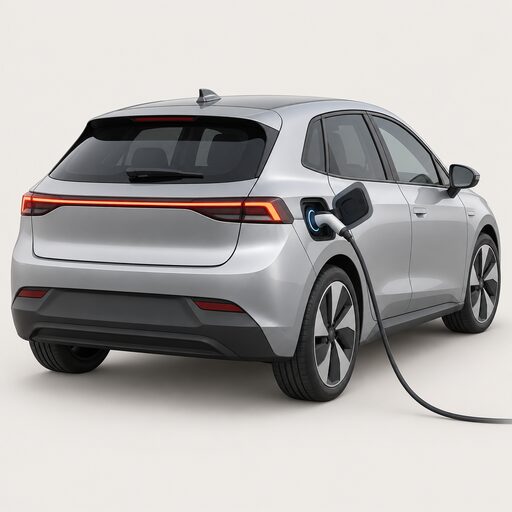
For a household today, the practical position is that V2G exists as equipment, standards and connection rules rather than as a single bundle. V2G lets an electric vehicle draw power from the grid to charge and also send electricity back when needed, generating cash for the owner2. V2H does the same thing but uses the energy to power a home rather than delivering it back to the grid2.
What Powerloop was: a trial of domestic V2G
Powerloop sat in a category of publicly supported demonstrator projects rather than commercial products. Its stated objective was finding the hardware, building the software and creating the markets to demonstrate the feasibility and value in domestic V2G4. That phrasing matters: the project was as much about building a market structure and a software layer as about putting a particular box on a particular driveway.
The demonstrator programme it belonged to tested the commercial, technical and operational viability of V2G technology and how it can benefit both the electricity grid and consumers1. The output was not a tariff but a set of best practice recommendations for future product and service providers, intended to help them develop fit-for-purpose solutions with V2G technology1.
Domestic V2G is a narrower idea than the wider family of technologies it belongs to. V2X allows electric vehicles to operate bidirectionally, charging from the electricity grid but also discharging to the grid, building or home as needed5. Within that, V2G sends energy to the grid and V2H keeps it in the house2. Powerloop was concerned with the domestic end of that spectrum, where the car sits on a home driveway and the household, not a fleet manager, decides what happens to it.
The distinction between a trial and a product is the single most important thing to understand about Powerloop. A trial recruits a defined group, collects data, and ends. A product has a price, terms and a complaints route. Powerloop was the former, which is why searches for it now lead to a closed door rather than a sign-up page. Households weighing up bidirectional charging today are choosing between current commercial offers, not between Powerloop and something else.
Who ran it: the consortium behind the project
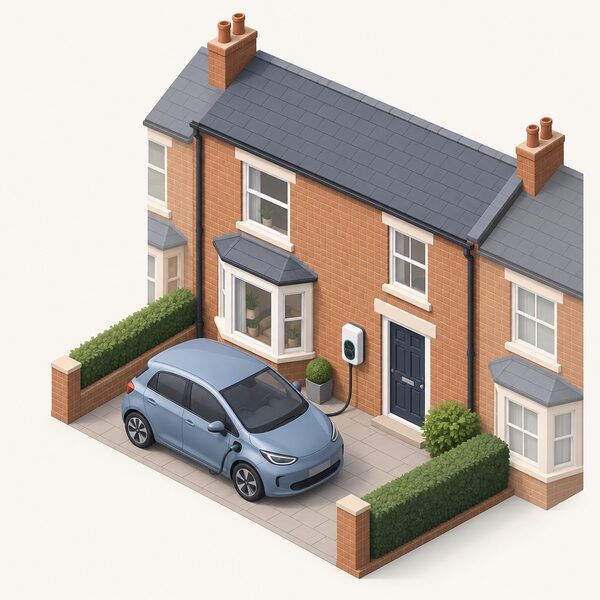
Powerloop was delivered by a consortium of partners, led by Octopus Energy and Octopus Electric Vehicles1. That combination is characteristic of domestic V2G: a licensed supplier to handle the energy and the payments, and a vehicle business to handle the cars, because the technology only works when both halves are present.
The Energy Saving Trust was a partner with a research remit rather than a commercial one. Its role in Powerloop was to gain insight into the 135 customers' driving and charging habits, and their perceptions of V2G functionality1. That is the independent strand of the project, and it is the part that speaks to households rather than to the industry.
The wider V2G research landscape in Britain shows how these consortia are typically assembled. The V2GB project drew on consortium members Nissan, Energy Systems Catapult, Cenex, Moixa, Western Power Distribution, National Grid ESO and Element Energy, and was funded by the Office for Low Emission Vehicles and the Department for Business, Energy and Industrial Strategy, in partnership with Innovate UK6. Its project coordinator was Nissan Technical Centre Europe6. Cenex has described its own work as delivering the largest domestic V2G demonstrator in the world7.
Octopus Energy's corporate structure is worth noting for anyone tracing responsibility. Octopus Energy Limited holds encompassing licences alongside Octopus Energy Operations Limited, Octopus Energy Operations 2 Limited and Octopus Energy Trading Limited8. The group also operates Co-Op Energy, which scores the same in independent supplier assessments9.
"which was delivered by a consortium of partners, led by Octopus Energy and Octopus Electric Vehicles"
What it set out to prove: the feasibility and value of domestic V2G
The project's purpose was explicit. Powerloop was the project developed to test the feasibility of domestic V2G1. Feasibility, in this context, is a broad word covering three separate questions: whether the hardware exists and works, whether the software and market arrangements can pay a household for its car's energy, and whether the sums add up.
The demonstrator programme addressed all three, testing the commercial, technical and operational viability of V2G technology and how it can benefit both the electricity grid and consumers1. The recommendations that came out were aimed at future product and service providers, to help them develop fit-for-purpose solutions with V2G technology1. In other words, the project's legacy is guidance for the companies that came after it.
The value question is where the evidence is thinnest, and the sources are candid about it. One analysis found that smart charging is only able to capture 40% of the revenue that V2G can4. That is the case for bidirectional equipment in a single figure. But the same analysis has not taken account of additional cost of equipment required to enable V2G nor the impact on battery degradation4. So the 40% figure describes revenue, not net return, and the costs that would determine whether a household is better off are explicitly outside it.
That gap is not a flaw in Powerloop so much as a limit on what any trial of this kind can conclude. Revenue from grid services can be measured during a trial. The wear on a car battery over a decade of cycling, and the cost of a bidirectional charger and its installation, are harder to observe in a short project. Households reading claims about V2G earnings should hold both halves of the equation in view, which is the subject of V2G earnings and the tariffs behind them and V2G, battery degradation and vehicle warranties.
How the trial worked: recruitment, data collection and analysis
The published activity list for Powerloop is short and telling: continuous recruitment, then data collection and analysis4. Continuous recruitment means participants were brought in as the project ran rather than in a single intake, which suits a technology where hardware availability and vehicle compatibility change month by month.
The research methods used across comparable domestic energy trials give a sense of what data collection involves. The Energy Consumer Satisfaction Survey used a mixed mode method of data collection which was largely online and included face to face interviewing targeted at digitally excluded respondents, with an additional 300 boost interviews comprising prepayment meter and standard credit customers10. That is a large-scale official survey rather than a V2G trial, but it shows the standard applied when a study needs to reach beyond the confident and the connected.
Smaller trials produce smaller samples. In Project Sciurus, of the survey respondents, 131 were able to be matched with chargepoint data collected during the trial11. That figure is worth holding beside Powerloop's 135 researched customers1: domestic V2G evidence rests on samples in the low hundreds, not thousands.
Where trials monitor the home rather than the car, the scope widens. In one Living Lab trial, Energy Systems Catapult monitored key areas of participants' electricity usage including EV charging, smart heating controls and smart plug control12. A consumer study conducted amongst 238 ivie app users examined gas and electricity use13. For scale, a field randomised controlled trial on boiler optimisation ran with 61,000 users of Loop, a smart meter energy advice app14. V2G trials sit at the small, detailed end of that range.
Where and when it ran
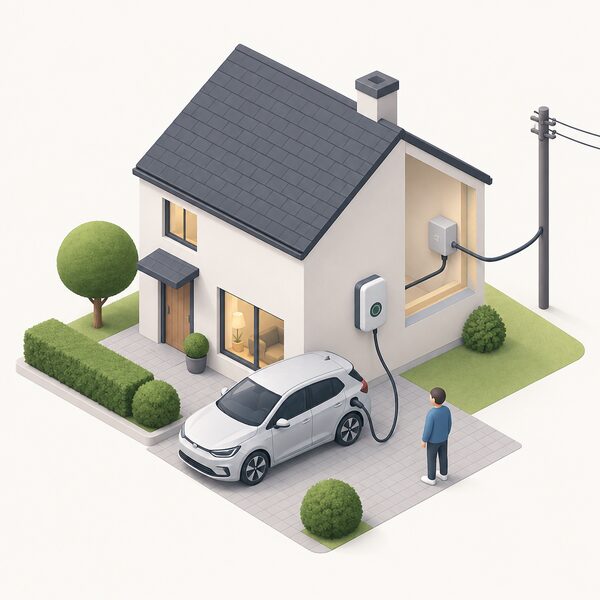
Powerloop was a British domestic project, run with households rather than at a single demonstration site. The published material does not break participation down by nation, so there is no separate figure for England, Scotland, Wales or Northern Ireland. What can be said is that the grid connection rules a household meets today are set nationally, and they are the practical constraint on any V2G installation.
Those rules are specific. It is likely that V2G will be greater than 16 A per phase and therefore G98 is not applicable and G99 should be used3. G98 covers single premises connections at or below that threshold; a bidirectional charger that can export at higher currents falls outside it. This is the point at which a domestic V2G plan stops being a product choice and becomes an application to the network operator, a subject covered in Grid connection rules for bidirectional charging.
The timing of the wider domestic V2G effort is better documented than Powerloop's own dates. Project Sciurus reported in June 2021 that after completing the world's largest domestic V2G trial, the majority of trial participants now say something had changed in their view of the technology15. In September 2023, a domestic EV charging flexibility trial was initiated via Power Responsive, in which domestic households would offer real-time flexibility to the ESO balancing activities through EV charging for the first time16.
The charging infrastructure that any V2G household depends on has grown substantially since. As of August 2026 there were 47,810 charging locations around the UK, of which 7,104 were rapid or ultra-rapid locations17. Those are public chargepoints rather than home equipment, but they set the context in which a home charger is one node among tens of thousands.
What Powerloop means for householders considering V2G today
The honest summary is that Powerloop proved the concept and closed, and that the commercial offers which followed are different products with different terms. A household looking at V2G now is choosing equipment, a car and a payment arrangement, and each of those has its own conditions.
The equipment side has matured. Easee contributes to a pilot with its V2G-ready chargers, the Easee Max and Easee Pro, helping to test how energy stored in vehicles can be used19. DEFA Power states that with the ISO15118-20 standard implemented in both vehicles and charging boxes, V2G and V2H become possible10. That is the crux: bidirectional operation needs both ends of the cable to support the standard, which is why which cars support bidirectional charging in the UK matters as much as the charger.
Home energy equipment makers have moved in the same direction. GivEnergy's Gateway 2 offers instantaneous switchover to maintain power during a grid outage, with an EV charger output of 32 A AC20. Sigenergy's SigenStor EV DC lists peak shaving and VPP dispatch among its capabilities21. LuxPowerTek publishes a product lifecycle and support policy covering its hardware19. These are maker statements about their own products, and they describe home energy systems that can coordinate a car, a battery and the house.
On the supplier side, the current Octopus Energy propositions are add-ons rather than standalone tariffs. Charge Anytime is an add-on to existing tariffs, not a standalone tariff22. Intelligent Drive Pack is an add-on to an existing home energy tariff where customers pay an extra monthly subscription fee for unlimited smart EV charging23. OVO's equivalent is described in the same independent guide23. Neither is Powerloop, and neither is a V2G tariff in the sense the trial explored.
What remains for a household is the dependence that V2G does not remove. The car still has to be charged from the grid, the household still buys that electricity from a supplier, and the export payment depends on a market arrangement that a company operates. V2H can provide backup power from an EV to a home during power outages and support off-grid setups, but it is limited to certain EV models and compatible chargers25. That is a real gain in resilience and a partial one: it covers the models and the equipment that support it, and nothing more. The wider question of what bidirectional technology can and cannot do for a home's independence is set out in Emerging technology and household energy independence.
Sources25 cited
- Vehicle-to-grid best practice guide, Energy Saving Trust, 2026
- LCT strategy, Energy Networks Association, 2026
- G98 Single Premises, Energy Networks Association, 2026
- More than money: finding the true power of V2G, Cenex, 2026
- Well-adapted energy system, Climate Change Committee, 2026
- V2GB: Vehicle-to-Grid Britain, Cenex, 2026
- Vehicle-to-grid, Cenex, 2022
- FiT licensee contact details, Ofgem, 2026
- Differences between green energy suppliers, Which?, 2026
- DEFA Power OCPP and V2G guide, DEFA, 2025
- Project Sciurus trial insights report, Cenex, 2021
- Equiwatt partners with Energy Systems Catapult, Energy Systems Catapult, 2023
- ivie app, ivie, 2025
- The impact of boiler optimisation on gas consumption and household comfort, Nesta, 2023
- Changing perceptions: the importance of V2G, Cenex, 2021
- Domestic EV charging to help ESO balance energy system for first time, NESO, 2023
- EV charging statistics, Zapmap, 2026
- EV charging statistics, Zapmap, 2026
- Product lifecycle and support policy, LuxPowerTek, 2025
- Gateway 2, GivEnergy, 2026
- SigenStor, Sigenergy, 2026
- Octopus Energy EV energy tariffs, Uswitch, 2025
- OVO EV energy tariffs, Uswitch, 2025
- 9 ways to flex your energy around peak times, ivie, 2026
- Vehicle-to-grid charging guide, Uswitch, 2025
 V2G and V2H ChargingCan your electric car earn money by sending power back to your home or the grid?
 The Full Energy Independence GuideCan you really run your home on your own power in the UK, and how far can that go before the grid still matters?
 The Transmission NetworkWondering who owns the pylons near your house, or why the grid needs upgrading before you can run a heat pump or an electric car?
 The Full New Technology GuideWhich new home energy ideas can you actually buy in the UK right now, and which are still stuck in trials?
 Bidirectional Charging StandardsDoes your electric car and charger actually support sending power back to your home or the grid?
 Energy Tech Company FailuresRecords UK and overseas home energy technology firms that have failed or withdrawn products, and what happened to installed equipment, warranties and apps.