
In this guide
When an energy technology company fails, the hardware already in a home does not stop working on the day the administrator is appointed. What stops is everything that depended on the company: the warranty, the servicing, the spare parts, and, for cloud-connected devices, the app that made the product useful. The Energy Ombudsman will not consider disputes against a supplier that has ceased trading, because the supplier cannot be made to act, and it cannot progress cases already open on its systems when a supplier fails1.
The immediate supply is protected. If an energy supplier goes out of business because of financial problems, electricity and gas continue to be supplied to the home, and supply is not cut off1. A special administrator is chosen to run the failed company until it is rescued, sold, or its customers are moved to other suppliers1. Where a case was already open with the Energy Ombudsman, the Ombudsman contacts the consumer to discuss next steps, and a prior dispute is sometimes upheld by the new nominated supplier1.
The harder problem is the orphaned product. A device whose app, monitoring or firmware updates run through a manufacturer's cloud becomes a dead device when that company stops paying for the servers, even though the physical unit is intact. The same failure removes the warranty route, because there is no company left to honour it. This page sets out what the rules say, which firms have failed, and what remains enforceable.
What happens when an energy technology company goes bust
The formal mechanism for a failed energy supplier is the Energy Supply Administration Order. An administrator is chosen to run the company of the energy supplier that has gone out of business, and the special administrator runs it until it is rescued, for example through restructuring, or sold, or until its customers are moved to other suppliers1. For the household, the practical effect is continuity of supply with a change of counterparty.
That protection covers the commodity, not the equipment. A failed installer, a failed manufacturer or a failed scheme leaves the installed product behind with no counterparty at all. The National Energy Foundation has handled cases where the installer that fitted the faulty installation is no longer trading and the guarantee is missing, fraudulent or cancelled, which is the shape most orphaned-product problems take6. The guarantee is the weak point: it is only as good as the company standing behind it.
Scheme closures create the same effect at scale. The Energy Company Obligation scheme was announced for closure, and energy suppliers have now stopped advertising or accepting applications for ECO4 funding, with no further funding for new installations after March 20267. Birmingham City Council's advice pages record that its partners, City Energy and Next Energy, can no longer get funding from energy companies to complete installations for new applicants9. Households part-way through a funded installation therefore face a gap that no warranty covers.
Consumer Energy Solutions ceased trading, recorded in the same Welsh Government statement that announced the ECO closure7. Spark Energy Supply Limited, a domestic energy supplier with about 290,000 customers, ceased trading, following the collapse of Extra Energy earlier that week10. Each of those events stranded a set of customers with live complaints and, in some cases, live equipment.
Orphaned products: warranties, apps and servicing after a company fails
An orphaned product is one whose maker, importer or servicing route has gone, leaving the owner with hardware and no support. Three dependencies break at once.
The first is the warranty. A manufacturer's warranty is a contractual promise by that manufacturer. When the company is gone, there is no one to claim against, and the guarantee may be missing, fraudulent or cancelled in the cases the National Energy Foundation sees6. A warranty backed by an insurer or a third-party guarantee scheme behaves differently from one backed only by the maker's balance sheet, and that distinction is worth establishing before purchase rather than after.
The second is the app and the cloud. A smart energy product that reports, schedules or controls through a manufacturer's servers depends on those servers continuing to run. When the company stops trading, the servers are a cost with no revenue behind it. The physical device may still heat water or store electricity, but the scheduling, monitoring and tariff optimisation that justified the premium stop. This is the point at which a company failure becomes a dead device.
The third is servicing and spares. A heat battery, a home battery or a bidirectional charger needs occasional attention, and the parts come from the maker. With no maker, an installer can often keep a unit running, but cannot obtain proprietary components.
"in cases where the installer that fitted the faulty installation is no longer trading and the guarantee is missing, fraudulent or cancelled"
The independence question follows directly. A product that works from local controls, with no cloud account and no maker-specific parts, survives its maker. A product that needs a login, a subscription or a firmware feed does not. That is a design choice made at purchase, and it is the single most useful thing a household can establish about an emerging energy product.
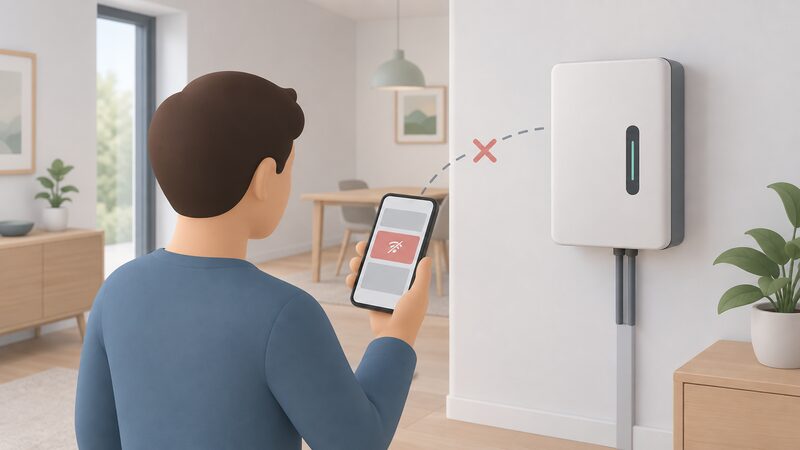
The Energy Ombudsman will not consider disputes against a supplier that has ceased trading
The rule is explicit. The Energy Ombudsman will not consider disputes against a supplier that has ceased trading, as the supplier will not be able to act on any decision2. For the same reasons, it is not able to progress any cases currently open on its systems2. Once a company ceases trading, no new cases can be opened for dispute with the closed company, although prior disputes are sometimes upheld by the new nominated supplier3.
This is a structural limit, not a discretionary one. An ombudsman scheme works by making a binding decision that a member company must then carry out. A company in administration or liquidation cannot be made to carry out anything, so the scheme has nothing to enforce against. The Energy Ombudsman does not issue fines or dictate how companies operate; that is the responsibility of the companies' trade body or regulator3.
Ofgem's position is narrower still. Ofgem does not directly get involved with complaints about energy suppliers or network operators and does not investigate individual disputes, including heat network disputes11. A household that has lost its route to the Ombudsman through a company failure therefore has no regulatory appeal that will produce a remedy against that company.
What remains is the insolvency process, where a consumer is an unsecured creditor alongside others, and the supplier of last resort arrangements that move customers to a new supplier. The Ombudsman handles disputes involving suppliers trading in Britain only3, so a failed overseas manufacturer of a home energy device sits outside the scheme entirely.
Why open cases stop when a supplier ceases trading
An open case stops because the decision has no one to land on. The Ombudsman's process is to ask the consumer to send information and evidence, review evidence from both the consumer and the energy company, inform the consumer of its decision, and give the energy company a set of actions to resolve the problem5. Every one of those final steps is addressed to the company. Remove the company and the process has no addressee.
The scheme's funding model explains the same limit from the other side. The Energy Ombudsman is funded by the suppliers signed up to its scheme, who pay a fee for each case reviewed regardless of the outcome or decision3. A company that has ceased trading is no longer a signed-up supplier paying fees, and is no longer bound by the scheme's terms of reference.
The practical consequence for a household is that timing matters more than merit. A complaint raised while the company is still trading can be escalated and decided. The same complaint raised a month later, after the company fails, cannot be accepted at all. Where a case was already open when the supplier failed, the Ombudsman contacts the consumer to discuss next steps1, and the new nominated supplier sometimes upholds a prior dispute3.
The scheme's reach has also widened in adjacent areas, which matters for households whose problem sits with a network operator, a heat network or a flexibility provider rather than a supplier. The Ombudsman can consider disputes about network operators if there is a loss of service or a problem with a connection or repair13. It can review disputes with any heat network if the heat network supplier has not done what is required of it by the Energy Bill Relief Scheme and Energy Bill Discount Scheme legislation, and from 1 April 2025 it can help consumers and small businesses resolve heat network disputes11. From 8 January 2026 it can handle disputes for a number of flexibility service providers, and from that date only a number of flexibility service providers become members of the scheme14. Disputes about flexibility service providers can be considered where the consumer became aware of the problem on or after 8 December 202515.
Which failed suppliers are excluded, and which are not
The clearest way to see the rule in operation is the list of companies the Ombudsman will not accept new disputes about. Green Network Energy, Utility Point and Zog Energy are all recorded as not accepting any new disputes about the supplier16. The wording is the same for each, which reflects a single policy applied to a closed book.
The distinction between a failed supplier and a live one is not always obvious from the trading name. Enetic Utilities Ltd trades as Enetic and is recorded as Active17. A household checking whether it can still escalate a complaint needs to establish the company's status, not the brand on the bill.
The Ombudsman also declines categories of dispute regardless of company status. It does not deal with commercial decisions made by companies about whether to provide a product or service, and it does not deal with liquid petroleum gas12. A maker's decision to withdraw a product, discontinue a model or stop supporting an app is a commercial decision, and that places it outside the scheme even when the company is trading normally.
There is a separate and older route for some installations. The Ombudsman can review disputes with Green Deal providers if they are unable or unwilling to help when something goes wrong with a Green Deal plan14. A Green Deal complaint about Home Energy and Lifestyle Management Ltd, which has gone out of business, illustrates the boundary: the provider has failed, so the practical remedy is limited even where the scheme covers the dispute type8.
Escalating a complaint before a company fails: the 8-week rule and deadlock letters
The window to escalate is defined by two triggers. A consumer can complain if a reported problem is not fixed within eight weeks, if the consumer and the energy company cannot agree how to fix it, if a deadlock letter is received, or if the consumer is not happy with the decision received7. The supplier has eight weeks to resolve the issue unless it sends a deadlock letter enabling the consumer to come to the Ombudsman sooner18.
A deadlock letter is the supplier's written statement that the problem cannot be fixed or that it believes there is no more it can do7. It shortens the wait but starts a clock of its own: a dispute must be escalated within 12 months of receiving the letter3. The eight-week route and the deadlock route are alternatives, and the eligibility wording used across the Ombudsman's dispute pages is consistent: a deadlock letter received, or eight weeks without the complaint being resolved19.
The same eight-week principle runs through adjacent schemes. For the Smart Export Guarantee, if after eight weeks a satisfactory solution has not been agreed between both parties, the complaint may be referred to the Energy Ombudsman8. For Feed-in Tariffs, a domestic or micro business generator whose mutually agreeable outcome has not been reached after eight weeks can refer the complaint26. The Ombudsman's own summary is that if after eight weeks the issue is still unresolved, it can then investigate18.
The supplier is meant to prompt the consumer. Your energy company should write to you at eight weeks or deadlock to tell you how to contact the scheme27. In practice, a household that has not received that letter should not wait for it, because the company may fail in the meantime and close the route permanently.
Awards, remedies and timeframes if your dispute is accepted
The remedies available are practical as well as financial. Suppliers can be told to take practical action, such as crediting or cancelling an account or changing a tariff, to make an apology, or to offer a financial award, or a combination of these, and recommendations may be made to prevent the issues happening again4. Ofgem's guidance describes the outcomes in similar terms: financial compensation, an apology, agreeing to fix the problem, a refund, or an affordable payment plan11.
The financial ceiling depends on the dispute type and the consumer type.
| Dispute type | Maximum award | Source |
|---|---|---|
| Domestic energy disputes | up to £10,000 | 4 |
| Small business disputes | up to £20,000 | 4 |
| Energy brokers | up to £10,000 | 4 |
| Heat networks | up to £10,000 domestic, up to £20,000 small business | 4 |
| Energy networks | up to £10,000 domestic, up to £20,000 small business | 4 |
The level of maximum financial award may vary depending on the type of energy company and the terms of reference that cover that scheme4. The average award is around £50, and the most common financial award is around £50, sometimes referred to as a Time and Trouble Award3. Awards are based on the cost of putting things right, such as ensuring the consumer has been charged accurately, clearing unfair charges or fixing faults4.
On timing, the supplier has eight weeks to investigate and resolve the problem29. Once the Ombudsman has evidence from both parties, most disputes are resolved within six weeks4. The consumer has up to 14 days to upload evidence to support the case3. The gap between the maximum and the average is the single most important thing to understand: the ceiling is for serious detriment, and the typical outcome is a small recognition payment plus a correction.
Who qualifies: domestic, microbusiness and small business eligibility
Only domestic consumers, micro-businesses and small businesses may apply to the Energy Ombudsman26. The Ombudsman can process complaints for both domestic and small business consumers in the energy sector30.
The microbusiness thresholds are set out in two places. A company with an annual consumption of electricity of not more than 100,000 kWh, or gas consumption of not more than 293,000 kWh, qualifies, as does a company with fewer than ten employees or their full-time equivalent and an annual turnover or annual balance sheet total not exceeding £2 million30. The usage thresholds are specific to the fuel complained about30.
The small business thresholds are higher. A company has fewer than 50 employees or their full-time equivalent, and an annual turnover of at most £6.5 million or a balance sheet total of £5.0 million, or has an annual electricity consumption of not more than 200,000 kWh or an annual gas consumption of not more than 500,000 kWh30.
Territorially, the Ombudsman handles disputes involving suppliers trading in Britain3. That leaves Northern Ireland outside the scheme's supplier disputes, and it leaves a failed overseas manufacturer outside it everywhere. The scheme is also one of over 20 Ombudsman schemes in the UK, with travel, retail, insurance, employment, financial products and banking handled elsewhere14.
How to register a dispute and what evidence you need
The first step is to log a dispute with the supplier28. The Ombudsman's eligibility checklist is consistent across dispute types: complain to the supplier first, wait eight weeks or receive a deadlock letter, have sufficient evidence including the complaint date, and confirm the supplier name matches the bill22.
Registration is available via the website, telephone, email or post30. The postal address is Energy Ombudsman, P.O. Box 966, Warrington, WA4 9DF, and phone lines are open Monday to Friday 8am until 6pm, closed Saturday, Sunday and Bank Holidays33. For heat networks, the number is 0330 440 1624, pressing option 3 for Heat Networks when prompted21. The first step for a heat network problem is to contact the heat network supplier and ask it to fix the situation11.
Evidence can be uploaded in a wide range of formats, including pdf, csv, txt, doc, docx, xls, xlsx, ppt, pptx, png, gif, jpg, bmp, mov, mp4, mp3, m4a, tif, tiff, msg, wav and eml3. The Ombudsman will refuse to accept a case if it is apparent that the consumer is pursuing a dispute without merit and intends to cause inconvenience, harassment or expense to the supplier, and a frivolous complaint has no serious purpose or value3.
The service is free to consumers, and free and independent for heat network consumers3. It is approved by Ofgem to handle service disputes in the energy sector, is part of the Trust Alliance Group, and traces its origins to Ombudsman Services, a not-for-profit organisation established in 20023.

What this means for a household's energy independence
The pattern across every failure recorded here is the same. The physical supply is protected, the commercial relationship is not, and the equipment sits somewhere between the two. A household that has bought an emerging energy product has taken on a dependency on a company that may not exist in five years, and the dependency is greatest where the product is cloud-connected.
The enforceable routes are narrow and time-limited. The Energy Ombudsman will not consider disputes against a supplier that has ceased trading2, Ofgem does not investigate individual disputes11, and a maker's decision to withdraw a product is a commercial decision outside the scheme12. What remains is the warranty, which is only as strong as the company behind it, and the installer, who may still be trading when the maker is not.
The design features that preserve independence are the ones that remove the company from the loop: local controls that work without an account, standard components that a competent installer can source, and a warranty backed by something other than the maker's own balance sheet. Where a product needs a login, a subscription or a firmware feed to function, the household's independence lasts exactly as long as the company does.
For the wider picture of how these technologies fit together, the emerging home energy technology guide sets out the field, and technology readiness levels and how to read energy product claims covers how to judge a maker's claims before purchase. Households weighing a product whose maker may not survive should also read buying pre-production and crowdfunded energy products, which deals with the same exposure at the point of sale.
Sources34 cited
- What happens if your energy supplier goes out of business, Ofgem, 2026
- Supplier of last resort information, Energy Ombudsman, 2026
- FAQs, Energy Ombudsman, 2026
- What to expect, Energy Ombudsman, 2026
- We may be able to help resolve your energy dispute, Energy Ombudsman, 2026
- Energy Market Consumer Protection, Hansard, 17 June 2026
- Written statement: support for householders impacted by closure of the Energy Company Obligation scheme, Welsh Government, 13 March 2026
- Research briefing CBP-9585, House of Commons Library, 13 May 2026
- Getting help with your energy bills, Birmingham City Council, 15 April 2026
- Spark Energy ceases trading: our advice to consumers, Energy Ombudsman, 23 November 2018
- Complain about your energy supplier or network operator, Ofgem, 2026
- Energy suppliers, Energy Ombudsman, 2026
- Network operators, Energy Ombudsman, 2026
- How we can help, Energy Ombudsman, 2026
- Information for disputes with flexibility service providers, Energy Ombudsman, 2026
- Raise a dispute: EDF Energy, Energy Ombudsman, 2026
- Raise a dispute: Enetic, Energy Ombudsman, 2026
- Raise a dispute, Energy Ombudsman, 2026
- Raise a dispute: Foxglove Energy, Energy Ombudsman, 2026
- Raise a dispute: Capture Energy, Energy Ombudsman, 2026
- Raise a dispute: Theodore Stevenage Limited, Energy Ombudsman, 2026
- Raise a dispute: Luminex Power Limited, Energy Ombudsman, 2026
- Raise a dispute: VIVID Housing Limited, Energy Ombudsman, 2026
- Raise a dispute: Theodore Bracknell Limited, Energy Ombudsman, 2026
- Raise a dispute: Cynon Taf Community Housing (2007) Ltd, Energy Ombudsman, 2026
- Feed-in Tariffs: dispute resolution, Ofgem, 17 September 2026
- How to complain about your energy company, Ombudsman Services: Energy, August 2014
- Understanding your rights, Energy Ombudsman, 2026
- Smart meters: your rights and expectations, Department for Energy Security and Net Zero, 8 August 2025
- EV tariffs and home charging: what consumers need to know, Energy Ombudsman, 11 September 2026
- Raise a dispute: Essential Living, Energy Ombudsman, 2026
- Raise a dispute: Westminster Council, Energy Ombudsman, 2026
- Creating a case with the Energy Ombudsman, Energy Ombudsman, 2026
- Heat networks affected by the Energy Prices Act 2022, Energy Ombudsman, 2026
 When a Manufacturer FailsWhat happens to warranties, spare parts, monitoring apps and cloud services when a manufacturer enters administration, exits the UK or discontinues a platform, and the practical options for owners left without support.
 Every Supplier CollapseA record of the domestic suppliers that ceased trading, when they failed, and which supplier took on their customers.
 Tech Readiness and ClaimsHow the technology readiness level scale used in UK innovation funding maps onto what a household can actually order, and how to read claims like 'proven', 'pilot' and 'trial' on home energy products.
 Tech and Energy IndependenceAssesses which technologies in development would genuinely increase a household's control over its own energy, and which deepen dependence on suppliers, networks or cloud services.
 When Your Installer Goes BustWhat happens to deposits, part-completed work, workmanship guarantees and complaints when a home energy installation company fails, and how to claim on deposit protection, an insurance-backed guarantee, card or finance cover, and who honours the manufacturer's warranty.
 Product RecallsHow recalls and safety notices work for energy equipment in UK homes, who issues them, how to check a product, and what replacement, repair and refund routes exist.