In this guide
Heat batteries have been put into occupied British homes through a small number of funded demonstration projects rather than through the mass market. The two that carry most of the published evidence are the Sunamp Living Lab trial, which received £9.25 million to develop and trial an extended thermal storage system in 100 homes across the UK, and the Electrification of Heat demonstration project, which installed 742 heat pump systems against a target of up to 750 and fitted a heat battery instead of a hot water tank in 33 flats that had no space for one1.
Government defines a heat battery as "an electric heating appliance that can be used flexibly to utilise periods of cheap and clean electricity generation by heating a thermal storage medium, which then heats water via a heat exchanger to feed a central heating system and/or a sanitary hot water system"4. That definition explains why the trials exist: the interest is not in the store for its own sake but in the ability to move a home's heat demand to hours when electricity is cheap or clean, and to fit heat into homes where a cylinder will not go.
The published findings from the largest project are cautiously positive on the heat pump systems as a whole rather than on heat batteries specifically. Energy Systems Catapult reported that heat pumps can be successfully installed in all the types of property tested, that they can operate with good efficiencies and provide positive consumer heating experiences, and that 85% of consumers would recommend them3. The heat battery element was a small, targeted part of that picture, and no separate published performance figure for those 33 units appears in the project's headline findings.
What a heat battery is, and why it is being tested rather than sold at scale
A heat battery stores heat in a medium, commonly a phase-change material, and releases it through a heat exchanger when the home calls for heating or hot water4. The Energy Saving Trust notes that heat batteries can heat water for central heating or for taps, and that they may have a longer lifespan than electrical batteries8. That is a different proposition from a hot water cylinder, which stores the hot water itself, and it is the basis of the heat battery versus hot water cylinder comparison.
The reason for trials rather than open sale is that the value of a heat battery depends on how a real household actually uses heat and electricity across a year. A UK trial has investigated preheating homes during periods of low-cost electricity and then switching heat pumps off during expensive periods, which is the same time-shifting logic applied without a dedicated store9. Whether a store makes that shift larger, cheaper or more comfortable is an empirical question, and only monitored homes answer it.
There is also a regulatory reason. Phase-change material heat batteries for hot water sit outside the recognised technology categories used by the main grant schemes. Warm Homes guidance states that they "cannot currently be installed through the scheme until there is a formally approved convention or they are a formally recognized technology category in SAP"10. The same restriction appears in Warm Homes: Social Housing Fund wave 3 guidance11. Demonstration funding has therefore been the practical route into occupied homes, and the question of whether heat batteries could become eligible under the Boiler Upgrade Scheme remains open.
The Sunamp Living Lab trial: £9.25 million and 100 homes
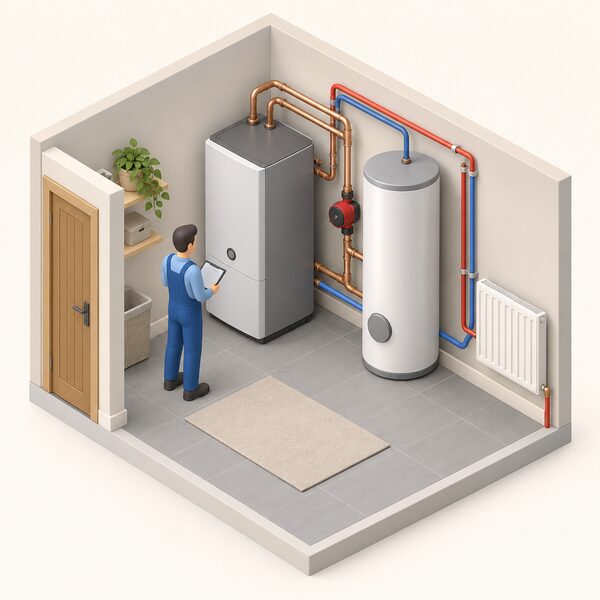
Sunamp is to receive £9.25 million to develop and trial its advanced thermal storage system in 100 homes across the UK1. The award came through the Longer Duration Energy Storage Demonstration programme, part of the Net Zero Innovation Portfolio run by the then Department for Business, Energy and Industrial Strategy, which provides funding for low-carbon technologies and systems1. Energy Systems Catapult, the net zero innovation centre, runs the trial in 100 homes from its Living Lab13.
The technical objective is explicit. Sunamp will extend its existing heat battery to provide increased storage duration and capacity, and pair it with household energy systems to tackle periods of low renewables generation on the grid13. In other words the trial is not testing whether a heat battery can store heat, which is settled, but whether a larger and longer-duration store changes what a household can do when wind output is low and prices are high.
The Living Lab itself is described as the vehicle for consumer trials of smart energy services aimed at overcoming the barriers to the decarbonisation of residential heat14. That framing matters when reading results: the unit of study is the household and its service experience, not the appliance on a test rig.
One feature of the Sunamp trial goes beyond hardware. Customers will have the option of part ownership of a wind farm through Ripple Energy1. For a site concerned with energy independence, that is a notable design choice: it pairs a physical heat store in the home with a financial stake in generation elsewhere, which is a different kind of security from self-generation on the roof. Further detail on the products themselves sits with Sunamp heat batteries and the Sunamp and Caldera comparison.
How the trial systems work: heat pump, thermal store and smart control
The system architecture described for the Sunamp trial is a heat pump charging renewable heat into large capacity time-shifting thermal storage, delivering space heating and hot water on demand1. The control layer is separate from both: the proposed system uses smart control logic from myenergi alongside the significantly large thermal storage from Sunamp1.
That three-part split, generator, store, controller, is what makes these systems interesting and also what makes them fragile. Each part is a dependency. The heat pump needs electricity; the store needs the heat pump or a direct electric input; the controller needs to know prices or carbon intensity, which in practice means a data connection to a supplier or a platform. A household gains the ability to buy heat when it is cheap, and in exchange it acquires a reliance on the control service continuing to exist.
Other trials have taken the same approach with different components. The Smart Flex Heat Pump trial worked with homeowners across Oxfordshire, funding additional communications and monitoring equipment for the heat pump plus training on its use, and monitoring ran through to June 202315. It supported only Grant and Samsung heat pumps, because those were the only brands the monitoring equipment worked with for that trial15. That constraint is common in field research and is a reminder that trial results describe the tested combination, not heat pumps or heat batteries in general.
The Electrification of Heat demonstration project: 742 heat pumps
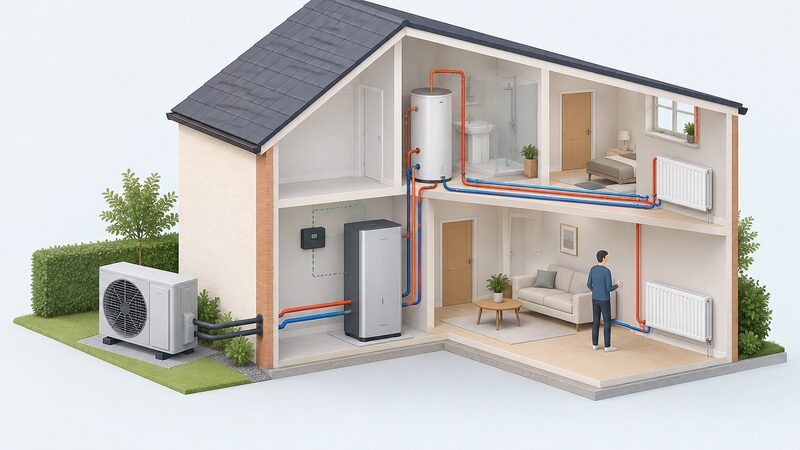
The Electrification of Heat demonstration project set out to install up to 750 heat pumps in three regions across Great Britain, and 742 heat pump systems were installed against that target2. It is described as the largest project of its kind in the UK12. The aim was to better understand how the rollout of heat pumps in homes across the UK could be accelerated2, and it formed part of the government's Energy Innovation Programme12.
Delivery was regional. Warmworks covered Scotland, E.ON the north east of England and OVO Energy the south east of England excluding London3. Installations ran across the South East of Scotland, Newcastle and the South East of England17. The project was led by Energy Systems Catapult with support from LCP Delta and Oxford Computer Consultants, and is funded by the Department for Energy Security and Net Zero, having originally been funded by the Department for Business, Energy and Industrial Strategy3.
| Element | Detail |
|---|---|
| Target | Up to 750 homes across Great Britain16 |
| Delivered | 742 heat pump systems16 |
| Housing scope | A broadly representative spectrum of housing types, socio-economic groups and on and off-gas grid locations12 |
| Technologies | A range of heat pump types including hybrids, and innovative technologies such as heat batteries12 |
| Heat batteries | 33 flats, instead of a hot water tank, due to lack of space6 |
| Reports published | Summary Report, Insights from Heat Pump Performance Data Report, Heat Pump Performance Data Analysis Report, Optimisation Report3 |
The majority of homes in the target set were on the gas grid6, which is what makes the project relevant to the typical British household rather than to off-grid outliers. Datasets have been made available to access alongside the reports3, which is unusual and valuable: it means the field data is open to re-analysis rather than surviving only as a summary. Related projects and their findings are collected under demonstration and test homes and closed trials and what they found.
Where the heat batteries went: 33 flats with nowhere for a tank
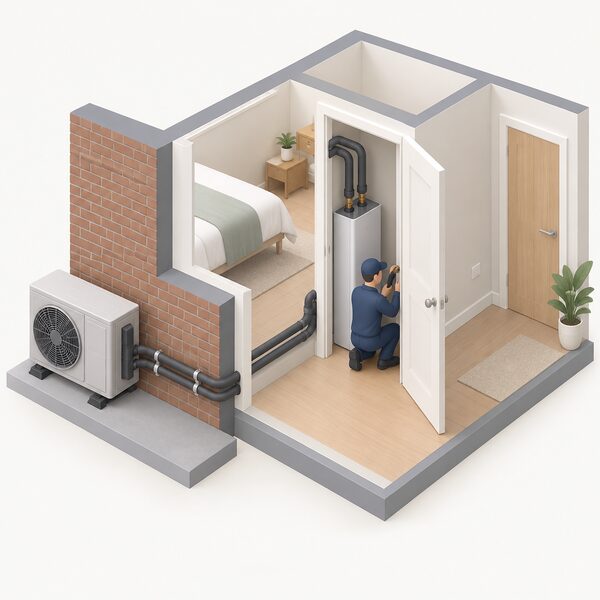
The heat battery element of the Electrification of Heat project was small and specific. A small number of homes, 33 flats, had a heat battery installed instead of a hot water tank, due to lack of space6. That is the clearest published statement of where the technology earns its place in a retrofit: not as a general replacement for a cylinder, but as the answer when no cylinder fits.
The scale of that constraint in the wider housing stock is substantial. Research among able to pay households found that nearly half of those surveyed reported that they did not have the space for a hot water tank in their home18. Flats are also where alternative heat arrangements already cluster: in England, communal heating was most likely to be found in flats at 11%, compared with 0.2% of houses and bungalows19. And a parliamentary committee recorded that there were 2 million households with electric storage heating, often flats, that are unsuitable for heat pumps20.
Those three figures together define the opportunity and the limit. The opportunity is large, because space is the binding constraint in a great many homes. The limit is that a heat battery solves a space problem, not a heat source problem: in the trial it still sat downstream of a heat pump. Where the property cannot take a heat pump at all, a heat battery charged directly from electricity is a different product, and the tepeo zero emission boiler trials are the relevant evidence there.
The zero emission boiler trials: 30 homes on a distribution network
Separately from the heat pump projects, UK Power Networks ran trials of tepeo's Zero Emission Boiler, which uses heat battery technology, in 30 homes across the South East and East of England21. A later trial is described as seeing new boiler systems trialled in 30 homes across London, the South East and the East of England7. These are network-operator trials, and their interest is different again: a distribution network wants to know whether a home with a heat store can be persuaded to take its electricity at times that suit the network.
That is a genuinely different independence question. A household with a charged store has heat regardless of what happens in the next few hours on the grid, which is a form of resilience. But the economic case usually depends on a time-of-use tariff, which is a contract with a supplier, and on a control signal, which is a dependency on a platform. The device buys time, not autonomy. The product itself is covered under tepeo and compared with conventional storage heating in tepeo ZEB versus storage heater.
Performance results: efficiency, cold weather and consumer satisfaction
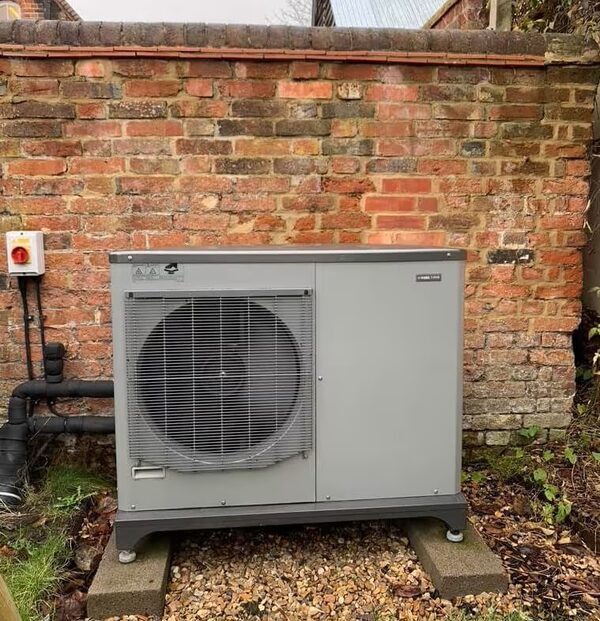
The headline published findings from the Electrification of Heat project are that heat pumps can be successfully installed in all the types of property which were tested, that they can operate with good efficiencies and provide positive consumer heating experiences, and that heat pumps were recommended by 85% of consumers3. The project moved from installation into a monitoring and optimisation phase, and it is that phase which produced the performance datasets12.
Two cautions apply when reading those results. First, the 85% recommendation figure is a consumer satisfaction measure from households that volunteered for a demonstration project and were supported through it, which is not the same population as the general market. Second, the published efficiency statements are qualitative at the headline level: the numbers sit in the performance data analysis and optimisation reports rather than in a single figure that can be quoted for all systems3.
Where measured performance has been examined for vulnerable households, the method has been broader than metering alone. Research on the transition to heat pumps for households at risk of fuel poverty combined in-depth interviews, technical home audits, analysis of monitored heat pump performance data, cost modelling and a review of existing evidence22. That mix matters because a system can meter well and still fail the household, through cost, controls or comfort.
Scottish government work on a Heat and Energy Efficiency Technical Suitability Assessment frames the risk directly: building owners should be able to understand which measures are not appropriate, including measures that could cause dampness, mould or condensation, or clean heating systems insufficiently sized to maintain warmth23. Undersizing is the failure mode that field trials are best placed to catch, because it only shows up in cold weather in a real occupied house.
"It has shown that heat pumps can be successfully installed in all the types of property which were tested by the Project."
Property types tested, from Victorian terraces to 1960s flats
The property range in the Electrification of Heat project was deliberately wide. Installations covered flats, semi-detached homes, mid-terraced houses and early 20th century detached homes2, described elsewhere as running from Victorian mid-terraces to pre-war semis and a 1960s block of flats17. Homes were selected to give a broadly representative spectrum of housing types, socio-economic groups and on and off-gas grid locations12.
That breadth is the project's main contribution to the question householders actually ask, which is whether their own house is a candidate. It does not, however, make every property equal in cost or disruption, and the trials tested feasibility rather than affordability.
The older stock is where the constraints concentrate, and the picture differs by nation. In Scotland, nearly two-thirds of private rented sector properties are tenements or flats, and more than a third were built before 1919; tenements built before 1919 account for 26% of the private rented stock compared with just 9% across all tenures24. Tenement work also raises an ownership question that does not arise in a house: which property is individually owned and which is commonly owned is set out in the title deeds of each dwelling, with contradictions or gaps defaulting to the Tenements (Scotland) Act 200424. In England and Wales, the evidence base is thinner for older homes: coverage of Energy Performance Certificates for properties built before 1930 in England stood at 61%25.
Which technologies suit which stock is developed further in emerging technology by home type and, by nation, in the guides for Scotland and England.
Costs, disruption and the barriers the trials were designed to expose
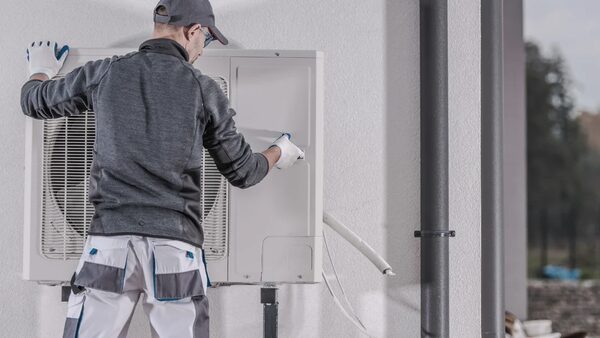
The Heat Pump Ready programme aims to develop innovative technology and ensure the innovation is tested and trialled in homes so that the real-world impact is understood26. Its Round 2 innovation funding competition names the barriers it wants addressed: the capital cost of heat pump system hardware and components, in-property changes required, internal and external space requirement, and the time taken for a heat pump install from accepted quote27. Those four items are a fair summary of what stops installations in practice, and a heat battery speaks directly to only one of them, space.
Beyond the property, a parliamentary briefing identifies a lack of qualified heat pump installers as a further potential barrier to rollout, alongside constraints imposed by planning rules and the need for electricity infrastructure upgrades28.
On price, published figures for heat batteries in the UK are scarce, and the pricing here is installer-quoted rather than listed. For context on electrical storage, a parliamentary briefing reports the Energy Saving Trust estimate that battery storage costs can be up to £10,000 depending on size, with a typical 5 kWh system around £4,60029. That is electrical storage, not thermal, and should not be read across to a heat battery. Official statistics on domestic battery installations exclude records where the cost per kW was less than £100 or greater than £5,00030, which indicates how wide the real spread of installed prices runs.
- Grant eligibility: phase-change material heat batteries for hot water cannot currently be installed through Warm Homes schemes pending a formally approved convention or formal recognition in SAP10
- Space: the constraint heat batteries address, and the reason 33 trial flats received one6
- Installer capacity and network upgrades: identified as rollout barriers alongside planning constraints28
- Time from quote to install: named as a target for innovation funding27
What emerging technology costs the first households to buy it is examined in the cost of early-adopter energy technology, and the eligibility of novel products under formal standards in standards and certification.
Permissions, notifications and testing standards
Trial homes still go through the same permissions as any other installation. Installation of an air source heat pump is permitted development in the relevant guidance31. Where a heat pump installer is not a registered competent person, the installer must notify an appropriate building control body before work begins32; the equivalent Welsh consultation text puts it as notifying the local authority or arranging for a registered building control approver to oversee the work33.
Network notification is separate and unavoidable. Energy Networks Association guidance states that every time an installer or customer installs an electric vehicle charge point or heat pump at an existing property, they must inform their network operator accordingly34. Where the appliance is listed on the Energy Networks Association online register and classed as connect and notify, one operator sets out that the installer should notify it once the heat pump is installed35. Another asks installers to check that the new heat pump is registered on the Energy Network Association's heat pump database, and to notify the installation within 28 days36.
For water heating performance, the government's Home Energy Model methodology refers to heat pumps providing water heating only being tested according to EN 1614737. A household weighing suitability before any of this can use the government service that checks whether a heat pump could suit a home, which asks for the nation, England, Scotland, Wales or Northern Ireland, the heating system type and the number of bedrooms38. Government grant eligibility can be checked through the Clean Energy service39.
What the trials mean for a household's energy independence
A heat battery changes when a household buys energy, not whether it buys energy. In the trial configuration the store is charged by a heat pump running on grid electricity1, so the dependencies are the grid, an electricity supplier, a time-of-use or flexible tariff to make the shifting worthwhile, a control platform, and the manufacturer that supports the appliance. The gain is real but bounded: heat already in the store is heat the household owns, available through a price spike or a short interruption to normal running, and the physical store is smaller than the cylinder it replaces.
Set against that, the published evidence is about small numbers. Thirty-three flats in one project6 and 30 homes in the zero emission boiler trials7 are demonstration scale, not proof of performance across the stock. The Sunamp Living Lab trial of 100 homes5 is the largest dedicated heat battery deployment in the published record, and its explicit purpose is to test longer duration storage against periods of low renewables generation13, which is precisely the condition on which a claim of independence would stand or fall.
It is worth noting how this compares with the other heat route that has been trialled at scale in the UK. Government committed to a hydrogen neighbourhood trial in 2023 and a village trial in 202540, with a village trial involving only 1,000 to 2,000 properties. Heat battery trials are smaller still, but they have produced open datasets and installed equipment that stays in the home afterwards. The broader picture across technologies is set out on the emerging home energy technology pillar and in emerging technology and household energy independence.

The honest position from the field results is narrow and useful. Heat batteries have been shown to work in occupied UK homes where a cylinder will not fit, within projects that reported good efficiencies and positive consumer heating experiences overall3. They are not yet a recognised technology category in the main grant schemes10, their installed prices are quoted rather than published, and the monitoring that would let a household predict its own running cost is still being published project by project.
Sources40 cited
- Our Homes Net Zero Toolkit: Sunamp heat battery trial, Energy Systems Catapult, 2025-07-31
- From flats to terraced houses: heat pumps are suitable for all property types, Energy Saving Trust, 2024-04-05
- Electrification of Heat summary reports and datasets, Energy Systems Catapult, 2024-12-19
- Delivering a smart and secure electricity system: implementation, GOV.UK, 2024-05-08
- Sunamp heat batteries project, Energy Systems Catapult, 2022-11-28
- Electrification of Heat home surveys and install report, Energy Systems Catapult, 2022-12-20
- New trial opens the door to low carbon heating, UK Power Networks, 2026-09-17
- Storing energy, Energy Saving Trust, 2026-07-15
- Efficiency and flexibility: a UK perspective on heat pumps in the electricity system, Heat Pumping Technologies Magazine, 2024
- Warm Homes: Local Grant policy guidance, GOV.UK, 2026-07
- Warm Homes: Social Housing Fund wave 3 scheme guidance addendum, GOV.UK, 2026-06
- Electrification of Heat demonstration project, Energy Saving Trust, 2024-02-26
- Sunamp funding for Living Lab trial, Energy Systems Catapult, 2022-11-28
- SSH2: enabling domestic interoperability, Energy Systems Catapult, 2019-07-04
- Smart Flex Heat Pump Trial, Low Carbon Hub, 2025-12-19
- Electrification of Heat installation statistics, Energy Systems Catapult, 2021-12-16
- Pump it up: innovation in low carbon heating, Energy Systems Catapult, 2022-12-23
- Able to Pay retrofit research executive summary, Bristol City Council, 2022-07
- English Housing Survey 2023 to 2024: low carbon technologies fact sheet, GOV.UK, 2023
- Public Accounts Committee report on decarbonising heating, UK Parliament, 2024-05-26
- Batteries could revolutionise UK home heating, UK Power Networks, 2024-09-04
- How to ensure a successful transition to heat pumps for households at risk of fuel poverty, GOV.UK, 2026-07-01
- HEETSA scoping consultation partial BRIA, Scottish Government, 2025-06-06
- Consultation draft: Energy Efficiency (Domestic Private Rented Property) (Scotland) Regulations, Scottish Government, 2025-06
- Energy efficiency of housing in England and Wales: 2025, Office for National Statistics, 2025-03
- Information about the Heat Pump Ready programme, GOV.UK, 2026-05-11
- Heat Pump Ready programme round 2 innovation funding competition, GOV.UK, 2026-04-21
- POSTnote on heat pumps, UK Parliament POST, 2026-09-19
- POSTnote on domestic energy storage, UK Parliament POST, 2026-06-25
- MCS domestic retrofit battery installations statistics, GOV.UK, 2026-05-28
- Air and ground source heat pumps: retrofit guidance, Croydon Council, 2026-09-17
- Approved Document L Volume 1: Dwellings, GOV.UK, 2026
- Approved Document L Volume 1 consultation version, Welsh Government, 2026-09-17
- Frequently asked questions about connecting to the networks, Energy Networks Association, 2026-09-17
- Apply for a new connection: heat pumps, Electricity North West, 2026-09-19
- Heat pump cost, time and what's involved, UK Power Networks, 2026-09-17
- Home Energy Model: heat pump methodology, GOV.UK, 2026-01
- Check if a heat pump could be suitable for you, GOV.UK, 2026-09-17
- Homes and energy: action for residents, Manchester City Council, 2026-09-20
- Written evidence on hydrogen trials for heat, UK Parliament, 2022-05-17
 Heat Batteries with Heat PumpsCan a heat battery replace a hot water cylinder if you have no space for one?
 Demonstration and Test HomesBefore new heating systems reach your home, they get tested in real houses with real people living in them.
 Heat Batteries and Zero EmissionA heat battery stores cheap overnight electricity as heat, then releases it to warm your home or your hot water.
 Which Homes Suit a Heat PumpMost UK homes can have a heat pump fitted, so the real question is whether yours makes it easy or expensive.
 How They Perform in UK HomesHow well do heat pumps really work in UK homes, and why do some run far better than others?
 The Full Home Batteries GuideA home battery stores cheap or solar power for later, but will it really cut your bills enough to be worth it?