In this guide
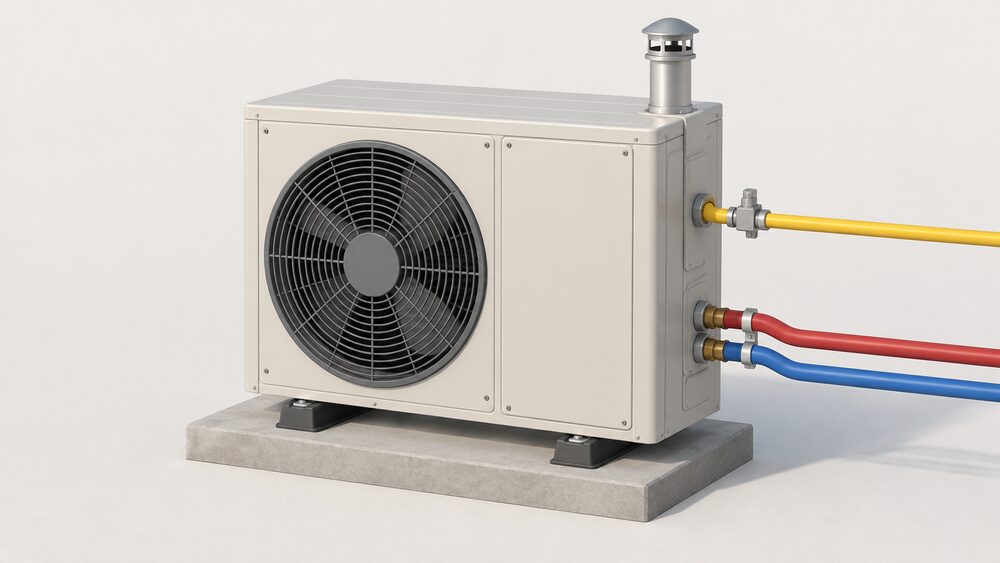
A gas absorption heat pump is a heat pump that is driven by heat rather than by an electrically driven compressor. Most heat pumps use an electrically driven compressor1, and the absorption alternative replaces that compressor with a thermal cycle: a burner, a solar collector or a waste heat stream supplies the energy that moves the refrigerant, and the unit then draws its useful heat from ambient air, ventilation exhaust air, or a water or ground source2. The drive energy for a heat pump can come from electricity, gas or thermal energy3.
That single change has consequences. A thermally driven unit draws very little electricity, which matters where a supply is constrained, but it still consumes a fuel, so it does not by itself take a household off gas. The mainstream UK route runs the other way: air source heat pumps are the most common type of domestic heat pump in the UK and are suitable for most types of homes4, and heat pumps are technically suitable for most UK homes if installed appropriately5.
This page sets out how the sorption cycle works, what can drive it, what efficiency can be expected, what it costs, where the technology is used, and how it sits against a UK housing stock that is being pushed off gas.
What a gas absorption heat pump is, and how it differs from an electric one
A conventional heat pump is a device which uses a small amount of electricity to absorb the natural heat from the air or the ground and pump it around the heating system of your property10. The mechanism is a vapour compression cycle: the heat pump, via an evaporator, a compressor and a condenser, transfers the heat to a hot water tank which feeds the heating distribution system11. The compressor is the component that does the work, and it is what most heat pumps have in common1.
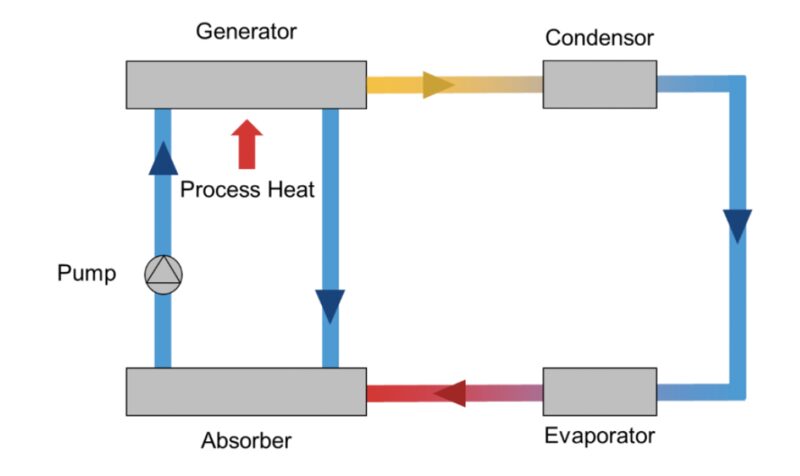
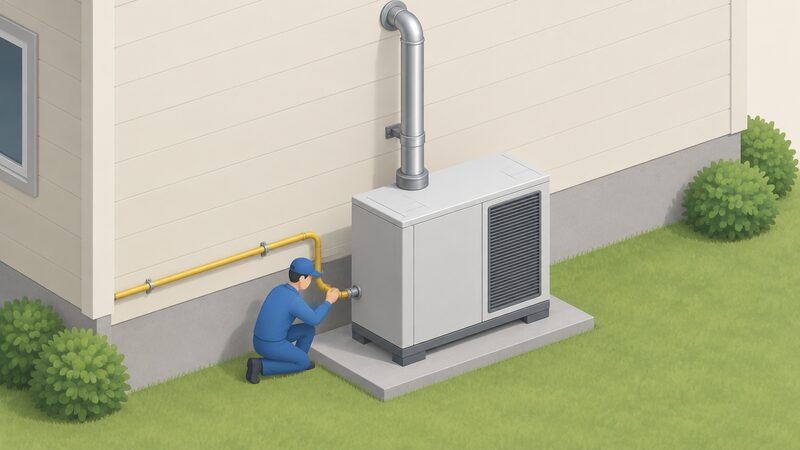
A gas absorption heat pump removes the compressor and replaces it with a thermal compressor. Instead of mechanical work, heat drives the refrigerant out of solution in a generator, and the cycle continues through an absorber, condenser and evaporator. The practical effect is that the unit needs a heat source to run at all, and that source can be a gas burner, a solar thermal array or a waste heat stream. The refrigerant side of the cycle still gathers heat from the environment, so the unit remains a heat pump rather than a boiler.
The distinction between absorption and adsorption matters here. Absorption uses a liquid working pair, where one liquid takes the refrigerant vapour into solution and is regenerated by heating. Adsorption uses a solid sorbent that holds the vapour on its surface and is regenerated the same way. Both are sorption cycles, both are thermally driven, and both are covered by the same European standard: gas sorption heat pump (GAHP) and thermal compression heat pump (TCHP) are both covered by the standard EN 123096.
Heat sources: natural gas, propane, solar and waste heat
The heat that drives a sorption unit and the heat it collects are two separate things, and both matter.
On the drive side, the energy can come from electricity, gas or thermal energy3. Natural gas is the common fuel for packaged gas absorption units, and propane is the equivalent for off-grid sites. Thermal energy covers solar heat and recovered waste heat, which is where the technology becomes interesting for buildings that already have a heat stream to spare.
On the collection side, the sources are the same as for any heat pump. Capturing heat from ambient air, ventilation exhaust air, or a water or ground heat source using a heat pump is the standard description in Approved Document L2. Water source heat pumps use the energy stored in ground water, surface, or sea or sewage water6, and the same definition appears in the domestic Renewable Heat Incentive rules, which describe a water source heat pump as a heat pump where the collecting medium is water12. Ground source units extract heat from the ground via buried pipes filled with a refrigerant13.
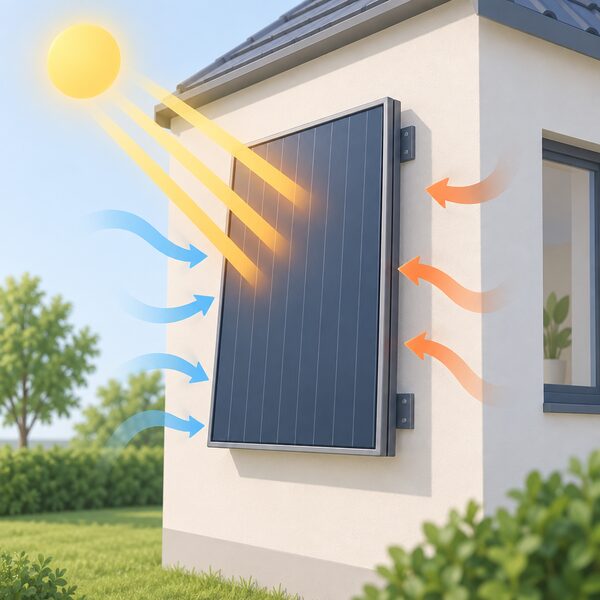
Solar assisted heat pumps sit alongside these. A solar assisted heat pump heats water by absorbing heat from direct sunlight and from the air14, and it has a large, flat evaporator panel that absorbs the heat from sunlight falling directly onto it and from the air around the panel14. Crucially, solar assisted heat pumps can also work without direct sunlight14, so the panel is not idle on a grey day.
"A solar assisted heat pump heats water by absorbing heat from direct sunlight and from the air."
The combination of a thermal drive and an ambient source is what makes the sorption route attractive on paper: a site with waste heat and a need for heating can in principle run a heat pump without adding to its electrical load.
Efficiency: where absorption beats electric heat pumps, and where it falls short
The efficiency case for sorption units is narrower than it first appears, and the comparison that matters is against mainstream electric heat pumps rather than against boilers.
Mainstream heat pumps are around three-to-four times more efficient than gas boilers, which should lead to lower household energy bills8. Bristol City Council puts the figure slightly differently, describing heat pumps as typically over three times more efficient than the most efficient gas boilers or electric heaters15. Ground source units are typically even more efficient than air source heat pumps, providing 3 to 4 times the amount of heat than the electricity they use16. The energy comparison is stark: the higher efficiency of a heat pump means the amount of energy needed can be less than a third the amount of energy needed by a gas boiler to produce an equivalent amount of heat17.
A gas absorption heat pump cannot match those figures, because its drive energy is a fuel rather than electricity, and the sorption cycle itself has lower conversion efficiency than a vapour compression cycle. What it does offer is a much lower electrical draw, which is a different kind of advantage: it reduces demand on the electricity network rather than reducing primary energy. Heat pumps generally use only a quarter of the electricity used by conventional electric heaters to produce the same amount of heat10, and a sorption unit pushes that electrical figure lower still, at the cost of burning something.
The honest summary is that absorption wins on electrical load and on the ability to run from waste heat, and loses on the efficiency per unit of delivered energy. Where a site has no electrical capacity to spare and a cheap heat stream available, the trade can make sense. Where a household is comparing running costs against an electric heat pump on a time-of-use tariff, it usually does not.
Costs: higher upfront, lower running costs
The cost picture for heat pumps generally is well documented, and it sets the frame for any alternative technology.
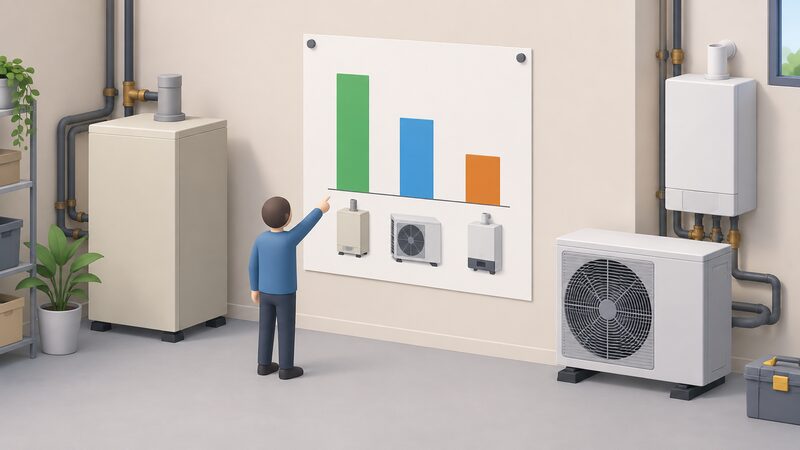
At current prices, the upfront costs of heat pumps are higher than fossil fuel boilers19. Running costs for heat pumps are typically lower when compared to those of traditional gas boilers, though the government notes that this depends on the system being installed and operated well20. Air source heat pumps are usually less expensive than ground source heat pumps21, and ground source systems give lower running costs and lower CO2 emissions but cost more to install21. Air to air heat pumps have lower upfront costs than other heat pump types19, and their advantage is a low upfront cost in smaller homes22.
For a gas absorption unit, the capital cost sits above a conventional gas boiler because the equipment is more complex and the installed base is small. Prices are installer-quoted and vary with the site, so no published range applies. The running cost case depends entirely on the price of the drive fuel against the price of electricity, and on how much of the heat can be recovered from a waste stream rather than bought.
One independent cost model puts an air source heat pump with subsidy at £960 in total lifetime cost, made up of £300 upfront costs, £80 maintenance costs and £580 running costs26. That is a mainstream electric comparison point, not an absorption one, but it shows the shape of the numbers a household is weighing against.
Residential, industrial and refrigeration applications
A heat pump is a device that can provide heating, cooling and hot water for buildings, districts and even for industry3, and it is a versatile system capable of providing heating, cooling and hot water for homes, commercial buildings and industrial applications27. Sorption cycles inherit that breadth, and in practice the industrial and refrigeration applications are the established ones.
Absorption refrigeration is the older use of the cycle. It suits situations where a heat source is available and electricity is scarce or expensive, which is why gas fired refrigeration has persisted in niche settings. The same machine run in heating mode becomes a heat pump, and the same cycle can serve both.
On the heating side, the suitability of the mainstream types is well mapped. Air source heat pumps are suitable for residential homes, apartments and small commercial buildings13, while ground source heat pumps suit single-family homes, larger residential buildings and commercial properties13. Best practice guidance exists for residential heat pump applications, covering system design, commissioning and operational performance27, and separately for large-scale installations in complex buildings, addressing electrical integration, system design challenges and real-world performance27. That second category is where thermally driven units have their clearest niche, because electrical integration is exactly the constraint they relieve.
Maintenance and refrigerants

Servicing for a heat pump follows the manufacturer's advice, usually once a year7. A typical service visit covers an electrical safety check, checking the thermostat operation, a general visual inspection of the unit, refilling refrigerant if needed, checking for leaks and pressures, cleaning filters and coils, checking all large components such as the compressor, fan and pump, lubricating moving parts, and replacing any small parts such as seals and gaskets as per the manufacturer's guidelines7.
A sorption unit changes that list in two ways. There is no compressor to check, but there is a generator, an absorber and a burner or heat exchanger to inspect, and the working pair has to be kept in condition. The refrigerant charge still needs checking, and the same leak and pressure checks apply.
Servicing is a manufacturer-led routine rather than a fixed legal interval: the Energy Saving Trust describes heat pumps as being serviced by an engineer in line with the manufacturer's advice, typically once a year7. Typical service tasks include cleaning filters, checking for leaks and verifying that components are functioning properly, and some models offer remote monitoring and management for diagnostics, servicing and maintenance7.
Refrigerants are the other maintenance consideration. Ground source units use buried pipes filled with a refrigerant13, and the choice of refrigerant affects both the leak checks needed and the environmental profile of the unit. A sorption unit using ammonia or lithium bromide avoids some high global warming potential refrigerants but introduces a working pair that needs its own handling regime. The standard covering the equipment, EN 12309, applies to gas sorption heat pumps and thermal compression heat pumps alike6.
Are gas absorption heat pumps a fit for UK homes moving off gas?
The short answer is that they sit against the direction of UK policy rather than with it.
Heat pumps are technically suitable for most UK homes if installed appropriately5, and the mainstream domestic route is the electric air source unit, which is the most common type of domestic heat pump in the UK and is suitable for most types of homes4. The scale of the intended transition is large: the Heat Pump Sector Deal expert advisory group described up to 10 million homes on the gas grid in the UK transitioning to heat pumps and hybrid heat pumps by 20359. A gas fired absorption unit keeps a household on mains gas, so it does not deliver the move off gas that the transition is built around.
There is a second constraint. Sizing rules for heat pumps are strict: heat pumps should be selected to meet the full space heating requirement at the design condition chosen for heat loss calculations2, and the Scottish building standards guidance adds that this should be with no heat from additional electric heaters within the design external temperature range28. Any alternative unit has to meet the same design standard to be a like-for-like substitute.
Where the technology does fit is off the gas grid and outside the domestic mainstream: sites with a waste heat stream, buildings with constrained electrical capacity, and industrial processes needing simultaneous heating and cooling. For a household weighing up its options, the practical comparison is between the established electric types, and the site's own emerging home energy technology landscape, rather than a gas fired sorption unit. Households in Scotland, Wales, England and Northern Ireland face the same grant lists and the same direction of travel, though the devolved administrations publish their own building standards guidance.
Sources28 cited
- Heat pump methodology, GOV.UK, 2026
- Approved Document L, Conservation of Fuel and Power, Volume 1: Dwellings, GOV.UK, 2023
- About heat pumps, European Heat Pump Association, 2026
- Air source heat pumps, Energy Saving Trust, 2026
- Heat pumps for domestic heating, UK Parliament POST, 2026
- Types of heat pumps, European Heat Pump Association, 2023
- Heat pump questions answered, Energy Saving Trust, 2026
- The Seventh Carbon Budget, Climate Change Committee, 2025
- Heat Pump Sector Deal final report, Scottish Government, 2021
- Facilitating net zero: heat pumps, Electricity North West, 2026
- Heat pumps, Planning Portal, 2026
- Domestic Renewable Heat Incentive: eligible heating systems, Ofgem, 2015
- Heat pumps, nidirect, 2025
- Solar assisted heat pumps, Energy Saving Trust, 2025
- Bristol Warm Homes Plan, Bristol City Council, 2025
- Ground source heat pumps, individual, Nesta, 2025
- Heat Buildings Strategy, Scottish Government, 2021
- Heat Buildings Strategy: Business and Regulatory Impact Assessment, Scottish Government, 2021
- Response to the Scotland draft climate change plan 2026 to 2040, Energy Saving Trust, 2026
- What impact can heat pumps have in domestic heating today, GOV.UK, 2023
- Air source heat pumps vs ground source heat pumps, Energy Saving Trust, 2026
- Air to air heat pumps, Nesta, 2025
- Boiler Upgrade Scheme Installer Guidance, Ofgem, 2022
- Boiler Upgrade Scheme Guidance for Installers, Ofgem, 2023
- Warm Homes: Local Grant policy guidance, GOV.UK, 2026
- Seven reasons we still need heat pump subsidies, Nesta, 2025
- Heat pumps, CIBSE, 2026
- Domestic Building Services Compliance Guide 2022, Scottish Government, 2022
 Energy IndependenceA heat pump runs your heating on electricity instead of gas or oil, so how much does that really cut what you pay and how exposed you are when fuel prices jump?
 Heating Off the Gas GridThe options for the four million UK households with no mains gas connection: oil, LPG, electric, heat pump, biomass and solid fuel, and how their costs, storage and supply security compare.
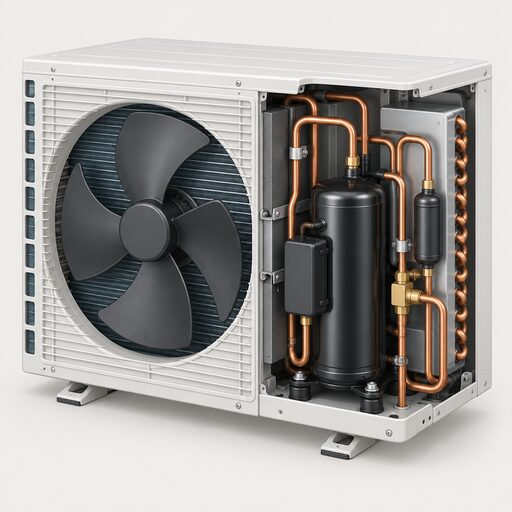 Air Source Heat PumpsHow an air source heat pump takes heat from outdoor air, the difference between air-to-air and air-to-water systems, typical efficiency, the £7,500 Boiler Upgrade Scheme grant, noise and planning limits, and what ownership means for a household's energy independence.
 How They Perform in UK HomesHow well do heat pumps really work in UK homes, and why do some run far better than others?
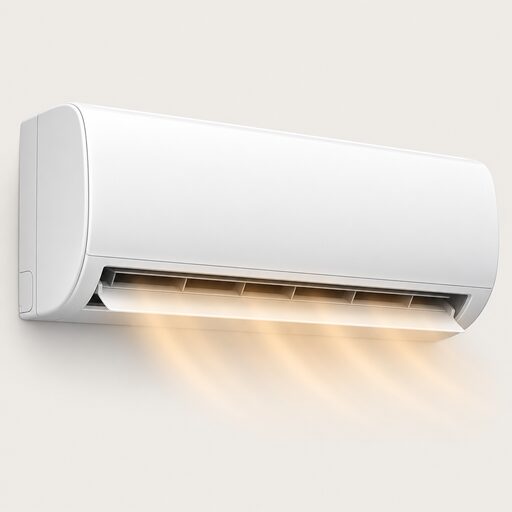 Air-to-Air Heating and CoolingAir-to-air heat pumps deliver warm air through indoor fan units rather than hot water to radiators.
 Which Homes Suit a Heat PumpMost UK homes can have a heat pump fitted, so the real question is whether yours makes it easy or expensive.