
In this guide
Sodium-ion is being offered to UK households as an alternative chemistry for home storage rather than as a replacement for the lithium-ion systems already installed in their tens of thousands. One UK supplier markets sodium-ion battery systems for residential and commercial energy storage, with appliance integration for solar PV, EV chargers and heat pumps, and states a long cycle life with 10-year product cover and an 8,000-cycle guarantee1. Those are the maker's own numbers. No independent or official figure for the energy density, cold-weather behaviour or field degradation of a sodium-ion home battery is published in the material behind this page, and that absence is itself the honest answer to where the technology stands: a product on sale, with performance evidence that has not yet been tested in public by a regulator, a certification body or a consumer organisation.
Everything else in domestic storage is still measured against lithium-ion. Lithium-ion and lead-acid remain described as the main types for domestic use, with lithium-ion the dominant choice, weighing two thirds less than lead-acid, able to discharge more of its stored energy, and offering greater long-term savings despite a higher upfront cost2. The lifetime figures a household plans around come from that world: about 10 to 12 years according to the Energy Saving Trust3, and around 10 to 15 years in a parliamentary briefing, which notes that domestic battery storage has a shorter lifetime than the solar panels it sits beside4.
For a household weighing sodium-ion, the practical question is not chemistry for its own sake but what storage does for independence and what dependence remains. A battery stores electricity to use later, making a home energy system more independent of the National Grid5. It does not disconnect the home. Supply, metering, tariff and, for most systems, an app and a cloud service all remain, and only the more expensive battery systems can provide electricity during a power cut6.
What a sodium-ion home battery is being sold to do
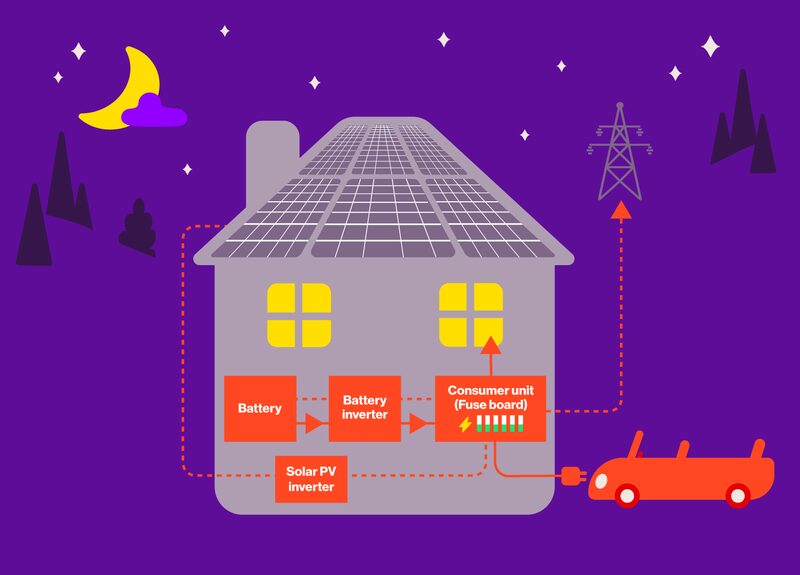
The job description is identical whichever chemistry is inside the cabinet. Batteries are a way for homeowners to store excess electricity produced from their solar system9. Unused generation can be used throughout the home, exported to the grid, or stored in a battery for use at another time10. Stored solar can power the home during the night11, can run a heat pump on the household's own electricity rather than imported units12, and can be charged when a tariff is cheap and drawn on when prices are high3.
The sodium-ion offer in the UK is framed the same way: residential and commercial energy storage, integrated with solar PV, EV chargers and heat pumps1. What differs is the evidence base behind it. Lithium-ion domestic storage has independent lifetime figures, published sizing guidance, a certification scheme and consumer-body assessments of value. Sodium-ion, at this stage, has a maker's specification sheet. That gap is the single most important thing for a buyer to understand, and it is the same gap that appears across emerging home energy technology generally: a working product can be years ahead of independent verification. The way to read such claims is set out in the guide to technology readiness and energy product claims.
Energy density: what is actually documented
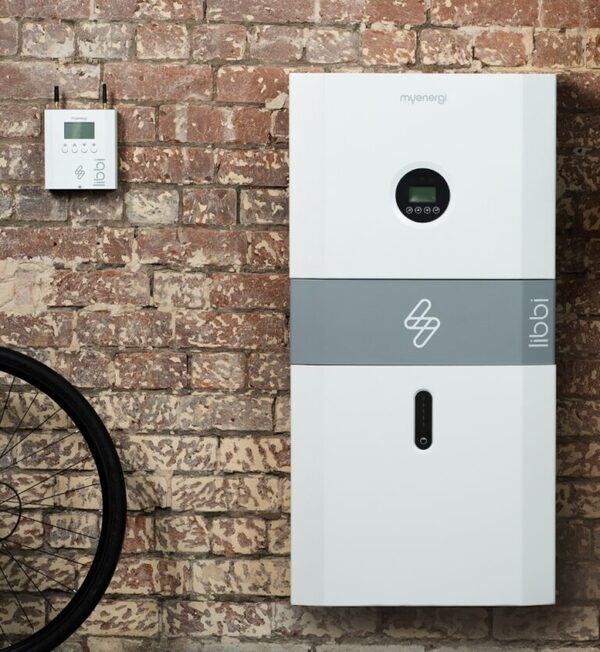
Energy density is the headline argument in any sodium-ion discussion, and it is the point on which the least verified UK data exists. What is documented is the comparison that matters for space-constrained homes at a broader level: lithium-ion batteries can have roughly double the energy density of water storage, which makes them effective where space is limited13. Against lead-acid, lithium-ion weighs two thirds less and can discharge more of its stored energy2.
No independent UK figure for the watt-hours per kilogram or per litre of a sodium-ion home cell is published in the material available here, and none should be inferred from the general chemistry literature. What can be said is that a home battery is a fixed installation, so mass matters far less than it does in a vehicle, and the practical constraint is cabinet volume and wall or floor loading rather than kilograms carried. A lower-density chemistry in a static application is a different trade-off from a lower-density chemistry in a car. The side-by-side treatment is developed further in sodium-ion vs lithium-ion home batteries, and the other chemistry people ask about in the same breath is covered in solid-state batteries.
Capacity and sizing: 8 to 10 kWh is the common domestic figure
Sizing guidance clusters tightly. For a 100 to 120 square metre home with three or four occupants, an 8 to 10 kWh battery paired with a 3 to 6 kWp solar installation is described as generally appropriate, and a properly sized solar storage system is said to lift self-consumption to 70 to 80 per cent7. A separate maker guide puts a typical family home with a 4 to 8 kW solar system at two to four battery modules, 10 to 30 kWh in total, and bigger houses with multiple air conditioners, electric vehicles or high appliance use at four to eight modules, 25 to 50 kWh or more14.
| Household | Solar array | Storage quoted |
|---|---|---|
| 100 to 120 m², 3 to 4 occupants | 3 to 6 kWp | 8 to 10 kWh7 |
| Typical family home | 4 to 8 kW | 10 to 30 kWh14 |
| Large home, EV and high appliance use | not stated | 25 to 50 kWh or more14 |
Both of those are maker sizing guides and should be read as such. The figure that cuts the headline capacity down in practice is the reserve: when the battery reaches a set level, perhaps 20 per cent of total storage capacity, the system stops discharging3. A nominal 10 kWh unit is therefore not 10 kWh of household supply. Sodium-ion systems sold in the UK are marketed into exactly this size band, for residential use alongside solar, EV charging and heat pumps1.
Lifetime, cycles and degradation

The lifetime a household should plan for is roughly a decade and a bit. The Energy Saving Trust gives about 10 to 12 years3. A parliamentary briefing gives around 10 to 15 years and makes the point that storage is the short-lived element of a solar and battery installation4. The Centre for Sustainable Energy gives a typical lifespan of 8 to 12 years, with payback periods in the region of 8 to 12 years, which is similar to that reported lifespan8. That overlap is the awkward fact of domestic storage economics: the system may only just pay for itself within its own life.
Maker figures for lithium-ion run slightly longer, at 10 to 15 years or 5,000 to 10,000 cycles for lithium iron phosphate types, against typically 3 to 7 years and fewer cycles for lead-acid14, and 10 to 15 years for modern lithium-ion used in solar storage7. The sodium-ion claim of an 8,000-cycle guarantee with 10-year product cover1 sits inside that lithium-ion cycle band rather than above it, on the maker's own numbers.
On degradation, the independent work in the public domain comes from vehicle-to-grid research rather than from static home storage: modelling assumes a battery lasting 2,000 full cycles15, and capacity fade is reported as reducible by 9.1 per cent over a year through battery management16. Those are V2G figures and do not transfer directly to a wall-mounted home unit, but they make the point that how a battery is cycled, not just how many times, drives its decline.
Because panels outlast cells, MCS advises that a household with solar panels can expect to replace the battery at least once during the life of the solar panel system17. That replacement is a cost, and for sodium-ion it is also a continuity question: a replacement module in year eleven depends on the company still existing, an issue examined in energy technology company failures and orphaned products.
Charging behaviour and what UK homes actually do
Monitored homes show a clear pattern. Battery-equipped homes show strong overnight charging peaks across autumn, winter and spring, consistent with energy arbitrage behaviour on time-of-use tariffs, and electric vehicle charging in the same homes peaks between midnight and 6am, optimising for current time-of-use tariffs18. That is the behaviour the economics reward: charge off-peak at the lowest rate and use the energy during the peak-rate period to reduce the bill19.
The consequence for independence is double-edged. A battery cycled largely on cheap overnight import is a tariff arbitrage device, not a route off the grid. A battery cycled on surplus solar is closer to self-supply: home battery storage is usually used in combination with solar panels, a smart time of use tariff, or both3, and in the Active Homes development at Neath in South Wales the householder's use of solar generated electricity is maximised by battery storage20. Excess beyond what the battery holds is exported to the grid21.
Charge and discharge limits are part of how life is protected. Home systems enforce a floor at around 20 per cent of capacity automatically22. In vehicles the same principle is advised to the driver: keep charge between 20 and 80 per cent most days23, avoid letting the battery get down to the 20 per cent mark24, and one manufacturer guide recommends charging to 80 per cent to protect the battery and maximise efficiency25.
The trade-off: density and fast charging against longevity
Every cell design trades energy density and charge rate against life. The clearest published evidence of that trade-off is in how vehicles behave at high states of charge. Charging slows significantly after about 80 per cent to protect the battery and prolong its lifespan27, most EVs slow charging after around 80 per cent28, and in some cases it can take as long to charge from 80 to 100 per cent as from 20 to 80 per cent29. As a rule of thumb, 20 to 80 per cent should take between 30 and 90 minutes27. The rate also falls at low states of charge, for example below 10 per cent, and the ideal battery temperature for charging is around 25 degrees Celsius30.
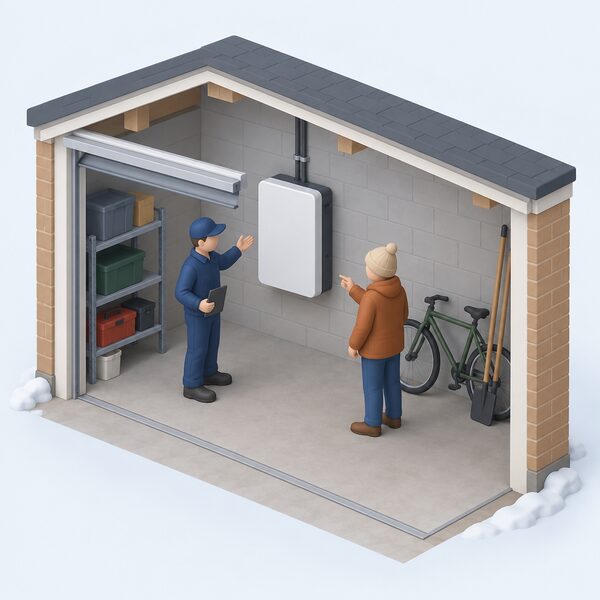
That temperature figure is the nearest documented point to the cold-weather question people ask of sodium-ion. It applies to EV batteries, not to sodium-ion home cells, and no verified cold-performance figure for a sodium-ion domestic battery is available here. A household in an unheated garage or an outbuilding should ask the installer for the manufacturer's stated operating temperature range rather than rely on general claims about the chemistry.
For a static home battery the trade-off lands differently from a car. A wall unit is rarely asked to accept a very high charge rate, so a chemistry that prefers steady cycling loses less in domestic service than it would in a vehicle. The general lithium-ion position remains that a higher upfront cost may be repaid by greater long-term savings2.
Using a car battery, and two-way energy flow
The largest battery most households will ever own is in the driveway. Electric vehicle batteries in principle offer a very large potential to contribute to home energy storage and electricity system balancing31. An energy efficient house of the future is modelled with both battery storage and an EV battery storing electricity32. Capacities are meaningful: a typical vehicle is described as having a 50 kWh battery and a 300 mile range33, with smaller models at 40 kWh nominal and 37 kWh usable34. Average range is given as 225 miles before charging35, and 100 to 200 miles from a single charge elsewhere24.
The limit is availability. Generally you cannot use an EV as a home battery; bidirectional charging is being trialled in some places but is not widely available3. Where it works, bidirectional charging allows EVs to power a home or export energy to the grid, and provides backup power during outages36, and a vehicle-to-grid system could offer two-way movement of energy, with energy stored in the car used in the home or sold back to the grid at peak demand37. Those routes are covered in bidirectional charging explained and vehicle-to-home and vehicle-to-load, and the choice between the two approaches in vehicle-to-grid or a home battery.
A home battery and solar work together for charging either way: with a home battery, surplus solar is captured and held for when it is needed, including overnight EV charging, rather than wasted or exported at a relatively low rate38, and charging from your own electricity is significantly cheaper than grid power and far cheaper than petrol or diesel over the same distance38. AC charging is the most common method for home and workplace charging, with the vehicle's onboard charger converting AC to DC39; rapid chargepoints cannot be installed at home40. Slow charging at home can be done from a standard 3-pin socket, but a dedicated unit is strongly recommended for regular charging41, and charging from a regular three-pin plug is possible but not recommended39. Around 85 per cent of all EV charging happens at home42.
Costs quoted for a full home charge vary. One 2025 figure is approximately 17 pounds for a 50 kWh battery, with eight pounds cited elsewhere in the same publication43. The average cost to charge at home was 13 pounds in October 2024, based on an average domestic rate of 24.5p per kWh and a typical 54 kWh battery44. A third figure is 14 pounds 70 for a 60 kWh battery at 24.5p per kWh45. All are import-rate figures; solar-charged miles sit outside them.
Warranties and cover
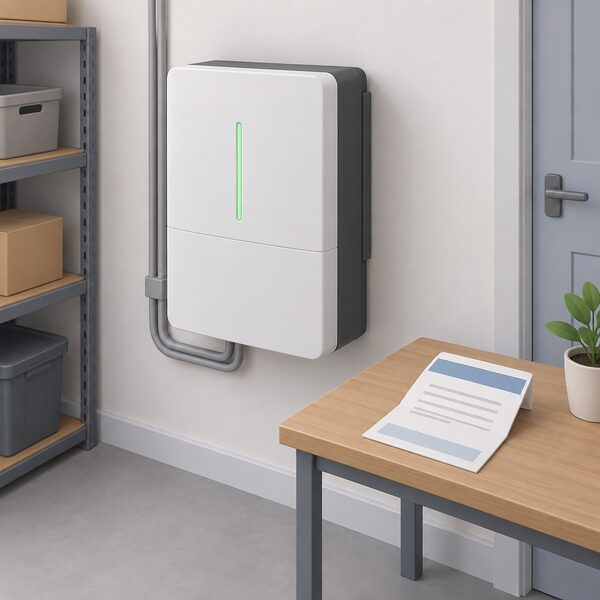
| Product | Cover stated | Source type |
|---|---|---|
| Sodium-ion home system (UK supplier) | 10-year product cover, 8,000-cycle guarantee1 | maker |
| EV traction battery | at least 8 years or 100,000 miles46 | official (SMMT) |
| EV traction battery | around 8 years or around 100,000 miles47 | independent |
| EV traction battery | 8-year or 10-year guarantee, 100,000 to 150,000 miles48 | independent |
The contrast matters. Vehicle battery cover is standardised across an industry and reported by an official trade body46. Home storage cover is set product by product, and the sodium-ion figure above rests on the company that sells it1. A ten-year product cover is only worth the decade if the company is trading in year ten, which is why company standing belongs in any assessment of an emerging-chemistry purchase.
Cost, value and what the consumer bodies say
No published UK price for a sodium-ion home battery is available here, so prices are installer-quoted and no range is given. On value, the independent position on domestic storage generally is cautious. Battery systems are currently very expensive and do not make financial sense for every household; they may save on imported electricity costs, and the more expensive systems can also provide electricity during a power cut6. The Centre for Alternative Technology goes further: at present this may not be worthwhile in a grid-connected house, batteries are still quite expensive, and there are environmental impacts in manufacture and disposal49. Payback periods of 8 to 12 years sit close to the battery's own lifespan8.
VAT treatment is defined in legislation: an electrical storage battery qualifies if it is intended for use solely for storing energy converted from electricity supplied to the residential accommodation or building in question, or generated by a microgeneration system50. Replacement is possible but not cheap. EV batteries can usually be replaced, but it is complicated and often expensive51; home batteries should be expected to be replaced at least once in the life of a solar array17. What early adoption of any new chemistry costs in practice is set out in what emerging energy technology costs early adopters.
Grid balancing: the value beyond the meter
Individually a home battery shifts a few kilowatt-hours. Collectively the picture changes: the combined potential of millions of homes with batteries could release stored power onto the grid when needed, helping balance supply and demand across the country9. Demand side response covers a range of services that vary the demand of both domestic and commercial consumers to help balance the power grid52. Further innovation in home battery technology, vehicle-to-everything and solar can give households additional backup options during power outages53, and heat batteries can help balance the electricity grid too54. Consultation work asks what action is needed to manage grid impacts and make the most of the opportunities afforded by vehicle-to-grid technologies55, while network-led projects explore ways for households to participate in flexibility markets, including those without their own low carbon technologies56. Modelling of domestic systems is being revised, with reworked solar PV and electric battery models in the Home Energy Model57.
For the household, flexibility income is a dependence as well as a benefit. It requires a supplier, a tariff, a communicating meter and usually a manufacturer's cloud platform. A sodium-ion battery changes the chemistry inside the box; it does not change that chain.
Where sodium-ion stands, and what to ask

What is confirmed is narrow. Sodium-ion battery systems are offered in the UK for residential and commercial energy storage, integrated with solar PV, EV chargers and heat pumps, with a maker-stated 10-year product cover and 8,000-cycle guarantee1. What is not confirmed, in any independent or official UK source available here, is sodium-ion energy density, cold-weather performance, field degradation, installed cost or long-term reliability in British homes.
Against that, lithium-ion carries a decade of published lifetime data, sizing guidance, certification and consumer-body scrutiny2. A household comparing the two is comparing a well-documented product with a less-documented one, and the questions that close the gap are specific: the stated operating temperature range, what the cycle guarantee actually guarantees and in what conditions, who honours the cover, and whether replacement modules will be obtainable in ten years. A list of which systems use the chemistry is kept in which home batteries use sodium-ion cells.
Practical habits that protect any cell are consistent across the evidence: only use rapid charging when needed, do not fully charge the battery, and do not let it get too low51. Home systems apply the equivalent automatically through a reserve level22. The independence a battery delivers is real but bounded: it makes the home's energy system more independent of the National Grid5, and lifts self-consumption towards 70 to 80 per cent on a properly sized system7. It does not end the relationship with a supplier, and for most installations it does not keep the lights on in a power cut.
Sources57 cited
- Sodium-ion battery systems for homes, Eleven Energy, 2026
- Electrical energy storage systems, Flexi-Orb, 2025-04-22
- Battery storage advice, Energy Saving Trust, 2026-08-19
- Solar and domestic battery storage briefing, POST, 2026-06-25
- Solar panel battery storage, Which?, 2026-05-14
- Making the most of your solar PV panels, Centre for Sustainable Energy, 2026-08
- Why solar battery storage matters, SunPower, 2026-05-19
- Battery storage advice, Centre for Sustainable Energy, 2025-10
- Batteries in the home, Solar Energy UK, 2026
- Renewables and electrics for householders, NICEIC, 2026
- Solar panels guidance, Oxfordshire County Council, 2026
- Running a heat pump efficiently, Energy Saving Trust, 2026-05-19
- Clean heating options for challenging dwelling types, ClimateXchange, 2024-09-20
- How many batteries does a home need, SAJ Electric, 2026-07-22
- Vehicle to Grid Britain, Cenex, 2026
- More than money: the true power of V2G, Cenex, 2026
- Battery storage for consumers, MCS, 2026
- Grid impacts of heat pumps, EVs and solar, Energy Systems Catapult, 2025-08-18
- The best heating for your home, Which?, 2025-09-22
- Building for 2050: low cost, low carbon homes, UK Government, 2022-12-05
- Solar panels and an electric vehicle: a householder's story, Energy Saving Trust, 2025-03-03
- Battery storage advice, England, Energy Saving Trust, 2026-08-19
- Best EV charging tariff guide, Uswitch, 2025-07-02
- Electric cars and energy bills, Uswitch, 2026-04-27
- Kia EV6 charging guide, Zapmap, 2026
- Lithium ion batteries at home, North Wales Fire and Rescue Service, 2026
- Electric car charging guide, Carwow, 2025-07-16
- Finding charging stations without home charging, Carwow, 2026-06-21
- Guide to EV charging, Zapmap, 2026-09-04
- How long does it take to charge an electric car, Zapmap, 2026-04-15
- Demand flexibility, CREDS, 2026
- House of the future, Energy Saving Trust, 2026-07-15
- Smart charging electric vehicles, Energy Saving Trust, 2025-03-25
- How long to charge an electric car, Uswitch, 2024-11-26
- Electric cars advice, Home Energy Scotland, 2026-09-20
- Integrating solar panels with EV charging, Uswitch, 2025-07-02
- Smart homes and a lower carbon footprint, Energy Saving Trust, 2026-01-21
- Can solar panels charge electric cars, CPA, 2026-04-15
- Electric car charging at home, myenergi, 2026
- Charging electric vehicles, Energy Saving Trust, 2026-04-23
- EV buying guide, Zapmap, 2024-12-06
- Electric car charging costs, Zapmap, 2026-09-04
- Debunking electric vehicle myths, Energy Saving Trust, 2025-09-22
- EV charging statistics, Uswitch, 2024-10
- Electric vehicle charge points, Flexi-Orb, 2025-04-22
- EVs: the facts, SMMT, 2025-09-22
- Lifetime cost of an electric vehicle, Uswitch, 2024-11-26
- Should you buy a used electric car, Energy Saving Trust, 2022-06-08
- Solar photovoltaic information, Centre for Alternative Technology, 2026-03-10
- Value Added Tax Act 1994, Schedule 7A, UK legislation, 2026
- Electric vehicle battery basics, Energy Saving Trust, 2025-09-16
- Demand side response briefing, POST, 2026-06-07
- A well-adapted energy system, Climate Change Committee, 2026-09-19
- No home left behind, Association for Decentralised Energy, 2026-09-20
- Electric vehicles: developing the market and infrastructure, CIBSE, 2026
- Neighbours could hold the key to cheaper, greener energy, UK Power Networks, 2026-06-15
- Home Energy Model consultation response published, Future Homes Hub, 2025-10-09
 Home Battery Install StatisticsHow many homes in the UK actually have a battery, and is that number growing quickly?
 The Full Home Batteries GuideA home battery stores cheap or solar power for later, but will it really cut your bills enough to be worth it?
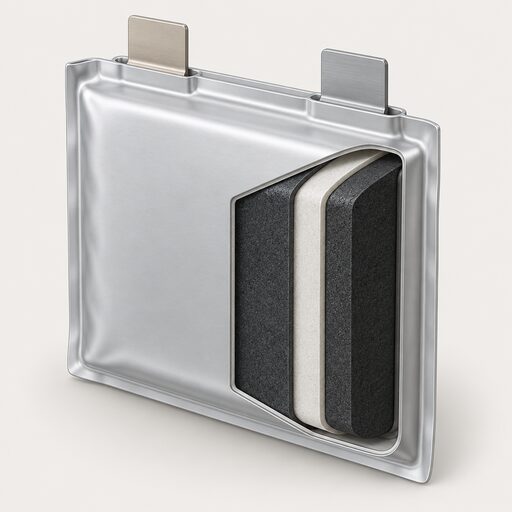 Solid-State BatteriesAre solid-state batteries on sale yet, and should you wait for one?
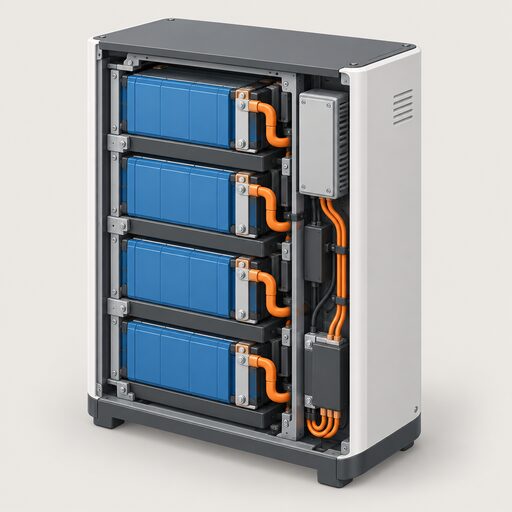 Batteries and IndependenceHow far home battery storage moves a UK household away from the grid and supplier pricing, covering self-sufficiency, winter limits, cost, lifespan, backup, export payments and flexibility earnings.
 Planning Permission in EnglandWhen a domestic battery or its enclosure falls within permitted development in England, when an application is needed, and how the position differs for outbuildings, listed buildings and conservation areas.
 The Full Statistics GuideHow many homes in the UK have solar panels, heat pumps or batteries?