

In this guide
Wales has a distinctive position in UK home energy technology: a devolved government with its own heat strategy, its own renewable energy targets and a coal mining legacy that has been turned into a national heat resource map. The headline numbers are these. Wales had 869 MW of renewable heat capacity at the end of 2023, after 67.5 MW of new renewable heat capacity was installed during that year1. The Welsh Government has set a target of installing 580,000 heat pumps in Wales by 2035, contingent on scaled up support from the UK Government and reductions in the cost of technology2. And in August 2024 it published a Mine Water Heat Opportunity Map covering all local authority areas, categorising coal mine workings as "Good", "Possible" and "Challenging" opportunities for mine water heat developments3.
For a household, the practical picture is narrower than the policy picture. Heat pumps are the technology carrying most of the domestic heating load, with 22,000 heat pumps in Wales by 2023 and approximately 6,900 new heat pumps installed in Wales in 20231. Solar PV and heat pumps together drove most of the growth in locally owned renewable capacity, with over 80% of new electrical and heat capacity in 2021 focused in the domestic sector4. Mine water heat, hydrogen and vehicle-to-home are at earlier stages: mapped, consulted on, or in feasibility, rather than available as a product a householder can buy.
What follows sets out what each technology is, what the Welsh Government and its agencies have published about it, and what dependence remains after installation. The grid, a supplier, gas and a manufacturer's company all stay in the picture to some degree, and the sections below say where.
Mine water heat in Wales: what the opportunity map shows
Wales's disused coal mine network is the largest untapped heat resource the country has mapped. The Welsh Government commissioned the Coal Authority to assess all known coal mine workings in Wales which might now hold water that is warmed by natural processes, and the resulting Mine Water Heat Opportunity Map was published on 29 August 20243. The map covers all local authority areas, and technical reports were prepared for 11 local authorities3. Both the map and the reports are published on the Welsh Government's website and link to DataMapWales, and are described as informative, freely accessible information and data3.
The underlying idea is straightforward. Water sitting in abandoned mine workings is warmed by natural processes underground, and where it can be brought to the surface it may offer a renewable, secure, low carbon source of heating for buildings in coalfield areas3. The Welsh Government singles out mine water treatment schemes and controlled gravity-driven discharges as locations offering particularly cost-effective potential for heating schemes, because the water is already being brought to the surface and managed3.
The funding behind the mapping was £450,000, confirmed in July 2022, which allowed the Coal Authority to investigate whether water from disused mines has the potential to play a vital role in supplying Wales's homes5. Sites were mapped to give a high-level assessment of where the best potential lies, with more detailed feasibility studies carried out on those considered to have the most realistic likelihood to connect to existing buildings and new developments5.
For a household, the map is a signal rather than an offer. It tells a coalfield community that a heat network may one day be viable there. It does not tell an individual house that it can have mine water heat. The mine water heat for homes page covers the technology itself, and the mine water heat temperature page covers what temperatures such systems can deliver.
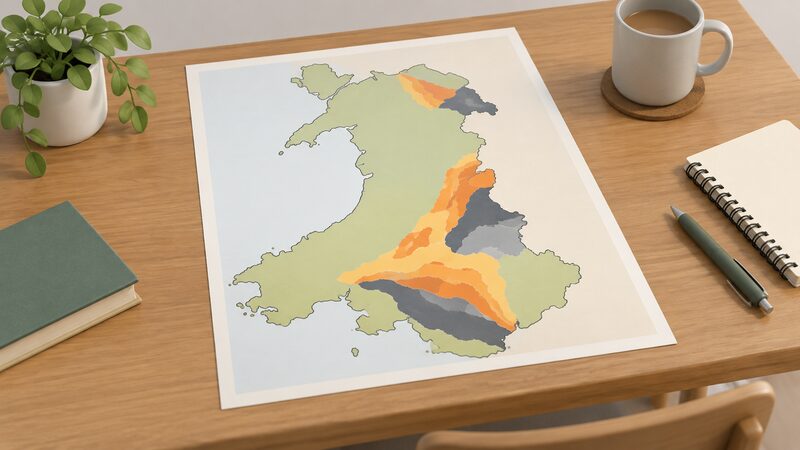
The map's 'Good', 'Possible' and 'Challenging' categories explained
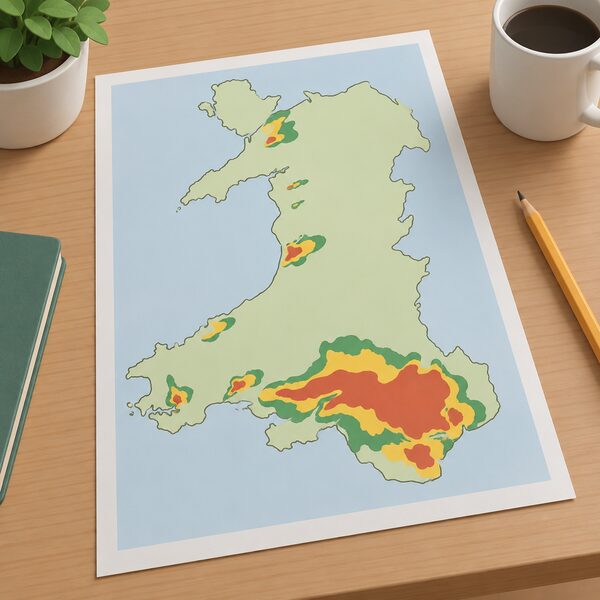
The map sorts known coal mine workings into three bands: "Good", "Possible" and "Challenging" opportunities for mine water heat developments3. The Welsh Government has not published the detailed scoring behind each band in the material available here, so the categories are best read as a screening tool rather than a guarantee.
What can be said is what the categories are for. The map exists to inform local authorities and developers on the opportunities and potential locations for mine water heat scheme sites3. A "Good" classification means the Coal Authority's assessment places that working among the most promising for a scheme; a "Challenging" classification means the geology, the water, the depth or the proximity to buildings makes a scheme harder to justify. The detailed feasibility studies were reserved for sites considered to have the most realistic likelihood to connect to existing buildings and new developments5.
That distinction matters for how a household reads the map. A "Good" rating on a coalfield area does not mean a heat network will be built, and a "Challenging" rating does not mean the heat is unusable, only that the engineering case is weaker. The map is a first pass across all known workings, not a project pipeline.
"Sites will be mapped to give a high-level assessment of where the best potential lies, with more detailed feasibility studies carried out on those considered to have the most realistic likelihood to connect to existing buildings and new developments."
Who the mine water heat map is for and how to use it
The map's stated audience is local authorities and developers3. That is the level at which mine water heat schemes are planned: a heat network needs an anchor load, a route and a customer base, and those are decisions taken by councils, developers and energy companies rather than by individual householders.
A householder in a coalfield area can use the map in three ways. First, to see whether their local authority area has workings classified as "Good" or "Possible", which indicates that mine water heat is at least on the table locally. Second, to check whether their area is one of the 11 local authorities with a technical report, which carries more detail than the map alone3. Third, to watch local planning and heat network consultations, because a scheme that reaches a household will arrive through a heat network connection rather than a standalone unit.
The wider policy context is that Wales is trying to keep more of the value from energy development in Wales for people and communities, and a proposed public energy company would build on existing Welsh Government-supported energy delivery functions6. Mine water heat sits inside that ambition: a local resource, locally developed, with the heat sold to local buildings.
The mine water heat for homes page covers what a connection involves. The demonstration and test homes page covers how Welsh schemes have been trialled in real properties.
Wales's renewable heat capacity today: 67 MW and what it means

Wales installed 67.5 MW of renewable heat capacity in 2023, bringing the total to 869 MW1. That single year's figure is the one to hold on to, because it shows both the scale of the current effort and its limits. In the same year, 109 MW of new renewable electricity capacity was installed, so renewable heat is running at roughly two thirds of the electrical build rate1.
The composition of that heat capacity is the more revealing number. Biomass still represents Wales's largest proportion of renewable heat, accounting for 55% of total renewable heat capacity1. Heat pumps are the growth technology but not yet the dominant installed base. In 2021, biomass accounted for 63% of all renewable heat capacity, followed by 16% from heat pumps4. The shift from 63% to 55% over two years shows heat pumps gaining share, but slowly relative to the target.
Regionally, the North Wales and Mid Wales regions account for the greatest proportion of Wales's total renewable heat capacity, at 31% each1. In 2021, Mid Wales accounted for 32% of renewable heat capacity, followed closely by North Wales at 31%, with the Cardiff Capital and Swansea Bay City regions at 18% each4. The concentration in rural mid and north Wales reflects the biomass base and the off-gas housing stock.
Welsh renewable heat projects produced nearly 2.7 TWh in 2023, against approximately 2.42 TWh in 20211. Heating accounts for 50% of energy use in Wales, which is why the heat side of the ledger matters as much as electricity3. For a household, the practical reading is that renewable heat in Wales is still carried mainly by biomass boilers and stoves, with heat pumps the technology the Welsh Government expects to take over the load.
| Measure | 2021 | 2023 |
|---|---|---|
| New renewable heat capacity | almost 29 MW from 2,210 projects4 | 67.5 MW1 |
| Total renewable heat capacity | 742 MW4 | 869 MW1 |
| Renewable heat generation | approximately 2.42 TWh4 | nearly 2.7 TWh1 |
| Biomass share of heat capacity | 63%4 | 55%1 |
| Heat pumps in Wales | 11,171 projects, 122 MW4 | 22,000 total1 |
Heat pumps: the technology carrying most of the heating load
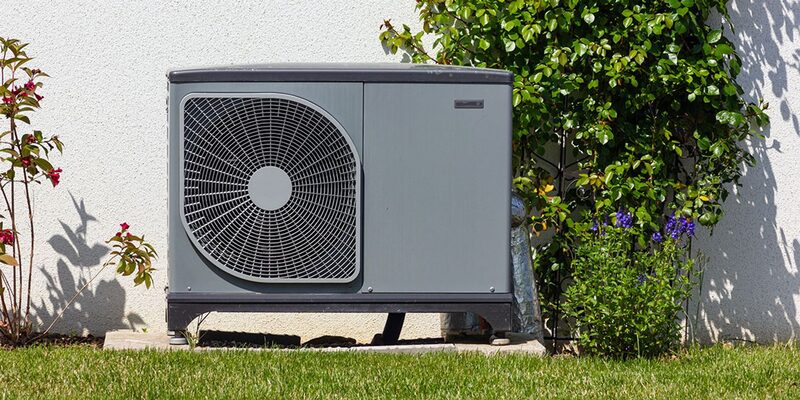
Heat pumps are the centre of Welsh heating policy. The Welsh Government has set an ambition to install 580,000 heat pumps by 2035, and the same target appears in its renewable energy targets consultation as a commitment that 580,000 heat pumps will be installed in Wales by 20351. The target is explicitly contingent on scaled up support from the UK Government and reductions in the cost of technology2. The Welsh Government has also accepted the Committee on Climate Change's projections on the heat pump numbers Wales needs by 2035 as the best basis for the target2.
The installed base is far behind the target. There were 22,000 heat pumps in Wales by 2023, after approximately 6,900 new heat pumps were installed in Wales in 20231. In 2021, 2,073 heat pump projects added 21 MW of electrified heat, and approximately 94% of renewable heat projects commissioned in Wales that year were heat pumps, from over 2,000 individual projects4. Domestic installations represented 92% of the 2021 capacity increase, at 19 MW4.
Wales has punched above its weight in the government-supported heat pump market. In the year ending June 2024, Wales took a 19% share of government-supported heat pump installations, the largest proportion of any part of the UK, ahead of the South West at 13% and the South East at 12%8. By the year ending September 2025, Wales's share had fallen to 13%, behind the South West and South East at 15% each9. That is a relative decline, not necessarily an absolute one, but it shows the Welsh lead narrowing.
The housing stock question is real. Only 1.5% of properties with EPCs in Wales have heat pumps, as of March 202510. The Committee on Climate Change's Balanced Pathway expects that by 2033, nearly a quarter of existing homes in Wales are heated by low-carbon electrified heating, predominantly heat pumps11. The Welsh Government's own consultation work states that heat pump installations, particularly those funded by government grant schemes, should be carried out correctly and supported by associated retrofitting measures to ensure energy bills do not rise following installation12. That is a condition on how the work is done, and it is the closest the published material comes to an answer on older Welsh housing stock: the technology is expected to carry the load, but only with retrofit alongside it.
Solar hot water and air source heat pumps in low-carbon show homes
Wales has used demonstration and retrofit programmes to test how these technologies behave in real Welsh homes. The Optimised Retrofit Programme funded three projects across Bridgend, Caerphilly, Flintshire and Ceredigion, covering environmental sensors, external wall insulation, PV, battery, mechanical ventilation with heat recovery, upgraded electrical heating and smart cylinder, communal heating upgrade with a heat battery, and air source heat pumps13. That combination is the template: fabric first, then a low-carbon heat source, then monitoring.
The Green Homes Wales scheme supports the installation, in domestic properties located in Wales, of certain types of energy efficiency improvement measures and low carbon heating systems14. The eligible measures include air source heat pumps, ground and water source heat pumps, high heat retention storage heaters, biomass boilers or stoves, solar thermal, solar PV, solar PV with a solar diverter or PVT, solar PV with battery storage, solid wall insulation, flat roof or room in roof insulation, loft insulation, cavity wall insulation, high performance glazing, draught proofing, floor insulation, and heating controls and smart home energy management systems15. The scheme provides interest-free loans to homeowners to decarbonise their homes and make them use less energy15.
The evidence from the programmes is that the combination matters more than any single measure. Welsh Government housing guidance states that deep retrofit with renewables can dramatically reduce fuel bills, keeping households out of fuel poverty as energy costs rise, and that renewables combined with storage, typically PV with batteries, further reduce fuel bills16. The same guidance notes that most new homes off the gas grid will be built using low carbon heating, with industry indicating heat pumps rather than LPG or oil are already being used17.
For a household, the show home and retrofit programme results point to a sequence: insulate and draught proof first, then size a heat pump to the reduced demand, then add solar and storage if the budget allows. The demonstration and test homes page covers the wider UK picture, and the innovation funding for home energy technology page covers the funding landscape.
Biomass, synthetic fuels and hydrogen: the backup options
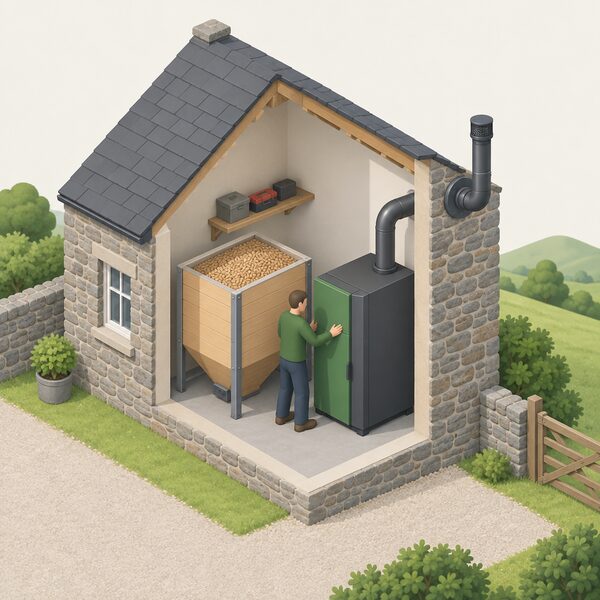
Biomass is not a backup in Wales; it is the incumbent. Biomass accounts for 55% of total renewable heat capacity, and in 2023 there were 35 biomass boiler installations in Wales, accounting for an additional 0.8 MW of new biomass boiler capacity1. In 2021, biomass deployment was 30% higher than in 2020, with 82 projects delivering an additional 7.6 MW of renewable heat capacity, and the largest single biomass project commissioned that year was a 1.2 MW site in Rhondda Cynon Taf4. Biomass carries the rural, off-gas load that heat pumps have not yet reached.
Hydrogen's position in Welsh homes is more limited than the policy noise suggests. The Welsh Government's heat strategy position is that off-gas areas will not use hydrogen1. That is a direct statement about the homes most often proposed for hydrogen conversion. Welsh hydrogen work has instead centred on production, with an objective of establishing a 10 MW renewable hydrogen production facility by 20244. The Welsh Government's EV charging strategy notes that hydrogen may start to take the lead as the most effective way to decarbonise heavy duty vehicles after 2030, which places hydrogen in transport rather than domestic heating18.
Natural gas remains central to the Welsh energy system. Natural gas now represents 94% of Wales's fossil fuel-based electricity generation1. That is the dependence that sits underneath every domestic heat decision in Wales: the electricity a heat pump runs on is still largely generated from gas, even as the renewable share grows. The hydrogen home heating trials page covers the UK trial picture, and the hydrogen-ready boiler or heat pump page covers the choice households are sometimes offered.
Waste technologies add a further heat source. The total heat and power capacity from waste incineration, anaerobic digestion, sewage and landfill gas technologies was 123 MW in Wales in 20231. Small-scale energy from waste plants under 10 MW are only permitted if regionally necessary1.
Vehicle-to-Home and EV charging as household storage
Vehicle-to-Home is the least developed of the technologies covered here, and the Welsh material treats it as part of the charging infrastructure question rather than a household energy product. The Welsh Government consulted in September 2024 on draft amendments to Building Regulations in Wales to ensure electric vehicle charging points are included in new residential buildings, new non-residential buildings, and buildings undergoing major renovations or material change in use where car parking is part of the development19.
The charging strategy behind that consultation was published in March 2021 and covers the period to 203020. It estimates the need for up to 55,000 fast chargepoints and 4,000 rapid chargepoints in Wales20. It also sets a payment requirement: payment for electric vehicle charging will be possible by contactless debit or credit card and an associated app based system18. In urban centres, taxis and private hire vehicles will have extensive access to charging facilities by 202518.
The starting point was low. As of October 2020, 3,500 domestic charge points in Wales had received grants from the Electric Vehicle Homecharge scheme, and there were a few thousand charge points installed at homes in Wales21. The consultation document stated that Wales currently had one of the lower levels of electric vehicle ownership in the United Kingdom and was behind England and Scotland in terms of the number of chargers available and electric vehicle ownership21.
On the household benefit side, the Welsh Government's housing guidance is positive about storage in general: renewables combined with storage, typically PV with batteries, further reduce fuel bills, and deep retrofit with renewables can dramatically reduce fuel bills16. It does not make a specific claim about Vehicle-to-Home earnings. An assessment published in July 2026 concluded that V2H is an emerging technology in Europe with limited compatible vehicles and chargers, high costs and a long payback for most homeowners22. The vehicle-to-home and vehicle-to-load page covers the technology, and the bidirectional charging page covers the equipment.
What these technologies mean for household energy independence in Wales
Wales's energy independence story is unusual because so much of it is about local ownership rather than individual self-sufficiency. The Welsh Government's target is for at least 1.5GW of renewable energy capacity to be locally owned by 2035, excluding heat pumps, and for 5.5GW of renewable energy capacity to be provided by heat pumps by 203523. In 2021, there was 897 MW of locally owned renewable capacity, with over 80% of new electrical and heat capacity focused in the domestic sector, largely due to the installation of solar PV and heat pumps4. By 2023, total locally owned electrical capacity was 688 MW and total locally owned heat capacity was 211 MW1.
That domestic concentration is the independence story. Around 56,200 domestic solar PV projects and over 10,500 domestic heat pumps were installed in Wales by 20214. A household with solar PV and a heat pump is generating its own electricity and using it to heat its own home, which reduces both the electricity and the gas it buys. The dependence that remains is the grid: a heat pump runs on electricity, and 94% of Wales's fossil fuel-based electricity generation is natural gas1. A household with a heat pump and no solar or battery is more dependent on the grid than one with a gas boiler, not less, because it has moved its heating load onto the electricity network.
The second dependence is the supplier. A proposed Welsh public energy company would be owned by the people of Wales and would not replace existing energy suppliers7. That is a statement about the retail market: the company is intended to retain more of the value from energy development in Wales for people and communities, not to take over supply6.
The third dependence is the manufacturer. Heat pumps, batteries and chargers are made by companies, and a household's warranty and spares depend on those companies continuing. The energy technology company failures page covers what happens when they do not.
The fourth is the pace of the grid itself. The Future Energy Grids for Wales report covers power, heat and transport, and states that renewable electricity will provide the basis for decarbonising most heat and transport25. The Welsh Government expects a move to a more decentralised energy system25. Planning Policy Wales encourages planning authorities to plan positively for low carbon and renewable energy by undertaking assessments of their area's potential to accommodate new developments26. The UK Committee on Climate Change has advised that Wales's targets are close to the maximum technically feasible for Wales27.
For a household, the honest summary is this. Heat pumps, solar and storage are available now and reduce the energy a home buys. Mine water heat is a mapped opportunity for coalfield communities, delivered through heat networks rather than individual units. Hydrogen is not coming to off-gas Welsh homes under current policy. Vehicle-to-Home is emerging and expensive. The grid, a supplier and a manufacturer all remain in the chain, and the Welsh Government's own targets are contingent on UK Government support and falling technology costs2.

Sources27 cited
- Energy Generation in Wales 2023, Welsh Government, 2025-03
- Commissions New Report Highlighting Recommended Steps to Accelerate Renewable Energy, Welsh Government, 2023-10-16
- Publication of Wales's Mine Water Heat Opportunity Map, Welsh Government, 2024-08-29
- Energy Generation in Wales 2021, Welsh Government, 2022-10
- Legacy of Welsh coal mines could heat homes of the future, Welsh Government, 2022-07-14
- Formation of Consolidated Welsh Public Energy Company, Welsh Government, 2026-09-07
- Shape Plans for a New Clean Energy Company Owned by Wales, Business Wales, 2026-09-07
- Heat Pump Deployment Quarterly Statistics, 2025 Q3, UK Government, 2025
- Summary of Responses to Consultation on Wales Renewable Energy Targets, Welsh Government
- Heat Pump Deployment Quarterly Statistics, June 2024, UK Government, 2024
- Wales Fourth Carbon Budget, Committee on Climate Change
- Preparing Wales for a Renewable Energy 2050, Welsh Government, 2023-10
- Optimised Retrofit Programme 3 Funded Projects, Welsh Government, 2023-04-26
- Green Homes Wales, Development Bank of Wales, 2026-09-17
- Green Homes Wales Scheme, Welsh Government, 2024-10-17
- Homes of Today for Tomorrow: Decarbonising Welsh Housing 2020-2050, Welsh Government, 2024-02
- Part L Wales Impact Assessment, Welsh Government, 2022-04
- Electric Vehicle Charging Strategy for Wales, Welsh Government, 2021-03
- Electric Vehicle Charging in Residential and Non-Residential Buildings, Welsh Government, 2024-09-06
- Electric Vehicle Charging Market Study Final Report, UK Government, 2021-07-23
- Electric Vehicle Charging Strategy Consultation Document, Welsh Government, 2020-12-02
- Vehicle-to-Home assessment, go-e, 2026-07-15
- Renewable Energy Deep Dive Biannual Recommendations Update 2, Welsh Government
- Publication of Energy Generation in Wales 2021, Welsh Government, 2021
- Publication of Future Energy Grids for Wales Report, Welsh Government, 2023-07-14
- Planning Policy Wales Edition 4, Welsh Government, 2011-02-28
- Update on Decarbonisation Programme, Welsh Government, 2018-12-04
 Home HeatingMost Welsh homes still run on mains gas, so what are the alternatives in rural areas?
 Home Energy Planning WalesSolar panels and heat pumps often need no planning permission in Wales, but the rules differ from England.
 Energy Policy in WalesWhat help can you get in Wales to make your home warmer and cheaper to run?
 The Full New Technology GuideWhich new home energy ideas can you actually buy in the UK right now, and which are still stuck in trials?
 Policy, Targets and Coming RulesHeat pumps are central to the government's plans for greener home heating.
 Technology by Home TypeWhich new energy technologies actually work in a flat, a terrace or a rural home?