

In this answer
Short answer
Wales had 22,000 heat pumps installed by 2023, according to official statistics, with approximately 6,900 new units added that year1. Government-supported installations have since run at between 568 and 1,766 per quarter, reaching 568 in Q2 20262. The Welsh Government target is 580,000 heat pumps by 20353.
The gap between the current stock and the 2035 target is the central fact of Welsh heat pump deployment. Wales has consistently punched above its weight in UK government-supported installations, taking 19% of the UK total in the year ending June 2024, the largest share of any region4. But the absolute numbers remain far below what the Climate Change Committee says is needed: nearly 25,000 installations per year by 20305.
The quarterly installation figures
Government-supported heat pump installations in Wales have fluctuated between roughly 500 and 1,800 per quarter since early 2024. The Q2 2026 figure of 568 is the lowest in the series, down from 749 in Q1 20266 and 1,766 in Q3 20257.
The quarterly pattern shows a marked decline through 2025 and into 2026. Wales recorded 1,562 installations in Q1 20258, 1,493 in Q2 20259, and 1,766 in Q3 20257. The drop to 749 in Q1 2026 and 568 in Q2 2026 represents a significant slowdown.
Earlier quarters were stronger. Wales recorded 1,786 installations in Q1 202410, 1,730 in Q2 20244, 1,609 in Q3 202411, and 1,484 in Q4 202412. The 2024 average was therefore well above the 2026 rate.
| Quarter | Wales installations |
|---|---|
| 2024 Q1 | 1,78610 |
| 2024 Q2 | 1,7304 |
| 2024 Q3 | 1,60911 |
| 2024 Q4 | 1,48412 |
| 2025 Q1 | 1,5628 |
| 2025 Q2 | 1,4939 |
| 2025 Q3 | 1,7667 |
| 2026 Q1 | 7496 |
| 2026 Q2 | 5682 |
These are government-supported installations only, meaning those backed by schemes such as the Boiler Upgrade Scheme. The total number of heat pumps installed in Wales, including those installed without government support, is higher. The 22,000 figure for 2023 covers all heat pumps, not just subsidised ones1.
Wales has historically accounted for a disproportionate share of UK government-supported installations. In the year ending June 2024, Wales took 19% of the UK total, ahead of the South West at 13% and the South East at 12%4. By the year ending September 2024, Wales held 18%11. By the year ending March 2025, Wales was at 14%, level with the South West8. By the year ending September 2025, Wales had fallen to 13%, behind the South West and South East at 15% each7.
What the 2035 target requires

The Welsh Government has set a target of 580,000 heat pumps installed in Wales by 20353. The Climate Change Committee has said annual installation rates will need to accelerate rapidly, reaching nearly 25,000 in 20305. The draft Heat Strategy for Wales goes further, envisaging 30,000 installations per year by 203013.
The target is contingent on scaled-up support from the UK Government and reductions in the cost of technology3. It is not a commitment that the Welsh Government can deliver alone, since much of the financial support comes through UK-wide schemes.
The Heat Strategy for Wales states that individual heat pumps are expected to be the dominant solution for homes in Wales13, and that heat pumps will be the championed solution for most building heat14. The strategy also notes that heat pump installations, particularly those funded by government grant schemes, should be carried out correctly and supported by associated retrofitting measures to ensure energy bills do not rise following installation15.
The employment implications are significant. The Heat Pump Association has estimated that Wales would need 5,446 full-time equivalent jobs in hydronic heat pump installation and servicing by 2035 to meet deployment targets16.
Who the figures cover
The installation statistics cover government-supported heat pumps, which means units installed under schemes such as the Boiler Upgrade Scheme. The Boiler Upgrade Scheme is available to urban and rural properties in England and Wales, including eligible self-builds, whether on or off the gas grid17.
The 22,000 total for 2023 covers all heat pumps in Wales, not just those supported by government schemes1. Approximately 94% of renewable heat projects commissioned in Wales in 2021 were heat pumps, from over 2,000 individual projects18. In 2021, 2,073 heat pump projects added 21 MW of electrified heat, and the total heat pump capacity in Wales was 122 MW across 11,171 projects18.
MCS certified installations, which cover solar PV, battery storage, heat pumps and other renewables, reached 103,506 in Wales by November 202319. This figure is not heat-pump-specific but indicates the scale of certified renewable activity in Wales.
Social housing tenants in Wales who have heat pumps installed under the Optimised Retrofit Programme are a specific group covered by separate support interventions20.
Planning rules and permitted development
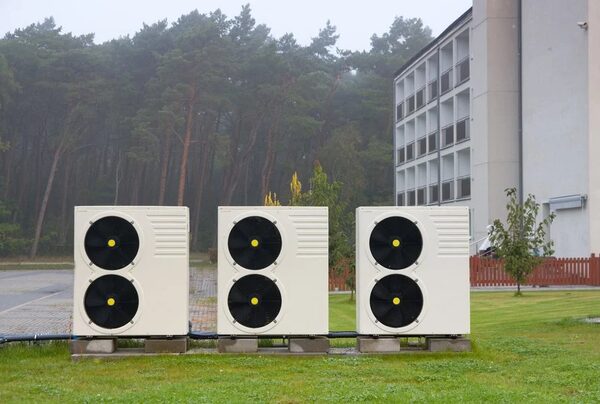
Most air source heat pumps in Wales fall under permitted development rights, but the rules differ from England. Wales requires a minimum 3-metre distance from the property boundary to reduce noise pollution potential21. This is more stringent than the rules in England.
From 1 June 2026, permitted development rights in Wales were extended. Heat pumps can now be installed on a wall or roof which fronts a highway, and air-to-air heat pump installations are allowed22. Previously, air-to-air heat pumps required planning permission due to a rule that heat pumps only be used for heating purposes23.
All installations in Wales that fall under permitted development rights must comply with MCS 020 a)22.
For ground source heat pumps, Class C of the General Permitted Development Order applies in England and Wales24. For air source heat pumps, Class G applies, with the restriction that outside conservation areas and World Heritage Sites the heat pump must not be installed on a highway-fronting wall above the level of the ground floor storey25.
Planning rules vary slightly in Wales and Scotland, where more stringent rules related to where the heat pump can be placed in relation to the property boundary exist26. Guidance on the Planning Portal relates to the planning regime for England; policy in Wales may differ27.
Grants, installers and building regulations
Government support for heat pumps in Wales comes mainly through the Boiler Upgrade Scheme, which is available to homeowners in England and Wales replacing fossil fuel heating systems, subject to property and installer criteria28. The scheme covers urban and rural properties, including eligible self-builds, whether on or off the gas grid17.
The Green Homes Wales scheme, announced in 2024, includes the installation of an air source heat pump, external wall insulation and smart home energy systems among eligible works29. A separate Welsh Government announcement in 2026 confirmed £5 million to help Welsh households invest in greener homes, mentioning installing a heat pump, upgrading insulation, or modernising heating systems30.
Official guidance recommends an installer who belongs to either the Microgeneration Certification Scheme or the relevant Competent Person Scheme31. For boiler and central heating installations under the Warm Home Discount regulations, the installer must be registered with TrustMark, with a certificate of lodgement issued by the operator of TrustMark32. The 2022 regulations set out equivalent quality assurance and consumer protection arrangements33.
Building Regulations in Wales apply to providing services and fittings such as hot water cylinders and fuel burning appliances34. Heat pump installations that involve such work fall within the building regulations regime.
What this means for household energy independence
A heat pump shifts a household's heating from gas to electricity. For a home with solar panels and a battery, that electricity can be self-generated, reducing reliance on the grid and on gas imports. For a home without on-site generation, the heat pump still removes direct gas dependence but increases electricity consumption, tying the household more closely to the electricity grid and its supplier.
The Welsh Government's own consultation acknowledges that heat pump installations funded by grant schemes should be supported by retrofitting measures to ensure energy bills do not rise following installation15. Without insulation and correct sizing, a heat pump can increase running costs rather than reduce them.
The planning regime in Wales, with its 3-metre boundary rule, can constrain where a heat pump is sited, particularly on smaller or terraced properties. The extension of permitted development rights to air-to-air heat pumps from June 2026 widens the options for homes that previously required planning permission22.
The 2035 target of 580,000 heat pumps is contingent on UK Government support and falling technology costs3. Households considering a heat pump in Wales are therefore dependent on a policy environment that is not wholly within Welsh Government control, and on a supply chain that the Heat Pump Association estimates will need 5,446 full-time equivalent workers in Wales by 203516.
Sources34 cited
- Energy generation in Wales 2023, Welsh Government, 2025
- Heat pump deployment tables Q2 2026, GOV.UK, 2026
- Publication summary: responses to consultation on Wales renewable energy targets, Welsh Government
- Heat pump deployment quarterly statistics UK June 2024, GOV.UK, 2024
- Wales fourth carbon budget, Climate Change Committee
- Heat pump deployment quarterly statistics UK 2026 Q1, GOV.UK, 2026
- Heat pump deployment quarterly statistics UK 2025 Q3, GOV.UK, 2025
- Heat pump deployment quarterly statistics UK 2025 Q1, GOV.UK, 2025
- Heat pump deployment quarterly statistics UK 2025 Q2, GOV.UK, 2025
- Heat pump deployment quarterly statistics UK 2024 Q4, GOV.UK, 2024
- Heat pump deployment quarterly statistics UK 2024 Q3, GOV.UK, 2024
- Heat pump deployment quarterly statistics UK 2024 Q4, GOV.UK, 2024
- Draft heat strategy for Wales, Welsh Government, 2023
- Draft heat strategy for Wales, Welsh Government, 2023
- Preparing Wales for a renewable energy 2050, Welsh Government, 2024
- From carbon to competitiveness, Heat Pump Association, 2026
- Boiler Upgrade Scheme guidance, Ofgem, 2023
- Energy generation in Wales 2021, Welsh Government, 2022
- More than 100,000 Welsh home and business owners turn to renewable energy, MCS Certified, 2023
- Developing support interventions for social housing tenants with heat pumps, Nesta, 2026
- Air source heat pump noise permitted development rights Wales report, Welsh Government, 2024
- Changes to permitted development rights in Wales from 1 June 2026, MCS Certified, 2026
- What could the next Senedd do on heat pump planning, Nesta, 2026
- Class C: installation of ground source heat pumps on domestic premises, legislation.gov.uk, 2026
- Class G: installation of air source heat pumps on domestic premises, legislation.gov.uk, 2026
- Are heat pumps noisy and is there regulation on noise, Nesta, 2025
- Heat pumps, Planning Portal, 2026
- Five ways to make air-to-air heat pumps take off, Nesta, 2025
- Green Homes Wales scheme, Welsh Government, 2024
- £5 million to help Welsh households invest in greener homes, Welsh Government, 2026
- Building regulations: heat pumps, Welsh Government, 2026
- Warm Home Discount (England and Wales) Regulations 2026, legislation.gov.uk, 2026
- Warm Home Discount (England and Wales) Regulations 2022, legislation.gov.uk, 2022
- When you need approval, Planning Portal, 2026
 Heat Pump Install StatisticsHow many heat pumps are actually being fitted in the UK each year, and is that number going up?
 Home HeatingMost Welsh homes still run on mains gas, so what are the alternatives in rural areas?
 Planning Permission in WalesDo you need planning permission for a heat pump in Wales?
 Wales Renewable Energy TargetsWales aims for renewable sources to meet the equivalent of 70% of its electricity consumption by 2030 and 100% by 2035, with at least 1.5 GW locally owned by 2035.
 How Much Does a Heat Pump CostA heat pump usually costs around eleven thousand pounds installed, though quotes vary a lot depending on your home.
 Fuel PovertyHow the Welsh Government defines and measures fuel poverty, the latest modelled estimate of 340,000 households (25%) as at October 2024, who is most affected, and how the Tackling Fuel Poverty Plan and the Warm Homes Nest scheme are meant to bring the figure down.