

In this answer
Short answer
Northern Ireland recorded 36 MCS-certified retrofit heat pump installations in 2026 Q2, up from 30 in 2026 Q1 and 9 in 2025 Q41. Those are the headline numbers from the quarterly heat pump deployment statistics, and they make Northern Ireland the smallest national count in the United Kingdom by a wide margin. The same series shows 10,114 installations across the UK in 2026 Q2, of which Northern Ireland's 36 represent a fraction of one per cent3.
The figures come from the Microgeneration Certification Scheme installation database and cover government-supported retrofit installations only2. That scope matters in Northern Ireland more than anywhere else in the UK, because the devolved administration schemes that operate there are not included in the totals4. The published count is therefore a floor, not a census.
How many heat pumps have been installed in Northern Ireland: the quarterly figures
The quarterly series is short and volatile. Northern Ireland recorded 0 government-supported installations in 2024 Q2 and 0 again in 2024 Q4, quarters in which the UK totals ran to 9,871 and 13,413 respectively4. The count then appears at 9 in 2025 Q4, 30 in 2026 Q1 and 36 in 2026 Q21. Read as a run of quarters rather than a single snapshot, the direction is upward, but the base is so small that a handful of installations moves the percentage by a large amount.
The UK context is worth holding alongside it. The 2026 Q2 total of 10,114 installations was split across England, Scotland, Wales and Northern Ireland, with Northern Ireland contributing 363. In 2024 Q1, Wales recorded 1,786 installations and Scotland 933 in the same quarter5. Those are not like-for-like comparisons, because the devolved schemes in Scotland and Wales feed into their national counts in ways the Northern Ireland figures do not, but they show the scale of the gap.
The Department for Energy Security and Net Zero publishes the series quarterly, and the collection page carries each release6. The figures are drawn from the MCS installation database, which records certified work as it is registered2.
The trend: from 9 installations in one quarter to 30 in the next
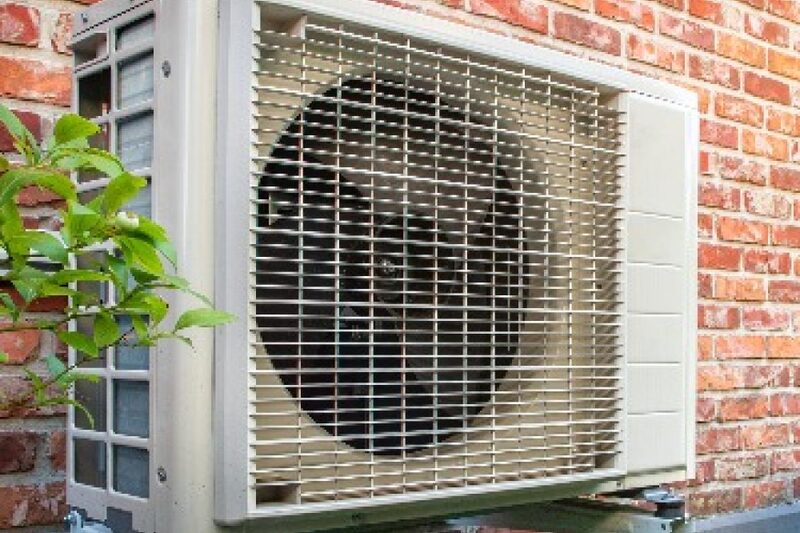
The jump from 9 installations in 2025 Q4 to 30 in 2026 Q1 is the single largest quarter-on-quarter move in the Northern Ireland series, and the statistics note that Northern Ireland was the only nation to see quarter-on-quarter growth in retrofit heat pump installations in 2026 Q12. The following quarter added 6 more, reaching 361.
Growth from such a low base is difficult to interpret. A 30% increase in government-supported heat pump installations across the UK in the 12 months to June 2025 was reported on a base of thousands7. The same percentage applied to a base of 9 installations means three additional installations. The Northern Ireland series will need several more quarters before a trend can be separated from noise.
There is a wider UK pattern the Northern Ireland figures sit inside. Ground and water source heat pump installations ran at 290 in 2024 Q1, 133 in 2024 Q2, 106 in 2024 Q3 and 126 in 2024 Q4, all government-supported and all UK-wide4. Air source units dominate the totals. The UK as a whole installed heat pump units equal to just 7% of the number installed in France, according to the 2025 heat and buildings evidence review10.

What the latest quarter shows: 36 installations and what it means for the trajectory
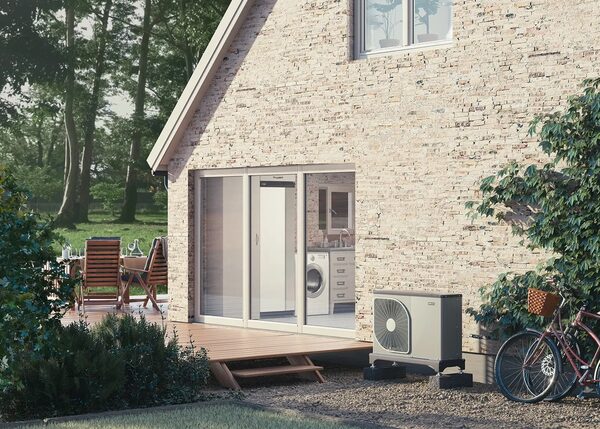
The 2026 Q2 figure of 36 retrofit domestic installations is the highest in the published Northern Ireland series1. It follows 30 in 2026 Q1 and 9 in 2025 Q42. On the face of it, that is four consecutive quarters of growth from a standing start.
The trajectory has to be read against the target. The Climate Change Committee's advice on Northern Ireland's fourth carbon budget states that by 2040, more than two-thirds of homes in Northern Ireland are heated by low-carbon electric heating, predominately heat pumps11. That is a transformation of the housing stock, not a niche programme. At 36 installations a quarter, the arithmetic is stark, and the Energy Saving Trust has reported that the ambitious targets for net zero programmes are not achievable with the current supply chain in Northern Ireland12.
The constraint is not demand alone. Northern Ireland has no dedicated heat pump grant scheme, unlike the Boiler Upgrade Scheme in England and Wales5. Installers must be MCS certified and certified to install heat pumps or biomass boilers to work under the Boiler Upgrade Scheme, and the same certification infrastructure underpins the MCS database from which the Northern Ireland figures are drawn13.
"For Northern Ireland, there are no dedicated schemes."
Why Northern Ireland's numbers are small compared with the rest of the UK
Three factors explain most of the gap, and they compound.
The first is scheme coverage. The statistics cover DESNZ government-supported heat pump installations only, and some devolved administration schemes in Scotland and Northern Ireland are currently not included4. Northern Ireland's own programmes therefore sit outside the published count, which means the true installation number is higher than 36 in any given quarter, though the statistics do not say by how much.
The second is the absence of a dedicated grant. The Energy Saving Trust states plainly that for Northern Ireland there are no dedicated schemes5. Households in England and Wales can access the Boiler Upgrade Scheme, where the installer applies for the grant on the household's behalf through Ofgem15. Northern Ireland households have no equivalent route, which removes the main financial lever that has driven uptake elsewhere.
The third is supply chain capacity. The Energy Saving Trust's low carbon heating report for Northern Ireland found that the ambitious targets for net zero programmes are not achievable with the current supply chain12. A small installer base constrains how many certified installations can be registered in any quarter, regardless of household interest.
The regional pattern within the UK reinforces how concentrated installations are. In the year ending September 2024, the smallest proportion of government-supported installations was in London and the North East at 3% each8. Northern Ireland's share is smaller still.
What counts as an installation in these statistics
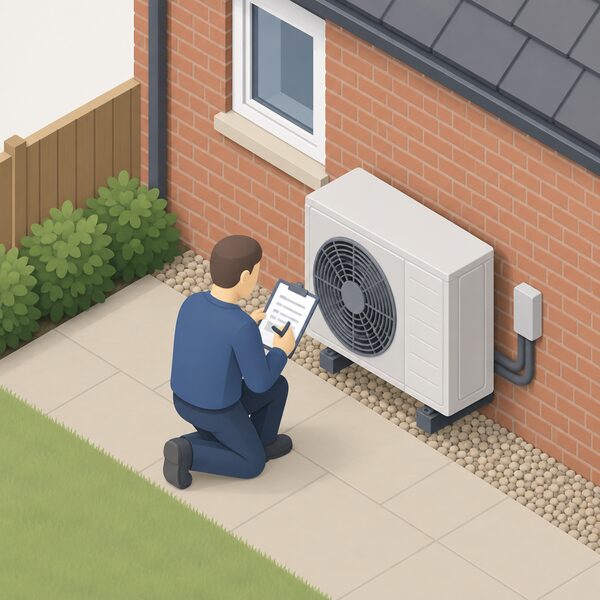
The published series counts retrofit heat pump installations in existing properties, MCS certified, with heat pumps up to 45kW thermal output3. It is a count of certified registrations, not of units sold, commissioned or operating.
Several categories fall outside it. New-build installations are not covered4. Devolved administration schemes in Scotland and Northern Ireland are not covered4. Unsupported installations, meaning those installed without any government support, are not covered4. The statistics also carry a data caveat: a small proportion of new-build installations in Scotland and Northern Ireland before 2023 Q4 may have been incorrectly classified as retrofit3.
There is a further wrinkle in the UK totals. A small number of heat pumps qualified for dual registration between the Renewable Heat Incentive and other schemes, so the total number of government-supported installations is slightly lower than the sum of the table figures16. That affects the UK aggregate rather than the Northern Ireland column, but it is a reminder that these are administrative counts with administrative edges.
| Measure | Value | Period | Source |
|---|---|---|---|
| Northern Ireland retrofit installations | 36 | 2026 Q2 | 1 |
| Northern Ireland retrofit installations | 30 | 2026 Q1 | 2 |
| Northern Ireland retrofit installations | 9 | 2025 Q4 | 2 |
| Northern Ireland installations | 0 | 2024 Q2 | 4 |
| Northern Ireland installations | 0 | 2024 Q4 | 5 |
| UK total | 10,114 | 2026 Q2 | 3 |
MCS: the quality mark behind the certified installation figures
Every installation in the Northern Ireland count is MCS certified. The Microgeneration Certification Scheme sets the standards that installers and products must meet, and certification means an installation is being carried out to industry-recognised standards17. The scheme covers heat pumps under standard MCS 00718.
The certification requirement runs through the support landscape. Installers working under the Boiler Upgrade Scheme must be MCS certified and certified to install heat pumps or biomass boilers13. Certified installers use MCS certified ground and water source heat pumps, tested for quality, reliability and performance19. The Warm Homes Local Grant requires installers certified on the MCS Installer Scheme for low carbon technology installations including heat pumps, solar panels and battery storage20.
That is why the MCS database is the source for the national statistics2. A certified installation is registered, and the registration is what the quarterly figures count. Installations that are not certified do not appear, which is one reason the published Northern Ireland number is best read as a certified-installation count rather than a total market measure.

How to find a certified installer and check an installation
The route to a certified installer in Northern Ireland runs through several registers. Building regulations guidance for heat pumps advises contacting an installer who can provide the necessary advice, preferably one who belongs to either the Microgeneration Certification Scheme or the relevant Competent Person Scheme21. The Energy Saving Trust advises choosing an MCS-certified heat pump installer22. For grant-funded work elsewhere in the UK, the Boiler Upgrade Scheme directs households to the MCS find a heat pump installer tool or to their energy supplier15.
For the electricity connection, Northern Ireland Electricity Networks sets out the process. A household nominates an EV charge point or heat pump installer, who carries out checks at the property and submits the application, managing the whole application on the customer's behalf23. That makes the installer the point of contact for the network application as well as the installation itself.
NISEP schemes add their own verification. For NISEP schemes installing air source heat pumps, an EPC is carried out by an accredited domestic energy assessor before and after installation24. Competent person registers such as TrustMark are also used to find an installer who will assess circumstances and the property to identify suitable measures20.
One limit is worth stating. Air-to-air heat pumps are covered by MCS consumer guidance, but at present no installers are yet certified to install air-to-air heat pumps25. Households considering that technology have no certified route in the current register.
What the statistics do and do not tell you about performance

The quarterly figures count installations. They say nothing about how those installations perform.
The statistics provide information to monitor the number of hydronic heat pumps with a capacity up to 45kW installed in the United Kingdom6. That is a deployment measure. It does not record measured efficiency, running costs, or whether a system was commissioned correctly.
Performance depends on factors the count does not capture. The Energy Saving Trust advises speaking to a certified installer and asking them to check the installation and explain the settings if you are not confident making changes, or if you moved into a property with a heat pump without manuals26. Commissioning and settings sit outside the certification data.
There is a wider measurement gap in the UK evidence base. The 2025 heat and buildings review notes that the number of heat pump units installed in the UK is just 7% of that in France10. Deployment statistics of this kind are the standard international comparator, which is why the Northern Ireland series matters despite its small numbers: it is the only consistent quarterly measure of certified retrofit activity in the nation.
For households, the practical implication is that the published count is a guide to market activity, not a guarantee of system quality. Certification confirms the installer and product met a standard. It does not confirm a particular measured outcome in a particular home.
Sources26 cited
- Heat pump deployment statistics: June 2026 summary, GOV.UK, 2026
- Heat pump deployment quarterly statistics United Kingdom 2026 Q1, DESNZ, 2026
- Heat pump deployment tables Q2 2026, DESNZ, 2026
- Heat pump deployment quarterly statistics United Kingdom June 2024, DESNZ, 2024
- Heat pump deployment quarterly statistics United Kingdom 2024 Q4, DESNZ, 2024
- Heat pump deployment statistics collection, GOV.UK, 2024
- Heat pump deployment quarterly statistics United Kingdom 2025 Q2, DESNZ, 2025
- Heat pump deployment quarterly statistics United Kingdom 2024 Q3, DESNZ, 2024
- Heat pump deployment quarterly statistics United Kingdom 2025 Q2, DESNZ, 2025
- NI low carbon heating in buildings, Energy Saving Trust, 2025
- Northern Ireland's fourth carbon budget, Climate Change Committee, 2025
- Clean Heat Market Mechanism, MCS, 2026
- Boiler Upgrade Scheme guidance for installers v5.1, Ofgem, 2026
- Heat pump deployment quarterly statistics United Kingdom 2025 Q3, DESNZ, 2025
- Get a heat pump, GOV.UK, 2026
- Heat pump deployment quarterly statistics United Kingdom 2025 Q1, DESNZ, 2025
- Ground and water source heat pumps, MCS, 2026
- Heat pump guide: air source vs ground source, IAA, 2026
- Your connections process: EVs and heat pumps, Northern Ireland Electricity Networks, 2026
- How to ensure a heat pump runs efficiently, Energy Saving Trust, 2026
- NISEP list of schemes 2026-27, Utility Regulator, 2026
- Heat pumps guidance, Energy Saving Trust, 2026
- Heat pumps: building regulations, Planning Portal, 2026
- ECO scheme home energy efficiency, Leeds City Council, 2026
- Complaints about electricity, oil and gas, Consumer Council for Northern Ireland, 2026
- Air-to-air heat pumps, MCS, 2026
 Planning Permission in NIDo you need planning permission for a heat pump in Northern Ireland?
 Heat Pump Install StatisticsHow many heat pumps are actually being fitted in the UK each year, and is that number going up?
 Housing Stock Data for NIMost homes in Northern Ireland heat with oil, so why are the grants and help different from the rest of the UK?
 Fuel PovertyWhy does Northern Ireland have such a high rate of fuel poverty, and how many households are affected?
 Home HeatingWhy do so many homes in Northern Ireland run on heating oil, and will that ever change?
 Home Energy Planning Rules in NIDo you need planning permission for solar panels or a heat pump in Northern Ireland?