
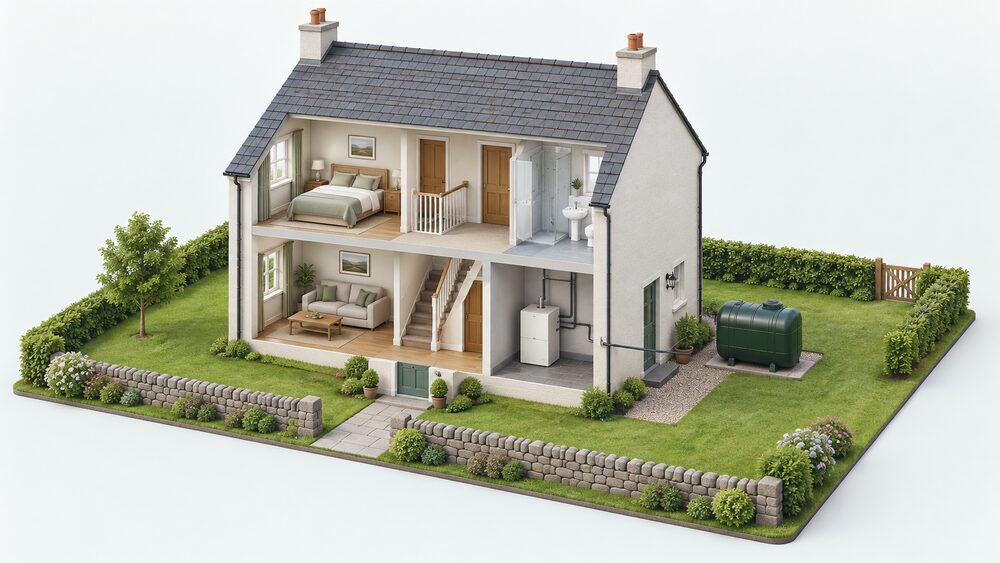
In this guide
Northern Ireland heats its homes with oil to a degree no other part of the UK approaches. Census 2021 recorded 62.5% of households using oil for heating, either on its own or alongside another fuel, and 49.5% using oil as their only central heating1. Official statements put it more bluntly: roughly two thirds of homes rely on oil heating, and approximately 500,000 homes rely on oil as a primary heating source2. Mains gas reaches 33% of households1.
That single fact shapes almost everything else about household energy in the province: the size of the bills, the exposure to price shocks, the design of grant schemes, and the difficulty of decarbonising a housing stock whose default heating appliance sits in a tank outside the back door. The Climate Change Committee has said plainly that the majority of homes are heated by highly emitting oil boilers and that Northern Ireland should transition rapidly to low-carbon heating3.
This page sets out the figures, what drives them, how the position compares with Scotland, Wales and England, the rules that apply to oil installation and support, and what all of it means for a household's energy independence.
What the figures actually say
The headline number depends on how the question is asked, and the published figures do not settle on a single share. That is a difference in definition rather than a contradiction, and it is worth setting out because the range is wide.
At Census 2021, 62.5% of households used oil for heating, either on its own or in combination with other types of fuel1. The same census found 49.5% of households used oil as their only central heating6. A separate Commons Library briefing records 63% of households using heating oil and 33% on mains gas at the same census1. Northern Ireland Housing Statistics, looking at heating systems rather than households, recorded that the majority of homes still had oil central heating, at 67% of heating systems, in 20167.
Official statements since have used rounder language. A March 2026 debate in the Commons heard that over 60% of homes rely on oil for heat, and separately that almost two thirds of homes rely on heating oil8. An April 2026 press release said roughly two thirds of homes in Northern Ireland rely on oil heating, and gave the figure of approximately 500,000 homes relying on oil as a primary heating source2. Trading Standards, writing in 2026, put the use of bulk fuel at over 60% of homes relying on heating oil as their primary source of heating9.
The pattern is consistent: somewhere between half and two thirds of households, depending on whether oil is the sole fuel or one of several, and around 500,000 homes where oil is the main heat source. For a household trying to understand its own position, the practical point is that oil is the norm rather than the exception in Northern Ireland, and that the alternatives are mains gas where the network reaches, electricity, or solid fuel.
"At Census 2021 63% of households used heating oil and 33% mains gas"
What drives the oil share
The driver is geography and network economics. Mains gas is available to 33% of households1, which means two thirds of homes have no gas connection to switch to. Extending a gas network to dispersed rural housing is expensive, and the housing stock was built around the alternative that was available: a tank and an oil boiler.
That pattern has not fully stopped. A 2023 Department for Finance consultation on building regulations noted that EPC data suggests some 30% or more of new dwellings in Northern Ireland are still being constructed using home heating oil10. The same consultation recorded high levels of reliance on oil for existing dwellings, at 68%10. So the stock is not only dominated by oil, it has continued to add oil-heated homes.
The Department for Communities states that more than two-thirds of Northern Ireland households use oil boilers as their main source of heating11. Electricity plays a small role: only 4% of homes in Northern Ireland use electricity for heating, with the majority heated by oil and gas12.
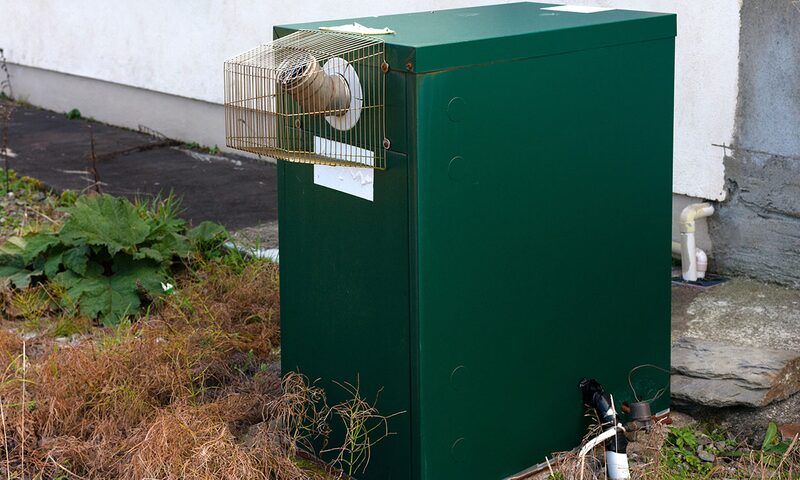
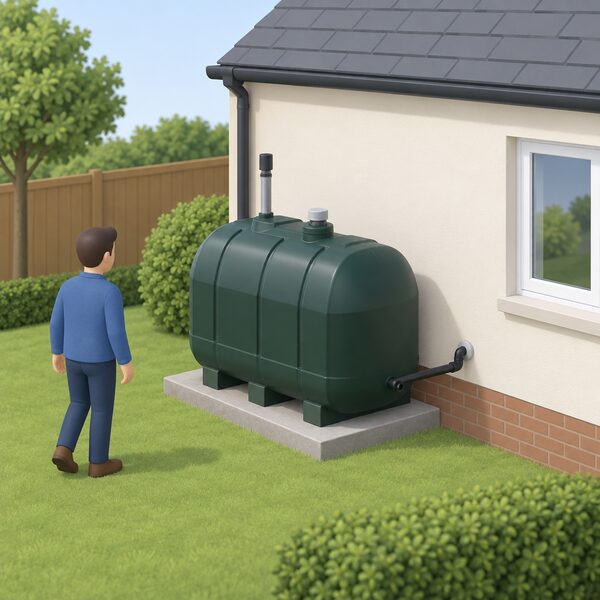
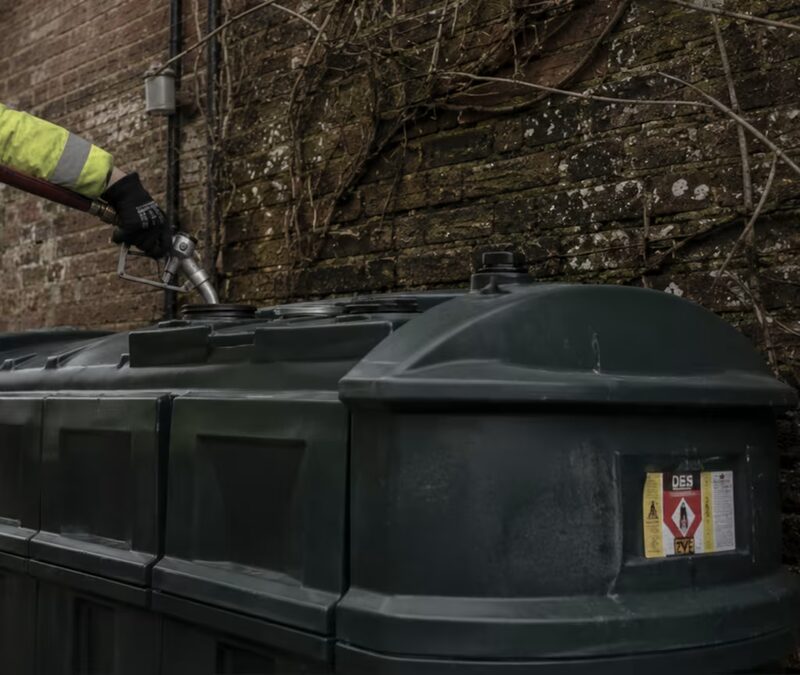
The consequence is a household energy position unlike the rest of the UK. A home on oil is not connected to a pipe that delivers heat on demand. It buys its fuel in bulk, stores it in a tank, and depends on a distributor to deliver it. That is a different kind of dependence from a gas connection, and it behaves differently when prices move.
How the four nations differ
Northern Ireland is the outlier, and the gap is large. Census 2021 recorded 62.5% of households using oil for heating in some form, against 33% on mains gas1. No other UK nation comes close to that oil share.
The comparison matters because it explains why Northern Ireland has its own support scheme, its own regulations and its own decarbonisation problem. The Home Heating Oil Support Scheme is explicitly territorial: it applies if you live in Northern Ireland13. The Energy Price Guarantee for domestic gas consumers in Northern Ireland was issued as a separate direction under section 22 of the Energy Prices Act 2022, cited as the Energy Price Guarantee for Domestic Gas Consumers in Northern Ireland, Direction No.114. Heat networks are also handled differently: in Northern Ireland both consumer protection and regulation of heat networks are devolved to the Northern Ireland Assembly, and the Utilities Regulator would regulate there15.
The practical differences a household notices are these:
- Fuel type. Oil dominates in Northern Ireland in a way it does not elsewhere, with mains gas reaching only a third of households1.
- Support schemes. Northern Ireland runs its own oil-specific support, separate from the gas-focused measures that apply where mains gas is the norm13.
- Regulation. Heat network consumer protection and regulation sit with the Northern Ireland Assembly, not a single UK-wide body15.
- Advice services. The Consumer Council NI and Northern Ireland Energy Advice give free, independent and impartial energy advice to all domestic householders in Northern Ireland16.
For a fuller comparison of how the four nations diverge on powers, grants and targets, see home energy across the UK nations and which energy powers are devolved and which are reserved.
The rules that apply to oil homes
Oil heating in Northern Ireland carries its own regulatory framework, and it is worth knowing where the boundaries sit before any work is commissioned.
Building control regulations cover boilers and stoves, and the siting of an oil tank17. That means an installation is not simply a matter for the householder and the installer: the siting of the tank and the boiler installation fall within building control.
On the support side, the Home Heating Oil Support Scheme is open to households who use oil as their primary source of heating, are resident in Northern Ireland, and, in either of the qualifying months, are in receipt of a qualifying benefit, or are a single person or couple, including pensioners, with an annual income of less than £30,000 net of allowable deductions18. Once activated, the voucher can be used to purchase home heating oil with any Northern Ireland oil supplier18. To apply online, a household needs a National Insurance number, its own or joint household income if not getting a qualifying benefit, and a contact email address or smartphone number13.
The Home Heating Oil (Temporary Financial Assistance) Regulations (Northern Ireland) 2026 are new, and the screening outcome did not recommend a full EQIA19.
Separately, the Northern Ireland Sustainable Energy Programme has eligibility rules aimed at priority group customers, covering homes without existing heating, or with electric heating, solid fuel heating, LPG, old oil fired central heating systems of 15 years old or more, or oil fired systems that are broken beyond viable repair20. For whole house solutions, heating systems with oil or LPG boilers must be at least 15 years old or be broken beyond viable repair for those properties to be eligible20.
What the price record shows
The case for treating oil as a household energy security question rests on what happens to the price when supply tightens. The record is stark.
Consumer Council data recorded that the average price of home heating oil in Northern Ireland increased by approximately 85 to 95% between the end of February and mid-March 20261. An April 2026 press release described recent price increases of nearly 100% in just a few weeks2. A Lords debate in November 2022 heard that two-thirds of households in Northern Ireland use heating oil21.
That is the shape of oil dependence: a household that has bought its fuel in advance is insulated for as long as the tank lasts, and then exposed to whatever the market is charging when it refills. There is no equivalent of a price cap on a delivered tank of oil in the way there is on a regulated gas or electricity tariff. The Energy Price Guarantee direction for Northern Ireland covered domestic gas consumers, not oil14.
The support scheme exists precisely because of that exposure. Its stated purpose is to provide financial assistance to households impacted by rising home heating oil costs, agreed by the Northern Ireland Executive on 16 April 202622. The £36.4 million package was agreed for home heating oil users in Northern Ireland2.
For a household, the practical implication is that budgeting for oil is not like budgeting for a direct debit. The cost arrives in lump sums, at whatever the market rate is on the day of delivery, and the timing of a refill can matter as much as the annual total.
Where the low-carbon transition stands
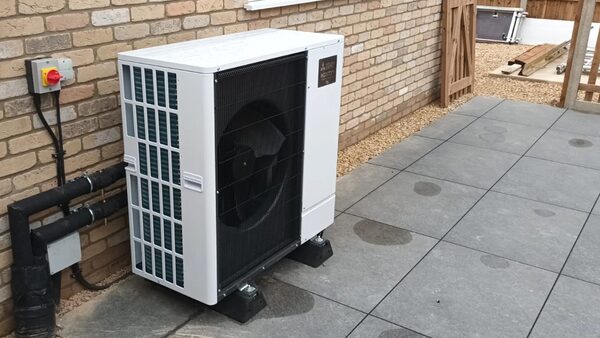
The direction of travel is set out in the Climate Change Committee's advice, and it is a substantial change from the current position. The Committee's pathway has more than two-thirds of homes in Northern Ireland heated by low-carbon electric heating, predominately heat pumps, by 20405. That is a modelled target, not a measurement of current uptake.
The starting point is small. Only 4% of homes in Northern Ireland use electricity for heating, with the majority heated by oil and gas12. The Committee has stated that with the majority of homes heated by highly emitting oil boilers, Northern Ireland should rapidly transition to low-carbon heating3.
The building regulations consultation gives a sense of how the transition might begin. It found that a significant increase in the uptake of heat pumps is likely under both options considered for new homes off the gas grid, if oil heating is no longer viable10. That is a projection about new build, not a statement about the existing stock.
For households, the honest position is that the transition is planned rather than delivered. The current stock is oil-dominated, the gas network reaches a third of homes, and heat pump numbers are a small fraction of the total. The Committee's 2040 figure is a target to be worked towards, and the pace will depend on grant funding, grid capacity and the cost of replacing a working oil boiler.
For more on the specific numbers, see how many homes in Northern Ireland have oil central heating and how many households in Northern Ireland have an air source heat pump.
Grants and support for oil households
Support for Northern Ireland households falls into two broad categories: help with the cost of oil itself, and help with the cost of improving the home so less oil is needed.
The Home Heating Oil Support Scheme is the first kind. It is open to households using oil as their primary heating source, resident in Northern Ireland, and either receiving a qualifying benefit or with annual income under £30,000 net of allowable deductions18. Around 340,000 households across Northern Ireland are eligible4. The scheme's purpose is to provide financial assistance to households impacted by rising home heating oil costs22.
The Affordable Warmth Scheme is the second kind. It aims to help with the effects of fuel poverty and energy inefficiency, and is directed at low-income households23. It offers up to £7,500 for energy efficiency upgrades, and up to £10,000 for homes of solid wall construction needing insulation24. Eligibility requires living in Northern Ireland, owning and occupying the property as a main home or holding a life interest, and a total annual gross income of less than £23,00023. It is not available for tenants living in social housing: a household is not eligible if it is a Housing Executive or housing association tenant23. Grants are subject to the availability of funding23.
The scheme is delivered by the Housing Executive25. Applications go through the NI Energy Advice Service, and if the household meets the entry requirements an application form is sent out, to be completed and returned with supporting documents to the local Grant Office23. A technical assessment may take up to 60 minutes23. Work must not start until written confirmation of grant aid is received, and the scheme will not pay for any work started or finished before written permission is given23. Grant aid work is usually expected to be completed within three months of the date of approval23.
The measures are prioritised. Priority 1 covers insulation, ventilation and draught-proofing, including installation or topping up of loft insulation to 300mm, roof, loft and eaves ventilation, a hot water cylinder jacket, cavity wall insulation where suitable, draught proofing doors and windows, and removal and replacement of ineffective cavity wall insulation23. Priority 2 covers heating, including replacing solid fuel, LPG or Economy 7 by providing natural gas or oil central heating, converting Economy 7 to a high efficiency electrical storage system only where gas and oil are not available, and boiler replacement or system upgrade23. Priority 3 covers replacing single glazed windows, and Priority 4 covers solid wall insulation for detached properties only23.
For the full detail of these schemes, see the Affordable Warmth Scheme in Northern Ireland, the Home Heating Oil Scheme in Northern Ireland and NISEP.
What it means for energy independence
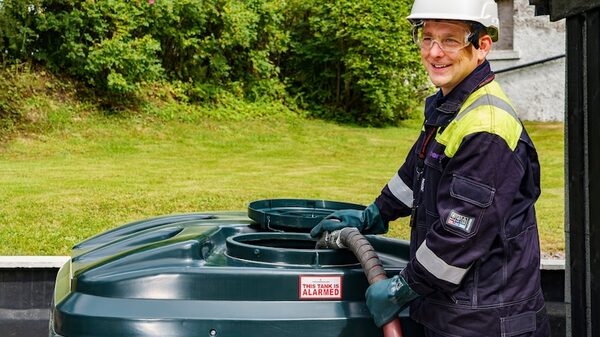
Oil heating gives a Northern Ireland household something a gas connection does not: a store of fuel on its own property. A full tank is heat for weeks regardless of what happens to supply, and there is no supplier who can interrupt it remotely. That is a genuine form of resilience, and it is why oil remains the default in areas the gas network never reached.
The dependence it substitutes is different, not absent. An oil household depends on a distributor to deliver, on imports to supply the market, and on a price it does not control. The Consumer Council data showing an approximately 85 to 95% rise in the average price of home heating oil between the end of February and mid-March 2026 is the clearest illustration of what that means in practice1. A household that refilled in that window paid close to double what it would have paid weeks earlier.
There is also a regulatory asymmetry. The Energy Price Guarantee direction for Northern Ireland covered domestic gas consumers14, and the support that followed for oil users came as a separate, temporary scheme with a fixed budget and an eligibility test4. Oil households are supported through discrete interventions rather than a standing price mechanism.
On the electricity side, the position is also distinctive. No smart electricity meters had been installed in homes in Northern Ireland as of early 2026, and the Department for the Economy has announced plans for a rollout to all homes starting in 202826. Until then, a household's visibility of its own electricity use depends on manual reads.
The advice infrastructure exists and is free. The Consumer Council NI and Northern Ireland Energy Advice give free, independent and impartial energy advice to all domestic householders in Northern Ireland16, and NI Energy Advice offers independent and impartial energy advice to domestic householders in Northern Ireland27.
The honest summary is that Northern Ireland's oil dependence buys short-term storage security at the cost of long-term price exposure, and that the transition away from it is planned but not yet delivered. For the wider picture, see fuel poverty in Northern Ireland and Northern Ireland's climate act targets and carbon budgets.
Sources27 cited
- Census 2021 heating fuel data for Northern Ireland, House of Commons Library, 2026
- Lyons announces agreement on Home Heating Oil Support, Department for Communities, 2026-04-16
- Electric technologies will benefit Northern Ireland, Climate Change Committee, 2025-03-19
- Lyons announces opening date for Home Heating Oil Support Scheme, Department for Communities, 2026-08-26
- Northern Ireland's fourth carbon budget, Climate Change Committee, 2025-03-19
- Northern Ireland census heating data, House of Commons Library, 2021
- Northern Ireland Housing Statistics 2023-24, Northern Ireland Statistics and Research Agency, 2024
- Heating Oil Support debate, Hansard, 2026-03-16
- Cost of living pressures and bulk fuel checks, Trading Standards, 2026
- Building regulations discussion document 2023, Department of Finance, 2023-10-11
- Central heating in Northern Ireland, nidirect, 2026-09-17
- NIEE Social Action Plan, Utility Regulator, 2020
- Home Heating Oil Support service, nidirect, 2026-09-17
- Energy Price Guarantee for Domestic Gas Consumers in Northern Ireland, Direction No.1, GOV.UK, 2022-12-19
- Heat networks regulation, House of Commons Library, 2026-09-20
- Low carbon heating, nidirect, 2026-09-17
- Domestic oil installation and boiler servicing, nidirect, 2024-08-27
- Home Heating Oil Support Scheme, Department for Communities, 2026-09-17
- Home Heating Oil (Temporary Financial Assistance) Regulations (Northern Ireland) 2026 screening, Department for Communities, 2026-09-03
- Northern Ireland Sustainable Energy Programme Framework Document, Utility Regulator, 2009-09
- Energy Prices (Domestic Supply) (Northern Ireland) Regulations 2022(NorthernIreland)Regulations2022), Hansard, 2022-11-16
- Home Heating Oil Support Scheme FAQs, Department for Communities, 2026-04-16
- Affordable Warmth Scheme, Northern Ireland Housing Executive, 2026-09-17
- Fuel poverty and energy efficiency funding, House of Commons Library, 2026-05-13
- Stay warm at winter, Belfast City Council, 2026-09-20
- Smart meters in Northern Ireland, Consumer Council, 2026
- Energy saving grants in your area, nidirect, 2026-09-17
 Housing Stock Data for NIMost homes in Northern Ireland heat with oil, so why are the grants and help different from the rest of the UK?
 Fuel PovertyWhy does Northern Ireland have such a high rate of fuel poverty, and how many households are affected?
 Housing Stock and EPCsNorthern Ireland's homes score best in the UK for energy efficiency, yet most run on heating oil.
 Climate TargetsNorthern Ireland has committed to cutting its greenhouse gas emissions to almost nothing by 2050, with a big reduction due by 2030.
 Planning Permission in NIDo you need planning permission for a heat pump in Northern Ireland?
 Energy Supply in NICan you get gas where you live in Northern Ireland, and what happens if your power goes off?