
In this guide
Air conditioning in Northern Ireland is governed by a planning regime separate from the rest of the UK, and the decisive fact is this: the permitted development rights introduced on 4 July 2023 cover air source heat pumps, not cooling-only air conditioners. The Department for Infrastructure announced that "Air source heat pumps will now no longer require planning permission, subject to certain conditions and limitations, as long as they are at least 1 metre from the boundary of a neighbouring property and comply with the prescribed noise standard"1. A unit that only cools falls outside that right.
That distinction decides most cases. Planning guidance states that permitted development rights for air conditioning "only apply if the system provides a heating function (including if it can provide both heating and cooling)", and that a cooling-only system requires a planning application2. A reverse-cycle unit, which is an air-to-air heat pump in effect, sits inside the right; a pure air conditioner does not.
Everything else follows from the same split. Planning powers in Northern Ireland rest with district councils, and the Planning (General Permitted Development) Order (Northern Ireland) 2015 grants permission for the classes of development described in its Schedule, subject to the exceptions, limitations and conditions attached to each class3. Building control is a parallel regime, not a substitute, and air conditioning is treated as a fixed building service under the Building Regulations (Northern Ireland) 20125.
When air conditioning in Northern Ireland needs planning permission
The starting point is that planning permission is granted automatically for the classes of development set out in the Schedule to the Planning (General Permitted Development) Order (Northern Ireland) 2015, but only within the terms of that class3. Anything outside those terms needs an application to the district council. For air conditioning, the terms are narrow.
The order was made under sections 32 and 247(6) of the Planning Act (Northern Ireland) 2011, and it transferred planning powers to district councils6. Its effect is that "planning permission is hereby granted for the classes of development described as permitted development in the Schedule", subject to "any relevant exception, limitation or condition specified in the Schedule"8. The Schedule is where the detail lives, and it is the Schedule that separates heating equipment from cooling equipment.
Two classes matter here. Class F covers "the provision of a ground or water source heat pump within the curtilage of a dwellinghouse", and Class G covers "the installation, alteration or replacement of an air source heat pump within the curtilage of a dwellinghouse"4. Both are in Part 2 of the Schedule, the domestic part. Neither class is written to catch a unit whose only function is to cool air.
| Equipment | Permitted development route | What it means in practice |
|---|---|---|
| Air source heat pump (heating, or heating and cooling) | Class G, Part 2 of the Schedule4 | Right applies subject to the 1 metre boundary condition and the prescribed noise standard1 |
| Ground or water source heat pump | Class F, Part 2 of the Schedule4 | Right applies within the curtilage of a dwellinghouse4 |
| Cooling-only air conditioner | None | Planning application to the district council required2 |
| Non-domestic building | None | "permitted development rights for small scale renewables do not extend to non-domestic buildings"7 |
That leaves a household with a straightforward test. If the equipment is an air source heat pump, meaning it provides heating, the permitted development route is open subject to conditions. If it is a cooling-only air conditioner, the route is closed and a planning application is the way through. The Planning (General Permitted Development) (Amendment) Order (Northern Ireland) 2023 is the instrument that added the heat pump rights, and it amended the 2015 Order rather than replacing it1.
There is a further layer that applies whatever the class. The order states that applicants "still have to make sure their development complies with any environmental and other consents that may be needed, including building regulations"6. Permitted development removes the need for a planning application. It does not remove the need for building control, and it does not remove the need for listed building consent where the building is listed.
For a household, the practical consequence is that the planning question is answered by what the unit does, not by what it is called. A unit sold as air conditioning that reverses to provide heating may fall within Class G. A unit sold as an air conditioner that only cools will not. The distinction is worth settling before any equipment is ordered, because it determines whether the installation can proceed or must wait on a decision.
Permitted development: what it covers and its limits
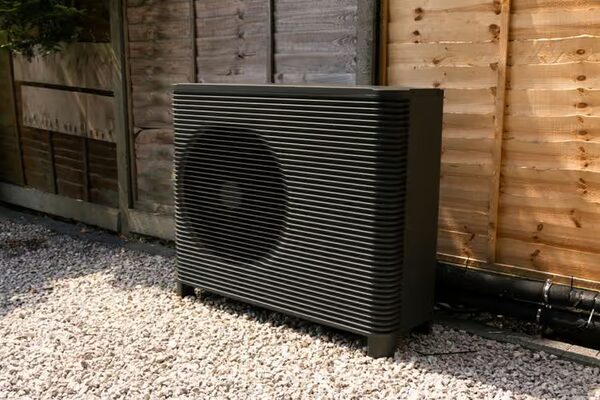
The permitted development right for air source heat pumps in Northern Ireland is real but conditional. The Department for Infrastructure's announcement of 12 June 2023 set out the conditions plainly: the unit must be at least 1 metre from the boundary of a neighbouring property, and it must comply with the prescribed noise standard1. Those are not guidance figures. They are the terms on which the right is granted.
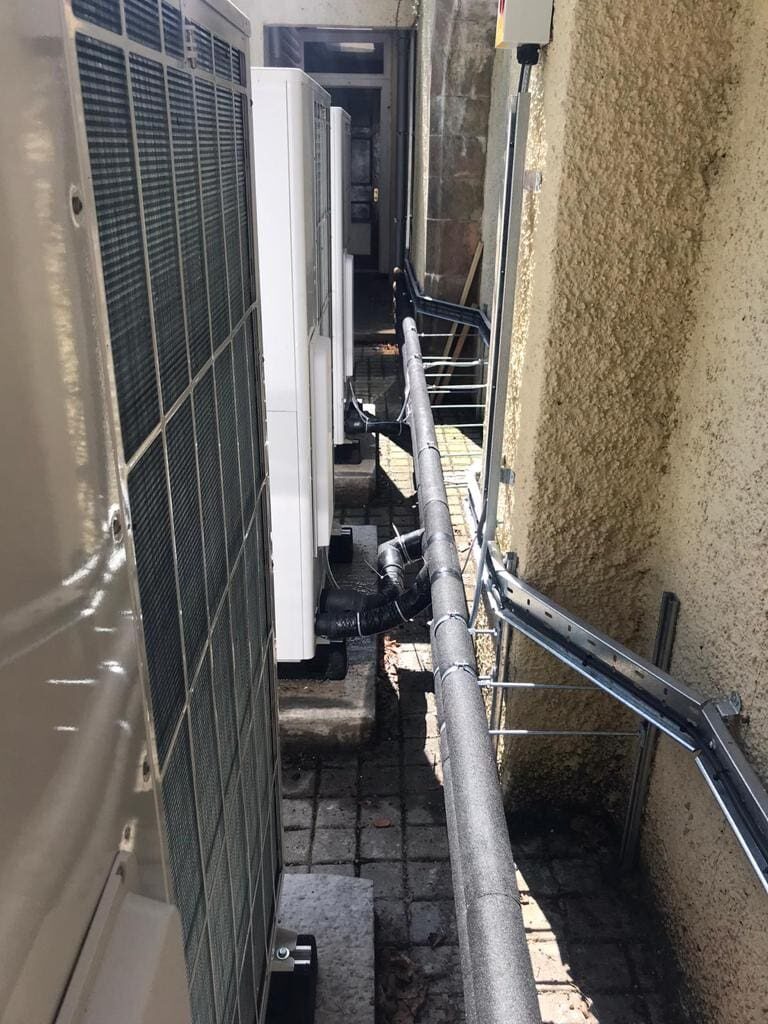
The 1 metre condition is the one most likely to bite in a Northern Irish setting, because many terraced and semi-detached houses have side passages narrower than that, and rear gardens that run tight to a boundary. A unit placed against a gable wall facing a neighbour's land may fail the condition on distance alone, whatever its noise output. Where the condition cannot be met, the right does not apply and a planning application is needed.
The noise standard is the second condition. It is prescribed rather than left to judgement, which means a household cannot rely on its own assessment of whether the unit is quiet enough. The Department's announcement describes the conditions and limitations as attaching to the right, and the Schedule to the 2015 Order carries the detail1.
There is movement on the boundary rule, but not in Northern Ireland. A UK government consultation published on 13 February 2024 sought views on "removing the limitation that they must be at least 1 metre from the boundary of the property" for the air source heat pump permitted development right10. That consultation concerns the English right, which sits in Part 14 of the Town and Country Planning (General Permitted Development) (England) Order 201511. It does not change the Northern Ireland position, and the 1 metre condition remains in force there.
For a household, the limits mean the right is usable but not universal. A detached house with a clear side return and a modern quiet unit is likely to sit inside it. A mid-terrace house with a narrow passage may not. The right also depends on the unit providing heating, so the choice of equipment and the choice of position are both constrained by the same set of conditions.
Where the rules differ from England, Scotland and Wales
Planning is devolved, and the four nations have separate permitted development regimes. Northern Ireland's order is the Planning (General Permitted Development) Order (Northern Ireland) 2015, amended in 2020 and again in 20231. England's heat pump rights sit in Part 14 of the Town and Country Planning (General Permitted Development) (England) Order 201511. Scotland has its own instrument, and its guidance states that "development which does not meet the criteria or thresholds within the legislation will not be considered to be permitted development"13.
| Nation | Instrument | Treatment of cooling |
|---|---|---|
| Northern Ireland | Planning (General Permitted Development) Order (Northern Ireland) 2015, amended 2020 and 20231 | 2023 amendment covers air source heat pumps; cooling-only equipment has no right1 |
| England | Town and Country Planning (General Permitted Development) (England) Order 2015, Part 1411 | 2025 changes brought cooling systems within scope for air source heat pumps including air-to-air systems, according to a manufacturer14 |
| Scotland | Separate Scottish instrument13 | Development outside the legislation's criteria or thresholds is not permitted development13 |
| Wales | Separate Welsh regime | Not covered by the Northern Ireland order1 |
The practical differences are three. First, the legal instrument is different in each nation, so a right that exists in one does not exist in another by default. Second, the conditions differ: Northern Ireland's 1 metre boundary rule and prescribed noise standard are set in its own order, and England's equivalent conditions are set in its own. Third, the treatment of cooling differs. England's 2025 changes brought cooling systems within scope of permitted development for air source heat pumps including air-to-air systems, according to Daikin, a manufacturer14. Northern Ireland's 2023 amendment did not do the same for cooling-only equipment.
Building regulations diverge as well. Official guidance on building regulations approval states plainly that "there are different rules in Scotland and Northern Ireland"15. That matters because air conditioning is a fixed building service under the Building Regulations (Northern Ireland) 2012, so the compliance route runs through the Northern Ireland regime rather than the English one5.
There is also a timing gap on standards. A Commons Library briefing records planned updates to energy requirements for new homes across the UK, with England and Wales in 2025, Scotland in 2024 and Northern Ireland in 2026 or 202714. A Northern Ireland consultation document from 11 October 2023 records the Department's expectation that it would accept England's changes but was "keen to set a lower maximum permissible air permeability level than 8.0 m3/(h.m2) @ 50 Pa", and notes a recalibration of the local position "some 18-24 months later"16.
For a household, the message is that advice written for England does not transfer. A guide that describes the English 2025 position on cooling systems is describing a different jurisdiction. The Northern Ireland position is set by the 2015 Order as amended in 2023, and by the conditions in its Schedule.
Outdoor unit placement: noise, neighbours and boundaries
Placement is where planning, building control and neighbour relations meet. The planning conditions set the boundary distance and the noise standard for permitted development heat pumps1. Building control adds its own requirements, because the Building Regulations (Northern Ireland) Order 1979 includes among the matters that may be regulated "measures to prevent pollution and nuisance"17. Noise from an outdoor unit is squarely within that.
The 1979 Order also sets out how building regulations may be framed. They "may be expressed in terms of performance, types of material, methods of construction or of ensuring safety, or otherwise"9. That matters for an outdoor unit because it means compliance can be assessed against a performance standard rather than a prescribed product, and it means the installer's judgement about siting carries weight.
The 1979 Order provides a route where a provision appears unreasonable in a particular case. The Department "may give a direction dispensing with or relaxing that provision in relation to that building" where it appears unreasonable to apply it9. That is a relaxation power, not a general exemption, and it is exercised case by case.
On the boundary itself, the position is simple for permitted development heat pumps and less simple otherwise. The 1 metre condition is measured from the boundary of a neighbouring property, not from the householder's own fence line if the fence sits inside the boundary1. For a cooling-only unit going through a planning application, there is no fixed distance rule; the application is assessed on its merits, and noise and visual impact are the matters a planning officer will weigh.
For a household, the sequence that removes uncertainty is to establish the boundary line, measure the available distance, and check the unit's rated noise output against the prescribed standard before committing to a position. Where the distance is marginal, the planning application route settles the question at the cost of time. Where the unit is cooling-only, that route is the only one available in any case.
Flats, listed buildings and conservation areas

Flats and protected buildings are where permitted development most often falls away. Guidance on air source heat pumps states that "permitted development rules for air source heat pumps are more restricted for flats and shared buildings", and that planning permission is more likely to be required18. The reason is structural: the curtilage of a dwellinghouse is the unit of the right, and a flat within a shared building does not have the same curtilage as a house.
Listed buildings face a higher bar again. Guidance states that "if your property is listed, you will usually need listed building consent before installing an air source heat pump, even if planning permission is not required"18. A separate guidance source puts it as planning permission, and in some cases listed building consent, being required for a listed building or a site of a designed scheduled monument7. Both point the same way: the permitted development route is not available, and consent is needed.
Conservation areas are treated separately from listing. Guidance on air conditioning states that "if your home is in a protected area such as a Conservation Area then permission will be required", and that listed building consent is required for listed buildings2. Guidance on insulation takes the same approach: where a building is listed or is in a conservation area, the local planning authority is the body to consult before work begins19.
| Situation | Planning permission | Listed building consent |
|---|---|---|
| Detached or semi-detached house, heat pump, conditions met | Not required1 | Not applicable |
| House, cooling-only air conditioner | Required2 | Not applicable |
| Flat in a shared building | More likely to be required18 | Not applicable unless listed |
| Listed building | Usually required7 | Usually required18 |
| Conservation area | Required2 | Only if the building is listed2 |
For a household in a flat, the practical position is that the outdoor unit is likely to need planning permission, and the freeholder or management company may also have a say under the lease. For a listed building, the position is that consent is needed before work starts, and the local planning authority is the body to consult. For a conservation area, permission is required, and the design and siting of the unit will be part of what is assessed.
How to apply for planning permission if you need it
An application goes to the district council, which is the planning authority in Northern Ireland6. The application is made under the Planning Act (Northern Ireland) 2011, the statute under which the 2015 Order was made9. The council will assess the siting, appearance and noise impact of the unit, and will grant or refuse.
The building control side runs in parallel and has its own procedures. The Building Regulations (Northern Ireland) Order 1979 sets out how plans are handled. A district council with which plans are deposited "shall notify the person by or on whose behalf the plans were deposited whether it has passed or rejected the plans"9. Where plans are rejected, "a notice rejecting the plans shall specify the grounds of the rejection"9. That gives an applicant a stated reason to work from.
The 1979 Order also provides for staged approval. A district council "may in prescribed cases pass them by stages in accordance with the regulations"9. It may also pass defective plans provisionally subject to modifications, or approve compliant plans provisionally subject to prescribed investigations9. These are procedural routes that allow work to progress while a point is resolved.
There are appeal rights where a council refuses. An applicant aggrieved by the rejection of plans may appeal in writing to the Department within a prescribed period9. Where a district council refuses a relaxation application, or grants it subject to conditions, the applicant may appeal to the Department within a prescribed period9. Where a council does not approve a particular type of building matter within a prescribed period, the applicant may appeal to the Department in writing9.
On timing, the legislation sets no single figure for a householder planning application. The Northern Ireland Housing Executive, describing its own grant process rather than planning, states that "it can take up to six months for us to provide an Approval of Application", that documents must be provided "within six months of the date on our letter", that it aims to give "no less than 10 working days' notice" of an inspection, that it may take "up to two weeks to schedule a visit to your work site from when we receive your request for an inspection", and that it may take "up to four weeks until we release the grant payment" once documents are received20. Those are grant administration timescales, not planning determination periods, but they indicate the order of magnitude a household should allow.
Building control and electrical certification

Air conditioning is a fixed building service in Northern Ireland. The Building Regulations (Northern Ireland) 2012 define a fixed building service as "fixed systems for heating (but excluding process heating), hot water service, air conditioning or mechanical ventilation; or any combination of systems of the kinds referred to in paragraphs (a) and (b)"5. That definition brings air conditioning within the scope of the regulations.
The same regulations provide a limited exemption. "The provision of a control device" for an existing fixed building service does not require notices or deposit of plans5. That covers adding or replacing a control on equipment already installed. It does not cover the installation of the air conditioning system itself.
Planning guidance on air conditioning states that "the installation of air conditioning must comply with building regulations", and advises contacting "an installer who belongs to the Microgeneration Certification Scheme or a relevant Competent Person Scheme"2. Competent person schemes allow registered installers to certify their own work rather than requiring a separate building control application, which is why the scheme membership matters.
Energy performance certificates are a related obligation. District councils are the enforcing authority for EPCs in Northern Ireland, and the guidance advises that "for advice on EPCs or if an EPC has not been made available to you as a buyer or new tenant, contact your local district council"21. The Energy Performance of Buildings (Certificates and Inspections) Regulations (Northern Ireland) 2008 implement Articles 7, 9 and 10 of the Energy Performance of Buildings Directive, covering energy performance certificates, the inspection of air-conditioning systems and independent experts22. Regulation 31 imposes a duty on the enforcement authority to enforce the duties relating to certificates and air-conditioning inspections22.
The regulations have been amended several times. The 2008 principal Regulations were amended by the Energy Performance of Buildings (Certificates and Inspections) (Amendment) Regulations (Northern Ireland) 2008, made on 6 June 2008, and then by the 2009 amendment regulations24. A further amendment followed in 201326. The 2008 Regulations also amended the Building Regulations (Northern Ireland) 2000, revoking the requirement to produce an energy rating notice for new dwellings and replacing it with a requirement to produce an energy performance certificate23.
For a household, the practical point is that planning permission and building control approval are separate requirements, and satisfying one does not satisfy the other. An installer's scheme membership is the mechanism that usually handles the building control side for domestic work. Where the work falls outside a scheme, a building control application to the district council is the route.
Landlords, tenants and rented homes
A tenant cannot authorise fixed equipment in a building they do not own. The Northern Ireland Housing Executive's Affordable Warmth Scheme makes the position explicit for its own work: "if you are a private tenant, we need your landlord's consent for work to take place in their property"27. The same principle governs air conditioning, because the outdoor unit is a fixture and the installation is development.
For a flat, there is a second layer. The permitted development right for air source heat pumps is more restricted for flats and shared buildings, and planning permission is more likely to be required18. Beyond planning, the lease may require freeholder or management company consent for any alteration to the exterior, and that consent is a contractual matter separate from planning.
For a landlord considering an installation, the planning position is the same as for an owner-occupier: a heat pump may fall within permitted development subject to the 1 metre and noise conditions, and a cooling-only unit needs an application2. The building control position is also the same, because air conditioning is a fixed building service under the 2012 Regulations5.
For a tenant who wants cooling without those complications, a portable unit avoids the planning question entirely, because it is not development. The limits of portable units are covered in Portable Air Conditioners: How They Work and Their Limits, and the rental-specific position is set out in Can you use a portable air conditioner in a rental property?.
What a refusal or complaint means for an installation
A refusal at planning stage is not the end of the process, but it does stop the work. The 1979 Order gives appeal rights on the building control side: an applicant aggrieved by the rejection of plans may appeal in writing to the Department within a prescribed period, and where a district council does not approve a particular type of building matter within a prescribed period, the applicant may appeal in writing9. Where a council refuses a relaxation application or grants it subject to conditions, there is a further appeal right9.
A complaint from a neighbour is the usual route by which an unauthorised installation comes to a district council's attention. The council is the planning authority, and it can take enforcement action where development has been carried out without the required permission6. The remedy is either a retrospective planning application or removal of the unit. Building control approval cannot cure a planning breach, because the two regimes are separate.
There is a procedural trap worth knowing. If a district council does not notify its decision within the prescribed period, the application is treated as refused on the last day of that period9. An applicant who assumes silence means consent may find the appeal window running from a date they did not notice.
On the building control side, the 1979 Order also allows a council to pass plans by stages, to pass defective plans provisionally subject to modifications, and to approve compliant plans provisionally subject to prescribed investigations9. These routes exist so that a fixable defect does not force a fresh application.
For a household, the sequence after a refusal is to read the stated grounds, address them, and either reapply or appeal within the prescribed period. Where the refusal rests on the 1 metre boundary condition or the noise standard, repositioning the unit or specifying a quieter model may resolve it. Where it rests on the building being listed or in a conservation area, the consent route is the one that applies, and the local planning authority is the body to consult2.
Sources27 cited
- Changes to permitted development rights for domestic heat pumps, Department for Infrastructure, 2023
- Planning permission for common projects, Planning Portal, 2026
- The Planning (General Permitted Development) Order (Northern Ireland) 2015, legislation.gov.uk, 2015
- Schedules to the Planning (General Permitted Development) Order (Northern Ireland) 2015, legislation.gov.uk, 2015
- The Building Regulations (Northern Ireland) 2012, legislation.gov.uk, 2012
- The Planning (General Permitted Development) Order (Northern Ireland) 2015, explanatory memorandum, legislation.gov.uk, 2015
- Fact sheet 5: air source heat pumps, Pendle Borough Council, 2026
- The Planning (General Permitted Development) Order (Northern Ireland) 2015, full text, legislation.gov.uk, 2015
- Building Regulations (Northern Ireland) Order 1979, legislation.gov.uk, 1979
- Changes to various permitted development rights: consultation, GOV.UK, 2024
- Planning guidance on heat pumps, London Borough of Richmond upon Thames, 2026
- The Planning (General Permitted Development) (Amendment) Order (Northern Ireland) 2020, legislation.gov.uk, 2020
- Domestic air source heat pumps in Scotland, legislation.gov.uk, 2016
- Research briefing on energy efficiency of homes, House of Commons Library, 2026
- Building regulations approval: how to apply, GOV.UK, 2026
- Building regulations discussion document and pre-consultation, Department of Finance, 2023
- Planning Act (Northern Ireland) 2011, legislation.gov.uk, 2011
- Air source heat pumps: planning guidance, Westmorland and Furness Council, 2026
- Improving energy saving and sustainability in conservation areas and listed buildings, Brighton and Hove City Council, 2026
- How long will the whole process take, Northern Ireland Housing Executive, 2026
- Energy performance certificates, nidirect, 2026
- Energy Performance of Buildings (Certificates and Inspections) Regulations (Northern Ireland) 2008, Building Control Northern Ireland, 2008
- Energy Performance of Buildings Regulations (Northern Ireland) 2008, Building Control Northern Ireland, 2008
- Energy Performance of Buildings (Certificates and Inspections) (Amendment) Regulations (Northern Ireland) 2008, Building Control Northern Ireland, 2008
- Energy Performance of Buildings (Certificates and Inspections) (Amendment) Regulations (Northern Ireland) 2009, Building Control Northern Ireland, 2009
- Energy Performance of Buildings (Certificates and Inspections) (Amendment) Regulations (Northern Ireland) 2013, Building Control Northern Ireland, 2013
- Affordable Warmth Scheme, Northern Ireland Housing Executive, 2026
 Planning Permission EnglandExplains when an external air conditioning or air-to-air heat pump unit in England needs planning permission, and how permitted development applies.
 Planning Permission in NIDo you need planning permission for a heat pump in Northern Ireland?
 Planning Permission ScotlandHow Scottish permitted development rules treat external air conditioning and air-to-air heat pump units, where they differ from England, and the position for conservation areas, listed buildings and flats.
 Home Energy Planning Rules in NIDo you need planning permission for solar panels or a heat pump in Northern Ireland?
 Planning Permission WalesDo you need planning permission for an air conditioning unit outside your home in Wales?
 Planning Permission in EnglandDo you need planning permission for an air source heat pump?