
In this guide
Air conditioning in a flat is governed less by the equipment than by the building. A fixed system with an outdoor condenser is an alteration to the property, and in a leasehold flat that means the lease, the freeholder and often a managing agent all have a say before a unit is ordered. Official guidance is direct on the point: leaseholders may need to get permission from their landlord, freeholder or management company1. The same applies to a private rented flat, where the landlord's consent is required for work in their property2.
The second constraint is planning. In England, adding air conditioning may be permitted development provided all the limits and conditions in legislation are met, covering function, size, placement and quantity of units, but the rights apply only if the system provides a heating function, including heating and cooling. A cooling-only system requires a planning application3. Flats also sit under different rules from houses, and a listed building is excluded outright.
The third is cost and timing. The temporary zero rate of VAT for installing energy-saving materials runs from 1 February 2024 to 31 March 20274. After that, the reduced rate of 5% applies to eligible installations5. For a flat with no outdoor space, the practical answer is usually a portable unit, which needs no consent for the building but does need proper venting and uses more electricity than a fixed system6.
What your lease says about air conditioning: the clause that decides everything
The lease is the controlling document. It sets out what counts as an alteration, what needs written consent, and what the freeholder may charge for considering a request. A fixed air-conditioning system falls squarely within that territory, because it involves pipework, drainage, an electrical supply and, in most designs, an external condenser fixed to the building.
Building regulations reinforce the point. Putting in a fixed air-conditioning system is a covered alteration requiring approval9. The requirements apply to buildings, or extensions of such buildings, or work to or in connection with such building or extension where the building is a roofed construction having walls and uses energy to condition the indoor climate10. A flat is such a building. Where a modification includes the provision or extension of any of the fixed services for heating, hot water, air conditioning or mechanical ventilation, the energy efficiency of the building must be considered11.
Wales defines fixed building services to include any part of, or any controls associated with, fixed systems for heating, hot water, air conditioning or mechanical ventilation, or any combination12. That definition matters because it confirms that the controls, not just the unit, form part of the regulated installation.
For a leaseholder, the practical sequence is to read the lease before anything else. Where the lease requires consent, the freeholder or managing agent will normally want to see what is being fixed, where, how it is drained, and how noise is controlled. The Energy Performance of Buildings (England and Wales) (Amendment) Regulations 2024 deal with disclosure of assessment data in relation to an air-conditioning system to which Part 4 applies4, which shows how far the regulatory reach extends for larger systems.
Consent from the freeholder or managing agent: how to ask and what to expect

Consent is a process, not a formality. Official guidance states that leaseholders may need to get permission from their landlord, freeholder or management company1, and the same wording appears in planning guidance for equipment installed within the grounds of a house or a block of flats14. For a private tenant, the landlord's consent is required for work to take place in their property2.
Schemes that fund energy work show how consent is documented in practice. Under the Affordable Warmth Scheme, a private tenant needs the landlord's consent for work to take place in their property2. Under the Warm Healthy Homes Fund consultation, tenants who privately rent from a landlord and who satisfy the eligibility criteria may apply to the scheme with agreement, and the landlord must agree to pay half the cost of the energy upgrades15. Under the Boiler Upgrade Scheme, a Letter of Authorisation must be used if the property is owned by an organisation not listed on Companies House, and consent must come from an individual16. The letter can be submitted either prior to, or following, the provision of the confirmation of Property Owner Consent to an application being made17.
The pattern is consistent: consent is evidenced in writing, and the person giving it must have authority to do so. For a flat, that usually means the freeholder or the managing agent acting under delegated powers. Where the freeholder is a company, the signatory must be identifiable. Where the building is managed, the agent will often require a method statement covering fixings, drainage route, electrical connection and noise.
A household should expect the request to be assessed against the lease, not against the merits of cooling. The lease may permit the work subject to conditions, refuse it, or require a licence to alter with a fee. None of that is a comment on the equipment.
Flats and permitted development: why the rules differ from houses
Permitted development rights for flats are narrower than for houses, and the difference is structural rather than arbitrary. A house has its own curtilage and its own roof; a flat shares a building envelope with neighbours, so an external unit affects common parts and other leaseholders.
In England, Class G permitted development rights for air source heat pumps cap the outdoor compressor unit, including any housing, at 0.6 cubic metres where the installation is on, or within the curtilage of, a block of flats7. The same limit appears in official guidance: the outdoor compressor housing, the box within which the machinery sits, is not to exceed 0.6 cubic metres18. No more than one air source heat pump may be installed on, or within the curtilage of, a dwellinghouse which is not a detached dwellinghouse or a block of flats19. The heat pump must not be installed on a building or on land within the curtilage if the dwellinghouse or block of flats is a listed building19.
Scotland has its own permitted development classes, and several of them name flats directly. One covers the installation, alteration or replacement of a flue forming part of a biomass heating system on a dwellinghouse or building containing a flat20. Another covers the installation, alteration or replacement of a ground source heat pump and any associated pipes or apparatus within the curtilage of a dwellinghouse or building containing a flat20. A further class covers a flue forming part of a combined heat and power system on a dwellinghouse or building containing a flat20. The wording of these classes shows that Scottish permitted development explicitly contemplates works on buildings containing flats, where the English householder rights for many common projects do not apply to flats at all.
Wales and Northern Ireland operate under separate regimes, and the position on flats differs again. Where a flat sits in a conservation area, permission is required, and listed buildings need listed building consent3.
External condensers and the building's facade: the usual sticking point
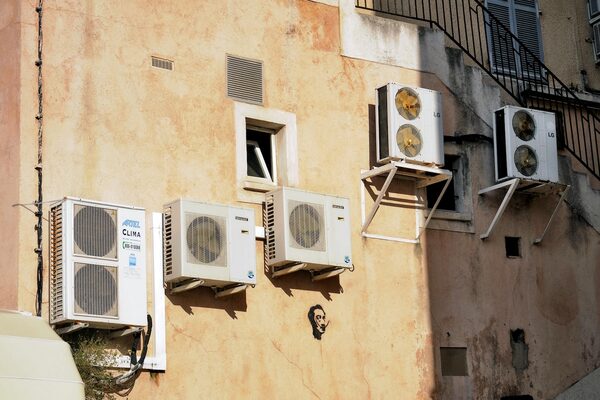
The condenser is where most flat applications fail. It is visible, it vibrates, it drips, and it is fixed to a wall that may be common property. Even where the lease permits an alteration, the freeholder may refuse a fixing to the facade.
The planning limits are tight. The 0.6 cubic metre cap on the outdoor compressor unit and its housing applies to blocks of flats7, and the same figure appears in official guidance for England18. A listed building excludes the installation entirely19. Where a noise assessment is needed, a planning application must include a noise assessment report8.
Ventilation design matters too. Official guidance on flat roof cold deck insulation places ventilation openings either at the eaves or upstand21, which is a reminder that roof and facade elements are engineered as a system. Adding a condenser to a facade changes that system, and a managing agent will normally want an assessment of fixings and weatherproofing.
"leaseholders may need to get permission from your landlord, freeholder or management company"
For a flat with no balcony and no external wall available, the fixed split system may simply be unavailable. That is the point at which the alternatives matter.
Portable and split options compared: which suits a flat
The choice for a flat turns on whether an external unit can be fixed at all. Where it can, a split system is more efficient and quieter. Where it cannot, a portable unit is the practical route, with the trade-offs stated plainly.
Portable units use 30 to 50% more electricity than fixed systems6. They need to be properly vented to the outside using a special fitting for the window; a vent through an open window will let heat back in6. They are not silent, and they occupy floor space.
Air-to-air heat pumps are particularly well suited to smaller homes and flats and can take up less wall space than traditional radiators22. That is the independent view of the technology, and it explains why a flat that can take an external unit often benefits twice: cooling in summer and heating in winter, which is also what brings the installation within permitted development in England3.
| Option | External unit | Consent needed | Efficiency note |
|---|---|---|---|
| Portable monobloc | None | Generally none for the building | 30 to 50% more electricity than fixed systems6 |
| Split system | Yes, condenser | Lease and often planning | Permitted development only if it heats as well as cools3 |
| Air-to-air heat pump | Yes, condenser | Lease and often planning | Suited to smaller homes and flats22 |
For a flat with no outdoor space, the portable route avoids the consent question entirely, but it does not avoid the venting requirement or the running cost penalty. Pages on portable air conditioners and air conditioning without an outdoor unit set out the alternatives in more detail.
Drainage and the drain hose: what a portable unit actually needs
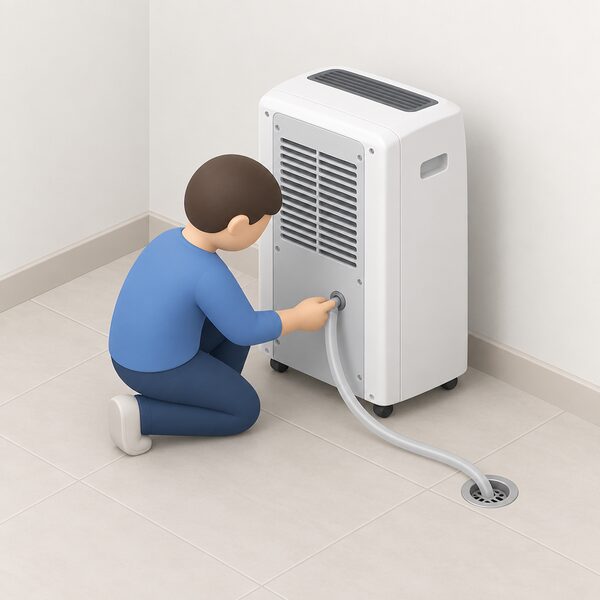
Drainage is the detail that catches people out. A portable unit produces condensate, and how it deals with that water determines whether a hose is needed at all.
Independent guidance is clear on venting: portable units need to be properly vented to the outside using a special fitting for the window, and a vent simply put through an open window will let heat back in6. Venting and drainage are separate questions, and a unit can be correctly vented while still needing a drain route.
On drainage specifically, the position varies by model. A retailer answer dated 16 March 2026 states that a drain hose with an internal diameter of about 13 mm, half an inch, should be used with the condensate drain port on the AirFlex 15. A second retailer answer dated 18 March 2026 states that the same unit is self-evaporating in cooling mode and needs a drain hose only when the tank is full, shown by error code E4, or in dehumidifier mode. Both statements come from the same retailer and describe the same model, so the practical reading is that normal cooling may need no hose, while dehumidifier mode and a full tank do.
Ventilation more broadly is a building consideration. Approved Document F Volume 1, in its consultation version, gives examples of minor works including the provision of a self-contained mechanical ventilation or air-conditioning appliance such as a cooker hood, bathroom extract fan or room air conditioning unit not installed in a room containing an open-flued combustion appliance23. The same document sets a minimum whole-dwelling ventilation rate of 31 litres per second for a three bedroom dwelling under criterion 1 by number of bedrooms23. A portable unit does not substitute for that background ventilation.
Running costs and the 0% VAT window on cooling units
The VAT position is time-limited and worth stating precisely. Official guidance states that a rate of 0% VAT applies to both certain products supplied by the installer and the cost of all work to install those products in the home5. The same guidance notes a rate of either 5% or 0% VAT when certain energy-saving products are installed in the home if the household is eligible5.
The temporary zero rate for the installation of energy-saving materials applies from 1 February 2024 to 31 March 20274. Official guidance on the Boiler Upgrade Scheme confirms that between 1 April 2022 and 31 March 2027 there is a zero rate of VAT on the installation of energy-saving materials including heat pumps and biomass boilers16.
Where the reduced rate applies instead, the arithmetic is set out in official guidance: an installer charged £400 excluding VAT for insulation material, where the value of the materials is only 40% of the cost of the total supply, produces a reduced-rate VAT charge of 5% of £1,000, which is £5025. The example is about insulation, but it shows how the reduced rate is calculated on the total supply.
For a flat, the VAT question is bound up with the consent question. A fixed installation that qualifies for the zero rate is also an installation that needed lease consent and, in many cases, planning. A portable unit bought over the counter is a retail purchase and does not attract the installer relief. Pages on air conditioning running costs and air conditioning cost cover the wider picture.
Noise, neighbour complaints and what the law expects of you
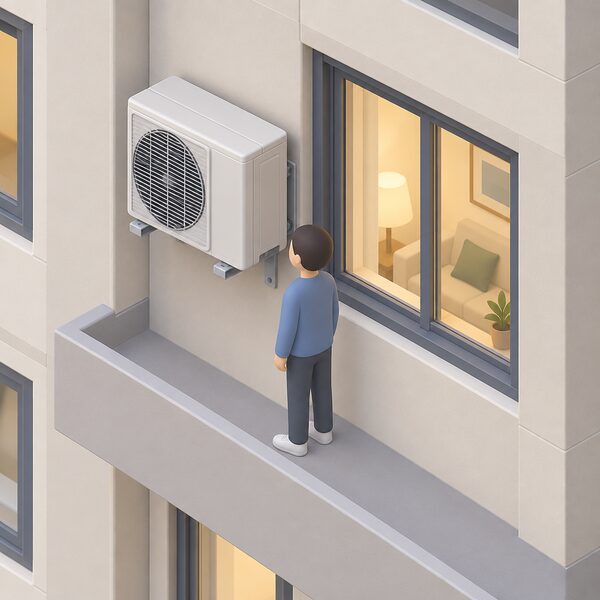
Noise is the constraint most likely to generate a complaint in a block, because a condenser fixed to a shared wall transmits vibration as well as sound.
The planning limit is specific. Permitted development rights for air source heat pumps require that the unit must not exceed 37dB(A) at the nearest habitable room of a neighbouring property8. Where a noise assessment is needed, a planning application must include a noise assessment report8. That figure is the threshold for permitted development, not a general licence to make noise, and a managing agent may impose a stricter condition in the lease.
Ventilation systems in flats have their own noise and performance characteristics. Intermittent extract ventilation uses individual extractor fans in bathrooms, kitchens and utility rooms, usually controlled by a light switch, a timer or humidity sensor; they are relatively cheap to install and reasonably effective but not always sufficient for very air-tight or damp-prone properties26. Centralised mechanical extract ventilation draws moist air from wet rooms through ducts to a central unit, often in a loft, then to the outside; the systems are complex and expensive to install, and only suitable where there is sufficient space for ductwork26. Positive input ventilation is usually located in the loft, blows fresh air into the home, forcing stale moist air out through background ventilation and the building fabric; it can be cold directly under the fan, may not provide fresh air to the rooms that need it, and forcing warm moist air into the building fabric can lead to condensation and structural damage26.
The lesson for a flat is that adding cooling equipment to a building already served by mechanical ventilation changes the pressure balance. A unit that exhausts air through a window kit can work against an extract system, and the two should be considered together. Pages on air conditioning noise and air conditioning and humidity develop both points.
Portable units in a rented flat, and what the maker states
For a tenant, the portable route avoids the consent question for the building, though the tenancy agreement may still restrict appliances. The maker's own product data is the reliable source for what a specific model does.
The Meaco Cirro 12000 BTU portable air conditioner is listed by the maker as sold out, with a restock date of March 202727. A separate dated event records the unit returning to stock in October 2026, so the two dates disagree and the maker's own page is the more recent statement. The same page lists an A energy rating, no inverter technology, a cooling capacity of 12000 BTU, no heating capacity, app compatibility as optional, modes of cool, fan, dry and sleep, a warm pebble colourway, a glow in the dark remote, and flexible window kit dimensions of up to 39 cm width and up to 4 m in length27.
| Specification | Meaco Cirro 12000 BTU |
|---|---|
| Cooling capacity | 12000 BTU27 |
| Heating capacity | N/A27 |
| Energy rating | A27 |
| Inverter technology | No27 |
| Modes | Cool, Fan, Dry, Sleep27 |
| App compatible | Yes (optional)27 |
| Window kit | Up to 39 cm width, up to 4 m length27 |
| Availability | Sold out, restock March 202727 |
The absence of inverter technology is worth noting against the general efficiency picture, since portable units already use 30 to 50% more electricity than fixed systems6. A household comparing models should read the maker's own specification rather than a summary. Pages on portable air conditioners and Meaco cooling cover the range.
What this means for a flat's energy independence

A flat's cooling options sit at the opposite end of the independence scale from a house with a garden. The building is shared, the envelope is not the household's to alter, and the consent chain runs through a freeholder or managing agent who has no interest in the household's comfort.
A fixed system, where it is permitted, delivers the best efficiency and the lowest running cost, and an air-to-air heat pump adds a heating function that brings it within permitted development in England3. That is a genuine gain in independence: the household is no longer wholly dependent on a central heating system it does not control.
A portable unit delivers no such gain. It depends on the electricity supply, on a window that can take a vent kit, and on a manufacturer's continued support for the model. It uses 30 to 50% more electricity than a fixed system6, and it does nothing for heating. Where the maker's stock position is uncertain, as with the Cirro 12000 BTU listed as sold out until March 202727, the household's dependence on a single product line is exposed.
The dependence that remains is structural. A leasehold flat cannot be made energy independent by cooling equipment alone, because the building fabric, the ventilation strategy and the external envelope are shared. What a household can control is the choice of system, the consent it obtains, and the running cost it accepts. Pages on home cooling and cooling and energy independence set that in a wider context.
Sources27 cited
- Planning advice: solar panels and planning permission, Cornwall Council, 2026
- Affordable Warmth Scheme, Northern Ireland Housing Executive, 2026
- Is permission needed for installing new roof tiles, Planning Portal, 2026
- The Energy Performance of Buildings (England and Wales) (Amendment) Regulations 2024, legislation.gov.uk, 2024
- VAT on energy-saving products, HM Revenue and Customs, 2026
- How to keep your home cool in hot weather, Centre for Sustainable Energy, 2026
- Class G: installation or alteration of air source heat pumps on domestic premises, legislation.gov.uk, 2026
- Air source heat pumps, Bracknell Forest Council, 2025
- Building regulations approval, GOV.UK, 2026
- Building regulations, Planning Portal, 2026
- Regulation 7A, legislation.gov.uk, 2026
- Amendments to the Approved Documents Part L, Welsh Government, 2019
- The Gas Safety (Installation and Use) Regulations 1998, legislation.gov.uk, 1998
- Planning permission: stand alone solar equipment, Planning Portal, 2026
- Warm Healthy Homes Fund consultation, Department for Communities, 2026
- Boiler Upgrade Scheme: guidance, Ofgem, 2023
- Boiler Upgrade Scheme: Letter of Authorisation, Ofgem, 2026
- Permitted development rights: impact assessments, Scottish Government, 2026
- Class G: installation or alteration of air source heat pumps on domestic premises, legislation.gov.uk, 2026
- The Town and Country Planning (General Permitted Development) (Scotland) Amendment Order 2009, legislation.gov.uk, 2009
- Building regulations: new roofs thermal resistance insulation, Planning Portal, 2026
- What it's really like to have a heat pump, Which?, 2025
- Approved Document F Volume 1: dwellings (consultation version), Welsh Government, 2020
- Fitness for Human Habitation guidance for landlords, Welsh Government, 2022
- Draft VAT guidance on changes to energy-saving materials, HM Revenue and Customs, 2026
- Ventilation, Centre for Sustainable Energy, 2025
- Meaco Cirro 12000 BTU portable air conditioner, Meaco, 2026
 Leasehold Consent for EnergyHow a lease restricts alterations, who grants consent for solar, heating and glazing work in a flat, and how planning permission and listed building consent sit alongside freeholder permission.
 Heating Controls by Home TypeCompares the control arrangements that suit flats, terraces, open-plan conversions, large detached houses, solid-wall period homes and new builds.
 Ventilation in FlatsGetting enough fresh air into a flat is harder than a house, because you often have only one outside wall and neighbours on every other side.
 The Full Cooling and Air Conditioning GuideDo you really need air conditioning in a British summer, or would a fan and better shading do the job?
 Energy Improvements in FlatsLiving in a flat, what can you actually change yourself and what needs the freeholder or management company to agree?
 High-Rise Flats and SafetyWho signs off new insulation, cladding or heating in a high-rise flat?