In this guide
An electric fan cools the people in a room, not the room itself. It moves air across the skin, which makes a person feel cooler, but it does not remove heat: National Energy Action states that fans "do not lower the temperature of a room"1. The cooling works only where the airflow lands, so a fan is effective when it blows directly onto someone2, and in extreme heat it stops helping: above a room temperature of 35 degrees, a fan will likely heat a person up rather than cool them down3.
What fans offer in return is a very low power draw. A small desk fan is listed at 20W, a pedestal fan at 50W and a large fan at 75W, costing 0.5p, 1.3p and 1.9p an hour respectively at an electricity price of 25.7p/kWh1. Ceiling fans can make occupants feel 2 to 4°C cooler through wind chill4, although official Welsh guidance notes they only slightly reduce room temperatures5.
This page covers the main types sold in the UK (desk, pedestal, tower, ceiling and bladeless), with particular attention to tower fans; what each draws and costs; where to place them; safe use and cleaning; the temporary 0% VAT rate on domestic electricity in Great Britain; and how fans sit alongside night ventilation and shading in a household that wants to stay cool on as little bought-in energy as possible.
Tower fans: a column of moving air, not a cooling machine
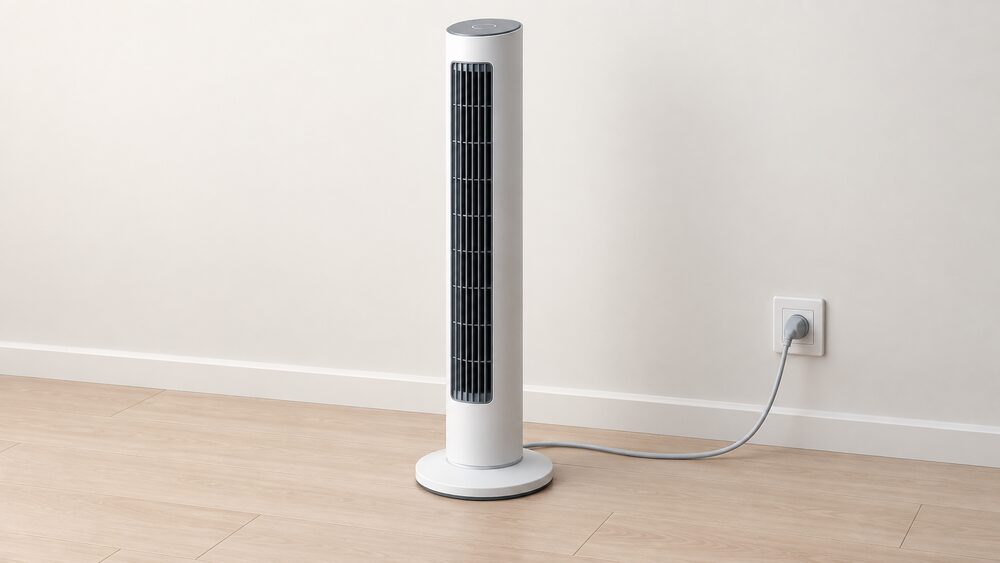
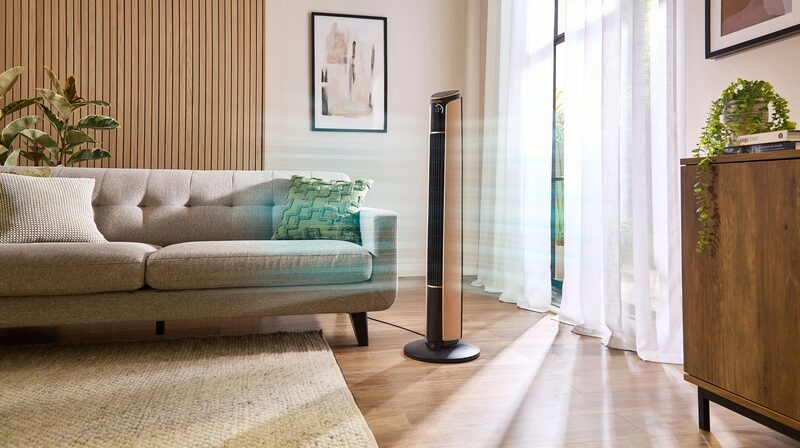
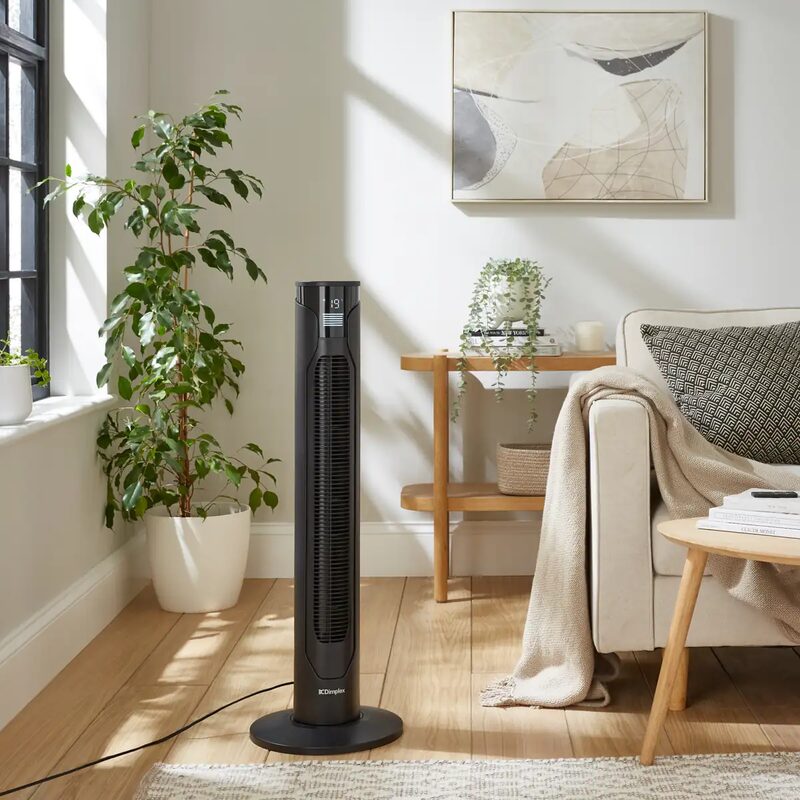
A tower fan is a tall, narrow floor-standing fan that draws air in and pushes it out through a vertical grille, spreading the airflow over a person's height rather than from a single round head. Whatever its shape, it works on the same principle as every other electric fan: it moves room air and creates a cooling sensation on the skin1. It has no refrigerant, no compressor and no connection to the outdoors, so it cannot carry heat out of the home.
That distinction matters because UK guidance draws a clear line between devices that move air and devices that remove heat. Air conditioners "actively remove heat and reduce room temperature"1; fans do not. Air coolers sit between the two: they use water to slightly cool air and are more effective than fans in dry conditions1. A tower fan sold with a water tank or "cooling" mode is, in effect, a small evaporative cooler, covered on the page on evaporative air coolers.
What a tower fan does well is make an occupied room feel more bearable while the air temperature stays the same. The cooling effect comes from air passing over skin, which helps sweat evaporate. It stops the moment the airflow leaves the person, which is why guidance stresses that fans are only effective when blowing air directly onto someone2.
Published UK guidance does not give a separate power rating or running cost for tower fans. The figures on this page for desk, pedestal and large fans, and for the "average fan", are the independent benchmarks available; a particular tower fan's draw is set by its maker and printed on its rating plate. For comparison with fixed systems that heat as well as cool, see air conditioning that heats.
Why a tower fan suits slim, space-saving cooling
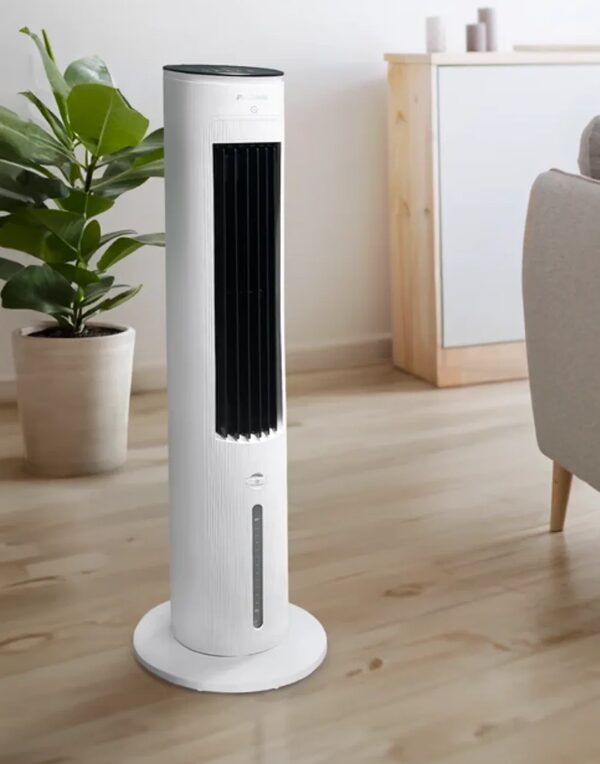
The appeal of a tower fan is mostly about footprint and reach. A column that stands against a wall or in a corner takes up less floor than a pedestal fan with a wide head and base, and it spreads its airflow vertically, which suits a person sitting on a sofa or lying in bed. Those are design choices rather than performance claims, and no independent UK source in this guide measures tower fans against other types.
The broader case for a small, plug-in device in a small home rests on the physics common to all fans. Because a fan cools only the person in its airstream2, the amount of room it serves is the space one or two people occupy, not the volume of the room. In a compact flat or bedroom, one tower fan aimed at the occupied spot does the job a fan can do, without any installation, planning consent or outdoor unit.
That contrasts with the fixed alternative often suggested for small homes. Air-to-air heat pumps transfer heat from outside air into the home through fan coil units or "blowers", and can both heat and cool air depending on what is needed8. They cool the room itself, but they are installed systems with outdoor units, running costs far above those of a fan, and the planning conditions set out on the air conditioning planning pages.
For households weighing space and simplicity, the trade is clear:
- A tower fan: plug-in, movable, no outdoor unit, cools people only.
- A fixed air-to-air system: installed, heats and cools, reduces room temperature, needs an outdoor unit and more electricity.
Plymouth Energy Community sums up the cost side: fans "are far cheaper to run than air conditioning", while air conditioning increases electricity use and can add significantly to summer energy bills2. A full comparison is on air conditioning vs fans.
Where a fan falls short in a hot room
The firmest limit is temperature. The Centre for Sustainable Energy sets out the threshold in plain terms:
"if the room temperature is above 35 degrees, a fan will likely heat you up rather than cool you down"
At that point the air being blown onto the skin is hotter than the skin itself, so moving more of it adds heat rather than carrying it away. That is the condition of a severe heatwave in a top-floor flat or a poorly shaded room, which is exactly when cooling is most needed. The risks to vulnerable people in those conditions are covered on heatwaves and health at home.
The second limit is that a fan leaves the room as hot as it found it. Even ceiling fans, which move a large volume of air, "can help air movement (but only slightly reduce room temperatures)" according to Welsh Government guidance on overheating in newer homes5. The 2 to 4°C figure often quoted for ceiling fans is a perceived effect, a wind chill on how a person feels4, not a reading on a thermometer.
The third limit is that a fan does nothing for an empty room. Because cooling depends on air blowing directly onto a person2, running a fan in a room nobody is in uses electricity without benefit, and it does not "pre-cool" a bedroom for later.
| What people ask of a fan | What the evidence says |
|---|---|
| Lower the room temperature | Fans do not lower room temperature1 |
| Make occupants feel cooler | Yes, by moving air over the skin; ceiling fans 2 to 4°C perceived4 |
| Help in extreme heat | Above 35 degrees, likely to heat a person up3 |
| Match air conditioning | Air conditioners actively remove heat; fans do not1 |
A fan is therefore best understood as one layer. Keeping heat out in the first place, through external shading and passive cooling, and flushing it out at night, does the work a fan cannot.
Placing a fan for the best cooling effect
Placement follows directly from how a fan works. Since fans are only effective at cooling when blowing air directly onto a person2, the aim is to put the airflow where people sit, work or sleep, not to point it at the middle of the room. A tower fan beside a bed or desk, a desk fan at arm's length, or a pedestal fan angled at a seating area all serve that purpose.
Plymouth Energy Community notes that a bowl of ice or a damp cloth in front of a fan can boost the cooling effect2. That is a small, temporary evaporative effect. It must not be confused with the social-media trick of hanging bags of ice above a fan, which Electrical Safety First warns against (see the safety section below)9.
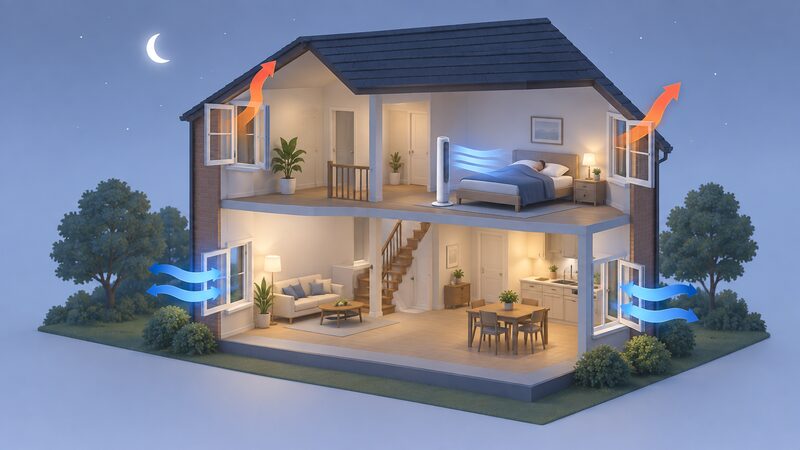
A fan also works better as part of a ventilation strategy. Citizens Advice notes that a well insulated home is usually easier to keep cool, with ventilation by opening windows at night and using extractor fans and vents10. In practice that means:
- Keeping windows and curtains closed on the sunny side during the hottest part of the day.
- Opening windows at night, when outdoor air is cooler, so cooler air replaces the warm air built up indoors.
- Using a fan to push that air across the room or towards occupants while windows are open.
- Running extractor fans in kitchens and bathrooms to remove heat and moisture at source.
The approach is detailed on night ventilation and purge cooling. The Centre for Alternative Technology notes that in the UK's mild climate some form of passive ventilation is usually appropriate, with warm air rising through the building and replacement fresh air coming ideally through a buffer space11. A fan placed to assist that natural flow, rather than fight it, gets more from the same few watts.
Running costs on 0% VAT domestic electricity
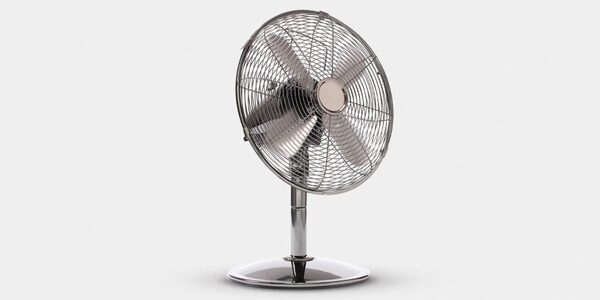
A fan's running cost is its power draw multiplied by the price of electricity, which is why fans are cheap to run. National Energy Action gives these figures, all based on an electricity price of 25.7p/kWh1:
| Fan type | Power draw | Cost per hour at 25.7p/kWh |
|---|---|---|
| Small desk fan | 20W | 0.5p |
| Pedestal fan | 50W | 1.3p |
| Large fan | 75W | 1.9p |
Other independent sources give broader figures. Uswitch states that floor or desktop fans typically draw 60W or less, costing under 2p an hour, and that fans and portable evaporative coolers use less than 0.1 kWh, with some as low as 20W4. The Centre for Sustainable Energy puts the average fan at around 3p an hour3, and End Fuel Poverty Coalition reports that the average fan uses less than 100 watts and costs around 3p an hour6. The range reflects different fan sizes and electricity prices; the sources agree that a typical fan costs pennies an hour.
For contrast, Which? estimates that a 2kW fan heater used for an hour every morning costs roughly £3.85 a week12. A fan heater looks similar but heats air with a wire coil, which is why its draw is many times that of a cooling fan.
The temporary zero rate of VAT
A temporary zero rate of VAT applies to qualifying supplies of domestic electricity in Great Britain from 1 October 2026 to 31 March 20277. Because every fan's running cost is set by the unit price, a lower unit price lowers the cost per hour of any fan in a GB home during that period. The sources do not state whether the 25.7p/kWh figure above includes VAT, and no official figure is published for the new unit price, so no adjusted per-hour cost is given here. The practical effect on a device drawing 20W to 75W is measured in fractions of a penny per hour.
The separate 0% VAT relief for energy-saving materials applies to installed products such as insulation and heat pumps; plug-in fans are not part of that scheme. Wider comparisons with air conditioning are on air conditioning running costs.
Desk, pedestal, tower, ceiling or bladeless: which fits which room
All electric fans cool the same way, so choosing between them is about where the air needs to go and how much space is available, not about one type cooling more. The independent figures give a sense of scale: a small desk fan at 20W and a pedestal fan at 50W1, with ceiling fans producing a perceived 2 to 4°C cooling4.
| Type | Typical use | Published power figure |
|---|---|---|
| Desk fan | One person at close range, desk or bedside | 20W (small desk fan)1 |
| Pedestal fan | Seating area, adjustable height and tilt | 50W1 |
| Large floor fan | Wider spread of air | 75W1 |
| Tower fan | Slim floor column, vertical airflow | No independent figure; maker's rating |
| Ceiling fan | Whole-room air movement from above | 2 to 4°C perceived cooling4 |
| Bladeless fan | Floor or desk, airflow through a ring | No independent figure; maker's rating |
Desk fans suit a single person at short range. Pedestal fans reach further and adjust in height. Tower fans trade reach for a small footprint. Ceiling fans are fixed, need wiring, and move air over a whole room, but still only slightly reduce room temperature5. Bladeless fans, sold under brands including those on the Dyson fans page, work on the same principle of moving air.
Heater-fan combinations
Some products combine a fan with a heater. The De'Longhi Capsule Desk Personal Fan Ceramic Heater is designed "for desk, short distance use", and its product listing states "Low energy consumption 360w"13. That figure is for the heater function and is well above the 20W listed for a small desk fan1. Fan heaters use a coil of wire to heat air and force it into the room with a fan, and are usually small, cheaper, give instant heat and can be noisy14.
UK makers selling fans for cooling include those covered on the Meaco and Duux pages. Noise and power vary by model and are set out in each maker's specification.
Extractor fans are a different job
Extractor fans do not cool people; they remove moist, stale air. The Centre for Sustainable Energy notes that in kitchens, bathrooms and utility rooms, extractor fans are required to remove excess moisture, and opening a window helps where there is none15. BEAMA states that regulations recommend all kitchens, toilets and bathrooms have an extractor fan, preferably with a timer or air sensor16. In summer, they also help take heat from cooking and showers out of the home.
Care, cleaning and safe use
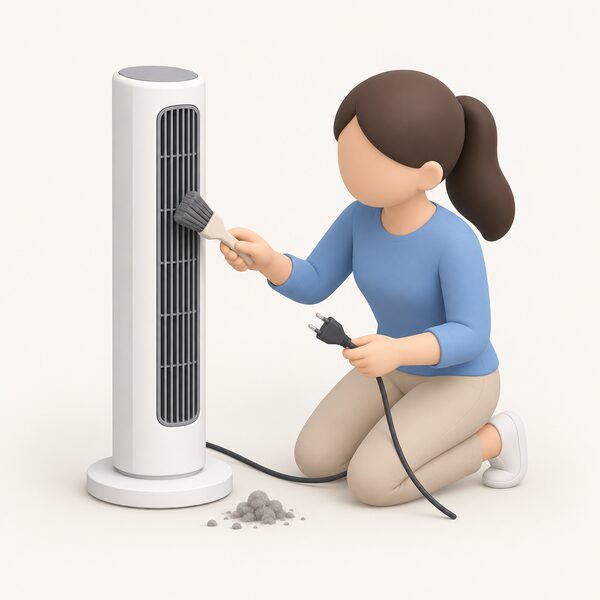
Fans are low-risk appliances, but they are still mains-powered electrical products, often stored for months and then run for long hours in hot weather. Electrical Safety First advises checking a fan before use after storage: that cables are in good condition and vents are free from dust build-up9. Its guidance on fan heaters makes the airflow point directly:
"It is important vents are kept clear and that the flow of air is not restricted by dust and fluff."
No UK safety body sets a fixed cleaning interval for cooling fans. The standard in the guidance is condition-based: clear vents and sound cables before each season and whenever dust visibly builds up. A tower fan's narrow grilles and internal drum collect dust in ways that are not always visible from outside, which makes that check more relevant for this type.
Running a fan overnight
The guidance cited here sets no specific overnight rule for cooling fans. Electrical Safety First does recommend not using a portable heater overnight14, and that includes fan heaters and heater-fan combinations such as those described above. A cooling fan that doubles as a heater is covered by the heater advice when it is heating.
Extract fans and run-on
For fixed extract fans, building guidance adds a further rule. The Welsh Government states that rooms where steam will be produced should be provided with higher levels of ventilation, normally mechanical fans and windows17. The consultation version of Approved Document F for Wales states that in rooms with no openable window, an intermittent extract fan should keep running for a minimum of 15 minutes after the room is vacated18. These are building rules for installed fans, not for plug-in cooling fans, but they bear on how heat and moisture leave a home in summer.
What owning a fan means for household energy independence
A fan is one of the few cooling devices that barely touches a household's energy dependence. At 20W to 75W for the fans listed by National Energy Action1, and typically 60W or less for floor and desktop fans4, its demand is small enough to run from modest home generation or a small battery. Covering that load with solar panels is discussed on cooling with solar panels. A fan has no refrigerant, needs no installer or F-gas engineer, and most models have no app or cloud account in the loop.
The dependence that remains is the electricity itself, and the grid or supplier that provides it when there is no home generation. A fan also depends on its maker for spare parts, and the unit itself is imported or bought from a manufacturer like any other appliance.
The bigger limit is physical rather than contractual. A fan cannot reduce the heat in a home; it only makes that heat more tolerable for the person in its path, and it stops helping above 35 degrees3. So the independence a fan offers depends on the building doing most of the work. Citizens Advice notes that a well insulated home is usually easier to keep cool10. The Climate Change Committee states that by improving ventilation and providing shading, builders and home owners can reduce the risk of overheating, improve comfort and avoid the need to invest in alternative cooling measures such as air conditioning19.
Taken together, the picture for a household aiming to be self-sustaining is:
- Shade and insulation keep heat out, with no running cost.
- Night ventilation flushes stored heat out when outdoor air is cooler.
- Fans make occupied rooms comfortable for pennies an hour.
- Air conditioning reduces room temperature, but at far higher electricity use2.
Each step down that list adds reliance on bought-in electricity. The wider trade-offs are set out on home cooling and energy independence, and the full range of options on the home cooling guide.
Sources19 cited
- Summer energy tips, National Energy Action, 2026-08-13
- Make your home more comfortable in warmer weather, Plymouth Energy Community, 2026-09-20
- How to keep your home cool in hot weather, Centre for Sustainable Energy, 2026-07
- Is air conditioning worth it in the UK?, Uswitch, 2026-07-14
- Summertime overheating in newer build properties, Welsh Government, 2023
- High temperatures herald health fears for millions, End Fuel Poverty Coalition, 2024-08-12
- Temporary zero rate of VAT for domestic electricity in Great Britain, HM Revenue and Customs, 2026-10-01
- Heating your home with renewable energy, Which?, 2025-09-22
- TikTok fan cooling hack warning, Electrical Safety First, 2026-09-19
- Make sure your home is energy efficient, Citizens Advice, 2026-09-19
- Low energy buildings, Centre for Alternative Technology, 2025-06-27
- Are electric heaters eco-friendly?, Which?, 2026-01-15
- De'Longhi Capsule Desk Personal Fan Ceramic Heater, Quiet Mark, 2026-09-17
- Portable heaters safety advice, Electrical Safety First, 2026-09-17
- Ventilation advice, Centre for Sustainable Energy, 2025-07
- Mould and condensation infographic, BEAMA, 2022
- Building regulations: doors and windows, Welsh Government, 2026-09-17
- Approved Document F consultation version, Welsh Government, 2020-11
- Preparing for climate change: what can be done, Climate Change Committee, 2019-08-20
 The Full Cooling and Air Conditioning GuideDo you really need air conditioning in a British summer, or would a fan and better shading do the job?
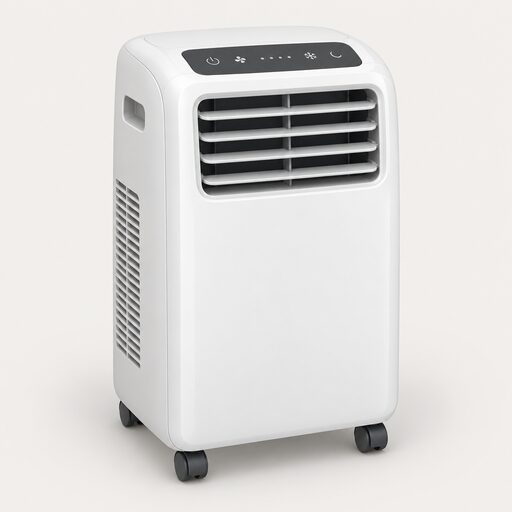
 Types of Air ConditioningPortable, wall-mounted, multi-room or ducted: which air conditioning suits your home?
 Electric BoilersHow electric flow boilers heat a conventional wet system, what they cost to buy and run, where they suit UK homes, and why point-of-use efficiency near 99% does not translate into cheap heating at the meter.
 Air-to-Air Heating and CoolingAir-to-air heat pumps deliver warm air through indoor fan units rather than hot water to radiators.
 Air-to-Water Wet SystemsAir-to-water heat pumps feed radiators, underfloor heating and a hot water cylinder, and are the most common domestic heat pump in the UK.
 UK Cooling DemandPublished data on air conditioning ownership and home overheating, with projections for summer temperatures in each UK nation, and what rising cooling demand means for summer electricity use.