

In this guide
For most houses in England, an air conditioning outdoor unit does not need a planning application, because the installation can fall within permitted development rights. Adding air conditioning to a home may be considered permitted development provided all the limits and conditions set out in legislation are met, and those limits cover the function, size, placement and quantity of units1. The condition that catches most households is function: the rights only apply if the system provides a heating function, including a unit that can both heat and cool, so a cooling-only air conditioner needs a planning application1.
Where the rights do apply, they are not a free hand. Development is not permitted unless the air source heat pump complies with the MCS Planning Standards or equivalent standards, which is where noise is controlled2. In a Conservation Area permission is required, and a listed building needs listed building consent as well1. Flats sit outside the dwellinghouse rights altogether.
The practical effect is that the answer turns on four things: what the unit does, where it goes, what the building is, and whether it meets the noise standards. Get those right and the route is usually a building regulations notification rather than a planning application. Get one wrong and the same unit becomes a full application, with the outdoor unit's position and appearance open to the conservation officer and to neighbours.
What the permitted development rules actually say
The permitted development route for air conditioning in England is built on the air source heat pump class in the General Permitted Development Order, not on a separate air conditioning class. That is why the function of the unit decides everything. The rights only apply if the system provides a heating function, including if it can provide both heating and cooling; a system that only cools does not qualify1. A reverse-cycle air conditioner is therefore an air-to-air heat pump in planning terms, and a cooling-only unit is not.
The standards condition is the second gate. Development is not permitted by Class G unless the air source heat pump complies with the MCS Planning Standards or equivalent standards2. Those standards carry the noise assessment, so a unit that is otherwise well placed can still fail the condition if the installer's assessment does not support it. The government's own review of air source heat pump noise emissions recommended a change in planning rules to make it easier for households to install heat pumps under permitted development rights, while strengthening heat pump noise assessments conducted by installers6. That recommendation points to the direction of travel rather than to a rule a household can rely on today.
The third gate is quantity and siting. Amendments to the domestic air source heat pump permitted development rights in England mean that up to two air source heat pumps can be installed on detached dwellinghouses, allowing cooling and heating but not solely cooling, and the one metre boundary restriction was removed3. The removal of the boundary restriction matters on tight plots, where the only sensible position for an outdoor unit is close to a fence. The limit of two matters on larger systems, because a third unit, or a second unit on a semi-detached or terraced house, needs an application.
"Development is not permitted by Class G unless the air source heat pump complies with the MCS Planning Standards or equivalent standards condition of permitted development"
Where permission is required: conservation areas, listed buildings and flats
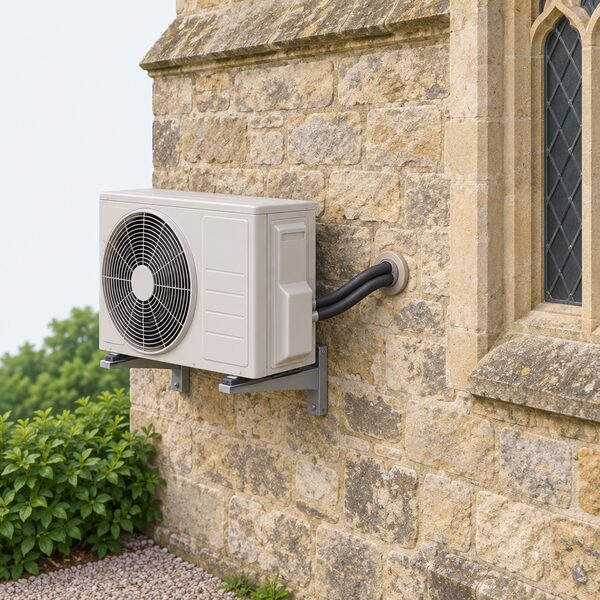
Three situations close the permitted development route, and they are the ones that generate most of the applications.
In a Conservation Area, permission is required. If a home is in a protected area such as a Conservation Area then permission will be required, and if the home is listed, listed building consent is required as well1. The two consents are separate: planning permission deals with the development, listed building consent deals with the effect on the special architectural or historic interest of the building. A listed building also needs both planning permission and listed building consent for an air source heat pump4.
For listed buildings, the scope of consent is wider than the outdoor unit alone. Central heating or other flues, vents, extracts, air con and heat recovery units and pipework are listed as minor works requiring consent7. That brings the internal work into the consent application: the pipe runs, the wall penetrations and the condensate route are all part of what is assessed, not just the box on the external wall.
Flats are a separate case again. The permitted development rights described here attach to dwellinghouses, so a flat is outside them and an application is the normal route. Leasehold ownership adds a second layer that planning permission does not touch: the lease and the freeholder's consent govern what may be fixed to the building, and a planning consent does not override a lease restriction. The practical sequence for a flat is lease and freeholder first, then planning, then building regulations.
Noise, neighbours and the standards condition
Noise is the reason the permitted development route has a standards condition at all, and it is the most common ground on which an installation fails to qualify. The condition is not a subjective test of whether a neighbour minds; it is a requirement that the unit complies with the MCS Planning Standards or equivalent standards2. The installer's assessment is what demonstrates compliance, which is why the choice of installer and the quality of the assessment carry planning consequences, not just technical ones.
The government's review of air source heat pump noise emissions, permitted development guidance and planning regulations recommended a change in planning rules to make it easier for households to install heat pumps under permitted development rights, while strengthening heat pump noise assessments conducted by installers6. The direction is towards more installations being permitted, with the noise evidence behind each one made more robust. Until any change takes effect, the existing condition stands.
In practice, the factors that decide whether an outdoor unit passes are its sound power rating, its distance from the neighbour's boundary and from habitable room windows, and the reflective surfaces around it. A unit tucked into a corner between two walls behaves differently from one on an open gable. Where the assessment cannot show compliance, the fallback is a planning application, and that is the point at which neighbour representations are formally heard. Noise is covered in more detail in how noisy air conditioning is, including the difference between indoor and outdoor unit figures.
Building regulations, which apply either way

Planning permission and building regulations approval are different consents, and the air conditioning question is really two questions. Putting in a fixed air-conditioning system is covered alteration work under the building regulations5, and the installation must comply with them1. A household that correctly concludes no planning application is needed has not finished: the building regulations notification still applies.
The competence route matters here. It is advisable to contact an installer who belongs to the Microgeneration Certification Scheme or a relevant Competent Person Scheme1. Those schemes are also where the MCS Planning Standards sit, so the same membership that supports the noise condition supports the building regulations side. The electrical work, the refrigerant handling and the condensate discharge all fall within the installation, and each has its own requirements.
For a household planning the work, the sequence is: establish whether the unit has a heating function, establish whether the property is a house or a flat and whether it sits in a Conservation Area or is listed, obtain the noise assessment, then notify building regulations. Where the property is a house outside protected areas and the unit heats as well as cools, the planning element is usually satisfied by the standards condition rather than by an application.
How the rules differ across the UK nations
England is not the whole picture, and the differences are material for anyone near a border or comparing notes with family elsewhere.
In Scotland, the position is set out in separate legislation. Development which does not meet the criteria or thresholds within the legislation will not be considered to be permitted development, and requires planning permission through a planning application8. Scottish Ministers have stated an intention to ensure parity in permitted development rights between Scotland and England for air source heat pumps and solar panels9, and a 2015 consultation proposed to remove the requirement for the step of asking the planning authority if prior approval of the equipment is needed9. Those proposals sit alongside the existing criteria and thresholds rather than replacing them.
Wales shares the Class G standards condition with England: development is not permitted unless the air source heat pump complies with the MCS Planning Standards or equivalent standards2. Welsh Government guidance covers boilers and heating, biomass appliances, insulation, micro-combined heat and power and electrics on the same internal-work principle as England, with planning permission not normally required where all the work is internal10.
Northern Ireland is different again. Guidance on small-scale wind states plainly that planning approval is needed16, and the air source heat pump permitted development route described for England does not carry across. Households there should treat an outdoor unit as an application rather than an assumed right.
| Nation | Air source heat pump permitted development | Key condition |
|---|---|---|
| England | Yes, up to two units on detached dwellinghouses3 | Heating function required; MCS Planning Standards or equivalent1 |
| Scotland | Criteria and thresholds in legislation; outside them, application required8 | Prior approval step proposed for removal9 |
| Wales | Class G applies with the same standards condition2 | MCS Planning Standards or equivalent2 |
| Northern Ireland | Planning approval needed16 | Separate regime |
What it means for a household's energy independence
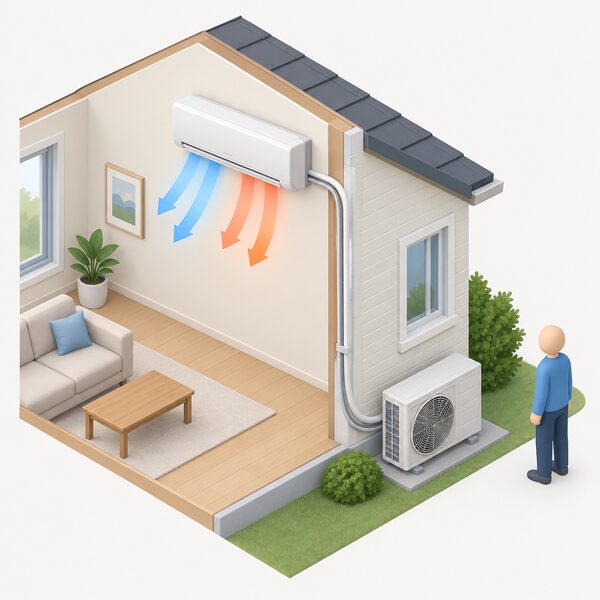
Planning permission is the gate that decides whether a household can cool its own home on its own terms, and the shape of that gate says something about the balance of independence and dependence in home cooling.
Where permitted development applies, the household can proceed without asking anyone's leave, which is a genuine measure of autonomy over the home. The unit itself delivers cooling and, in reverse-cycle form, heating from electricity rather than from gas, so the household is no longer wholly dependent on a gas supplier for comfort in both seasons. That is the independence the rules allow.
The dependence that remains is real and worth stating plainly. The system runs on electricity from the grid, so it substitutes one network dependence for another rather than removing it. The outdoor unit is a manufactured product with a maker's warranty and a supply chain behind it, and the installer's certification is what carries the planning compliance. The noise condition means the household's freedom is bounded by its neighbours' amenity, which is a deliberate limit rather than an accident. And in a Conservation Area, a listed building or a flat, the household does not hold the decision at all: the conservation officer, the freeholder or the planning authority does.
There is also a wider policy context. There is currently no legal requirement for existing homes to be retrofitted or for low-carbon heating technologies to be installed in existing homes, with exceptions for privately rented homes and homes owned by local authorities and housing associations in some parts of the UK17. Air conditioning in an existing English home is therefore a choice, not an obligation, and the planning rules are permissive by default for houses that meet the conditions. For the household, the practical independence on offer is the ability to install a reverse-cycle unit without an application, provided the function, siting and noise conditions are all satisfied. Where any of them fails, the independence is contingent on a consent that someone else grants.
Sources17 cited
- Planning permission for electrics, Planning Portal, 2026-09-17
- Class G: air source heat pumps on domestic premises, legislation.gov.uk, 2020-04-09
- Permitted development rights to support the provision of new homes: consultation, Scottish Government, 2025-09-03
- Heat pumps, New Forest District Council, 2026-09-17
- Building regulations approval, GOV.UK, 2026-09-17
- Heat pump applications surge after increase in government grant, GOV.UK, 2023-11-30
- Planning and listed building consent requirements, West Northamptonshire Council, 2023-12-14
- Domestic air source heat pumps: permitted development, legislation.gov.uk, 2015-11
- Permitted development rights: non-domestic solar panels and domestic air source heat pumps, Scottish Government, 2015-06
- Planning permission: boilers and heating, Welsh Government, 2026-09-17
- Planning permission: biomass fuelled appliances, Welsh Government, 2026-09-17
- Planning permission: insulation, Welsh Government, 2026-09-17
- Planning permission: micro combined heat and power, Welsh Government, 2026-09-17
- Planning permission: electrics, Welsh Government, 2026-09-17
- Planning permission: wind turbines, Welsh Government, 2026-09-17
- Wind, nidirect, 2026-05-18
- Retrofit and low-carbon heating requirements, House of Commons Library, 2026-09-17
 Planning Permission ScotlandHow Scottish permitted development rules treat external air conditioning and air-to-air heat pump units, where they differ from England, and the position for conservation areas, listed buildings and flats.
 Planning Permission in EnglandDo you need planning permission for an air source heat pump?
 Planning Permission NIHow Northern Ireland's planning rules apply to external air conditioning and air-to-air heat pump units, when consent is needed, and how the position differs from England, Scotland and Wales.
 Planning Permission WalesDo you need planning permission for an air conditioning unit outside your home in Wales?
 Building Regulations EnglandAdding a heat pump, solar panels or an extension usually needs building regulations approval, and it is separate from planning permission.
 Listed Buildings and AreasYour home is listed or sits in a conservation area, so do you need permission before adding solar panels, insulation or a heat pump?