
In this guide
Keeping a house cool without air conditioning starts with a hierarchy: stop the heat getting in, then remove what is already there, and only then consider a powered cooling machine. The Climate Change Committee reports that with 2ºC of warming, passive measures that require no energy use can reduce overheating in up to 80% of dwellings1. That is the case for treating shading, ventilation and internal gains as the first line of defence rather than an afterthought.
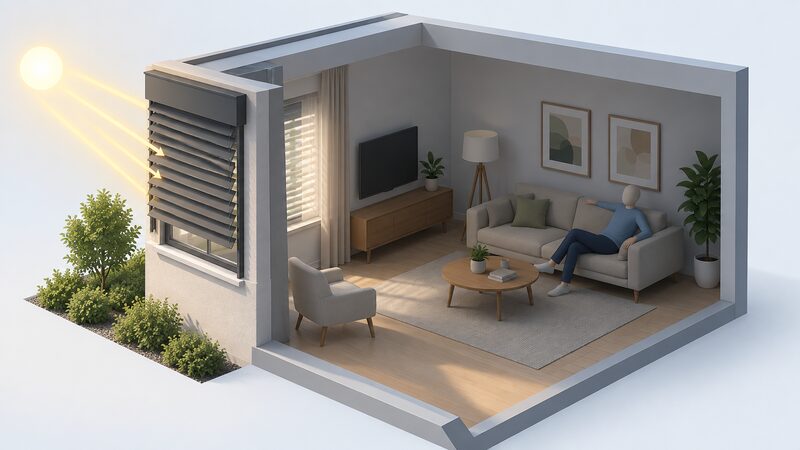
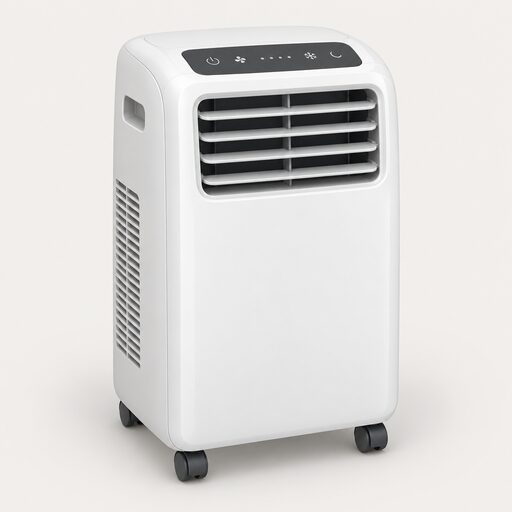
The measures themselves are unglamorous and cheap. CIBSE advises keeping external blinds or shutters closed whenever the sun can shine on the windows, or keeping internal blinds and curtains closed during the day, and using the coolest part of the house as much as possible2. Fans move air to create a cooling sensation on the skin but do not lower the temperature of a room, while air coolers use water to slightly cool air and are more effective than fans in dry conditions3. A typical portable air conditioner of 1,000 to 1,500W can cost around 26 to 39p per hour, roughly 14 to 20 times more than a fan3.
There is a second, less obvious route: a ground source heat pump can cool a home using the stable temperature of the ground rather than a refrigerant circuit, with no outdoor unit. The ground offers more stable temperatures year-round with the extreme highs and lows of air temperature removed4. This page sets out what passive cooling is, how the ground loop version works, what it costs to run, and where the approach reaches its limit.
What passive cooling is and how it works
Passive cooling is the set of measures that reduce heat gain and remove heat without running a refrigeration cycle. It works on three fronts at once: blocking solar gain before it enters, letting stored heat escape when the outside air is cooler, and cutting the heat that appliances and occupants generate indoors.
The design standard that takes this furthest is Passivhaus, described by Solar Energy UK as "an extremely rigorous design standard aimed at making buildings so well insulated and ventilated, that they hardly require any additional heating or cooling"7. Energy Saving Trust puts the same point more simply: such buildings need minimal extra heating or cooling8. A Passivhaus building aims to reduce the need to heat the building to such an extent that a conventional heating system is not needed at all8.
For an existing home, the practical version of passive cooling is a short list of habits and fittings. CIBSE's guidance for hot weather includes keeping the sun out with external blinds or shutters whenever the sun can shine on the windows, or internal blinds and curtains closed during the day; finding the coolest part of the house and using it as much as possible; and keeping the body cool with cool drinks, cool showers, a damp towel, or a fan, which uses a lot less energy than air conditioning2.
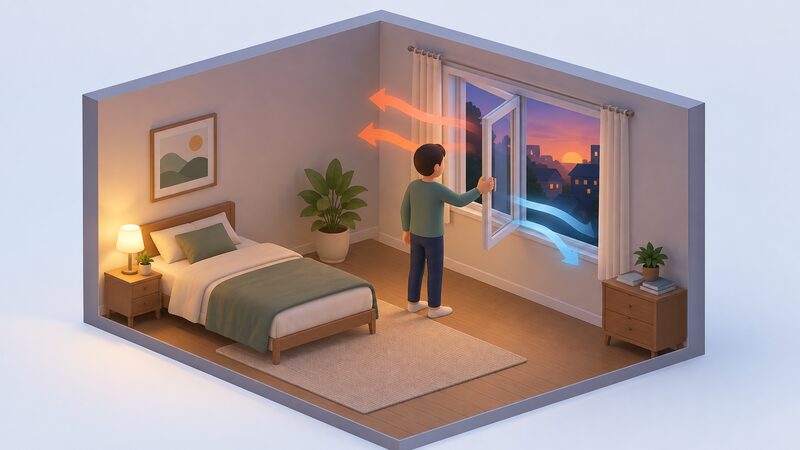
Ventilation is the other half. The simplest way of ventilating a home is to open the windows, though the Centre for Sustainable Energy notes there is no guarantee that the fresh air gets to the places that need it, and opening windows in winter can lead to significant heat loss9. That trade-off is why mechanical ventilation with heat recovery exists: it extracts warm damp air and draws in fresh air, passing the outgoing air through a heat exchanger so the heat is recovered and passed to the incoming air9.
The measures fall into a rough order of effort and cost:
| Measure | What it does | Running cost |
|---|---|---|
| External shutters, blinds, awnings | Blocks solar gain before it reaches the glass | None2 |
| Internal blinds and curtains | Reduces solar gain after it has passed the glass | None2 |
| Window opening | Removes stored heat when outside air is cooler | None9 |
| Fans | Moves air to create a cooling sensation on the skin | Cheapest powered option3 |
| Air coolers | Uses water to slightly cool air, more effective in dry conditions | Powered3 |
| Ground loop cooling | Circulates ground-cooled fluid, compressor off | Pump and fan only4 |
How a ground source heat pump cools a home using the ground's natural temperature
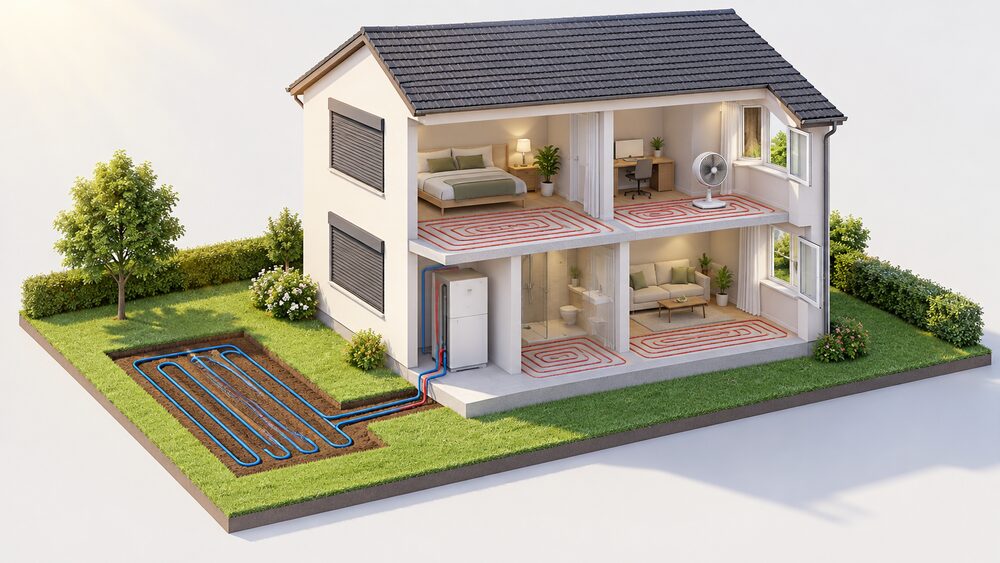
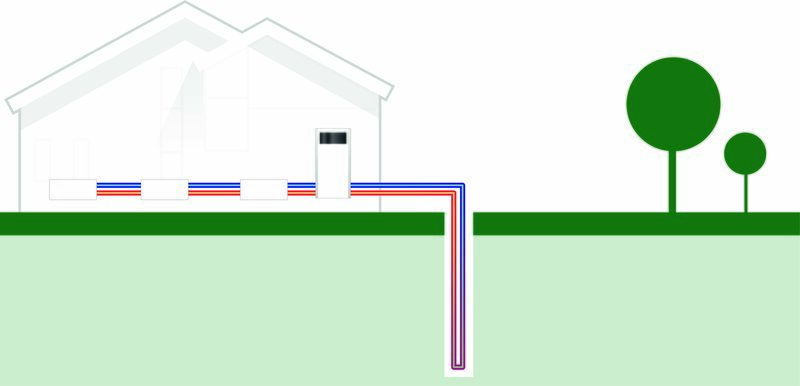
A ground source heat pump, also called a ground-to-water heat pump, transfers heat from the ground outside to heat a home and its water10. The same loop can run in the other direction. Because the ground sits at a steadier temperature than the air, it can act as a heat sink in summer just as it acts as a heat source in winter.
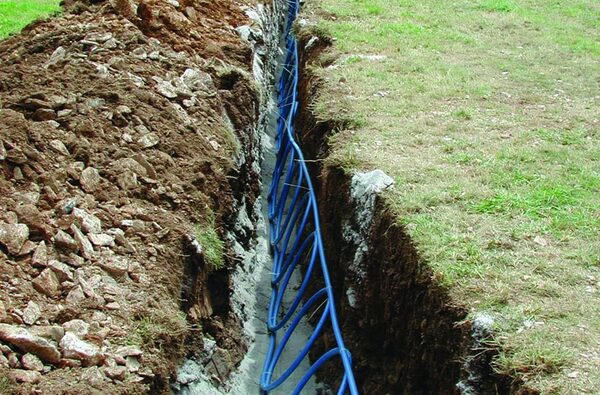
The mechanics are well documented. Ground source heat pumps work by circulating a mix of water and antifreeze around a loop of pipe buried in a garden11. Official guidance describes the principle as making use of heat stored in the ground to pre-heat water for the heating system, which is then heated to the required standard using electricity12. The Department for Energy Security and Net Zero's public attitudes tracker describes the technology in the same terms: these extract heat from pipes buried in the ground to heat your home and water13.
What makes the ground useful for cooling is its stability. The ground offers more stable temperatures year-round with the extreme highs and lows of air temperature removed4. An air source unit has to work against whatever the outside air is doing; a ground loop works against a temperature that barely moves between February and August.
The heat the pump produces for space heating is at a lower temperature than other forms of heating, and it works best with underfloor heating, which requires lower flow temperatures than radiators14. That matters for cooling too, because a floor or a fan coil that can deliver gentle warmth at low flow temperatures can also deliver gentle coolth at temperatures close to room level, without the draught and condensation problems of a conventional chiller.
Cost to run: around £20 a year, or about 50p for an 8-hour day
Passive measures themselves have no running cost. Shutters, blinds, awnings and window film use no energy at all, and opening windows uses none either. The only cost is the capital outlay, which is installer-quoted and varies with the size and type of the opening.
The powered options sit on a wide spectrum, and the comparison is the useful part. A typical portable air conditioner of 1,000 to 1,500W can cost around 26 to 39p per hour, roughly 14 to 20 times more than a fan3. A fan is therefore the cheapest powered cooling device in the home, and it does not lower the temperature of a room; it moves air to create a cooling sensation on the skin3.
For context on how cooling costs compare with heating, the published running costs of other electric systems set the scale:
| System | Typical running cost | Source |
|---|---|---|
| Heat pump | £800 to £1,050 a year | 16 |
| Night storage heaters, flat | £912 a year | 16 |
| Panel heaters, flat | £1,080 a year | 16 |
| Direct electric heating, three-bed semi | £2,700 | 17 |
| Immersion heater | Around 78p an hour | 18 |
| Water underfloor heating, 25m2, three hours a day for six months | Around £140 in total | 19 |
Those figures are heating, not cooling, but they set the scale. A ground loop cooling circuit that runs a circulation pump and a fan, with the compressor off, sits far below any of them. Where a household already has a ground source heat pump, the marginal cost of summer cooling is the electricity for the pump and the fan, not for a compressor.
Energy use: no more than a pair of light bulbs, with the compressor off
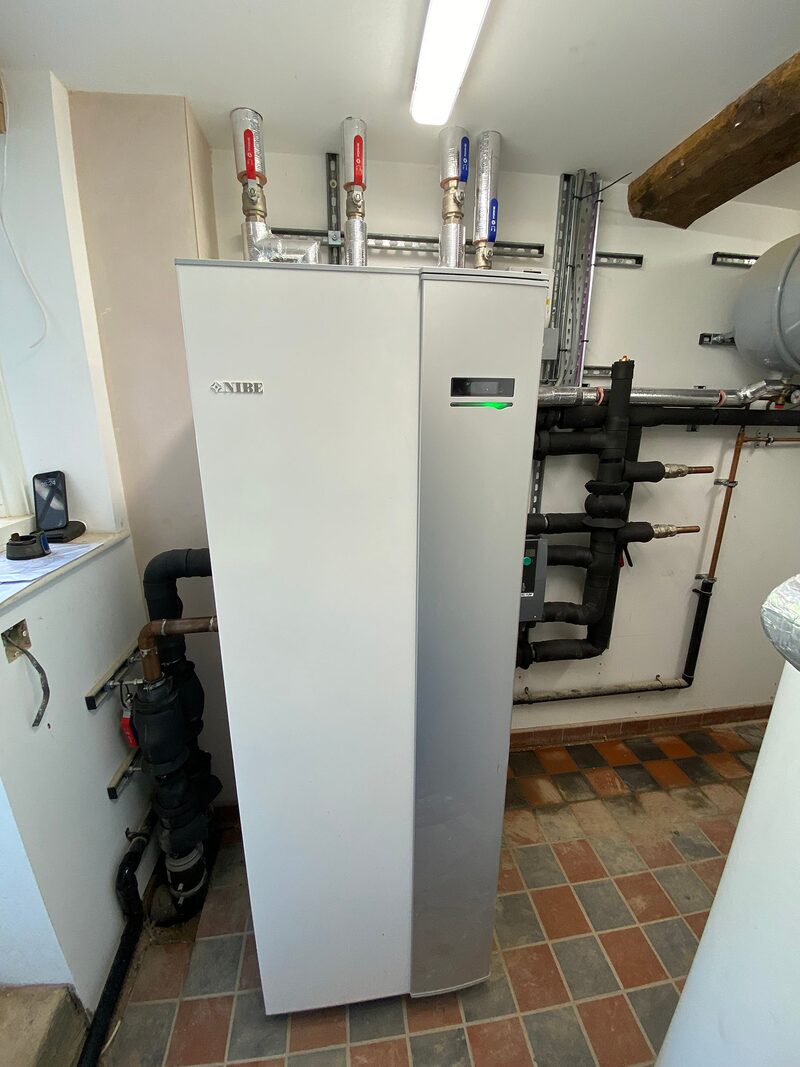
The reason ground loop cooling is cheap to run is that the most energy-hungry component is not needed. A heat pump moves heat using a refrigeration cycle, and it can do this even when it is cold outside through that process20. In passive cooling mode the refrigeration cycle is bypassed: the loop fluid, already cooled by the ground, is circulated through a heat exchanger or fan coil, and only the pump and the fan draw power.
That puts the electrical demand in the same bracket as small household loads. A heated clothes airer can consume as little as 0.3kWh21. Heat pump tumble dryers need no costly heating element22. A dehumidifier costs approximately 4p to 15p per hour depending on size and settings23. These are the kinds of loads a passive cooling circuit resembles, not the 1,000 to 1,500W of a portable air conditioner.
Reducing internal gains is the other half of the energy story, and it costs nothing. Turning appliances off at the wall rather than leaving them on stand-by, switching to energy-saving lightbulbs, only running the washing machine with a full load, and drying clothes outside instead of using a tumble dryer all cut the heat that appliances add to a room24. Every watt not dissipated indoors is a watt the cooling system does not have to remove.
How the cooling is delivered: heat exchanger, fan coil or MVHR, with no outdoor units
There are three common delivery routes for ground loop cooling, and none of them requires a box on an external wall.
- Heat exchanger. Transfers coolth from the ground loop into the heating circuit, so the same emitters that warm the house in winter cool it in summer.
- Fan coil unit. Blows air across a coil carrying the cooled fluid and distributes it into a room.
- Mechanical ventilation with heat recovery. Extracts warm damp air and draws in fresh air, passing the outgoing air through a heat exchanger that recovers heat and passes it to the incoming air9.
MVHR systems are more commonly found in new-builds or whole-house retrofits, though small decentralised MVHR systems can be installed in individual rooms9.
The absence of an outdoor unit is the defining practical advantage. There is no condenser fan running outside a bedroom window, no visible box on a wall, and none of the noise or planning questions that come with an external unit. For flats and terraced houses where an outdoor unit would be difficult to site or would need consent, that matters.
Air-to-air heat pumps offer a different route to the same end: they can provide cooling, and they heat by blown air, which negates the need for radiators or underfloor heating as well as enabling their use for cooling25. They do still need an outdoor unit, so they sit outside the passive cooling family even though they avoid water-based emitters.
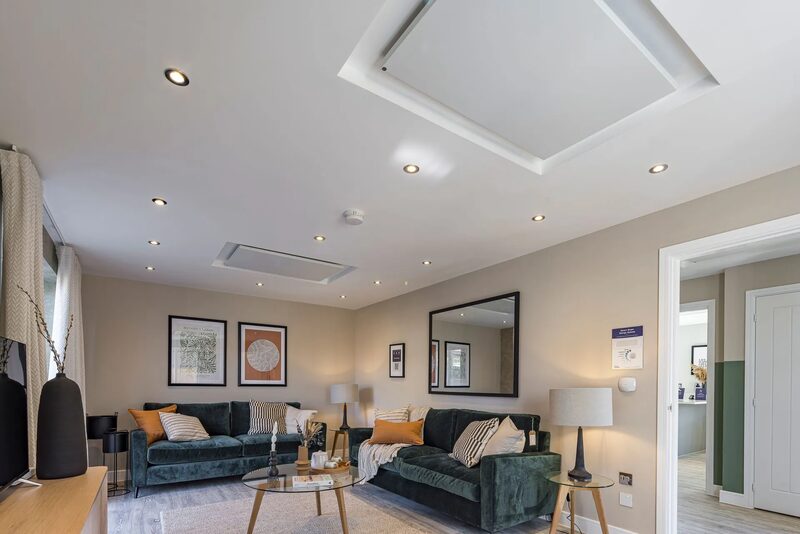
A simple add-on module compatible with all ground source heat pump systems
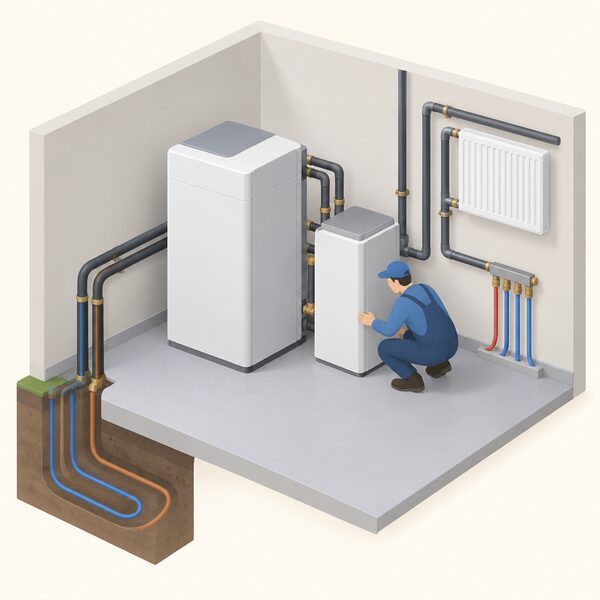
The appeal of ground loop cooling is that it can be added to a system a household may already own, rather than being a separate appliance. Heat pumps can work in all types of homes, including those that have less insulation, so the ground loop itself is not limited to highly insulated new builds11.
Whether a specific unit can run in reverse, or accept a cooling module, depends on the model, its controls and the way the loop was sized. Some ground source heat pumps are supplied cooling-ready; others need an additional module and a change to the control strategy. The compatibility question is one for the installer who knows the existing system, its loop and its emitters.
The wider context is that low carbon heating systems are more efficient than traditional heaters like gas boilers and electric radiators, and they do not use fossil fuels to heat a home26. A household that has already made that switch has the ground loop, the pump and often the low-temperature emitters in place. Adding summer cooling is then a question of controls and delivery, not of a second technology.
Government support has recognised the ground loop as a shared asset. The Warm Homes: Social Housing Fund is available for insulation, associated ventilation, and communal low carbon heating, with additional measures on an exceptional basis with justification28. Communal ground arrays serving several homes are one way to spread the capital cost of the loop across more than one household.
The bonus benefit: heat returned to the ground recharges the array
A ground loop that only ever extracts heat gets colder over time. Summer cooling reverses that flow: instead of taking heat out of the ground, the system puts heat back in. Over a year, a loop that both heats and cools is closer to balanced than one that only heats.
That balance is the reason ground source systems are described in terms of stable temperatures rather than peak output. The ground offers more stable temperatures year-round with the extreme highs and lows of air temperature removed4. A loop that is recharged each summer keeps that stability for longer.
There is a practical lesson from monitored Passivhaus homes about how heat behaves in a well-insulated building. At the Chippenham Passivhaus, using radiators as opposed to underfloor heating proved to be an effective and responsive solution, coping well with any additional solar heat gain29. Responsive emitters matter in a building where internal gains and solar gains can push temperatures up quickly.
Lower carbon: no refrigerants or energy-intensive cooling units
Cooling a home with a ground loop avoids two things at once: the refrigerant circuit of a conventional air conditioner, and the electricity that circuit consumes. Low carbon systems do not use fossil fuels to heat a home, and a home's carbon footprint should be significantly lower than with other kinds of heating26.
The comparison with mechanical cooling is stark in energy terms. A portable air conditioner of 1,000 to 1,500W draws roughly 14 to 20 times the power of a fan3. A ground loop cooling circuit draws a fraction of that, because the compressor is off and the ground is doing the work of the refrigerant.
There is also a maintenance and leakage dimension. Refrigerant circuits need F-gas handling, periodic checks and eventual decommissioning. A water and antifreeze loop does not. The trade-off is that the loop itself is a buried asset with its own installation requirements and, in some settings, a permit condition15.
For a household weighing independence, the ground loop is a genuinely local resource. It does not depend on a fuel delivered by tanker or pipe, and it does not depend on the outside air temperature on a particular afternoon. What it does depend on is electricity for the pump and fan, and on the manufacturer's controls and any app that manages the system.
Where passive cooling reaches its limit: around 4°C of warming
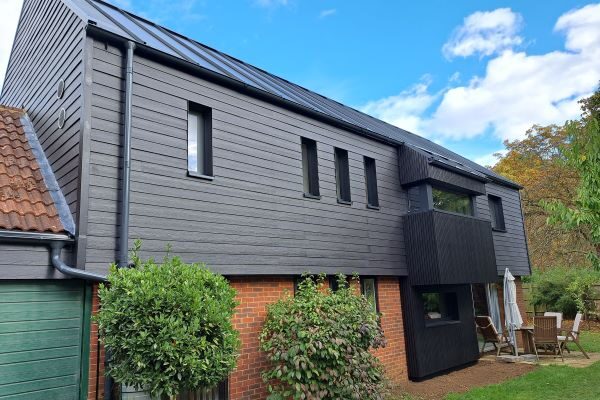
Passive measures are the first step in the cooling hierarchy, not a guarantee. The Climate Change Committee states that with 2ºC of warming, passive measures requiring no energy use can reduce overheating in up to 80% of dwellings, but that if we were to experience 4°C of warming there is a limit to the effectiveness of passive cooling1. The residual risk in the hottest scenarios has to be met by something else.
How a building performs also depends on how it is run. Post-occupancy data from European Passivhaus studies found typical internal temperatures ranging between 21°C and 24°C6. The same University of Bath monitoring work found that for each 1°C above 20°C, space heating consumption can rise by 2kWh m2a6. In other words, a warmer home is not just less comfortable; it uses more energy to keep at a given level.
The Passivhaus standard itself is not a promise of zero bills. Passivhaus alone cannot guarantee a house with no bills, but it does give proven reductions in heating demand of up to 80%5. That is a large reduction, and it is still a reduction.
Is passive cooling right for your home?
The honest answer is that passive measures suit almost every home, and ground loop cooling suits homes that already have, or can have, a ground source heat pump. The two are not alternatives; the first is the foundation and the second is an option built on it.
Start with the measures that cost nothing to run. Keep the sun out with external blinds or shutters whenever the sun can shine on the windows, or internal blinds and curtains closed during the day; use the coolest part of the house; keep the body cool with cool drinks, cool showers, a damp towel or a fan2. Cut internal gains by turning appliances off at the wall, using energy-saving lightbulbs, running the washing machine only with a full load and drying clothes outside24.
Then consider ventilation. Opening windows is the simplest route, with the caveat that fresh air may not reach the places that need it and that winter opening loses heat9. MVHR solves both problems but is more commonly found in new-builds or whole-house retrofits, though small decentralised units can serve individual rooms9.
Ground loop cooling is the step after that. It requires a ground source heat pump, a loop and a delivery route, and it delivers cooling with the compressor off and no outdoor unit. For a household already on that path, it is the lowest-energy powered cooling available. For a household without a ground loop, the passive measures remain the first and cheapest answer, and the home cooling pillar sets out where mechanical cooling fits when they are not enough.
Sources29 cited
- Deepening our understanding of summertime overheating in homes, Climate Change Committee, 2022-10-04
- BBC News highlights CIBSE's expertise on managing overheating in homes, CIBSE, 2024-07-31
- Summer energy tips, National Energy Action, 2026-08-13
- Introduction to water source heat pumps, Renewables First, 2026-04-08
- Passivhaus retrofit, Passivhaus Trust, 2026-09-20
- Passivhaus and the performance gap, Passivhaus Trust, 2020-06
- Will Scotland's future homes generate energy, Solar Energy UK, 2026-09-17
- Passivhaus: what you need to know, Energy Saving Trust, 2026-02-16
- Ventilation, Centre for Sustainable Energy, 2025-07
- Ground source heat pumps, Energy Saving Trust, 2026-07-16
- Ground and water source heat pumps, MCS Certified, 2026-06-09
- Ground source heat pumps, nidirect, 2026-09-02
- DESNZ public attitudes tracker: heat and energy use in the home, summer 2025, Department for Energy Security and Net Zero, 2025-10-28
- Ground source heat pump costs and savings, Which?, 2026-05-08
- Closed loop ground source heating and cooling systems: when you need a permit, GOV.UK, 2023-10-02
- Electric heating, Centre for Sustainable Energy, 2026-06
- Electric wallpaper explained, Energy Saving Trust, 2026-03-26
- Immersion heaters, Which?, 2026-06-01
- Underfloor heating costs, Which?, 2026-05-27
- How heat pumps work: a guide for homeowners, NICEIC, 2025-09-17
- Energy saving tips for the home, Confused.com, 2025-10-14
- Why tech saves, AMDEA, 2026
- Condensation, damp and mould, Plymouth Energy Community, 2026-09-20
- Financial help with electricity bills, British Gas Energy Trust, 2026-02-12
- Air-to-air heat pumps, Nesta, 2025-02-03
- Renewable heat: right for your home, Energy Saving Trust, 2026-05-19
- Heating your home, Energy Saving Trust, 2026-05-19
- Warm Homes: Social Housing Fund wave 3 scheme guidance addendum, Department for Energy Security and Net Zero, 2026-06
- Chippenham, Future Homes, 2025-03-04
 Using a Heat Pump for CoolingCan a heat pump cool your home in summer as well as heat it in winter?
 Cooling and Energy IndependenceExplains how passive measures, efficient cooling and on-site generation reduce a household's dependence on grid electricity in summer.
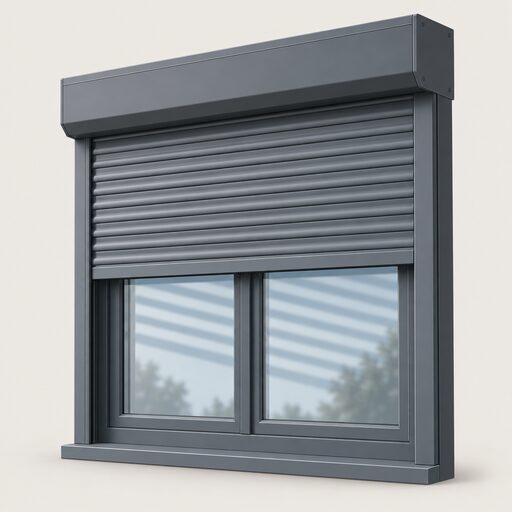 Part O OverheatingHow will your new home stay cool in summer?
 Fabric First ApproachWhy insulate before replacing the boiler or fitting a heat pump?
 The Full Cooling and Air Conditioning GuideDo you really need air conditioning in a British summer, or would a fan and better shading do the job?
 Heating and Energy IndependenceCan you heat your home without relying on gas or oil, and what would that take?